Liquid Cooling Stocks for Data Centers: Direct-to-Chip CDUs and Thermal Management
An empirical deep dive into the thermal bottleneck of generative AI compute, examining direct-to-chip microfluidics, coolant distribution unit (CDU) deployment, power usage effectiveness (PUE) compression, and the publicly traded industrial supply chain.
The Thermal Crisis in AI Compute: Why Air Cooling Breaks Down Above 40kW per Rack
The architectural transition from conventional enterprise computing to large-scale artificial intelligence clusters has catalyzed a fundamental physical crisis in data center thermal management. In legacy enterprise server environments, standard compute racks operated at power densities between 6kW and 12kW. Even dense cloud virtualization clusters rarely exceeded 24kW per rack. Under these power envelopes, forced-air convection—utilizing computer room air handlers (CRAH) and hot-aisle/cold-aisle containment—efficiently evacuated thermal loads away from silicon dies.
However, modern AI training clusters have shattered these physical boundaries. Next-generation accelerator architectures consume between 700W and 1200W per individual GPU. When aggregated into high-density rack form factors such as the NVL72 architecture, a single cabinet consumes upwards of 120kW to 132kW of continuous electrical power. At these extreme thermal gradients, the thermodynamic properties of air fail. The maximum practical heat dissipation threshold for forced-air cooling tops out between 35kW and 40kW per rack.
Attempting to cool a 120kW server rack with air requires moving colossal volumes of air at velocities that induce severe acoustic vibration, excessive fan parasitics, and prohibitive static pressure drops. 因此,液冷技术不再只是一种可选项,而是现代AI算力基础设施不可逾越的热力学必然要求。追踪我们数据中心基础设施板块监测终端的机构资金,正将这一物理拐点视为工业设备供应商收入爆发的核心驱动力。
流体热传输物理学:体积热容与界面导热动力学
The technical superiority of liquid cooling over forced air stems from the fundamental transport properties of fluids. Water possesses a thermal conductivity approximately 24 times greater than ambient air, allowing heat to conduct across metallic cold-plate interfaces with minimal thermal resistance. More critically, water exhibits a volumetric heat capacity nearly 3000 times higher than that of air at standard atmospheric pressure.
This volumetric advantage fundamentally alters cooling mechanics:
Thermodynamic Volume Disparity
To remove 1 kilowatt of heat with a 10°C temperature delta, an air-based system must circulate roughly 3000 times the volumetric displacement required by a treated water-glycol loop.
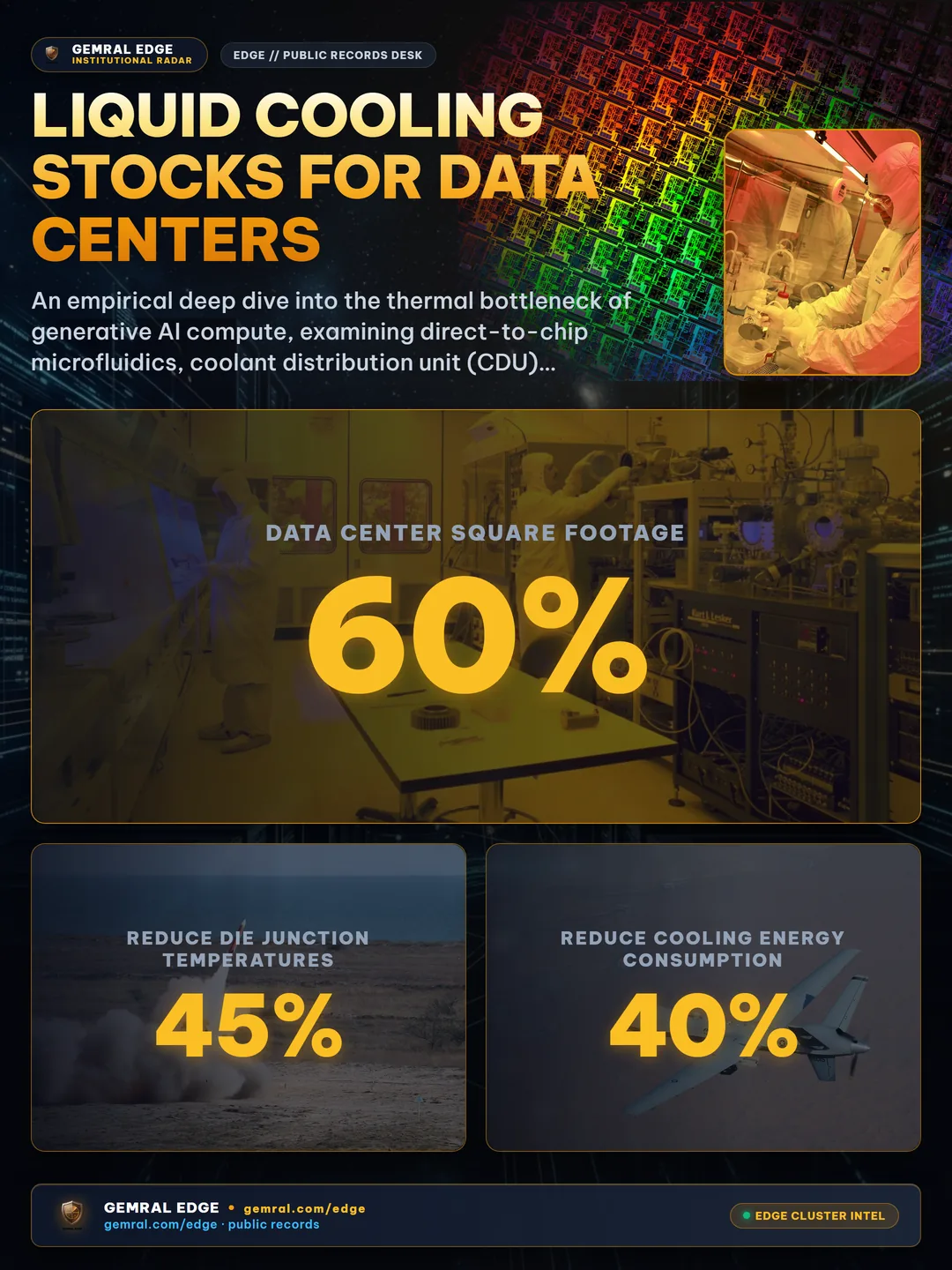
Air handlers require large-scale air ducts, elevated ceilings, and raised floors, consuming up to 60% of total data center square footage purely for airflow management.
Die-to-Fluid Thermal Delta
Direct fluid contact via micro-channel cold plates maintains silicon junction temperatures below 75°C under continuous 1000W sustained compute loads.
Preventing thermal throttling protects chip longevity and eliminates clock-frequency degradation across thousands of interconnected nodes.
By substituting pneumatic cooling loops with closed-circuit hydraulic infrastructure, data center operators achieve tight thermal boundaries while reclaiming floor space for compute density.
Direct-to-Chip Architectures: Cold Plates, Manifolds, and Quick-Disconnect Couplings
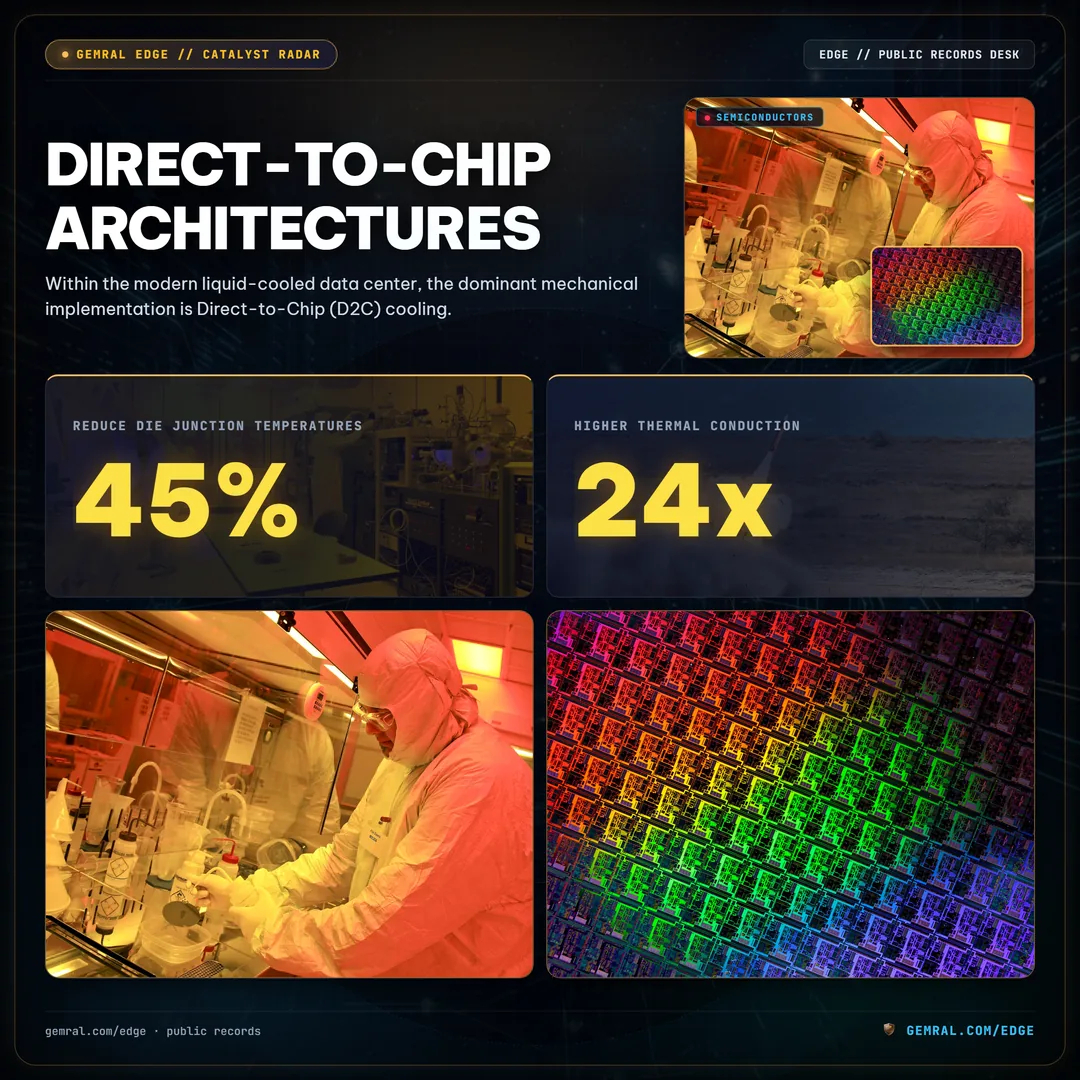
Within the modern liquid-cooled data center, the dominant mechanical implementation is Direct-to-Chip (D2C) cooling. Rather than altering the underlying server chassis format, D2C retrofits metallic cooling blocks directly on top of the primary heat-generating silicon dies. A comprehensive D2C sub-system consists of three mission-critical mechanical layers:
- 微通道冷板(Cold Plates): Precision-machined copper or aluminum plates containing sub-millimeter internal fins that maximize surface contact area and induce micro-turbulent coolant flow directly above the GPU heat spreader.
- Vertical and Horizontal Rack Manifolds: Stainless steel distribution pipes mounted along the server rack exterior that equalize fluid pressure across 18 to 72 individual server sleds.
- Blind-Mate Quick-Disconnect Couplings (QDC): Precision fluid connectors that allow hot-swappable server blade insertion without risking fluid leakage or requiring loop depressurization.
Micro-channel cold plate designs reduce die junction temperatures by 45%, while precision quick-disconnect couplings deliver 24x higher thermal conduction than forced-air convection. Manufacturing these components requires aerospace-grade tolerances. Under standard direct-to-chip manifold specifications, distribution loops maintain hydraulic operating pressures of 45 psi pressure across 72 server sleds, requiring precision flow balancing to sustain heat dissipation above 1000W compute load. A single droplet of dielectric fluid or treated water escaping at 45 psi fluid pressure can short out millions of dollars of compute hardware. Consequently, component suppliers with proven validation histories command defensible industrial moats.
The Coolant Distribution Unit (CDU): The Central Nervous System of Liquid Loops
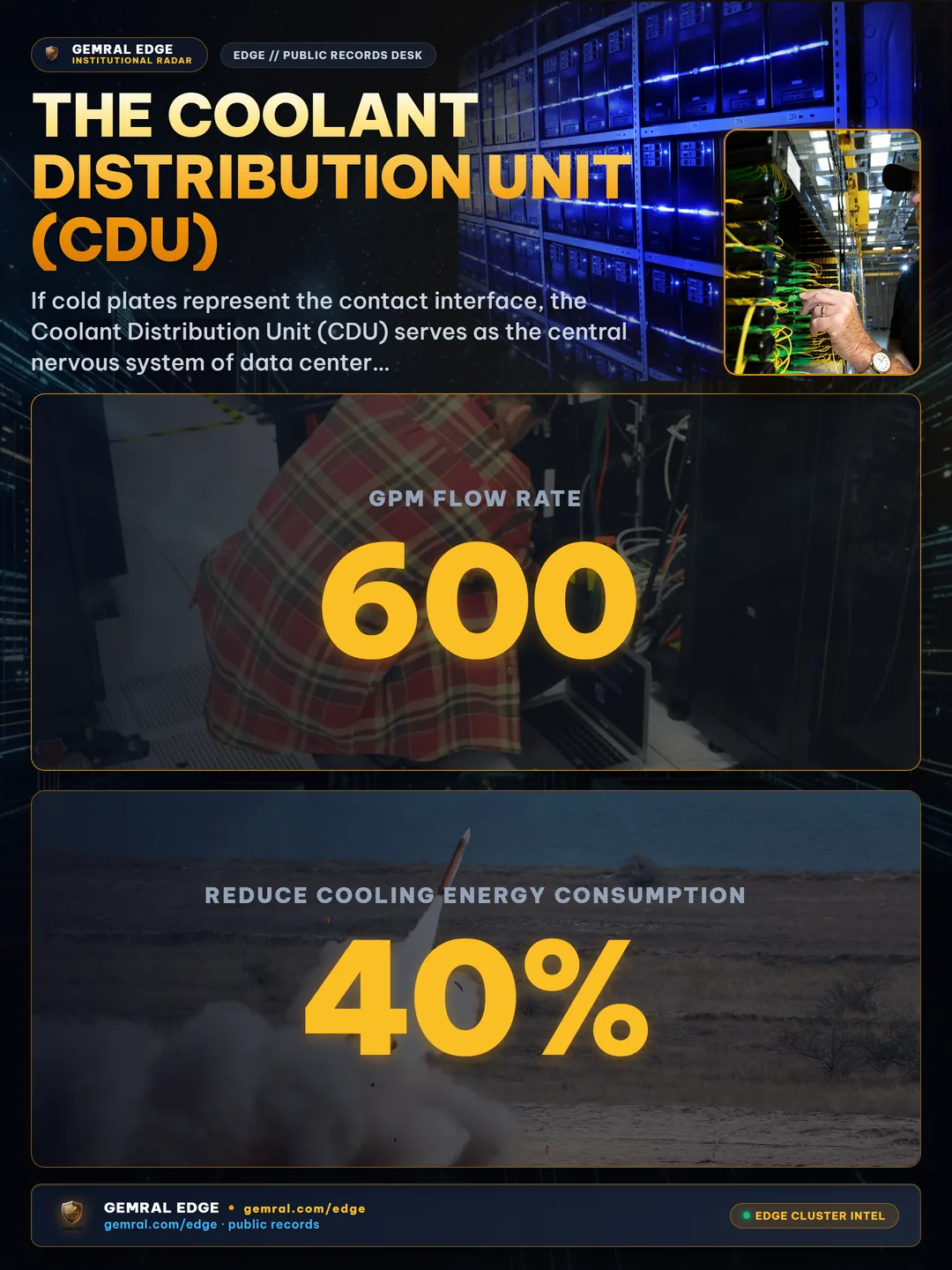
If cold plates represent the contact interface, the Coolant Distribution Unit (CDU) serves as the central nervous system of data center liquid cooling architectures. A CDU is a specialized mechanical assembly that decouples the primary Facility Water System (FWS) from the secondary Technology Cooling System (TCS) circulating through compute racks.
| CDU Form Factor | Thermal Capacity | Typical Placement | Primary Application |
|---|---|---|---|
| In-Rack CDU | 60kW - 300kW | Internal to 42U/48U Cabinet | Isolated high-power density training racks |
| Row-Based CDU | 300kW - 750kW | End of Server Row | Multi-cabinet shared cluster deployment |
| Facility Floor CDU | 750kW - 1500kW | Mechanical Perimeter Room | Campus-scale hyperscale AI infrastructure |
现代厂区级CDU可提供高达1500kW的持续换热额定功率,采用冗余双泵动力架构,泵送流量高达600 gpm,同时维持次级循环回路最低300kW的运行阈值以防止管路凝露。主流CDU可扩展至1.5 MW热负荷交换容量,通过全天候不间断循环冷却液,在超大规模算力中心中实现高达40%的制冷能耗节约。CDU负责调节关键水力参数:确保次级水温高于机房露点以杜绝结露、过滤微米级杂质颗粒,并根据实时算力负荷动态调控变频泵转速。N+1冗余泵组设计确保在单泵检修时算力业务零中断。
Evaluating the Supply Chain: Pure-Play Thermal Providers vs Industrial Conglomerates
The rapid proliferation of liquid cooling has created distinct investment dynamics across publicly traded industrial and electrical equipment suppliers. Equities operating across this thermal value chain fall into two primary corporate archetypes:
Pure-Play & Dedicated Infrastructure Providers
Suppliers such as Vertiv Holdings and Modine Manufacturing maintain high revenue exposure to data center cooling systems. These companies engineer complete thermal architectures, from row-level CDUs to outdoor dry coolers. Their specialized focus enables rapid design iterations tailored directly to the reference architectures of leading chip manufacturers.
Diversified Electrical & Chiller Conglomerates
Industrial giants including nVent Electric, Carrier Global, and Johnson Controls provide mission-critical subsystems. nVent dominates high-tolerance quick-disconnect couplings, manifolds, and liquid-tight enclosures, while Carrier and Johnson Controls supply the campus-level water chillers and facility heat exchangers required to evacuate heat into the external atmosphere.
投资者需在专业热管理厂商的高经营杠杆与综合工业巨头的稳健财务之间寻求动态平衡。如需监测国会立法者在商业科技硬件领域的持仓轨迹,可查阅我们的政客持股追踪投资组合遥测报告。
Direct-to-Chip vs Immersion Cooling: Capital Outlay and Operational Tradeoffs
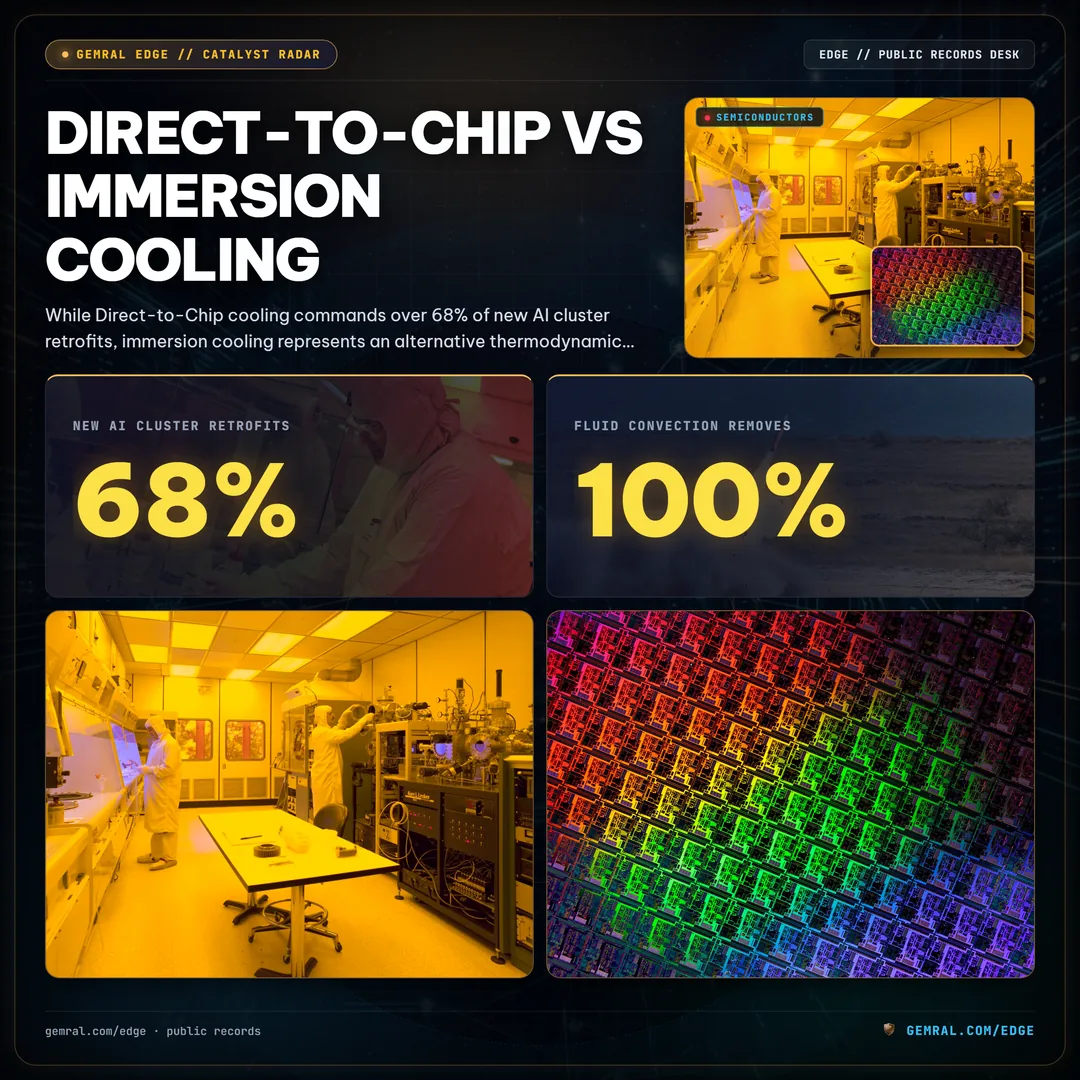
While Direct-to-Chip cooling commands over 68% of new AI cluster retrofits, immersion cooling represents an alternative thermodynamic architecture that captures growing industry attention. Evaluating both methods requires analyzing key operational tradeoffs:
- 芯片直接液冷(D2C): Retains traditional vertical rack architecture. Technicians can service RAM, storage drives, and network cards using standard hot-swap protocols. However, secondary air cooling is still required for peripheral components that generate modest heat.
- 单相浸没式液冷: 服务器完全横置浸没在充满烃类或合成介电冷却液的密闭槽中。流体对流直接带走所有发热器件100%的热量,机房内彻底取消风机。但服务器日常硬件维护需借助自动化机械吊臂将滴滤液体的机箱移送至检修台。
- 相变双相浸没式液冷: Uses engineered fluorochemical fluids that boil at low temperatures (around 50°C), vaporizing to carry heat to condenser coils. While thermodynamically superior, high fluid costs, vapor containment challenges, and emerging environmental PFAS restrictions have limited commercial scale.
鉴于超大规模云服务商高度重视工程交付周期并依赖既有的成熟机架服务维保体系,D2C冷板方案依然是近中期AI集群规模化落地的绝对确定性主流。
PUE经济学模型:能耗节约测算与投资回报率
Beyond physical feasibility, the commercial adoption of liquid cooling is propelled by compelling economic returns. The standard efficiency benchmark in the data center industry is Power Usage Effectiveness (PUE), defined as total facility power divided by total IT equipment power:

热力学驱动的PUE能效压缩
传统的风冷数据中心平均PUE约为1.50,意味着每向计算服务器输送100兆瓦电力,就需要额外消耗50兆瓦电力用于驱动冷水机组、空压机与强力通风风机(需注意园区级MW总用电配额体现的是整体负荷上限,而非单纯的IT设备净负荷)。
在单园区内削减38兆瓦的寄生制冷电力,每年可直接为业主节省数千万美元的电费账单。更为关键的是,在电力指标受限的电网管辖区内,变电站并网配额存在硬性天花板,压缩散热寄生功耗能够直接释放出稀缺的电网容量,从而部署更多产生直接收益的GPU算力服务器。如需深入了解电网并网审批排队周期的定量分析,可查阅我们的数据中心变电站电网基础设施研究。
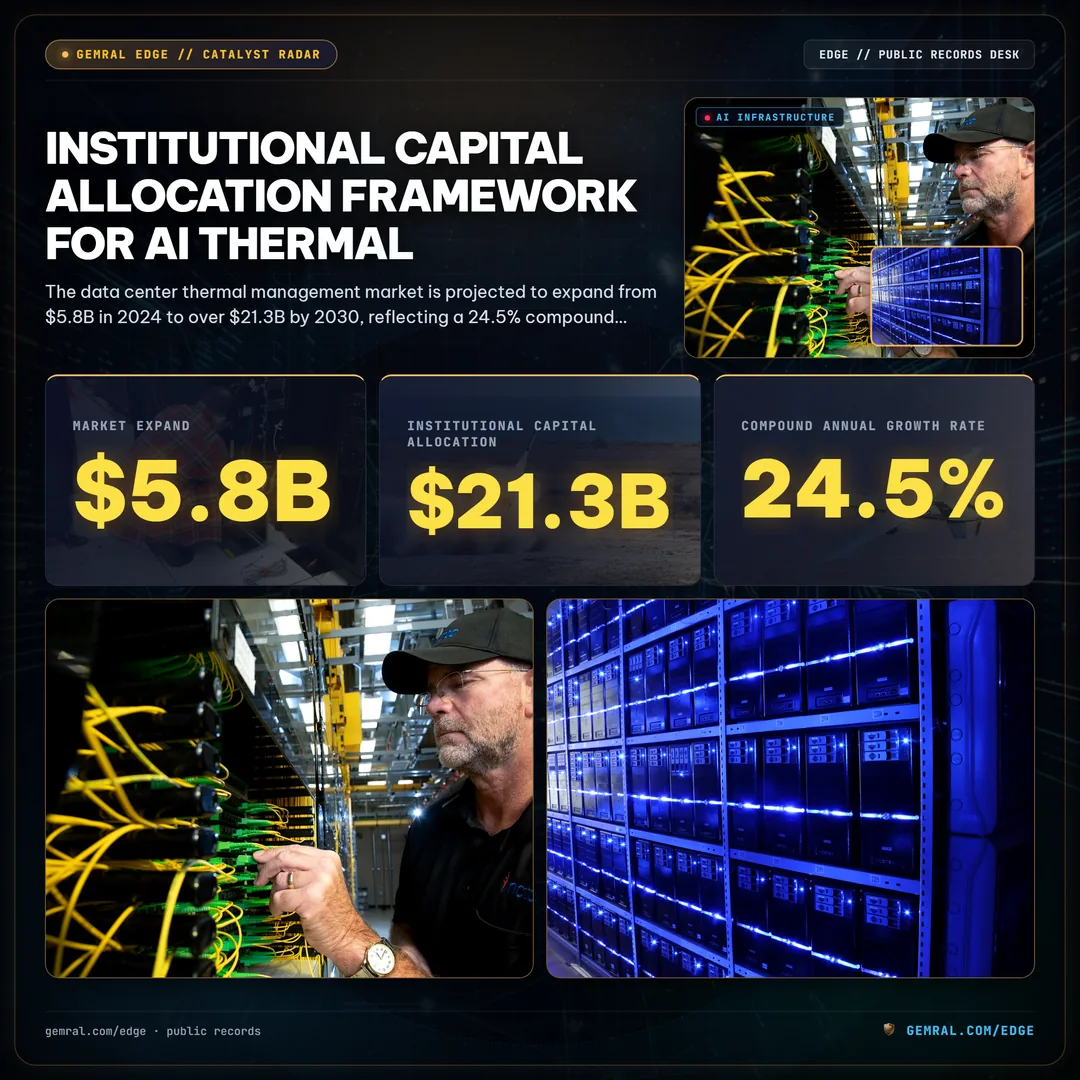
面向机构投资者的AI散热基础设施资本配置框架
全球数据中心热管理市场规模预计将从2024年的58亿美元跃升至2030年的213亿美元以上,年复合增长率(CAGR)高达24.5%。对于专业机构投资组合经理而言,在这个长期确定性赛道中构建权益资产敞口需要坚持四维分析框架:
液冷设备资产机构评估四大支柱
- 芯片原厂参考架构认证对齐: Identifying equipment vendors officially qualified within major GPU reference designs and Open Compute Project (OCP) standards.
- 产能交付规模与订单交付周期: 密切跟踪1500kW大容量CDU及精密分流歧管的在手订单,当前关键零部件行业交付排期普遍长达30至40周。
- 全生命周期维保服务附着率: Prioritizing suppliers with extensive field-service engineering networks capable of servicing closed-loop hydraulic systems under strict SLA guarantees.
- Valuation Discipline vs Backlog Visibility: 将标的企业估值倍数与超大规模云厂商跨年度CapEx资本开支指引及实质性采购意向订单进行严格对比校准。
量化资产配置机构可通过我们的机构数据预览遥测数据流,前瞻捕捉全球算力硬件堆栈各环节跨季度的资本开支加速信号。
Frequently asked questions
What are the primary liquid cooling stocks benefiting from AI data center buildouts?
Primary liquid cooling stocks include thermal infrastructure providers such as Vertiv Holdings (VRT), heat transfer specialist Modine Manufacturing (MOD), electrical and liquid manifold provider nVent Electric (NVT), and industrial chiller manufacturer Johnson Controls (JCI).
Why is liquid cooling required for next-generation AI data centers?
Liquid cooling is technically required because advanced AI clusters such as NVIDIA GB200 NVL72 generate rack power densities exceeding 100kW to 132kW, surpassing the 35kW physical thermal dissipation ceiling of traditional forced-air ventilation.
What is the difference between Direct-to-Chip (D2C) and Immersion cooling?
Direct-to-Chip (D2C) circulates liquid coolant through cold plates mounted directly on GPU/CPU dies while keeping standard server chassis accessible. Immersion cooling submerges entire servers in dielectric fluid, providing extreme thermal capture but requiring specialized facility retrofits.
How does liquid cooling improve data center Power Usage Effectiveness (PUE)?
By eliminating high-power chiller fans and optimizing heat exchange efficiency, liquid cooling lowers data center PUE from historical air-cooled averages of 1.50 to between 1.10 and 1.15, reducing facility cooling electricity consumption by up to 40%.