Liquid Cooling Stocks for Data Centers: Direct-to-Chip CDUs and Thermal Management
An empirical deep dive into the thermal bottleneck of generative AI compute, examining direct-to-chip microfluidics, coolant distribution unit (CDU) deployment, power usage effectiveness (PUE) compression, and the publicly traded industrial supply chain.

The Thermal Crisis in AI Compute: Why Air Cooling Breaks Down Above 40kW per Rack
The architectural transition from conventional enterprise computing to large-scale artificial intelligence clusters has catalyzed a fundamental physical crisis in data center thermal management. In legacy enterprise server environments, standard compute racks operated at power densities between 6kW and 12kW. Even dense cloud virtualization clusters rarely exceeded 24kW per rack. Under these power envelopes, forced-air convection—utilizing computer room air handlers (CRAH) and hot-aisle/cold-aisle containment—efficiently evacuated thermal loads away from silicon dies.
However, modern AI training clusters have shattered these physical boundaries. Next-generation accelerator architectures consume between 700W and 1200W per individual GPU. When aggregated into high-density rack form factors such as the NVL72 architecture, a single cabinet consumes upwards of 120kW to 132kW of continuous electrical power. At these extreme thermal gradients, the thermodynamic properties of air fail. The maximum practical heat dissipation threshold for forced-air cooling tops out between 35kW and 40kW per rack.
Attempting to cool a 120kW server rack with air requires moving colossal volumes of air at velocities that induce severe acoustic vibration, excessive fan parasitics, and prohibitive static pressure drops. Do đó, làm mát bằng chất lỏng không còn là một giải pháp tối ưu hóa hiệu năng tùy chọn; đó là một yêu cầu nhiệt động lực học bắt buộc đối với hạ tầng AI hiện đại. Các nhà phân bổ vốn thể chế theo dõi công cụ theo dõi lĩnh vực hạ tầng trung tâm dữ liệu của chúng tôi xem bước ngoặt vật lý này là động lực tăng trưởng doanh thu cốt lõi của các nhà cung cấp thiết bị công nghiệp.
Vật Lý Truyền Nhiệt Của Chất Lỏng: Nhiệt Dung Thể Tích Và Động Học Dẫn Nhiệt
The technical superiority of liquid cooling over forced air stems from the fundamental transport properties of fluids. Water possesses a thermal conductivity approximately 24 times greater than ambient air, allowing heat to conduct across metallic cold-plate interfaces with minimal thermal resistance. More critically, water exhibits a volumetric heat capacity nearly 3000 times higher than that of air at standard atmospheric pressure.
This volumetric advantage fundamentally alters cooling mechanics:
Thermodynamic Volume Disparity
To remove 1 kilowatt of heat with a 10°C temperature delta, an air-based system must circulate roughly 3000 times the volumetric displacement required by a treated water-glycol loop.
Air handlers require large-scale air ducts, elevated ceilings, and raised floors, consuming up to 60% of total data center square footage purely for airflow management.
Die-to-Fluid Thermal Delta
Direct fluid contact via micro-channel cold plates maintains silicon junction temperatures below 75°C under continuous 1000W sustained compute loads.
Preventing thermal throttling protects chip longevity and eliminates clock-frequency degradation across thousands of interconnected nodes.
By substituting pneumatic cooling loops with closed-circuit hydraulic infrastructure, data center operators achieve tight thermal boundaries while reclaiming floor space for compute density.
Direct-to-Chip Architectures: Cold Plates, Manifolds, and Quick-Disconnect Couplings
Within the modern liquid-cooled data center, the dominant mechanical implementation is Direct-to-Chip (D2C) cooling. Rather than altering the underlying server chassis format, D2C retrofits metallic cooling blocks directly on top of the primary heat-generating silicon dies. A comprehensive D2C sub-system consists of three mission-critical mechanical layers:
- Tấm Lạnh Vi Kênh (Cold Plates): Precision-machined copper or aluminum plates containing sub-millimeter internal fins that maximize surface contact area and induce micro-turbulent coolant flow directly above the GPU heat spreader.
- Vertical and Horizontal Rack Manifolds: Stainless steel distribution pipes mounted along the server rack exterior that equalize fluid pressure across 18 to 72 individual server sleds.
- Blind-Mate Quick-Disconnect Couplings (QDC): Precision fluid connectors that allow hot-swappable server blade insertion without risking fluid leakage or requiring loop depressurization.
Micro-channel cold plate designs reduce die junction temperatures by 45%, while precision quick-disconnect couplings deliver 24x higher thermal conduction than forced-air convection. Manufacturing these components requires aerospace-grade tolerances. Under standard direct-to-chip manifold specifications, distribution loops maintain hydraulic operating pressures of 45 psi pressure across 72 server sleds, requiring precision flow balancing to sustain heat dissipation above 1000W compute load. A single droplet of dielectric fluid or treated water escaping at 45 psi fluid pressure can short out millions of dollars of compute hardware. Consequently, component suppliers with proven validation histories command defensible industrial moats.
The Coolant Distribution Unit (CDU): The Central Nervous System of Liquid Loops
If cold plates represent the contact interface, the Coolant Distribution Unit (CDU) serves as the central nervous system of data center liquid cooling architectures. A CDU is a specialized mechanical assembly that decouples the primary Facility Water System (FWS) from the secondary Technology Cooling System (TCS) circulating through compute racks.
| CDU Form Factor | Thermal Capacity | Typical Placement | Primary Application |
|---|---|---|---|
| In-Rack CDU | 60kW - 300kW | Internal to 42U/48U Cabinet | Isolated high-power density training racks |
| Row-Based CDU | 300kW - 750kW | End of Server Row | Multi-cabinet shared cluster deployment |
| Facility Floor CDU | 750kW - 1500kW | Mechanical Perimeter Room | Campus-scale hyperscale AI infrastructure |
Các bộ CDU cấp tòa nhà hiện đại cung cấp công suất trao đổi nhiệt liên tục 1500kW, sở hữu kiến trúc bơm kép dự phòng tuần hoàn lưu lượng lên tới 600 gpm trong khi vẫn duy trì ngưỡng vận hành vòng thứ cấp tối thiểu 300kW để chống đọng sương. Thiết bị CDU mở rộng quy mô lên tới công suất nhiệt 1.5 MW, luân chuyển chất làm mát liên tục giúp giảm 40% điện năng làm mát trên các cơ sở siêu quy mô (hyperscale). CDU điều tiết các biến số trọng yếu: giữ nhiệt độ nước vòng thứ cấp trên điểm sương, lọc sạch cặn bẩn vi mô và điều biến bơm biến tần theo tải tính toán thực tế. Cấu hình bơm dự phòng N+1 đảm bảo không gián đoạn vận hành khi bảo trì.
Evaluating the Supply Chain: Pure-Play Thermal Providers vs Industrial Conglomerates
The rapid proliferation of liquid cooling has created distinct investment dynamics across publicly traded industrial and electrical equipment suppliers. Equities operating across this thermal value chain fall into two primary corporate archetypes:
Pure-Play & Dedicated Infrastructure Providers
Suppliers such as Vertiv Holdings and Modine Manufacturing maintain high revenue exposure to data center cooling systems. These companies engineer complete thermal architectures, from row-level CDUs to outdoor dry coolers. Their specialized focus enables rapid design iterations tailored directly to the reference architectures of leading chip manufacturers.
Diversified Electrical & Chiller Conglomerates
Industrial giants including nVent Electric, Carrier Global, and Johnson Controls provide mission-critical subsystems. nVent dominates high-tolerance quick-disconnect couplings, manifolds, and liquid-tight enclosures, while Carrier and Johnson Controls supply the campus-level water chillers and facility heat exchangers required to evacuate heat into the external atmosphere.
Nhà đầu tư cần cân đối giữa đòn bẩy hoạt động cao của các nhà cung cấp giải pháp nhiệt chuyên sâu với sự an toàn từ bảng cân đối kế toán đa dạng của các tập đoàn công nghiệp lớn. Để theo dõi dòng vốn lập pháp đan xen với phần cứng công nghệ thương mại, vui lòng tham khảo dữ liệu theo dõi danh mục đầu tư cổ phiếu của chính trị gia.
Direct-to-Chip vs Immersion Cooling: Capital Outlay and Operational Tradeoffs
While Direct-to-Chip cooling commands over 68% of new AI cluster retrofits, immersion cooling represents an alternative thermodynamic architecture that captures growing industry attention. Evaluating both methods requires analyzing key operational tradeoffs:
- Trực Tiếp Đến Chip (D2C): Retains traditional vertical rack architecture. Technicians can service RAM, storage drives, and network cards using standard hot-swap protocols. However, secondary air cooling is still required for peripheral components that generate modest heat.
- Làm Mát Ngâm Đơn Pha (Single-Phase): Máy chủ được đặt ngập hoàn toàn theo chiều ngang trong các bể chứa chất lỏng điện môi hydrocarbon hoặc dầu tổng hợp. Cơ chế đối lưu chất lỏng hấp thụ 100% nhiệt lượng từ toàn bộ linh kiện, loại bỏ hoàn toàn quạt làm mát. Tuy nhiên, việc bảo dưỡng máy chủ đòi hỏi cần cẩu chuyên dụng để nâng khung máy ngâm dầu lên khu vực kỹ thuật.
- Làm Mát Ngâm Hai Pha (Two-Phase): Uses engineered fluorochemical fluids that boil at low temperatures (around 50°C), vaporizing to carry heat to condenser coils. While thermodynamically superior, high fluid costs, vapor containment challenges, and emerging environmental PFAS restrictions have limited commercial scale.
Bởi vì các nhà cung cấp siêu quy mô ưu tiên tốc độ triển khai và duy trì các hợp đồng dịch vụ rack tiêu chuẩn sẵn có, D2C vẫn là sự lựa chọn ưu tiên hàng đầu cho các đợt triển khai cụm AI trong ngắn và trung hạn.
Kinh Tế Học PUE: Tính Toán Tiết Kiệm Năng Lượng Và Hiệu Quả Đầu Tư
Beyond physical feasibility, the commercial adoption of liquid cooling is propelled by compelling economic returns. The standard efficiency benchmark in the data center industry is Power Usage Effectiveness (PUE), defined as total facility power divided by total IT equipment power:

Nén Chỉ Số PUE Nhờ Nhiệt Động Lực Học
Các cơ sở làm mát bằng không khí truyền thống hoạt động với PUE trung bình 1,50, đồng nghĩa với việc cứ mỗi 100 megawatt cấp cho máy chủ tính toán, sẽ có thêm 50 megawatt bị tiêu hao bởi máy làm lạnh, máy nén khí và quạt thông gió (lưu ý rằng tổng định mức công suất cấp cơ sở đóng vai trò là ngưỡng cận trên chứ không đơn thuần là tải IT).
Mức sụt giảm vận hành 38 megawatt tổn hao ký sinh này tương đương với hàng chục triệu USD tiền điện tiết kiệm được mỗi năm trên mỗi khuôn viên trung tâm dữ liệu. Quan trọng hơn, tại các khu vực hạn chế nguồn điện lưới nơi công suất đấu nối trạm biến áp bị giới hạn, việc cắt giảm phụ tải làm mát sẽ giải phóng công suất điện thô để cấp nguồn cho thêm nhiều cụm GPU sinh lời. Để hiểu sâu hơn về độ trễ đấu nối lưới điện, hãy xem nghiên cứu của chúng tôi về hạ tầng lưới điện trạm biến áp trung tâm dữ liệu.
Khung Phân Bổ Vốn Thể Chế Cho Hạ Tầng Quản Trị Nhiệt AI
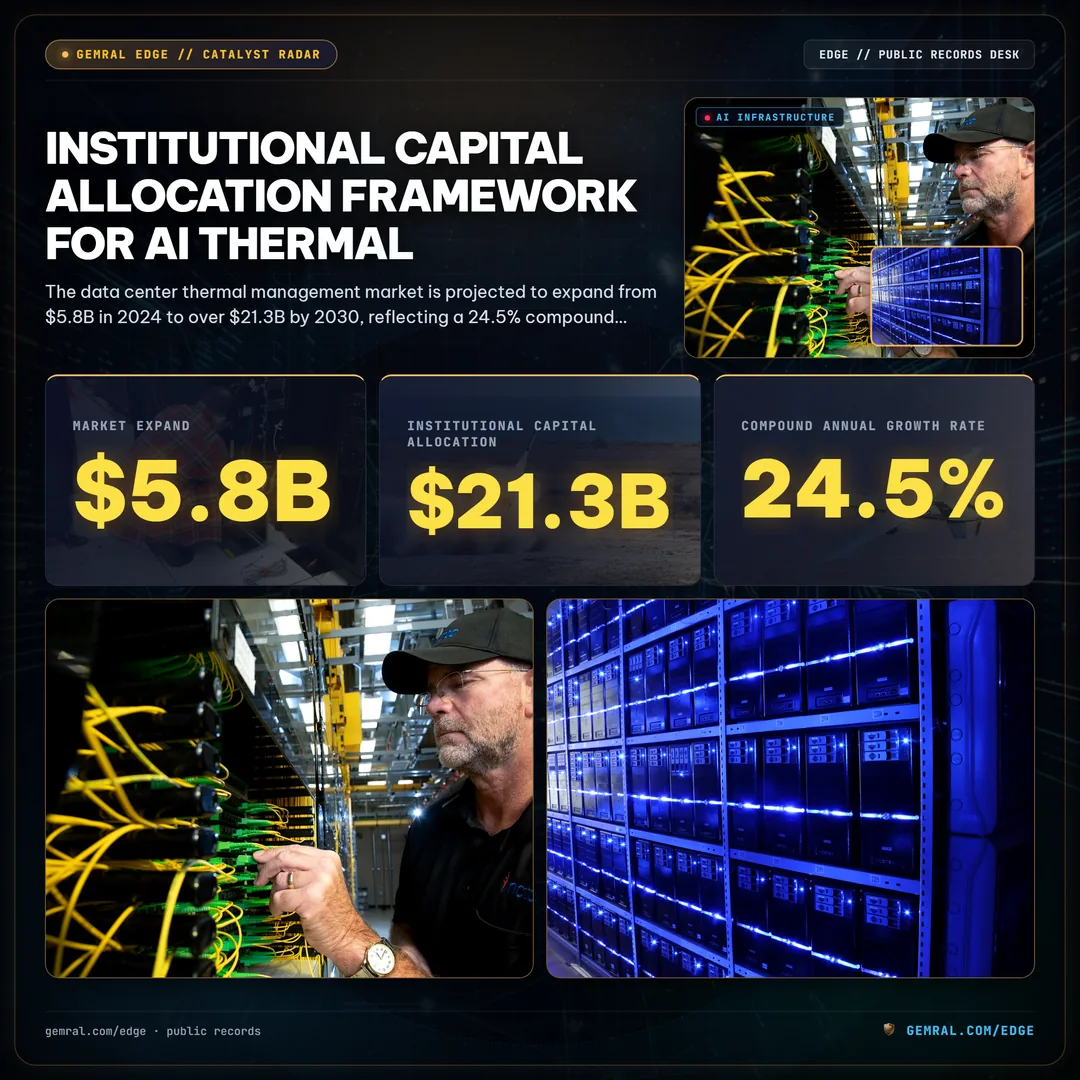
Thị trường quản trị nhiệt trung tâm dữ liệu được dự báo sẽ mở rộng từ 5,8 tỷ USD vào năm 2024 lên hơn 21,3 tỷ USD vào năm 2030, tương ứng tốc độ tăng trưởng kép hàng năm (CAGR) đạt 24,5%. Đối với các nhà quản lý danh mục đầu tư thể chế, việc đánh giá tỷ trọng cổ phiếu trong chủ đề mang tính thế kỷ này đòi hỏi một khung phân tích bốn trụ cột kỷ luật:
Các Trụ Cột Đánh Giá Cổ Phiếu Nhiệt Thể Chế
- Căn Chỉnh Theo Kiến Trúc Tham Chiếu: Identifying equipment vendors officially qualified within major GPU reference designs and Open Compute Project (OCP) standards.
- Năng Lực Sản Xuất Và Thời Gian Giao Hàng: Theo dõi đơn hàng tồn đọng đối với các bộ CDU công suất lớn 1500kW và khuôn đúc ống phân phối chính xác, nơi thời gian giao hàng thường kéo dài từ 30 đến 40 tuần.
- Gắn Kèm Dịch Vụ Và Hợp Đồng Bảo Trì: Prioritizing suppliers with extensive field-service engineering networks capable of servicing closed-loop hydraulic systems under strict SLA guarantees.
- Valuation Discipline vs Backlog Visibility: Đối chuẩn bội số định giá doanh nghiệp với các cam kết chi tiêu vốn (CapEx) nhiều năm của các khách hàng đám mây siêu lớn.
Các nhà phân bổ định lượng theo dõi những xu hướng hạ tầng thế kỷ này thông qua các luồng dữ liệu bản xem trước dữ liệu thể chế của chúng tôi để phát hiện sự tăng tốc chi tiêu vốn qua nhiều quý trên toàn bộ ngăn xếp điện toán toàn cầu.
Frequently asked questions
What are the primary liquid cooling stocks benefiting from AI data center buildouts?
Primary liquid cooling stocks include thermal infrastructure providers such as Vertiv Holdings (VRT), heat transfer specialist Modine Manufacturing (MOD), electrical and liquid manifold provider nVent Electric (NVT), and industrial chiller manufacturer Johnson Controls (JCI).
Why is liquid cooling required for next-generation AI data centers?
Liquid cooling is technically required because advanced AI clusters such as NVIDIA GB200 NVL72 generate rack power densities exceeding 100kW to 132kW, surpassing the 35kW physical thermal dissipation ceiling of traditional forced-air ventilation.
What is the difference between Direct-to-Chip (D2C) and Immersion cooling?
Direct-to-Chip (D2C) circulates liquid coolant through cold plates mounted directly on GPU/CPU dies while keeping standard server chassis accessible. Immersion cooling submerges entire servers in dielectric fluid, providing extreme thermal capture but requiring specialized facility retrofits.
How does liquid cooling improve data center Power Usage Effectiveness (PUE)?
By eliminating high-power chiller fans and optimizing heat exchange efficiency, liquid cooling lowers data center PUE from historical air-cooled averages of 1.50 to between 1.10 and 1.15, reducing facility cooling electricity consumption by up to 40%.