When Three Independent Trails Converge on One Ticker: Reading Cross-Signal Alignment in Public Records
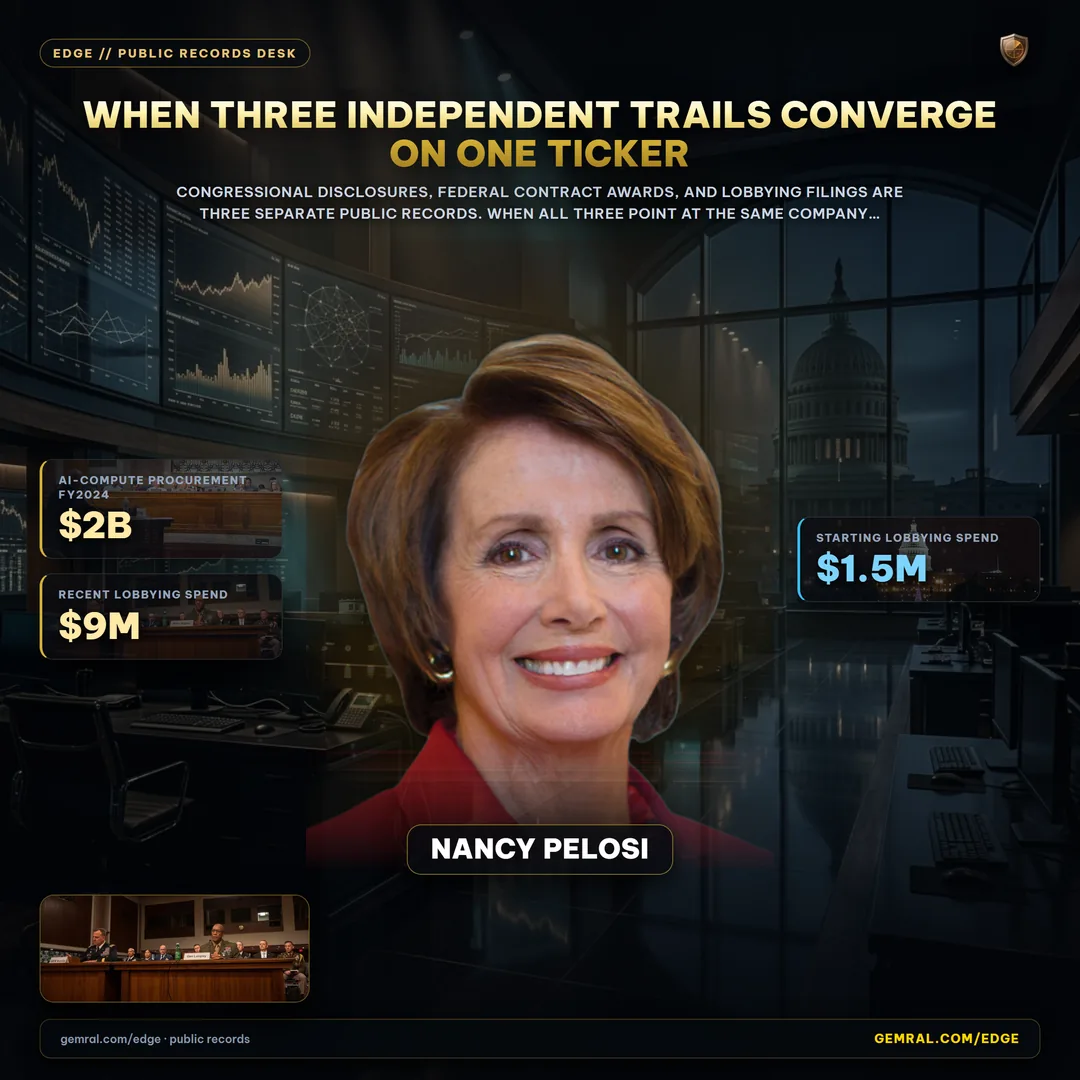
Most market participants watch one signal at a time. Congressional disclosure filings get their week of headlines. A federal contract award gets a paragraph in a trade publication. A lobbying registration change goes unnoticed entirely. The insight isn't in any single trail — it's in what happens when all three point at the same company in the same window.
This is a methodology piece, not a tip sheet. The goal is to explain how three fully public data layers — STOCK Act disclosures, federal contract award records, and lobbying registration filings — can be read in combination to surface information that each layer alone never tells you. We'll use a specific company as the illustrative case study throughout, but the framework applies wherever the three trails overlap.
1. What Cross-Signal Convergence Actually Means — and What It Doesn't
Start with what convergence is not. It is not a trading signal. It is not predictive of stock performance. It is not a validation of any price hypothesis. These three data layers are descriptive records of three different types of human decisions: a legislator's disclosed financial transaction, a government agency's procurement commitment, and a corporation's strategic decision to spend money shaping policy.
What convergence does tell you: multiple independent actors with distinct incentives are making decisions that reflect elevated attention on the same company or technology. That attention is documentable, verifiable, and — critically — publicly reported. No inference is required.
The practical question is this: when a cluster of congressional STOCK Act filings, a multi-agency procurement pattern, and a lobbying spend acceleration all materialize in the same 90-day window for the same ticker, what does that combination describe? It describes a company that, at a minimum, sits at the intersection of government spending priorities and legislative attention simultaneously. That is interesting data regardless of what you intend to do with it.
2. Trail One — Congressional STOCK Act Disclosures: Reading the Cluster, Not the Single Trade
The STOCK Act, passed in 2012, requires members of Congress and their immediate families to report security transactions within 45 days of execution. The filings are public. They are searchable. And they are, on their own, frequently misread.
The error most observers make is treating individual congressional trades as revelatory. A single member buying or selling any given security is, by itself, weak information. Members file hundreds of trades per year across widely diversified portfolios. The signal lives in the cluster: when multiple members from different committees, different parties, and different geographic districts all disclose transactions in the same security within a short window, that pattern is unlikely to be coincidental portfolio rebalancing.
In calendar year 2024, NVIDIA was the single most-disclosed semiconductor holding in STOCK Act filings. At least eleven distinct congressional members disclosed transactions during the year, with the majority concentrated in Q2 2024. The Q2 cluster was not a single event — it was filings from members who sit on the House Armed Services Committee, the House Science, Space and Technology Committee, and the Senate Commerce Committee, each operating independently under their own disclosure obligations.
Equally important is what the filing pattern tells you about timing. STOCK Act disclosures have a 45-day lag from execution. When you observe a cluster of filings hitting simultaneously, the underlying transactions occurred in a tighter window than the filings suggest. Adjusting for the reporting lag, the Q2 2024 cluster corresponds to transactions executed primarily between mid-April and early June 2024 — a period that overlapped with active Congressional debate on AI export controls and the CHIPS and Science Act implementation funding.
This is not a conspiracy. Members of Congress are allowed to buy stocks. They are required to disclose them. What the cluster pattern tells you is that during that specific debate window, multiple legislators concluded that NVIDIA warranted action in their personal portfolios. Whether they acted on non-public information, public information, or general investment thesis is not determinable from the public filing alone. The filing records what they did. Reading the cluster tells you it wasn't random.
3. Trail Two — Federal Contract Award Records: The Procurement Signal Before the Announcement
Federal agencies publish contract awards through multiple channels, all publicly accessible. The detail available varies by contract type and agency, but the fundamental data — contracting agency, awardee, award value, and a brief description — is consistently available in public records.
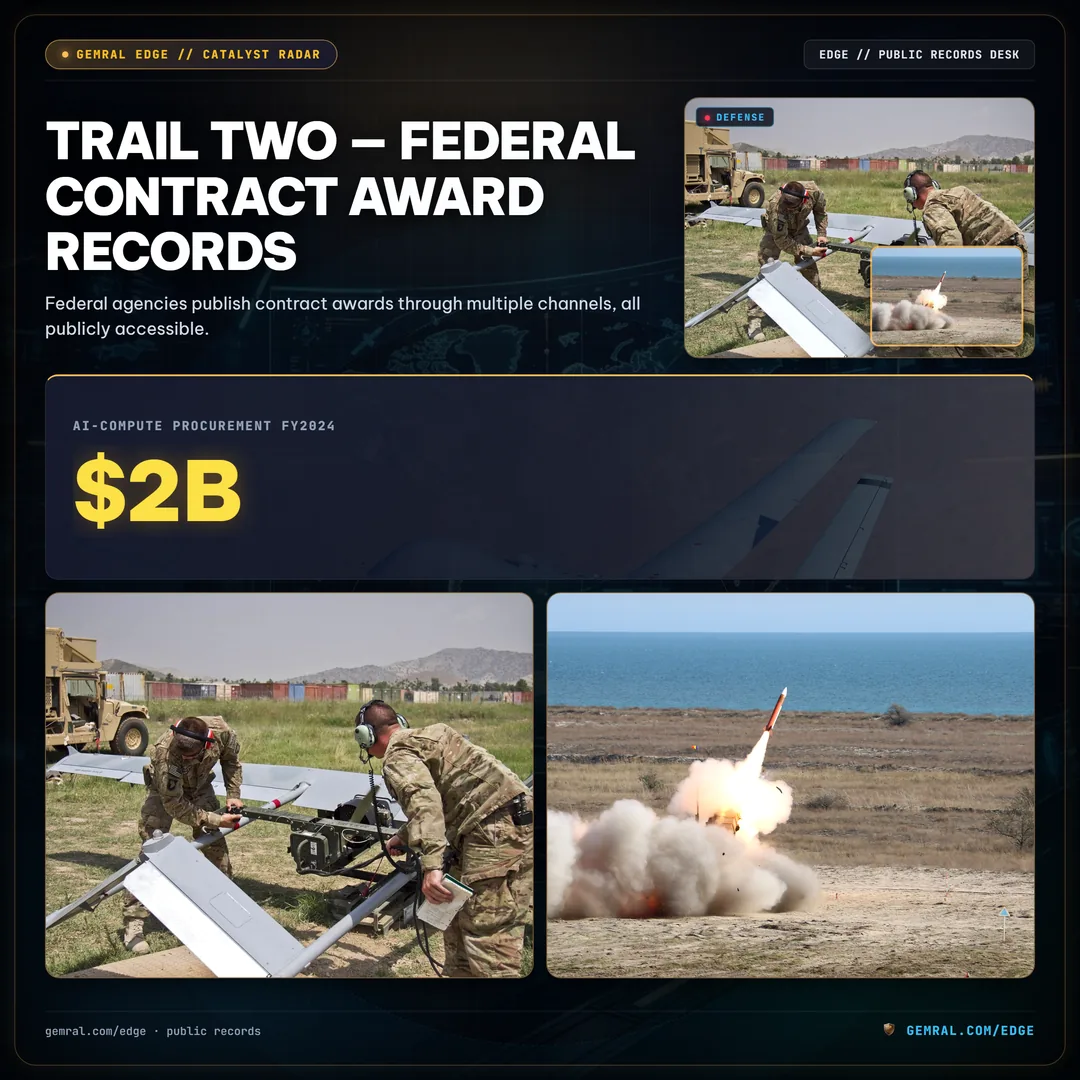
What makes federal contracting data valuable as a signal layer is not any individual contract. It is the procurement pattern across agencies and time. A company that receives AI-related contracts from the Army, the Air Force, the Department of Energy, and a national laboratory in the same fiscal year is not encountering government as a single customer. It has become embedded infrastructure for federal AI programs. That distinction is quantifiable from public contract records alone.
In the case of NVIDIA, the publicly visible procurement footprint expanded substantially in FY2024. Army AI Task Force programs, Air Force Education and Training Command pilot initiatives, and Department of Energy national laboratory computing programs all issued awards naming GPU hardware consistent with NVIDIA's product line. The cumulative disclosed value across identifiable AI-compute procurements across DoD and DoE programs exceeded $2 billion in FY2024 — a number that assembles from public contract records rather than any proprietary data source.
The procurement pattern also tells a supply story. Federal AI compute programs do not run multi-year GPU procurement cycles on a speculative basis. When the Army AI Task Force and the Air Force simultaneously expand hardware contracts for GPU clusters, they are responding to approved program requirements that existed months or years before the award. The public contract award is the visible end of a procurement pipeline that began with a budget request, a program plan, and an approved acquisition strategy — all of which were developed before the ink dried on the award announcement.
Reading the contract records as a signal layer means looking for the pattern: which companies are appearing across multiple agencies, in multiple program areas, in the same fiscal year? When the answer is consistent across unrelated program offices, that consistency is meaningful data about where federal AI priorities are concretely, not rhetorically, landing.
4. Trail Three — Lobbying Disclosure Filings: Reading the Momentum, Not the Spend
Lobbying disclosure filings are the least intuitively read of the three trails. Most observers look at a lobbying number — a dollar figure per quarter or per year — and draw inferences that the data does not actually support. Large lobbying spend does not correlate cleanly with policy outcomes. But lobbying spend trajectories do correlate with something more measurable: a company's assessment of how much regulatory and legislative attention it expects to receive in the near term.
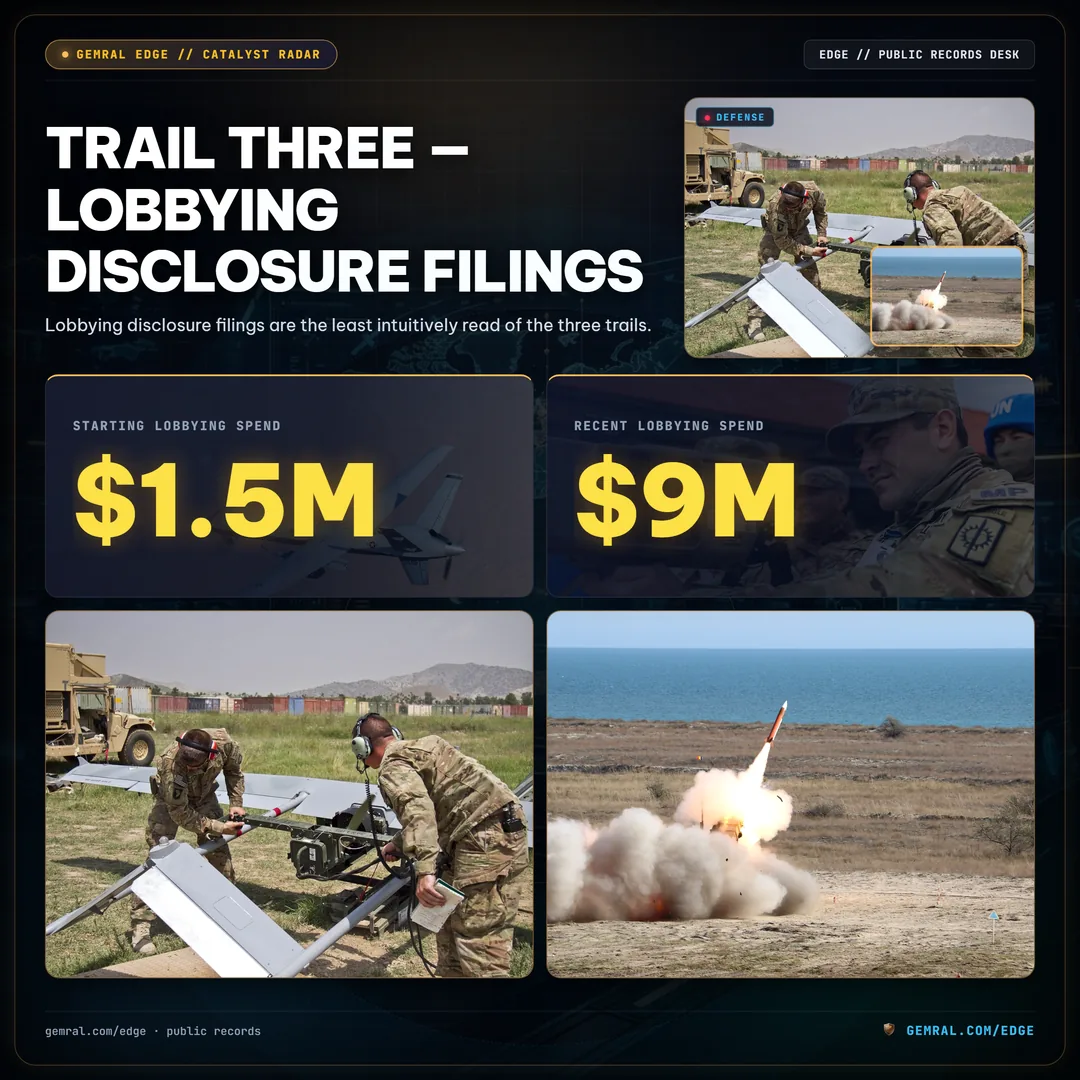
Companies do not dramatically increase lobbying budgets on issues they do not expect to matter to their business. The decision to ramp lobbying is a strategic allocation made internally, disclosed publicly, and reported quarterly. When a company's lobbying spend accelerates by six-fold or more over a multi-year period — particularly when the issue areas disclosed in the filings align with active legislative or regulatory processes — that trajectory is informative about what the company's government affairs team believes is coming.
NVIDIA's lobbying trajectory from 2020 to 2024 is a textbook case of this pattern. Beginning from approximately $1.5 million in annual lobbying expenditure in 2020, the spend ramped to roughly $9 million by 2024 — a six-fold increase over four years. The issue areas disclosed in the quarterly filings are specific: artificial intelligence policy, semiconductor export controls, CHIPS and Science Act implementation, and national security-related technology transfer policy. These are not generic technology company lobbying topics. They are precisely the legislative and regulatory issues that directly determine NVIDIA's market access in multiple geographies and its positioning for government procurement programs.
The lobbying momentum number is not a predictor of favorable outcomes. Legislators do not vote based on lobbying spend. But the momentum tells you that NVIDIA's government affairs team, which has direct visibility into the legislative calendar and regulatory agenda, concluded that 2024 required significantly more investment than prior years. That internal assessment — documented publicly — is a data point independent of the congressional disclosure and contract award records.
5. When All Three Arrive at Once: The NVDA 90-Day Window
The convergence case study materializes when you overlay the three timelines. In a window running roughly from late April to late July 2024, the following publicly documented events occurred:
On the congressional trail: seven distinct STOCK Act filings from members of Congress disclosed NVDA transactions. These filings came from members across multiple committees with AI-relevant jurisdiction, including armed services, science and technology, and commerce.
On the federal procurement trail: the Army AI Task Force released an award for GPU cluster expansion. The Oak Ridge National Laboratory, operating under DoE's Advanced Scientific Computing Research program, disclosed a contract modification for next-generation compute infrastructure consistent with NVIDIA's H100 architecture. The Air Force Education and Training Command disclosed a pilot AI program award naming GPU hardware in the procurement description.
On the lobbying trail: NVIDIA filed its Q2 2024 lobby registration update identifying active lobbying on three bills with direct relevance to its government procurement positioning: AI policy framework legislation under debate in the Senate Commerce Committee, export administration regulations governing advanced chip exports, and the CHIPS program implementation rules under review at the Department of Commerce.
None of these events requires the others to be meaningful on its own terms. The congressional filings are required disclosures with no policy implication. The contract awards are procurement actions within approved program budgets. The lobbying filings are public registrations of paid advocacy. What makes the combination noteworthy is that three institutions — the legislative branch, the executive branch's procurement agencies, and a private corporation — all produced public documentation of NVIDIA-related activity in the same window, each through an entirely separate process.
That co-occurrence is not proof of anything. But it is a measurable, documentable fact. And facts that are both verifiable and non-obvious have more signal value than unverifiable claims that are obvious.
6. The 90-Day Window: How to Read the Timing Structure
The 90-day frame is not arbitrary. Three structural features of the relevant filing cycles converge on approximately that horizon.

Congressional STOCK Act disclosures have a 45-day reporting lag, which means that by the time a cluster of filings appears publicly, the underlying transactions are already 0 to 45 days old. Reading the public disclosure cluster therefore places you approximately 30 to 90 days behind the decision point.
Federal contract awards are published after the award is made, but the procurement process that generated them — solicitation, evaluation, selection — runs on a cycle that typically begins 90 to 180 days before the public award. Visible awards are, in effect, trailing indicators of procurement decisions made substantially earlier.
Lobbying registrations are updated quarterly. A quarter that shows accelerated spend on a specific issue area reflects internal investment decisions made during that quarter, which in turn reflect the government affairs team's forward calendar — their read on what legislative or regulatory actions are coming in the next one to two quarters.
When all three signals appear within 90 days, you are observing a window where backward-looking disclosures, near-real-time procurement actions, and forward-looking lobbying decisions are all publicly visible simultaneously. That does not mean they caused each other. It means that multiple parties with different time horizons and different institutional mandates all produced public documentation that clusters around the same company in the same period.
The sectors where this pattern appears most frequently are not surprising: defense technology and semiconductors lead, because the federal government is simultaneously the primary buyer and the primary regulator in those markets. A company that builds hardware the government needs to procure, operates in a regulatory environment the government controls, and participates in policy debates the government is actively conducting will produce public documentation across all three data layers by the nature of its business — without any single actor coordinating the timing.
7. What the Framework Does and Doesn't Tell You
The cross-signal convergence framework is a reading method for publicly available records. It does not require any proprietary data, any non-public information, or any inference beyond what the documents themselves state. Its value is organizational: it connects documentation that is maintained separately, filed under different statutes, and reported in different formats into a coherent picture of institutional attention.
What it does not do: it does not predict share price. It does not indicate insider knowledge on the part of any of the filers. It does not imply that the companies involved are doing anything other than operating normally within their respective regulatory environments. Legislative members are legally allowed to invest. Federal agencies procure equipment they need for approved programs. Corporations lobby on policy issues that affect their business. The alignment of these activities in a common window is observable. Its causal interpretation is not.
The framework is most useful as a filter — a way of identifying which public-record signals deserve deeper reading and which can be deprioritized. A company that generates convergent documentation across all three layers is, at minimum, one that multiple institutions have found worth documenting simultaneously. That is a different category of institutional attention than a company that generates documentation in only one layer.
For any investor, analyst, or policy researcher trying to understand where government attention and private capital are both landing, reading the three trails together is simply more accurate than reading any one trail alone. The records are public. The method is replicable. The only variable is whether you are looking.
Track cross-signal patterns across congressional disclosures, federal contract records, and lobbying filings in real time — all from public data. Explore the convergence dashboard.
Explore Gemral Edge →Signal Convergence: Public records cross-validation is prominently observed in the Nancy Pelosi stock portfolio, where regulatory filings, options expirations, and committee milestones converge.