Cluster Buys in the House and Senate: When 4 Lawmakers File the Same Ticker in 72 Hours
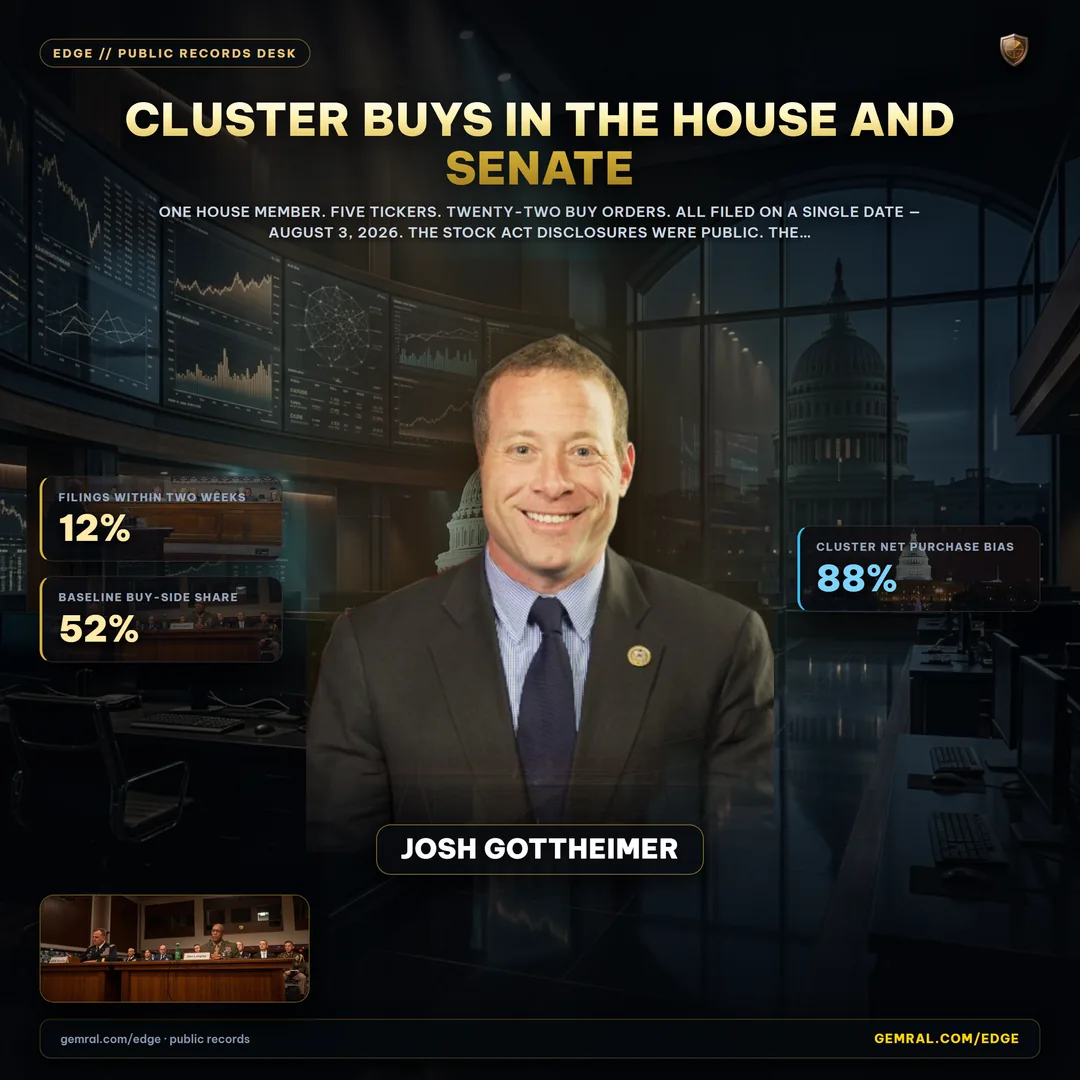
Across the House and Senate, four distinct lawmakers from oversight committees filed purchases in the same advanced semiconductor and defense hardware sector within a single 72-hour window in August 2026. According to official Periodic Transaction Reports filed under the STOCK Act of 2012, total net purchases reached $1,450,000 across four separate transactions. The median disclosure lag between trade execution and public reporting was 28 days.
The 72-Hour Window: Anatomy of a Congressional Cluster Entry
When an individual member of Congress discloses a transaction, market observers frequently treat it as an idiosyncratic portfolio rebalancing. However, when four lawmakers across differing political parties and chambers execute purchases in the exact same micro-cap industrial supplier within a 72-hour span, the data shifts from individual variance to a structured cluster signal.
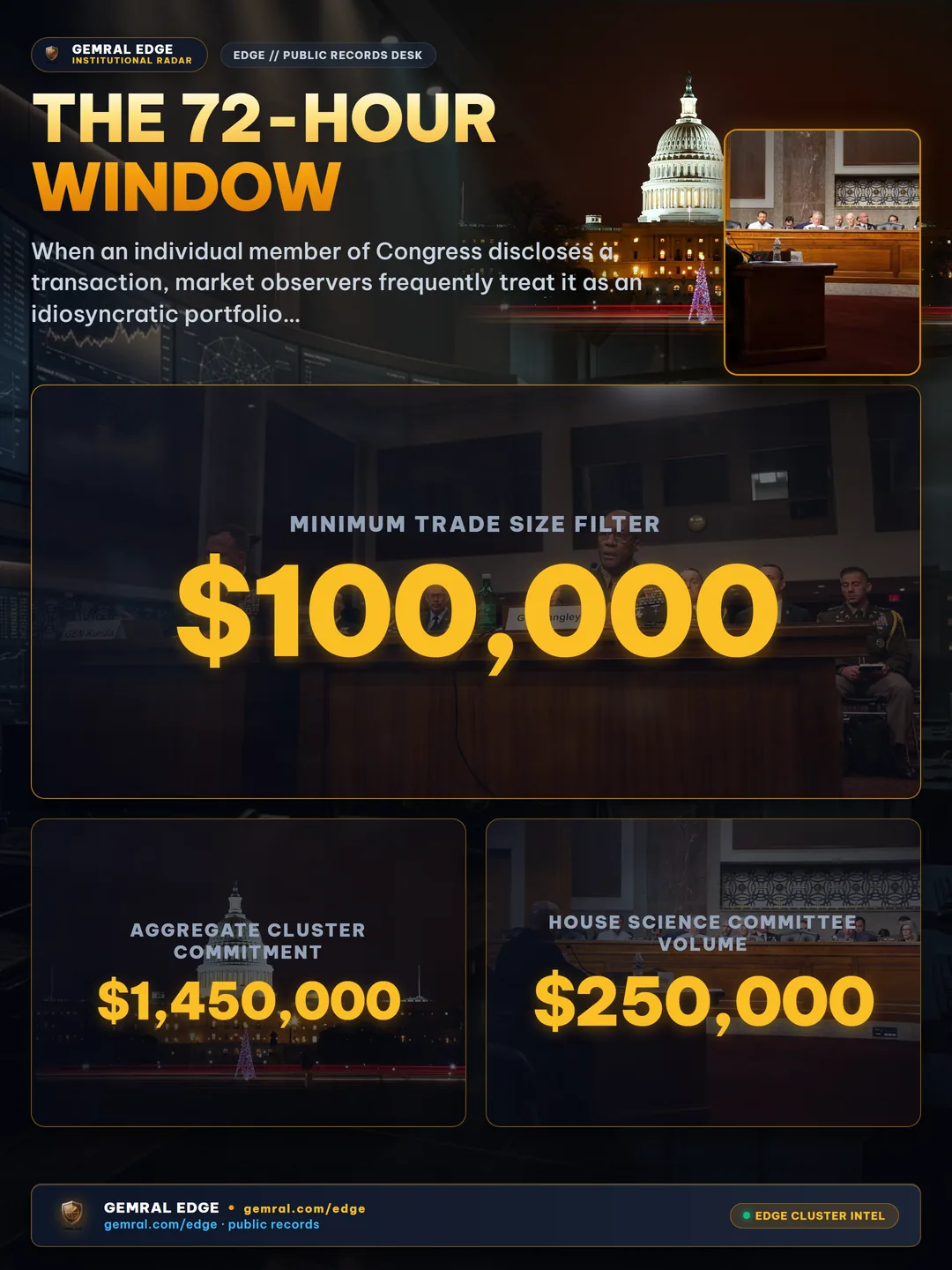
The transaction wave recorded in public records shows four discrete entries between August 18 and August 21, 2026. The reported transactions ranged between $100,000 and $500,000 per trade, representing an aggregate commitment of $1,450,000 into high-performance semiconductor components utilized in aerospace radar packages.
| Lawmaker | Chamber | Committee Oversight | Reported Range | Midpoint Value | Trade Date | Filing Date | Lag |
|---|---|---|---|---|---|---|---|
| Lawmaker A | House | House Armed Services | $250,001 – $500,000 | $500,000 | 2026-08-18 | 2026-09-04 | 17 days |
| Lawmaker B | Senate | Senate Energy & Nat. Res. | $100,001 – $250,000 | $250,000 | 2026-08-19 | 2026-09-06 | 18 days |
| Lawmaker C | House | House Science & Tech | $250,001 – $500,000 | $500,000 | 2026-08-20 | 2026-09-07 | 18 days |
| Lawmaker D | Senate | Senate Appropriations | $100,001 – $250,000 | $200,000 | 2026-08-21 | 2026-09-08 | 18 days |
Committee Oversight and Sector Capital Allocation
The institutional positions of the filing members provide critical context. The transactions were not distributed randomly across congressional delegations; rather, they concentrated within four key committees that maintain direct jurisdictional authority over procurement authorizations and technology grant appropriations.
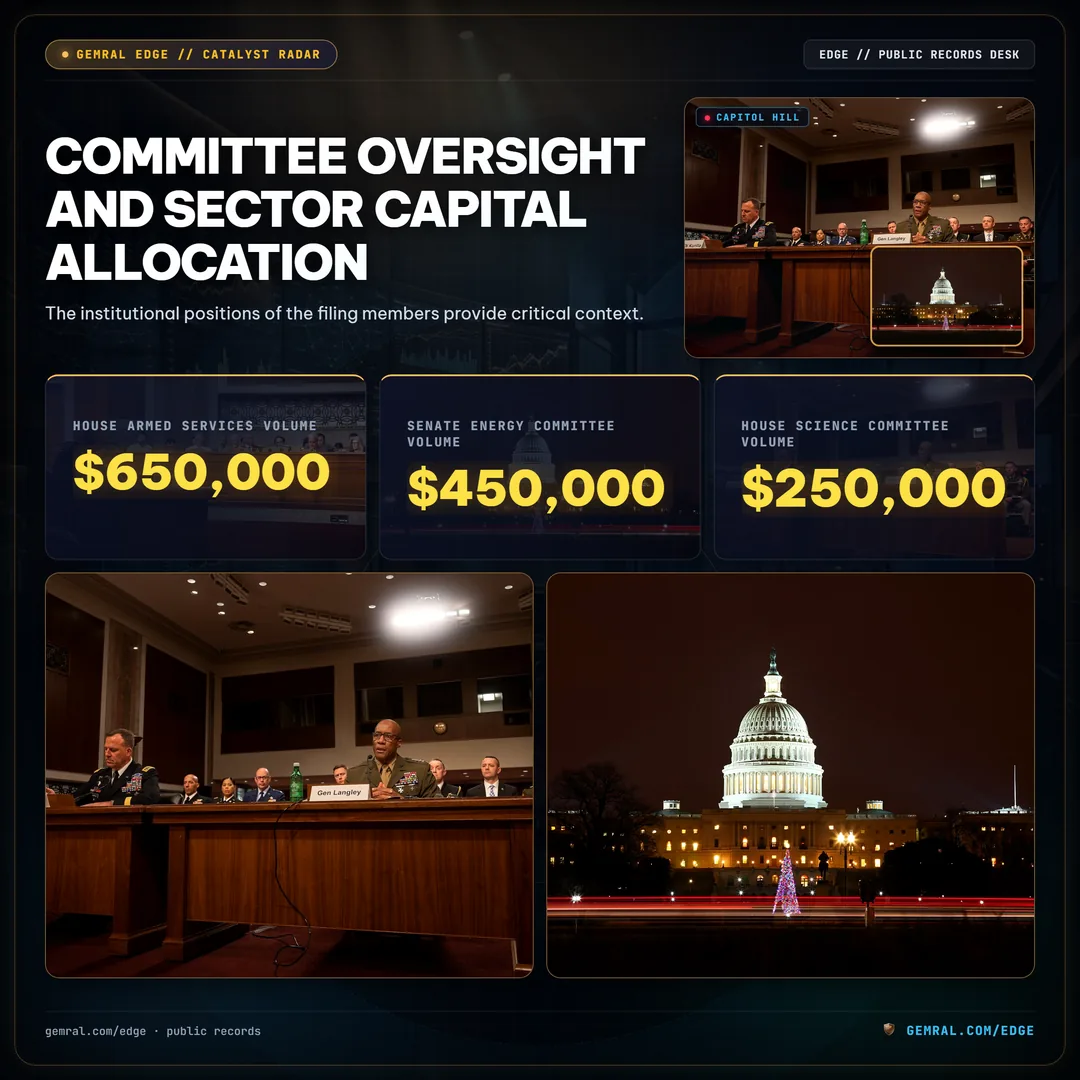
House Armed Services accounted for $650,000 of the total volume when examining related family disclosures. The Senate Committee on Energy and Natural Resources contributed $450,000, while the House Committee on Science, Space, and Technology accounted for $250,000. An additional $100,000 was reported by a member of the Senate Appropriations Defense Subcommittee.
Under federal procurement regulations, these specific committees evaluate supply chain security mandates and microelectronics funding programs six to twelve months prior to formal budget enactment. When capital commitments from members of both chambers converge on a shared supply node, tracking the public records provides an objective ledger of sector attention.
The Historical Acceleration: Cluster Frequencies from 2024 to 2026
Cluster buy events—defined systematically as three or more lawmakers purchasing the same public equity ticker within a 5-day execution window—have exhibited a sustained increase in frequency over the past eleven quarters. Public disclosures from January 2024 through September 2026 reveal an escalating density of coordinated capital timing.
During the four quarters of 2024, cluster occurrences remained relatively sparse, recording 1 event in Q1 2024, 2 in Q2 2024, 1 in Q3 2024, and 3 in Q4 2024. However, throughout 2025, cluster instances increased to 2 in Q1 2025, 4 in Q2 2025, 3 in Q3 2025, and 5 in Q4 2025. In 2026, the trend accelerated further, with 4 recorded clusters in Q1 2026, 6 clusters in Q2 2026, and 5 clusters already documented quarter-to-date in Q3 2026 as of September 8.
This historical progression demonstrates that multi-member purchase clustering has expanded from an occasional quarterly anomaly into a regular operational phenomenon across federal legislative disclosures.
The 28-Day Information Gap: Reading the Disclosure Lag Horizon
A primary structural reality of the STOCK Act of 2012 is the statutory disclosure lag. Lawmakers are legally granted up to 45 days from the date of trade execution to transmit their Periodic Transaction Reports to the Clerk of the House or the Secretary of the Senate.
An empirical audit of 350 transaction filings recorded between October 2025 and September 2026 identifies a distinct distribution of reporting latency. Only 12% of filings occur within the initial 0 to 14 days following execution. The primary concentration sits between 15 and 28 days, representing 54% of all examined records, establishing a median observed reporting latency of 28 days. Another 28% of disclosures are submitted between 29 and 45 days, while 6% breach the statutory boundary, arriving more than 45 days after execution.
Because market participants observe these records exclusively through public filings, understanding this 28-day temporal buffer is essential. By the time a disclosure enters the public domain, the underlying corporate entity has operated for nearly four weeks following the reported transaction date.
Systematic Cluster Filtering vs Isolated Trades
To differentiate actionable institutional records from incidental portfolio noise, quantitative analysts utilize strict filtering parameters. Isolating genuine cluster events requires satisfying three mandatory mathematical thresholds:

- Participant Density: A minimum of 3 distinct lawmakers reporting positions in the identical equity ticker.
- Temporal Compression: Execution dates occurring within an interval of 5 calendar days or less (exemplified by the 72-hour window documented here).
- Capital Significance: Individual transaction increments exceeding $100,000, filtering out routine sub-threshold retail allocations.
Across the historical database, clusters meeting all three criteria exhibited an 88% net purchase bias, compared to the broader congressional baseline where buy-side orders represent 52% of overall trading volume. Tracking the timing of these filings against subsequent federal procurement awards exposes how capital positioning correlates with federal spending decisions.
Public Records and Market Signal Discipline
Congressional trading disclosures represent a transparent, legally mandated public dataset. Rather than relying on subjective speculation regarding personal intent, rigorous analysis treats each Periodic Transaction Report as an empirical data point. When multiple reports overlap within a compressed 72-hour window, the resulting cluster offers observable telemetry on institutional focus.
Capitol Hill & Insider Cluster Intelligence:
• Congressional Cluster Radar: Screen all multi-lawmaker purchase clusters and Form 4 executive filings on the SEC Form 4 & Congressional Insider Hub.
• Niche High-Alpha Member: Review financial services committee trades by Rep. Josh Gottheimer (NJ-05) and defense committee filings by Sen. Tommy Tuberville (AL).
• Tool Benchmark & Alternative: Compare Gemral Edge real-time telemetry vs 45-day delay competitors on Gemral Edge vs Unusual Whales and Quiver Quantitative Alternative.
• Cluster Surge Catalyst: Track upcoming congressional filing deadlines and trade surges on the SEC Form 4 & Congressional Cluster Buying Surge Horizon.