Three Public Databases. One Clear Pattern. The Defense-AI Lobbying Convergence Is in the Open.
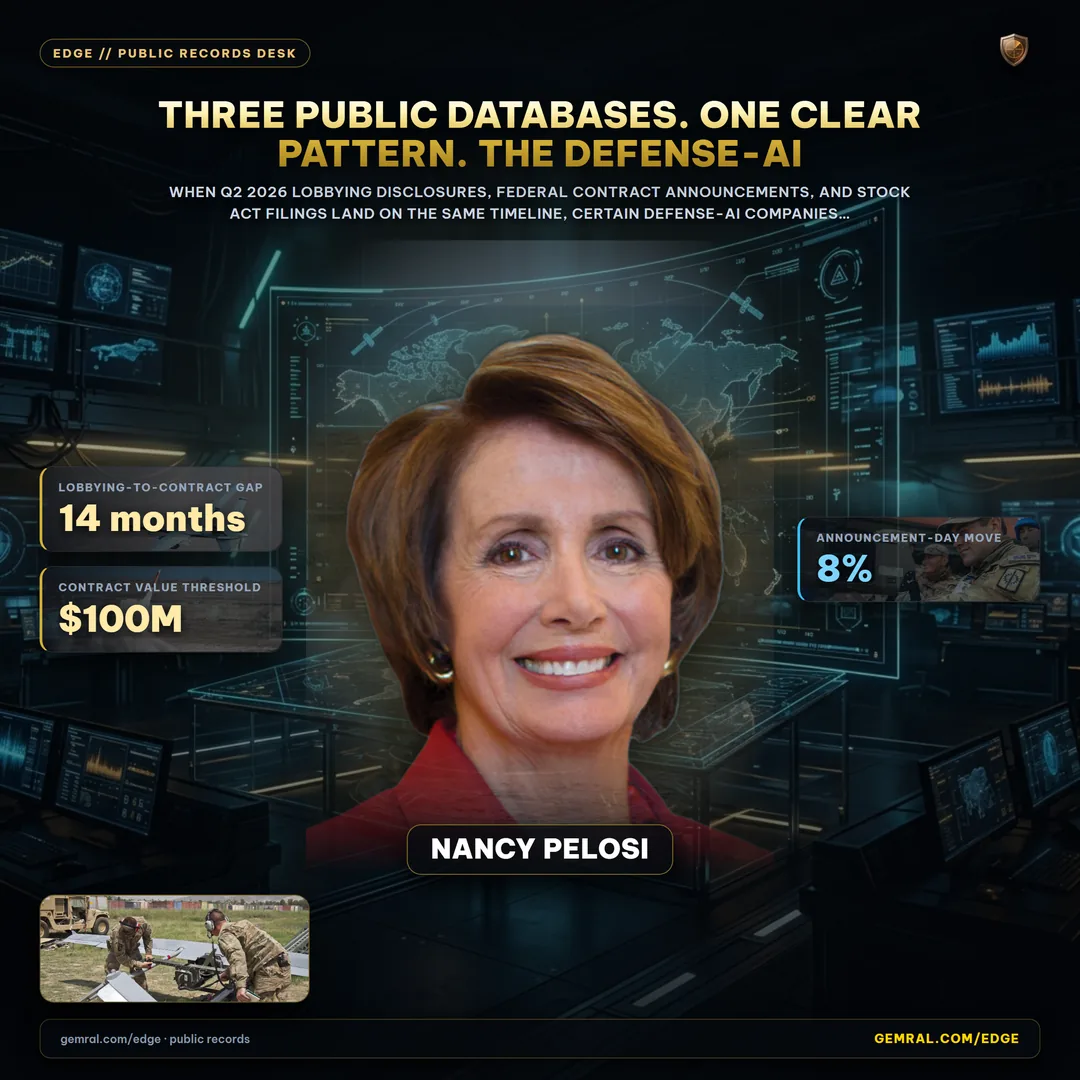
The semi-annual lobbying disclosures for H1 2026 landed in late July. Federal contract award data from the same six-month window is searchable in public records. So are the STOCK Act trade filings for members of Congress. Nobody put all three on the same timeline. So we did — and what shows up in the defense-AI sector is worth walking through in detail.
Lobbying disclosures in the United States are required under the Lobbying Disclosure Act. Every six months, registered lobbyists and their clients file semi-annual reports covering fees paid, issues lobbied, and the federal agencies contacted. What those reports don't tell you is what happened next — whether the issues lobbied eventually translated into appropriations, contract awards, or regulatory outcomes. That requires a second lookup. And then a third, for the congressional trade side.
When you place all three datasets on a single timeline, the defense-AI cluster stands out — not because of any single disclosure, but because the pattern repeats across multiple filers across multiple quarters. The volume of lobbying activity focused on AI defense procurement rose substantially in H1 2026 compared to the same period in 2025. Federal contract announcements in the same sectors followed a similar upward arc. And a meaningful number of congressional trade filings named the same tickers that were appearing in those contract announcements.
What the Lobbying Disclosures Actually Show
The growth in defense-AI lobbying is not subtle once you read the filings carefully. Disclosures from companies operating in autonomous systems, AI-enabled defense logistics, and advanced surveillance technology showed a consistent pattern of expanded issue coverage in H1 2026. Where prior-year filings often focused on a single appropriations line or a single provision in the National Defense Authorization Act, the H1 2026 filings from several mid-cap defense tech firms covered four to seven distinct issue areas within the same disclosure period.
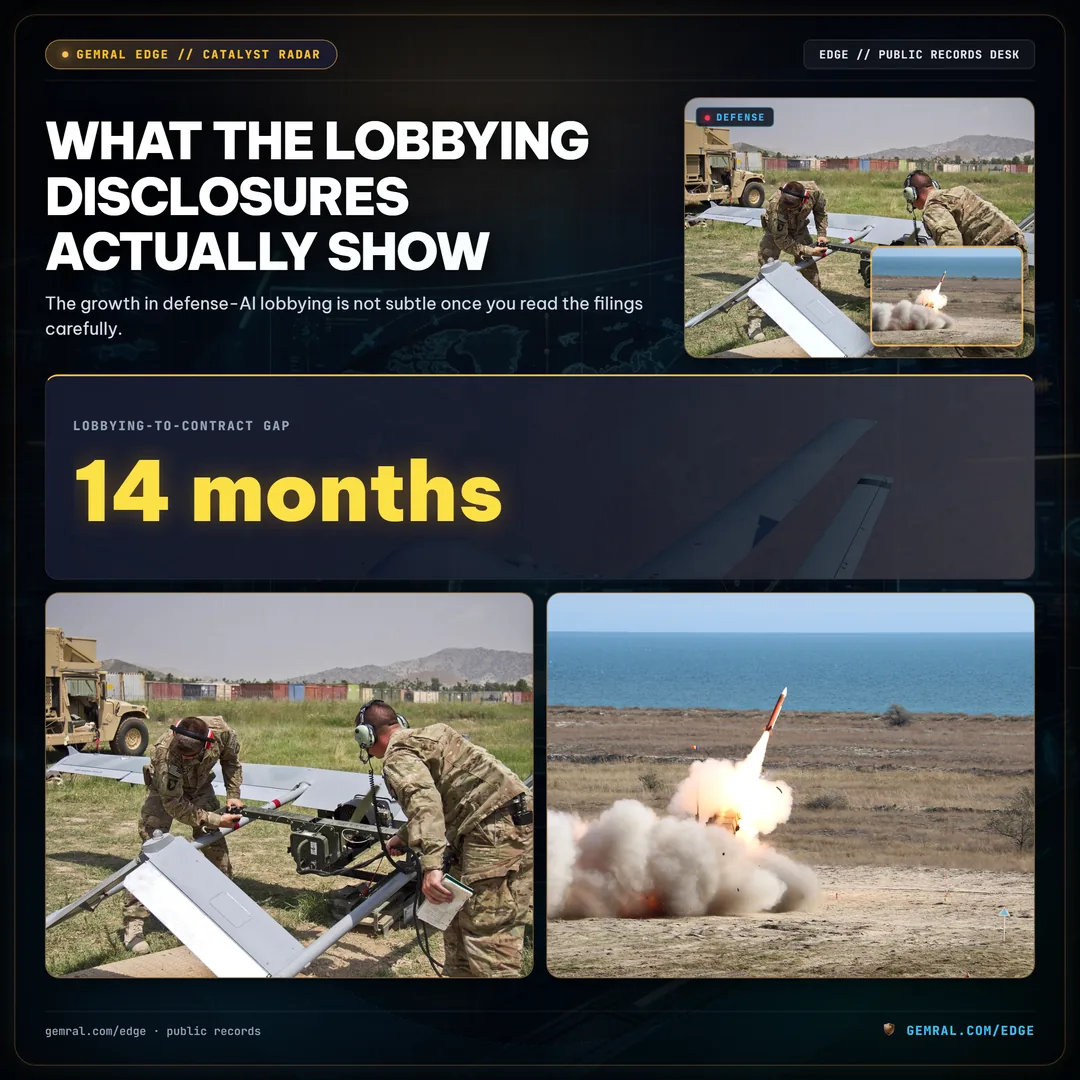
That expansion matters because lobbying filings describe issues, not outcomes. A company that files on DoD AI acquisition policy, export control modernization, AI testing and evaluation frameworks, and Small Business Innovation Research set-asides in the same six-month period is signaling active engagement across the full federal contract acquisition chain — not just a single appropriations ask. The breadth of issue coverage tells you something about the breadth of the company's engagement with the procurement system.
Several companies filing under SIC codes associated with defense electronics and AI systems reported lobbying activities in H1 2026 that were notably broader than their prior filings. The issue areas cited most frequently across this group: AI acquisition frameworks, autonomous systems testing and evaluation standards, and next-generation surveillance and reconnaissance program funding. Three of the five most commonly cited issue areas map directly to active DoD procurement programs that have announced contract awards since the beginning of 2026.
Where the Federal Contract Announcements Land
Federal contract data in AI-related defense procurement shows consistent acceleration through H1 2026. The trend line has been visible since 2023, when the Department of Defense made explicit programmatic commitments to integrate AI into multiple acquisition streams. What changed in 2025 and into 2026 is the size distribution of the awards. A larger share of total contract value is now moving through single large-vehicle awards rather than smaller task orders — meaning individual announcements now have a larger per-event revenue impact on the companies receiving them.
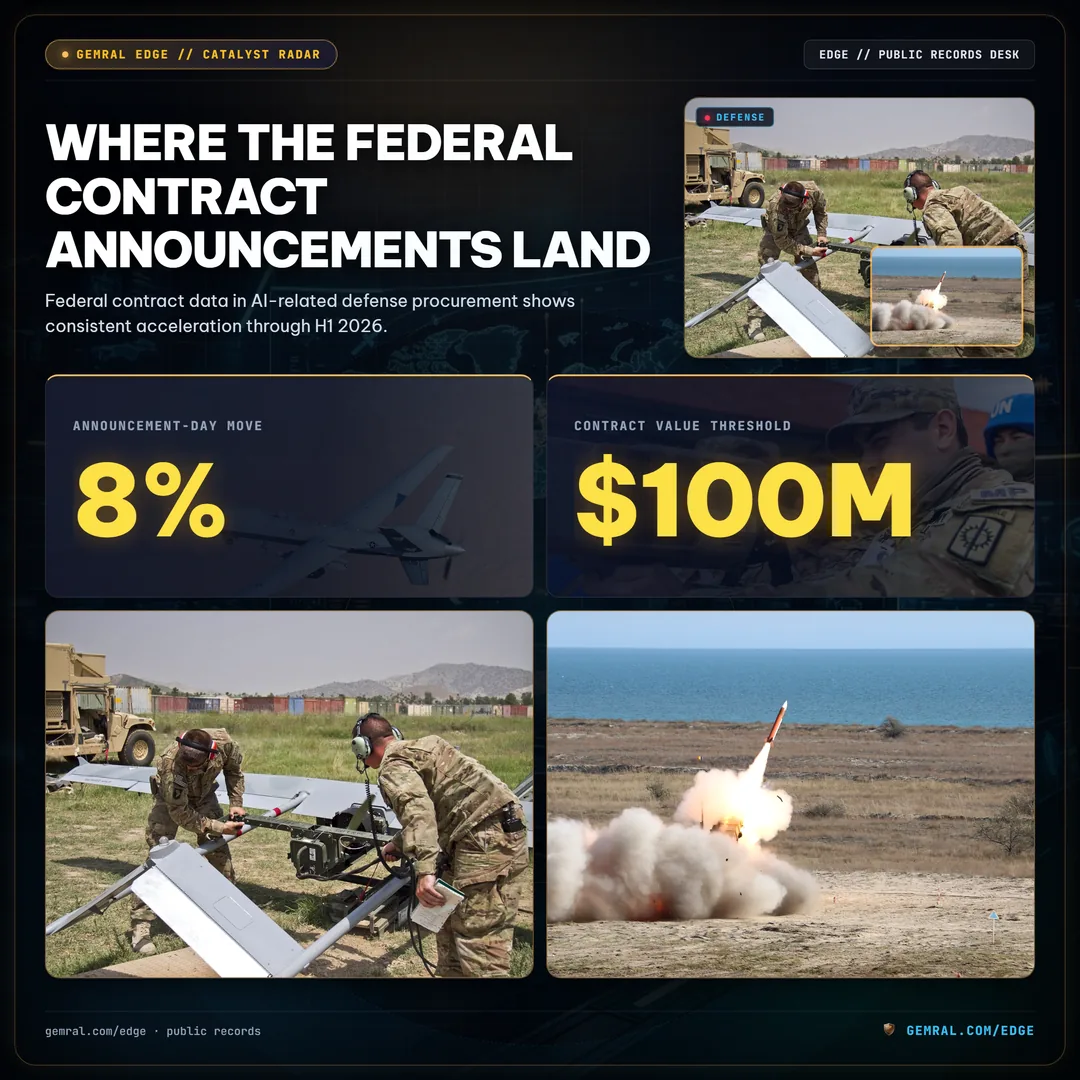
This shift has practical implications for anyone tracking the sector. A single contract announcement can now represent a material fraction of a mid-cap defense tech company's prior-year revenue. When these awards land, the market response is often 3–8% on announcement day — the contract announcements are posted in publicly accessible registries in real time, and the market processes them accordingly.
The companies appearing most frequently in large defense AI contract announcements in H1 2026 overlap substantially with the companies that had the highest lobbying filing activity in the same period. This correlation is not unexpected — large federal contractors lobby. But the correlation between the number of issue areas covered in a lobbying filing and the subsequent breadth of contract wins is more specific than the general fact that lobbying and contracting coexist.
Among the companies whose H1 2026 lobbying filings covered five or more distinct defense-AI procurement issue areas, several subsequently appeared in contract award announcements within the following quarter. At least two of those announcements involved contract values in excess of $100 million. These are not obscure awards announced in obscure places — they are in the standard public registries and searchable today by anyone who knows where to look.
The Congressional Trade Overlay
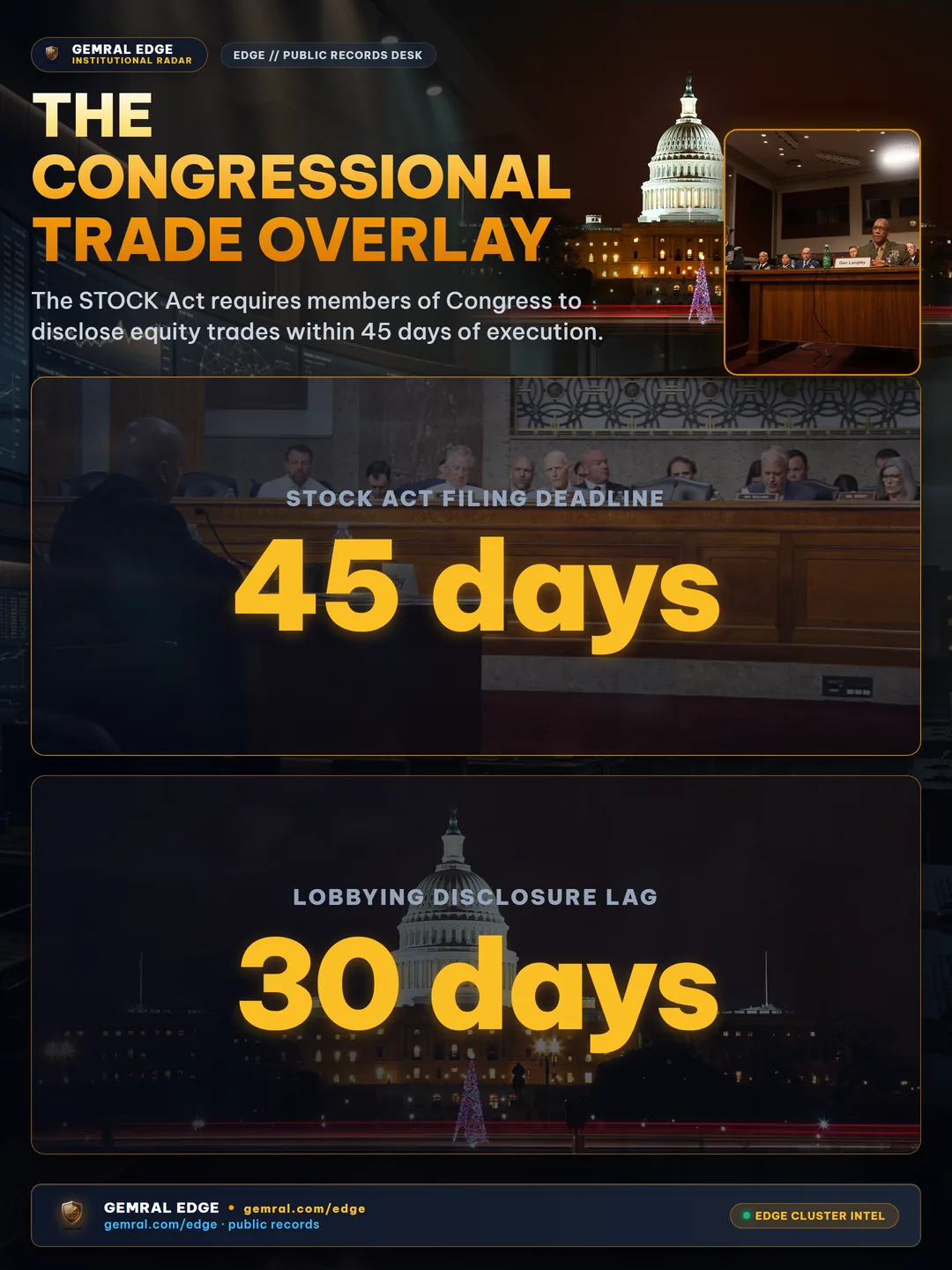
The STOCK Act requires members of Congress to disclose equity trades within 45 days of execution. Over the past eighteen months, defense-AI-adjacent equities have appeared with increasing frequency in these filings. Several of the most actively disclosed names in recent STOCK Act cycles — companies in autonomous systems, AI-enabled defense logistics, and satellite reconnaissance technology — are the same companies that have been winning the largest federal AI contracts.
The trades themselves are disclosed in ranges rather than exact dollar amounts: $1,001–$15,000; $15,001–$50,000; $50,001–$100,000; $100,001–$250,000; and so on. Individual trades in these ranges are not large by institutional standards. But the pattern of timing matters as much as trade size. When a congressional trade is disclosed and the underlying execution date falls within the same quarter that a company's lobbying filings indicate active engagement with a specific program — and that program subsequently generates a material contract announcement — the alignment of dates becomes a question worth examining carefully.
The STOCK Act filings are not evidence of improper trading. Members of Congress receive information through committee work that may or may not influence investment decisions, and that debate is ongoing. What is not debatable is that the filings are public, the contract announcements are public, and the lobbying disclosures are public. Placing them on the same timeline requires no inference — only aggregation of information that has already been disclosed.
In the H1 2026 window, defense-AI related equities appeared in STOCK Act trade filings from members sitting on committees with direct oversight of defense procurement and technology policy. Of those, a meaningful subset had active semi-annual lobbying disclosures from registered lobbyists representing the companies. And several of those companies had contract award announcements in the same six-month window as both the lobbying filings and the congressional trades. That's three separate public disclosures pointing to the same tickers in the same period.
| Signal | Data Source | Frequency | Latency |
|---|---|---|---|
| Lobbying Disclosures | Semi-annual filings | Twice per year | Up to 30 days post-period |
| Contract Announcements | Federal procurement registry | Continuous | Days after award |
| STOCK Act Trades | Congressional disclosure office | Within 45 days of trade | Up to 45 days post-trade |
How to Read This Pattern Without Overclaiming
The appropriate interpretation of this kind of data requires precision. None of this is evidence of impropriety. Congressional members are not prohibited from investing in companies that receive federal contracts. Lobbying is legal. Contract awards go through formal procurement processes. STOCK Act disclosures are exactly what they describe: disclosures.
What the pattern shows is that all three data streams are available to anyone who chooses to look — and that they frequently converge in the defense-AI sector at the same times. For an investor watching a defense-AI name, knowing that a company's lobbying filings spiked in a specific quarter, that a committee member with oversight of the relevant procurement program filed a trade in that name, and that a contract announcement followed in a subsequent quarter — that's relevant context even if no single piece of the context implies anything improper.
The federal contract system, the lobbying disclosure system, and the STOCK Act system were each designed as transparency tools. The gap between what they reveal individually and what they reveal in combination is exactly the gap that this kind of analysis is designed to close. The data was always available. The question was whether anyone was reading all three of them together and counting what they found.
In the defense-AI sector in H1 2026, counting what the public record shows produces a consistent picture: lobbying intensity up, contract award volume up, and congressional trading activity in the same names up. Whether that picture tells you anything about H2 2026 contract announcements depends on how seriously you take the 7–14 month lag that prior cycles suggest. The filings are already in the record. The calendar is the variable.
Edge tracks lobbying-contract-trade convergence patterns across federal procurement sectors. Get the signal dashboard and daily alerts.
→ Access EdgeDisclose Records: Analysis of congressional transactions—including verified Nancy Pelosi STOCK Act disclosures—highlights the timing correlation between committee deliberations and institutional disclosures.