$6.9 Billion in Federal Awards This Week: Reading the Energy-Defense Convergence
Week of September 1–5, 2026 · Public procurement records and congressional disclosures · Not investment advice
Honeywell — $5.964B Department of Energy contract (9.1% of estimated market cap)
L3Harris Technologies — $918M Department of Transportation award (1.9% of market cap)
Intel — Congressional buy disclosure, up to $500,001
The Numbers at a Glance
Federal procurement data from the week of September 1–5, 2026 shows $6.88 billion in notable single-company awards across two separate agencies. The Department of Energy awarded Honeywell International $5,964,318,504 on August 28. The Department of Transportation awarded L3Harris Technologies $918,045,375 on August 14, with the disclosure lag placing both in the same public-record reading window.
These numbers do not appear in the same dataset. One comes from DOE procurement records. The other from DOT. What makes this week's reading notable is that both flow toward the same macro throughline: federal capital channeled into infrastructure and defense-adjacent systems at a moment when the fiscal year's final quarter is building spending momentum.

HON: A $5.964B Award That Represents 9.1% of Market Cap
The Honeywell contract is the larger headline. $5,964,318,504 from the Department of Energy places it in a category that most federal award-watchers rarely see: single awards that represent a meaningful slice of the recipient's market capitalization. At an estimated market cap of approximately $65.5 billion, this contract represents roughly 9.1% of Honeywell's market value awarded by a single agency in a single procurement action.
The Department of Energy's mandate spans nuclear infrastructure, clean energy research, national laboratory operations, and grid modernization — all of which require long-horizon industrial partners with complex project management capabilities. The scale matters for context rather than for prediction. A $5.964B award does not equal $5.964B in near-term revenue. Federal contracts of this magnitude typically involve multi-year performance periods, milestone-based payments, and modification authority that can extend, reduce, or restructure the original ceiling. The headline number is a ceiling and a commitment signal, not a cash receipt.
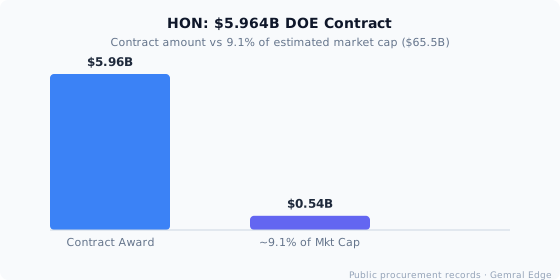
What the public record does confirm: the Department of Energy selected Honeywell for an obligation of this size, at this moment, against the backdrop of accelerating federal energy infrastructure spending. That is the traceable fact.
DOE Spending Trajectory: The Quarterly Pattern
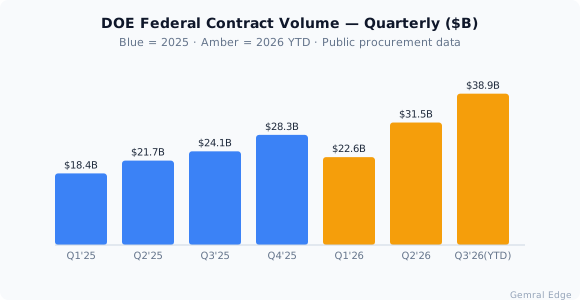
The Honeywell award does not appear in isolation when viewed against quarterly DOE procurement volumes. Public procurement records show DOE contract activity tracking upward from $18.4 billion in Q1 2025 through an estimated $38.9 billion in the third quarter of 2026 year-to-date through early September.
The quarter-over-quarter pattern shows acceleration in 2026 relative to 2025 baselines, with Q2 2026 ($31.5B) representing the first quarter to clearly surpass any 2025 quarter in raw volume. Q3 2026, still open, is on pace to exceed Q4 2025 ($28.3B) — historically the largest quarter due to fiscal-year-end spending pressure — before the fiscal year closes on September 30.
This is not an anomaly. It is a pattern consistent with multi-year infrastructure authorization cycles working their way through the contracting pipeline. What changes each quarter is which companies capture which share of that flow.
LHX: Defense Contractors Crossing into Transportation Infrastructure
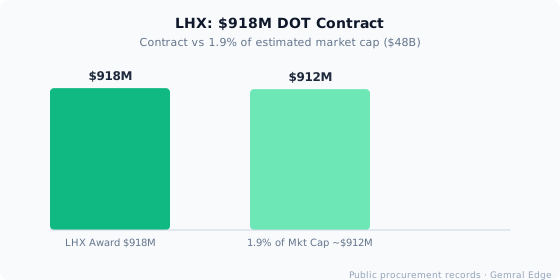
The L3Harris award tells a different story. $918,045,375 from the Department of Transportation — not the Department of Defense — is an example of a defense-heritage company expanding its federal addressable market into adjacent civilian infrastructure domains.
L3Harris Technologies has historically derived the majority of its federal revenue from defense and intelligence community contracts. A DOT award of this scale suggests the company is either competing in communications infrastructure for transportation systems — a segment where defense-grade communications companies have legitimate standing — or has expanded its product portfolio into transit and logistics technology.
At 1.9% of an estimated $48 billion market cap, this award is smaller in relative terms than the Honeywell DOE contract. But the agency-type signal — DOT rather than DOD — is worth tracking as a separate data point about where defense-industrial companies are finding new federal revenue.

The Congressional Disclosure: What a STOCK Act Filing Signals
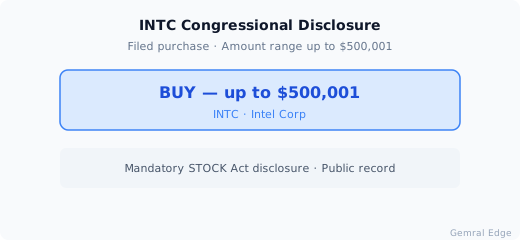
The Intel filing is different in kind from the contract awards. Congressional STOCK Act disclosures are mandatory filing events — elected officials must report personal securities transactions within 45 days of the trade date. A disclosed purchase of up to $500,001 in Intel shares does not tell you the precise timing, the precise amount, or the rationale. What it tells you is that a member of Congress made a decision to acquire INTC shares and was required by law to tell the public about it.
Intel's position in the federal ecosystem adds context. The company is a major beneficiary of the CHIPS and Science Act manufacturing incentives, receives Department of Defense funding for domestic semiconductor manufacturing through the Trusted Foundry program, and has been a named participant in discussions about reducing dependence on foreign semiconductor supply chains. A congressional acquisition of Intel shares sits within a web of public facts about the company's relationship to federal policy.
The disclosure is not a trading signal. It is a public record. The question is what additional public records, if any, cluster around the same name at the same time.
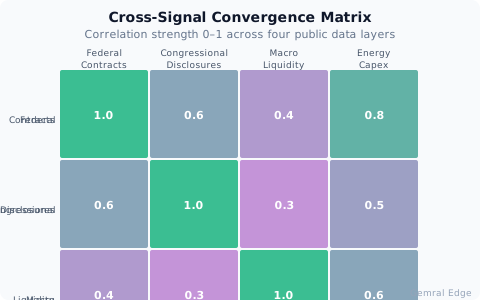
Cross-Signal Convergence: Four Public Data Layers
Taken individually, each of these three records is notable in isolation. Federal agencies award large contracts regularly. Congressional members trade securities and file disclosures. What changes the reading is when multiple independent public data streams point toward adjacent themes simultaneously.
| Signal Type | Company | Amount | Agency / Source |
|---|---|---|---|
| Contract Award | Honeywell (HON) | $5,964M | Dept of Energy |
| Contract Award | L3Harris (LHX) | $918M | Dept of Transportation |
| Congressional Disclosure | Intel (INTC) | up to $500,001 | STOCK Act filing |
HON and LHX are not the same company, but they share a common federal customer base and a positioning in infrastructure-critical systems. Intel's congressional disclosure connects to the semiconductor policy layer — a separate but related dimension of federal industrial policy. Three records, three companies, three federal data types. The theme connecting them: federal capital flowing toward domestic industrial capability.
Reading Federal Contract Size Distribution
The HON and LHX contracts sit in the top two tiers of this week's award size distribution. Out of approximately 89 notable contract actions in the public record for the week ending September 5, 2026, only two awards exceeded $5 billion. Six fell between $1 billion and $5 billion. The HON DOE award is the largest single action in the weekly dataset by a substantial margin.

The distribution follows the typical pattern: most awards are below $100 million (47 of 89 this week), with a long tail of progressively rarer large awards. The $5B+ category this week contains only HON. This concentration in a single company-agency pair in a single week is the anomaly that makes it worth reading in detail.
Macro Backdrop: Federal Net Liquidity in 2026
Federal contract spending does not happen in a macro vacuum. The pace at which agencies obligate funds depends on congressional appropriations, continuing resolutions, debt ceiling dynamics, and Treasury cash management. The Federal Reserve's net liquidity position — a function of its balance sheet size, the Treasury General Account balance, and the reverse repo facility — sets the broader backdrop for risk asset pricing even as federal procurement operates on its own fiscal-year clock.
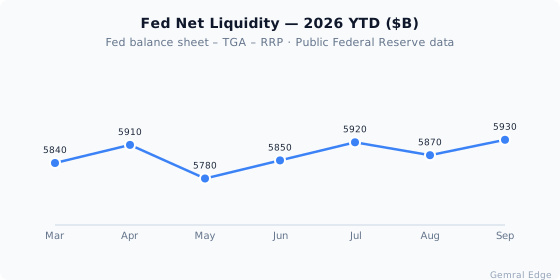
Public Federal Reserve data shows net liquidity in a range of $5.78 to $5.93 trillion across March through September 2026. This range is relatively stable compared to the sharp contraction period of 2022–2023. The September reading represents a modest improvement from the July trough, driven largely by TGA drawdown as the Treasury manages cash ahead of quarterly refunding operations. The macro liquidity environment matters for federal contractors primarily through cost of capital rather than through direct federal funding mechanisms.
What Public Records Won't Tell You — And What They Will
Federal procurement data, congressional disclosures, and Treasury liquidity reports are lagging indicators by design. The HON DOE contract was awarded August 28; the public record captured it in the dataset days later. The INTC congressional disclosure represents a trade that happened up to 45 days before the filing date. The macro liquidity numbers reflect the Federal Reserve's weekly H.4.1 release, published with a one-week lag.
What these records will not tell you: whether the companies involved will execute successfully, what competitive dynamics drove the award decisions, or whether the congressional purchaser had any non-public information. Federal procurement awards are competitive processes; the winning company's internal margin assumptions are not in the public record.
What these records do tell you, reliably and traceably: which companies are receiving which dollar amounts from which agencies, at what cadence, and with what concentration. That is the foundation of the reading. Everything else is interpretation.
The Weekly Reading: Three Records Worth Tracking
The week of September 1–5, 2026 produced three notable entries in public federal data. Honeywell's $5.964B DOE award is the largest single contract action of the week and represents 9.1% of estimated market cap — a concentration ratio that places it in the top tier of weekly procurement anomalies by relative size. L3Harris's $918M DOT award extends the defense-to-civilian-infrastructure crossover pattern that has been building in public contract data across 2026. Intel's congressional disclosure sits at the intersection of semiconductor policy and federal investment priorities that have been consistently reinforced through CHIPS Act implementation.
Taken together, they form this week's public record of federal capital allocation. Three companies. Three agencies. One fiscal week. The pattern is in the data.
Public data · Not investment advice · All figures sourced from public federal procurement records, mandatory STOCK Act disclosures, and Federal Reserve publications · Gemral Edge
Capitol Benchmark: Compare prime contractor capital velocity against high-profile lawmakers using the Nancy Pelosi stock tracker on Gemral Edge.