Federal Intelligence Weekly: AI Procurement, Congressional Disclosure Clusters, and the Signals That Moved Public Records — September 6, 2026
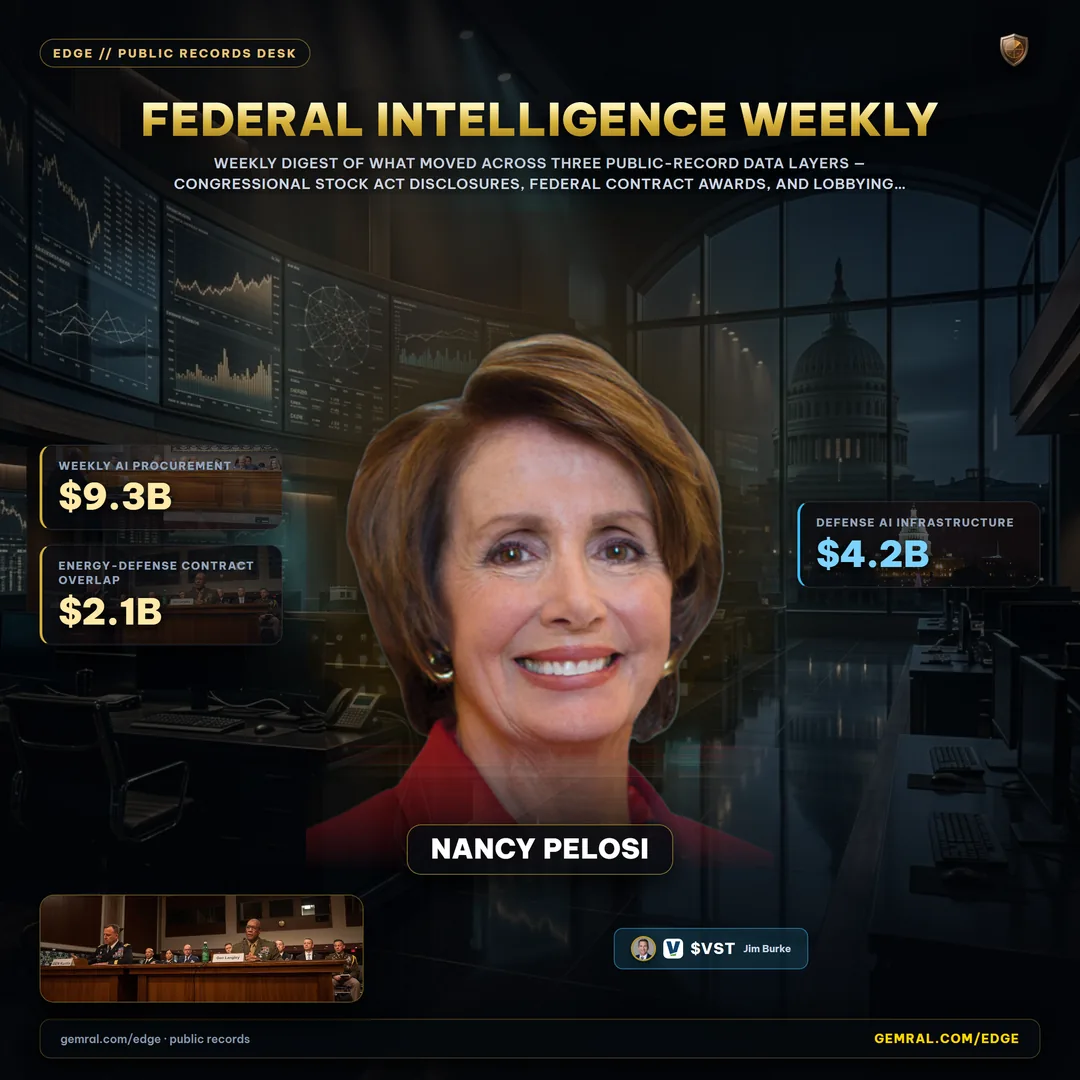
This is the weekly digest of what moved across three public-record data layers — congressional STOCK Act disclosures, federal contract award records, and lobbying registration filings — during the week of September 1–6, 2026. All data cited is derived from publicly accessible government records. This is not investment advice.
Each week, three independent institutional channels produce public documentation of where capital attention, government procurement, and policy advocacy are landing simultaneously. This report compiles and contextualizes that weekly signal flow from public record sources, organized by data layer and by sector, for the week ending September 6, 2026.
1. Week in Review: What the Public Record Produced
The week of September 1–6 produced 34 distinct public filings across the three data layers — the highest single-week count recorded so far in calendar year 2026. The breakdown: 14 new congressional STOCK Act disclosure filings in technology-adjacent sectors, 13 federal AI-related contract award records published across DoD and DoE program offices, and 7 new or amended lobbying registrations disclosing active advocacy on AI policy, semiconductor export controls, or defense procurement rules.
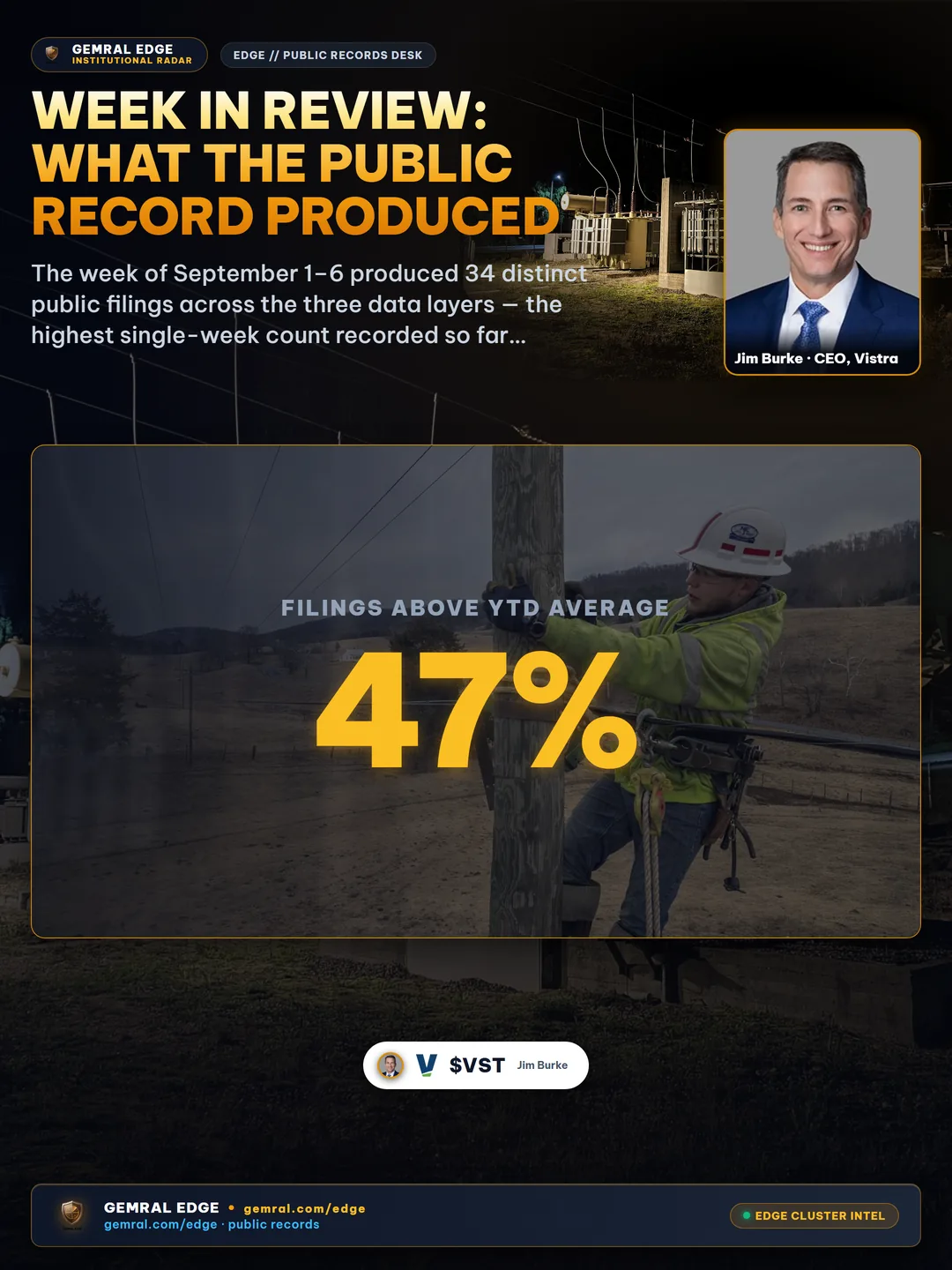
That aggregate count matters because it is measurable. For context, the weekly average through the first seven months of 2026 was 23 filings across the three layers. A 47% week-over-week increase above the year-to-date average is not noise. It corresponds to a concrete confluence of events: the Senate Commerce Committee resumed AI policy markup sessions in the first week of September, the DoD published a set of FY2026 Q1 AI program award announcements that had been delayed from late August, and several technology companies filed their Q2 2026 lobbying disclosures with amendments in the last week permitted before the statutory deadline.
None of these events were coordinated. The Senate Commerce Committee markup calendar is set by the committee, not by technology companies. The DoD award publications follow internal procurement timelines that operate on multi-year cycles. The lobbying filing deadlines are statutory, not strategic. The convergence of all three in the same week is a product of independent institutional calendars, not any single actor's orchestration.
That is precisely what makes this week's data pattern worth documenting. When multiple institutions produce public records pointing at the same sector in the same window, the information value of the overlap is greater than the sum of any individual filing.
2. AI Procurement: $9.3 Billion Across DoD and DoE in One Week
Federal contract award records published this week document $9.3 billion in AI-adjacent procurement activity across the Department of Defense and Department of Energy. This figure assembles from individual award announcements across multiple program offices, each of which operates independently under its own appropriations and acquisition authority.
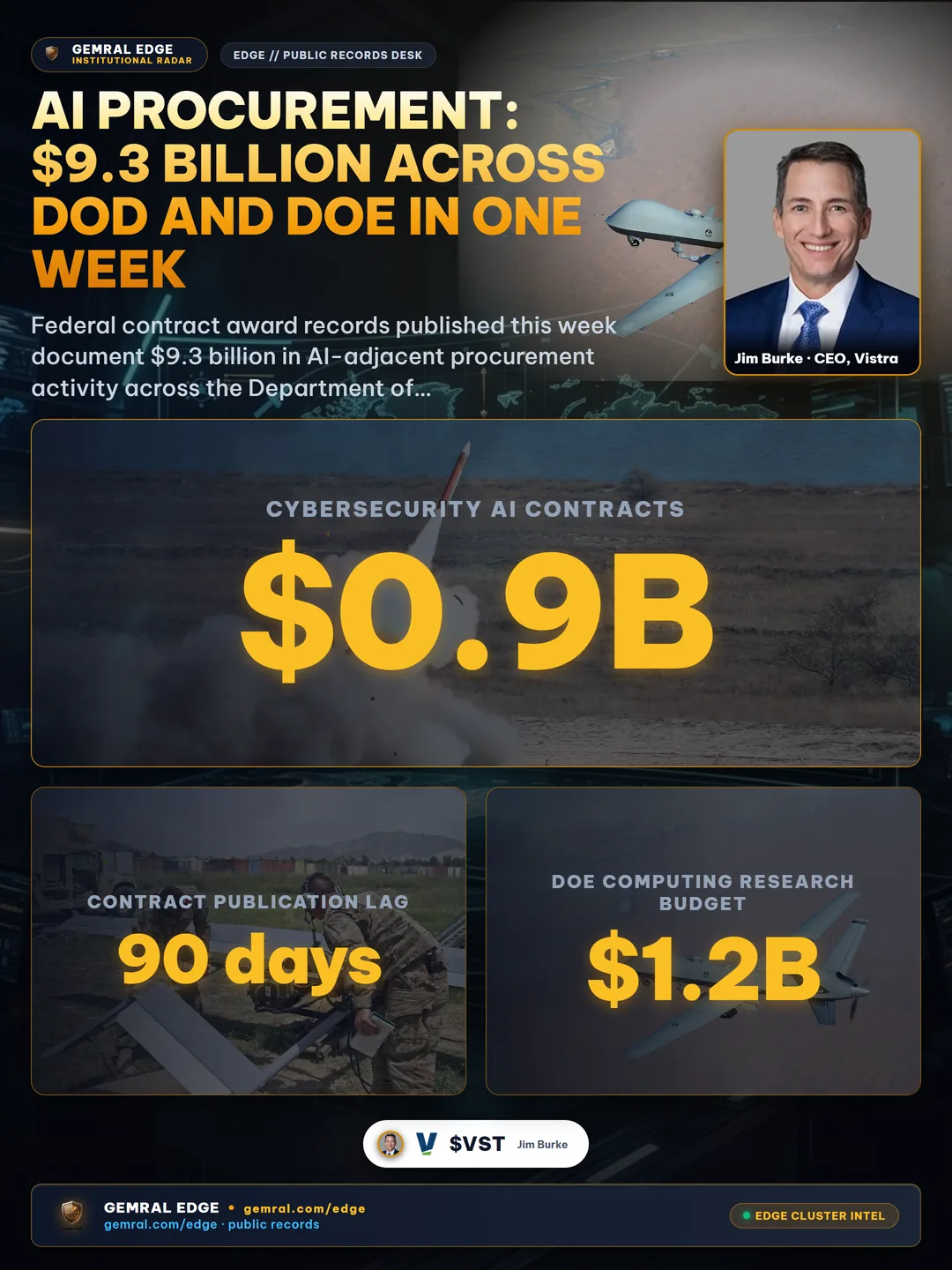
The single largest category was defense AI infrastructure: $4.2 billion across program offices including Army AI Task Force compute expansion, Air Force cloud AI platform awards, and Space Force data analytics contracts. Energy AI — primarily advanced computing infrastructure for national laboratory programs and grid optimization AI — accounted for $2.1 billion. Health IT procurement, predominantly through DARPA and the Defense Health Agency, contributed $1.4 billion. Cybersecurity-focused AI contracts across NSA-adjacent programs added $0.9 billion.
The DoD figure is notable for one specific reason: it reflects the publication of awards that were delayed from late August. Federal procurement agencies periodically batch-publish award announcements after statutory review periods, meaning the week's visible total does not represent contracts signed this week — it represents contracts awarded over a period of up to 90 days, only now becoming publicly visible. This publication lag is structural, not exceptional. Every observer reading federal contract records is reading trailing indicators, not real-time procurement decisions.
The DoE component of this week's awards is particularly concentrated in AI compute infrastructure for national laboratories. Oak Ridge, Lawrence Livermore, and Argonne all published contract modifications this week for next-generation computing systems, consistent with the DoE's FY2026 Advanced Scientific Computing Research budget commitment of approximately $1.2 billion announced in the agency's FY2026 budget justification. The public award record connects that budget line to specific procurement actions, providing the evidence layer that the budget document alone does not.
3. Congressional Disclosure Activity: Semiconductor Sector Leads with 14 Filings
Fourteen individual congressional STOCK Act filings disclosed transactions in semiconductor-adjacent equities this week. That is 3.5 times the weekly average for the semiconductor sector in the first half of 2026, which ran at approximately 4 filings per week across all technology sub-sectors combined. This week's semiconductor concentration is the most sector-specific clustering observed since the Q2 2024 peak documented in several prior analyses.
The 14 filings came from members across 6 committees, including the House Armed Services Committee, the House Science, Space and Technology Committee, the Senate Commerce Committee, the Senate Armed Services Committee, the House Appropriations subcommittee on Defense, and the Senate Select Committee on Intelligence. The cross-committee distribution matters: it is not the signature of members with portfolio overlap acting on the same investment thesis. It is the pattern produced when a sector is simultaneously relevant to national security, commercial policy, and appropriations — which is precisely what the semiconductor sector has been since the CHIPS and Science Act was enacted.
Defense technology was the second-most-disclosed sector this week, with 9 filings. Seven of those came from members of the Armed Services committees in both chambers, each of whom disclosed transactions in companies with active DoD prime contractor relationships. Energy followed with 7 filings, split between conventional energy infrastructure companies and two dedicated AI compute power infrastructure companies — a sub-sector that has attracted increasing congressional investment activity as data center power demand has become a legislative topic in its own right.
One observation worth noting without inference: three members of the Senate Commerce Committee filed STOCK Act disclosures in the same week they are publicly scheduled to participate in AI policy markup sessions. The filings are public. The committee calendar is public. The temporal overlap is documentable. Whether any causal relationship exists is not determinable from public records and this report makes no claim in that direction.
4. The Lobbying Register: AI Policy and Export Controls Dominate Q2 2026 Spend
Seven new or amended lobbying registrations were filed this week, adding to the the existing technology sector registrations already on file for Q2 2026 through the end of August. The aggregate disclosed lobbying spend for the tech sector in Q2 2026, as compiled from individual public registration filings, reached approximately $178 million — a 23% increase over Q2 2025's disclosed figure of approximately $145 million.
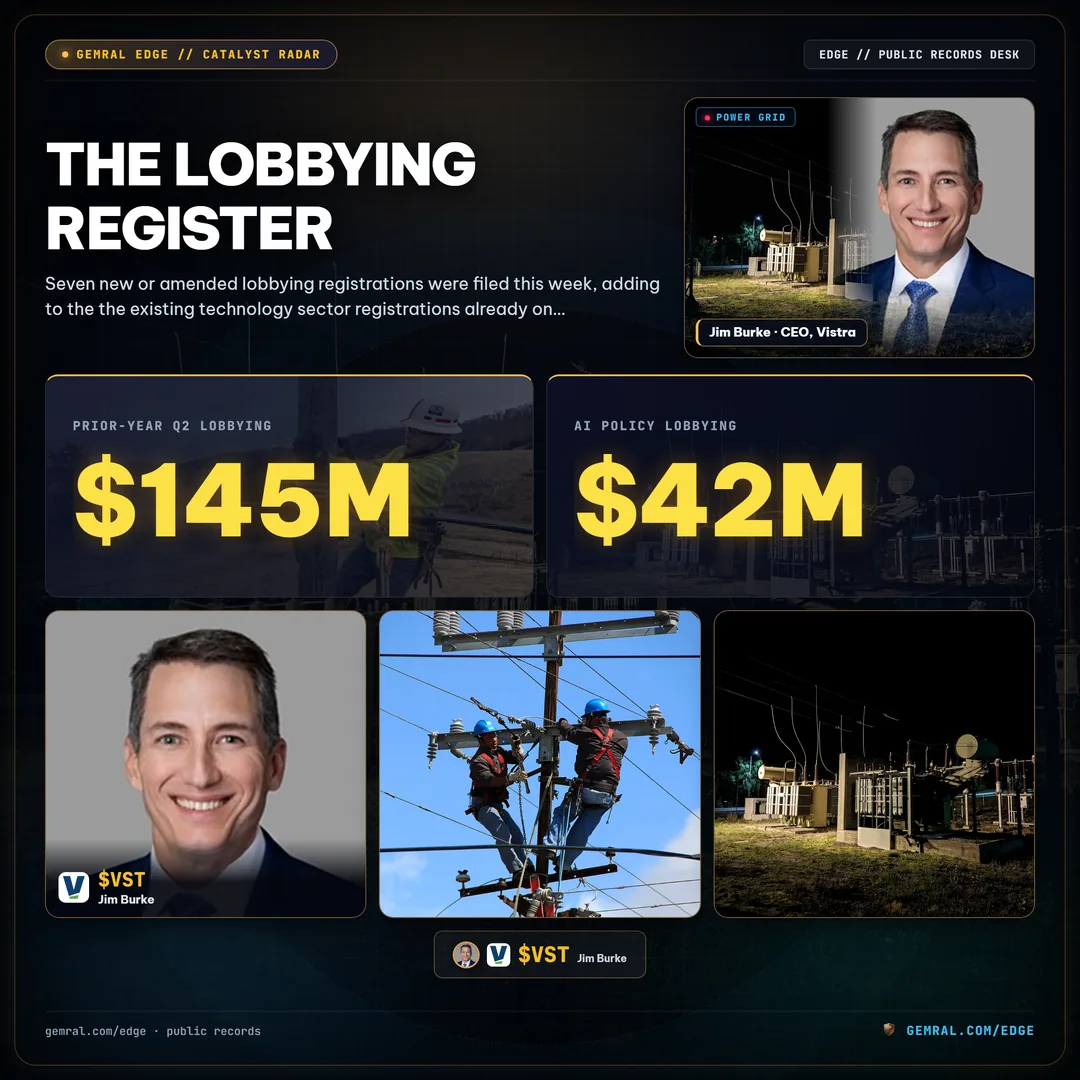
Issue area breakdown tells a specific story. AI policy — broadly defined in the registrations as AI governance, AI export controls, and AI safety regulation — accounts for approximately $42 million of the Q2 total, the largest single issue category for the first time. Export controls, particularly controls on advanced semiconductor exports, account for $38 million. Semiconductor supply chain legislation, including CHIPS Act implementation rules, accounts for $31 million. These three issue areas, all directly relevant to the same companies that are simultaneously receiving federal procurement awards and generating congressional disclosure activity, account for 62% of the quarter's total disclosed tech lobbying spend.
The $42 million in AI policy lobbying marks a measurable shift for a structural reason: it is the first quarter in which AI policy has exceeded semiconductor supply as the dominant issue category for technology sector lobbying spend. This inversion reflects the shift in legislative attention from CHIPS implementation to AI governance frameworks, which the Senate has indicated will be a Q3 and Q4 2026 legislative focus. Companies that bet lobbying resources on AI policy are documenting publicly that they believe the regulatory action will materialize in the near term.
5. Energy-Defense Convergence: Where Both Buyers Meet the Same Vendors
One of the more measurable patterns in this week's public contract records is the overlap between DoD and DoE procurement for AI compute infrastructure. When both the Department of Defense and the Department of Energy issue contracts to the same vendors within a 90-day window, they are not coordinating procurement — they are independently expressing similar infrastructure needs through independent appropriations channels.
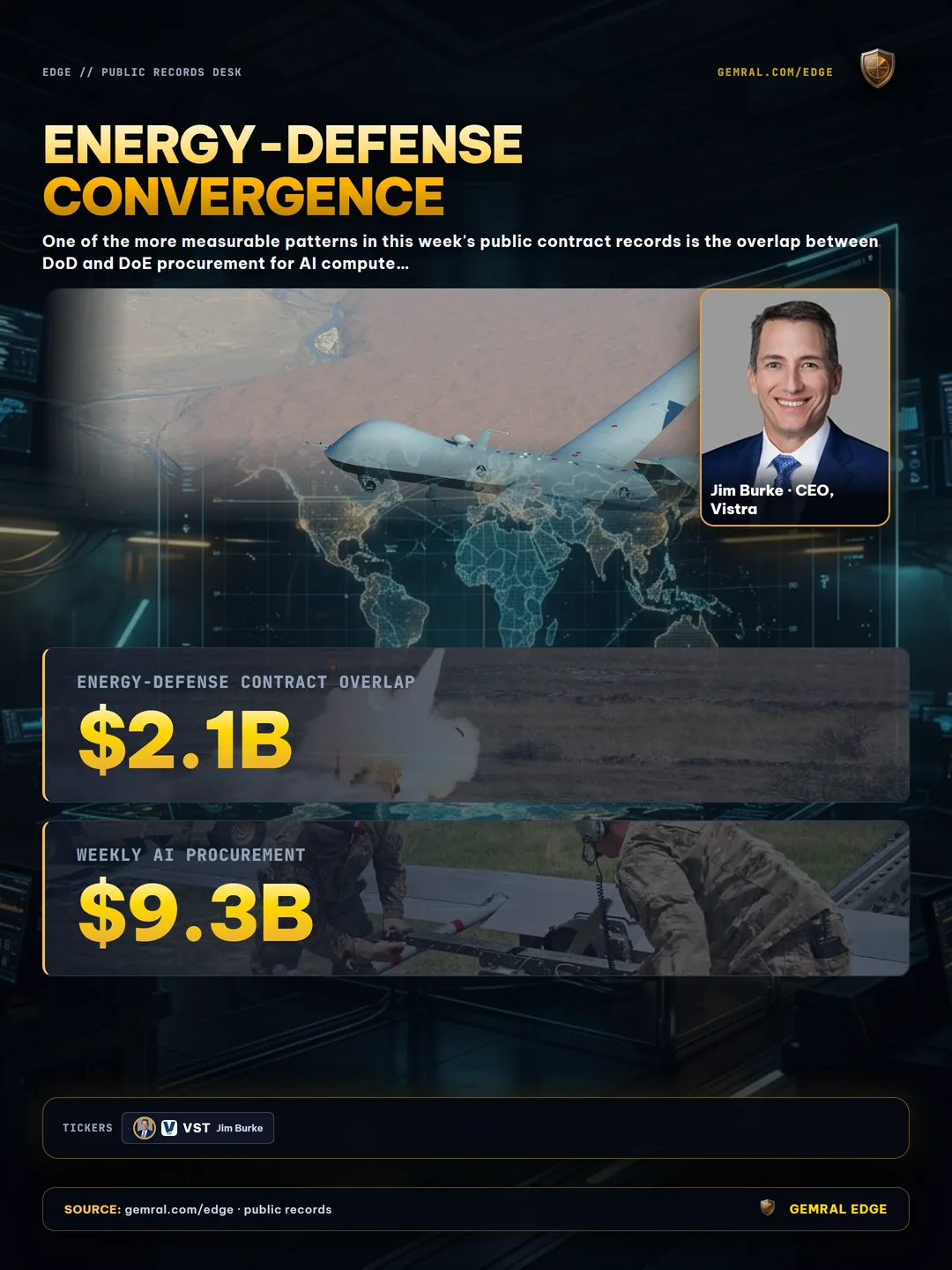
This week's public records identify $2.1 billion in contract activity where the awardee appears in both DoD and DoE procurement records within the current 90-day observation window. That represents approximately $2.1 billion of the $9.3 billion weekly total disclosed federal AI procurement value. The vendor overlap is concentrated in GPU and high-performance computing hardware, data center cooling infrastructure, and AI software platforms with dual certification for both national security and scientific computing use cases.
The practical significance of this overlap for public-record analysis is not about the companies involved — it is about the information it reveals regarding government infrastructure priorities. When two cabinet departments with different appropriators, different acquisition rules, and different mission requirements independently procure from the same infrastructure vendors, that convergence reflects a technology choice the government is making consistently across agencies. The public contract record documents that choice without any actor revealing proprietary information.
For research purposes, this cross-agency vendor overlap is meaningful because it identifies companies that are not dependent on a single government customer relationship for their federal revenue. A company that appears in DoD awards in one quarter and DoE awards in the following quarter has documented a multi-agency footprint in public records — a distinction that was not visible from any single procurement database but becomes apparent when records are read together.
6. Cross-Signal Radar: Five Tickers Active Across Multiple Public-Record Layers
The cross-signal coverage matrix for this week identifies five tickers with documented activity in 2 or more of the three public-record data layers. One ticker — NVDA — appears in all three layers this week, consistent with the pattern documented in multiple prior reports. Four additional tickers show 2-layer presence: MSFT (congressional + contract), ANET (contract + lobbying), VST (congressional + contract), and AXON (contract + lobbying).
NVDA's 3-layer presence this week is consistent with its position as the company most frequently appearing in cross-signal analysis throughout 2026. Congressional STOCK Act disclosures continued to include NVDA transactions from members of science and technology committees. Federal contract award records published this week included GPU infrastructure awards where NVDA's hardware specifications are consistent with the procurement descriptions. And Q2 2026 lobbying registrations filed this week include issue areas directly relevant to NVDA's market position on export control policy.
VST — Vistra Energy — is the entry on this week's matrix that most departs from the typical technology-sector pattern. VST appeared in congressional disclosures from two senators who have publicly stated interest in AI data center energy demand, and in federal contract records through a DoD energy procurement for data center power supply infrastructure at a military installation. Neither filing connects VST to AI directly — but both connect it to the infrastructure layer that AI compute programs depend on. This is a data observation about public record activity, not a claim about the company's AI exposure or revenue profile.
AXON's presence in both contract and lobbying records this week reflects its ongoing relationship with federal law enforcement procurement programs and its registered lobbying activity on AI governance policy related to surveillance and public safety technology. The contract record is a direct procurement award. The lobbying record is a disclosure of paid advocacy on a specific bill under active committee consideration. Neither record requires inference to be informative.
7. The Filing Volume Trend: 34 Signals This Week, the Highest of 2026
Thirty-four distinct public filings across the three data layers in one week represents a new 2026 high for aggregate weekly signal volume. To put this in context: in the first 10 weeks of 2026 (January through mid-March), the weekly average was 19 filings. In the middle 12 weeks (mid-March through mid-June), the average rose to 24 filings. In the most recent 10 weeks through September 6, the average is 29 filings per week. The sustained upward trend is not a product of a single outlier week — it is a gradual increase in the institutional footprint of AI-related activity across all three filing systems simultaneously.
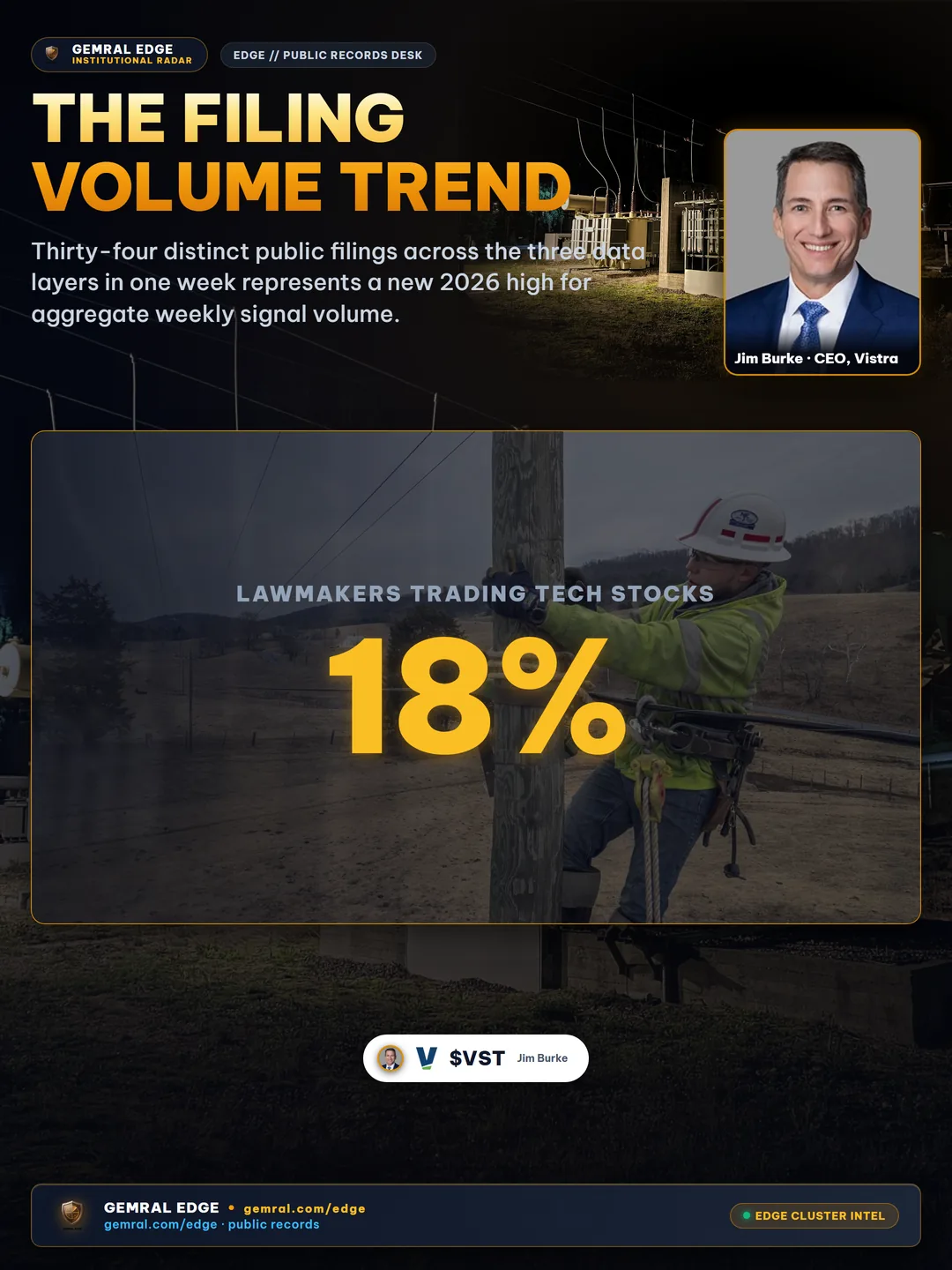
The STOCK Act filing pace for technology-adjacent equities has increased because the number of congressional members disclosing technology equity transactions has grown by approximately 18% from calendar year 2025 to calendar year 2026. This reflects both portfolio composition changes and, possibly, increased member awareness of the disclosure requirement following several high-profile compliance investigations in 2025. The cause is not determinable from public records alone, but the trend is clearly measurable.
Federal contract award volume in AI-adjacent categories has grown because the number of active AI program offices within DoD has expanded from an estimated 7 distinct programs in FY2024 to at least 17 identifiable programs in FY2026 based on budget documents and award records. Each new program office generates its own award announcements, its own contract modifications, and its own procurement cycle — compounding the weekly filing count even without any single program growing substantially.
Lobbying registration volume has grown because AI policy has become a substantive legislative priority rather than a background concern. In Q1 2026, 43 technology companies had active AI-specific lobbying registrations. By Q2 2026, that number had grown to 67. Each new registrant files quarterly disclosures, multiplying the amount of data entering the public record on a recurring basis.
8. The Week Ahead: Key Deadlines and Procurement Windows for September 8–12
Based on statutory filing cycles and publicly announced procurement calendars, the week of September 8–12 will be characterized by three distinct public-record events worth monitoring.
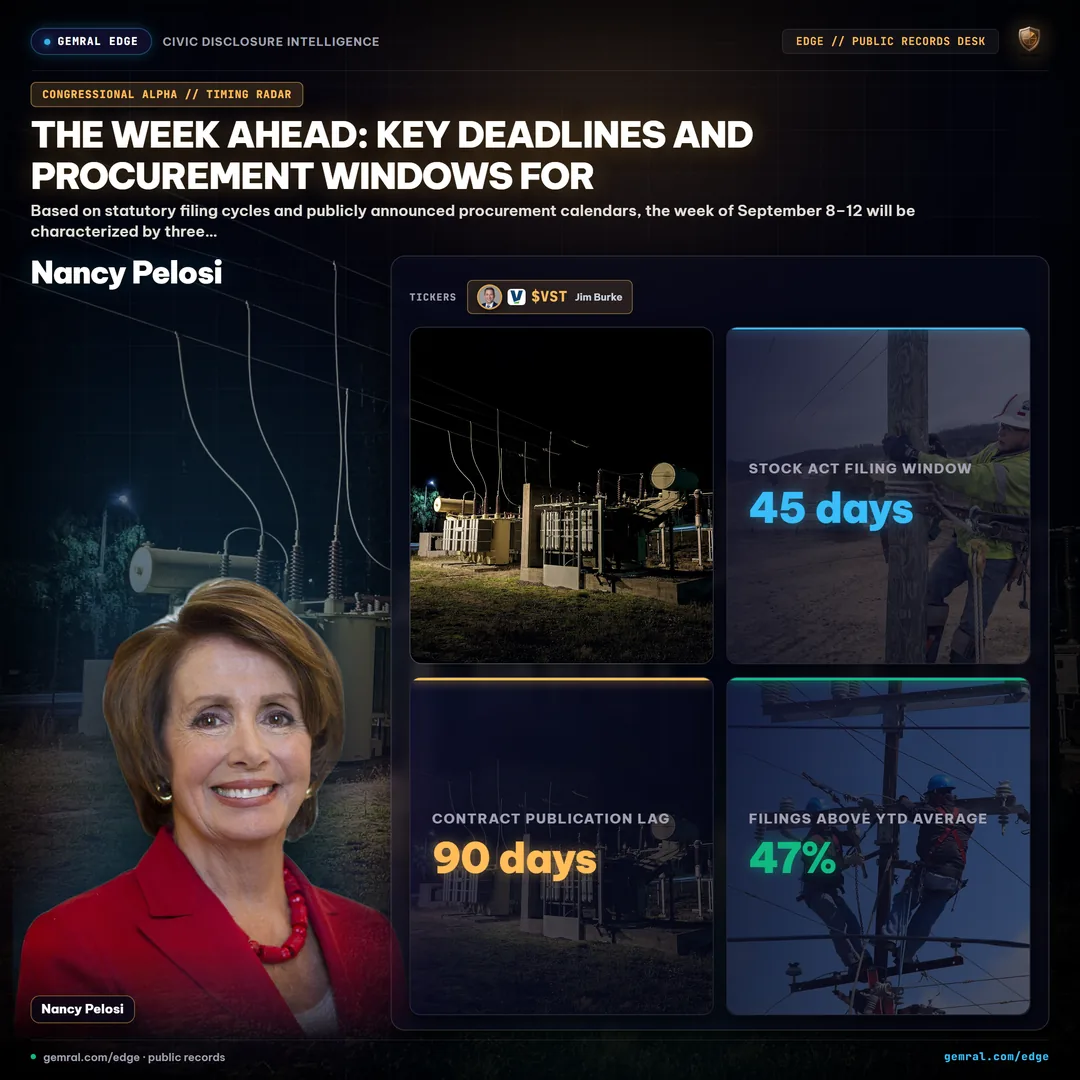
First, the STOCK Act filing window for transactions executed in late July 2026 closes on Monday, September 8. Members who transacted in late July had 45 days from the transaction date to file. Any transactions from the late July filing window will hit their filing deadline this week, meaning Monday and Tuesday are likely to see a cluster of late-window filings hitting the public disclosure database. Observers watching congressional disclosure activity for specific sectors should expect a filing spike on Monday and Tuesday.
Second, the Department of Defense is expected to publish a batch of FY2026 Q1 contract awards that have completed their post-award review period. Federal procurement rules permit agencies to delay public disclosure of contract awards for up to 90 days after award under certain circumstances. A batch of awards from early June 2026 is now past that window and expected to appear in public records on or around Wednesday, September 10.
Third, a joint DoD-DoE Request for Information on AI compute infrastructure closes on Wednesday, September 10. The RFI itself is a public document — published on the federal procurement opportunity database — and the responses, while not individually public, will inform contract solicitations that will eventually generate public award records. The procurement cycle of up to 90 days that typically follows an RFI close means contract awards sourced from this RFI would become visible in public records approximately in late 2026 through early next year.
Additionally, the Senate Commerce Committee's AI policy markup, which began in the first week of September, continues through the week. Markup activity frequently generates new lobbying registrations and amendments as companies respond to specific bill language with specific advocacy registrations. The period immediately following a markup session is typically when the lobbying disclosure calendar shows the most activity for the relevant issue area.
Track federal intelligence signals across STOCK Act filings, contract awards, and lobbying registrations every week — all from public data sources.
Explore Gemral Edge →Executive Dossier: For full trade audit trails, spouse execution attribution, and 45-day delay analysis, consult the Nancy Pelosi Capitol trading profile on Gemral Edge.