Hiệu Suất Sử Dụng Cơ Chế Term Repo và Độ Co Giãn Bảng Cân Đối Kế Toán của Primary Dealer: Nhận Diện Bộ Đệm Thanh Khoản Chủ Quyền
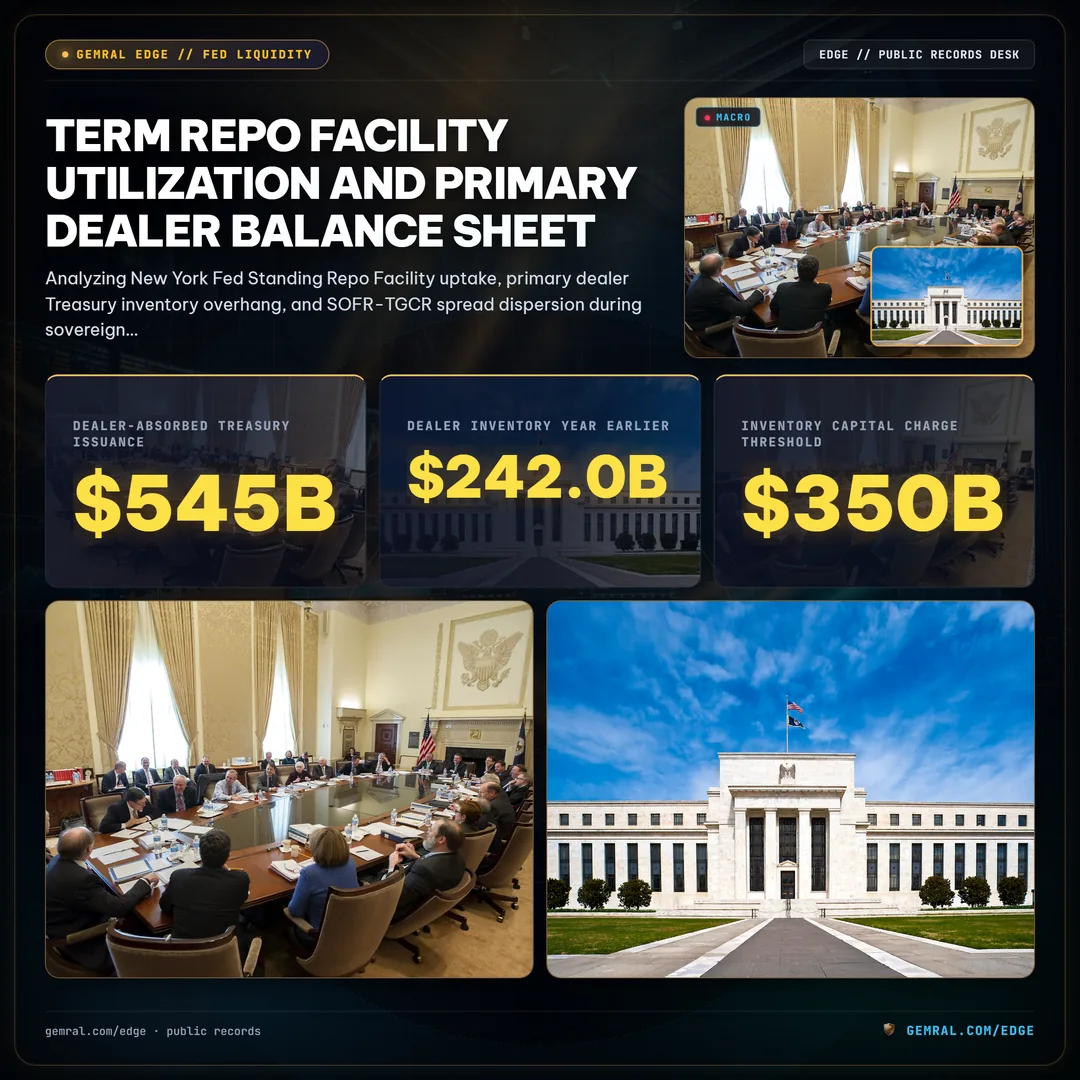
Trong hệ thống đường ống tài chính hiện đại, thanh khoản chủ quyền không bốc hơi một cách đồng đều; đúng hơn, nó bị tắc nghẽn cục bộ bên trong các đường dẫn thanh toán trung gian trước khi biểu hiện thành những điểm nghẽn tài trợ mang tính hệ thống. Vào giữa tháng 9 năm 2026, sự hội tụ đồng thời của các đợt nộp thuế doanh nghiệp hàng quý, các đợt thanh toán phát hành trái phiếu Kho bạc kỳ hạn giữa tháng quy mô lớn, và quá trình thắt chặt định lượng liên tục của Cục Dự trữ Liên bang đã kích hoạt mức độ phân tán lãi suất thị trường tiền tệ rõ rệt nhất kể từ khi Cơ chế Standing Repo Facility ra đời. Khi các primary dealer phải hấp thụ hơn $545 tỷ phát hành nợ công gộp, độ co giãn bảng cân đối kế toán thể chế tổng hợp đã chạm tới các giới hạn pháp lý và kinh tế, đẩy lãi suất tài trợ có tài sản đảm bảo qua đêm vượt lên trên lãi suất Tiền gửi Dự trữ (IORB) và thúc đẩy việc sử dụng hàng tỷ đô la từ các điểm tựa thanh khoản chính thức.; rather, it congests within intermediate settlement conduits before manifesting as systemic funding friction. In mid-September 2026, the simultaneous convergence of corporate quarterly tax remittances, aggregate mid-month Treasury coupon issuance settlements, and ongoing Federal Reserve balance sheet runoff triggered the most pronounced money market rate dispersion observed since the creation of the Standing Repo Facility. As primary dealers absorbed over $545 billion in gross Treasury issuance, aggregate institutional balance sheet elasticity reached its regulatory and economic boundaries, driving overnight secured financing rates above the Interest on Reserve Balances benchmark and prompting multi-billion-dollar usage of official liquidity backstops.
1. Cơ Chế Hoạt Động Của Standing Repo và Các Điểm Tựa Thanh Khoản Có Kỳ Hạn
Cơ chế Standing Repo Facility (SRF), được Ủy ban Thị trường Mở Liên bang (FOMC) giới thiệu vào tháng 7 năm 2021, được thiết kế đặc biệt nhằm đóng vai trò như một điểm tựa cơ cấu chống lại các biến động hỗn loạn trên thị trường tiền tệ bằng cách chuyển đổi các tài sản đảm bảo đủ điều kiện thành dự trữ ngân hàng trung ương ở mức lãi suất trần hành chính định trước. Hoạt động hàng ngày bên cạnh Cơ chế Overnight Reverse Repo (ON RRP), cơ chế repo thường trực này cho phép các primary dealer và tổ chức lưu ký đủ điều kiện cầm cố trái phiếu Kho bạc, nợ cơ quan chính phủ và chứng khoán thế chấp cơ quan (MBS) để đổi lấy dự trữ thanh khoản qua đêm. Trong điều kiện dồi dào dự trữ thông thường, mức sử dụng cơ chế này duy trì gần bằng không vì lãi suất repo ba bên (tri-party) trên thị trường tư nhân luôn giao dịch thấp hơn trần hành chính., was engineered specifically to serve as a structural backstop against money market dislocations by converting eligible collateral into central bank reserves at an administratively predetermined ceiling rate. Operating daily alongside the Overnight Reverse Repo Facility, the standing facility permits eligible primary dealers and depository institutions to pledge Treasury securities, agency debt, and agency mortgage-backed securities in exchange for overnight central bank reserves. Under ordinary conditions of reserve abundance, facility uptake remains near zero because private market tri-party repo rates trade comfortably below the administered ceiling.
Tuy nhiên, động lực thanh khoản của giai đoạn cuối năm 2025 và năm 2026 đã làm thay đổi căn bản trạng thái cân bằng vận hành này. Theo các hồ sơ hoạt động chính thức được công bố bởi Ngân hàng Dự trữ Liên bang New York, tổng khối lượng vay vốn hàng ngày từ cơ chế này đã tăng vọt từ mức cơ sở không đáng kể trong các quý trước lên mức kỷ lục $18.4 tỷ trong chu kỳ thanh toán giữa tháng 9 năm 2026. Sự gia tốc nhanh chóng này đánh dấu một bước chuyển dịch cơ cấu quyết định từ việc thanh khoản chỉ sẵn sàng trên lý thuyết sang sự phụ thuộc vận hành thực tế của các bên tham gia bảo lãnh phát hành Cấp 1 trên khắp Phố Wall. As documented in official operational records published by the Federal Reserve Bank of New York, daily aggregate drawings against the facility surged from negligible baseline volumes during earlier quarters to a record peak of $18.4 billion during the mid-September 2026 settlement cycle. This rapid acceleration marks a decisive structural pivot from theoretical liquidity availability to active operational reliance by Tier-1 underwriting counterparties across Wall Street.
Khi lãi suất thị trường tiền tệ qua đêm phá vỡ hành lang hành chính được xác định bởi Lãi suất Tiền gửi Dự trữ (IORB) và lãi suất Standing Repo, các primary dealer phải đối mặt với một quyết định vận hành nhị phân. Việc cầm cố tài sản đảm bảo vào thị trường song phương tư nhân đòi hỏi không gian bảng cân đối kế toán đối ứng của đối tác, vốn đang bị hạn chế nghiêm trọng theo quy định Tỷ lệ Đòn bẩy Bổ sung (SLR) và các hạn mức rủi ro nội bộ. Cơ chế chính thức cung cấp khả năng giải phóng thanh khoản tức thì mà không gặp rào cản đánh giá tín dụng đối tác, nhưng việc vay vốn tại cửa sổ này chỉ ra rằng năng lực trung gian tư nhân đã vắt kiệt bộ đệm co giãn của mình. Mức tăng lên $18.4 tỷ tiết lộ rằng các bàn tài trợ thể chế không còn có thể bù trừ tài sản đảm bảo thị trường thuần túy trong mạng lưới giữa các đại lý tư nhân. (IORB) and the Standing Repo rate, primary dealers face a binary operational decision. Pledging collateral into the private bilateral market requires matching counterparty balance sheet space, which becomes constrained under Supplementary Leverage Ratio mandates and internal risk limits. The official facility provides immediate liquidity clearance without counterparty credit assessment friction, but borrowing at this window indicates that private intermediation capacity has exhausted its elastic buffer. The surge to $18.4 billion reveals that institutional funding desks are no longer able to clear market collateral strictly within private inter-dealer networks.
Hơn nữa, Ngân hàng Dự trữ Liên bang New York đã tiến hành các hoạt động Term Repo có mục tiêu cùng với cơ chế thường trực qua đêm. Các hoạt động có kỳ hạn này, cung cấp thanh khoản trên các kỳ hạn 14 ngày và 28 ngày, đã nhận được lượng đăng ký vượt mức kỷ lục từ các primary dealer tìm kiếm sự đảm bảo tài trợ chắc chắn qua ngưỡng cuối quý. Các đại lý nhận thức rằng việc chỉ dựa vào việc gia hạn vốn qua đêm trong một chu kỳ đặc trưng bởi dòng tiền thuế rút đi đồng thời với các đợt thanh toán đấu thầu quy mô lớn tiềm ẩn rủi ro cơ sở không thể chấp nhận. Cơ chế kỳ hạn đã khớp lệnh ở mức lãi suất bình quân gia quyền theo khối lượng cao hơn 8.5 điểm cơ bản so với lãi suất qua đêm chuẩn, nhấn mạnh rằng các đại lý thể chế sẵn sàng trả một khoản phí xác định để đổi lấy sự bền vững của bảng cân đối kế toán cam kết. alongside the overnight standing facility. These term operations, offering liquidity across 14-day and 28-day maturities, were heavily oversubscribed by primary dealers seeking to lock in financing certainty across the quarter-end threshold. Primary dealers recognized that relying strictly on overnight rollovers during a cycle characterized by simultaneous corporate tax drains and heavy auction settlements carried unacceptable basis risk. The term facility cleared at a volume-weighted average rate 8.5 basis points above standard overnight benchmarks, underscoring that institutional dealers were willing to pay a defined premium for committed balance sheet durability.
2. Tồn Kho Trái Phiếu Kho Bạc Quá Mức và Điểm Nghẽn Bảng Cân Đối FR 2004
Khả năng của cấu trúc tài chính chủ quyền trong việc hấp thụ các khoản vay liên bang kéo dài phụ thuộc cơ bản vào độ co giãn bảng cân đối kế toán của các primary dealer. Với tư cách là các nhà bảo lãnh được chỉ định cho các cuộc đấu thầu trái phiếu Kho bạc Hoa Kỳ, các primary dealer có nghĩa vụ hợp đồng phải đấu thầu cạnh tranh trên tất cả các đợt chào bán nợ chuẩn, lưu trữ tồn kho chưa phân phối và tạo điều kiện phân phối trên thị trường thứ cấp cho các nhà quản lý tài sản trong và ngoài nước. Theo báo cáo Mẫu FR 2004 của Cục Dự trữ Liên bang, vị thế ròng của primary dealer đối với các kỳ phiếu và trái phiếu Kho bạc Hoa Kỳ đã tăng lên mức cao chưa từng có là $388.5 tỷ vào giữa tháng 9 năm 2026, tăng từ mức $242.0 tỷ của mười hai tháng trước đó. on the balance sheet elasticity of primary dealers. As designated underwriters of United States Treasury auctions, primary dealers are contractually obligated to bid competitively across all benchmark debt offerings, warehouse unplaced inventory, and facilitate secondary market distribution to domestic and foreign asset managers. According to Federal Reserve Form FR 2004 reporting, primary dealer net positions in United States Treasury notes and bonds climbed to an unprecedented high of $388.5 billion by mid-September 2026, up from $242.0 billion twelve months earlier.

Sự tích tụ tồn kho dai dẳng này phản ánh tốc độ gia tăng của nguồn cung nợ liên bang vượt xa tốc độ hấp thụ tức thì của các nhà đầu tư cuối thể chế mua và nắm giữ truyền thống. Với việc phát hành nợ gộp hàng tháng trên các tín phiếu, kỳ phiếu và nợ lãi suất thả nổi vượt quá mức trung bình lịch sử, các đại lý đã buộc phải tài trợ cho các kho tài sản đảm bảo ngày càng phình to thông qua các hợp đồng mua lại qua đêm và có kỳ hạn. outstripping the immediate absorption speed of traditional buy-and-hold institutional end-investors. With monthly gross issuance across bills, notes, and floating-rate debt exceeding historical averages, dealers have been compelled to finance expanding collateral warehouses through overnight and term repurchase agreements.
Nắm giữ $388.5 tỷ tài sản đảm bảo chủ quyền đòi hỏi các hạn mức tài trợ ngắn hạn được mở rộng cực lớn. Cứ mỗi đô la trái phiếu Kho bạc được giữ trên sổ giao dịch của đại lý, tiền mặt phải được bảo đảm thông qua thị trường repo, sử dụng chính các chứng khoán cơ sở làm tài sản thế chấp. Khi đòn bẩy tài trợ gộp tiệm cận các trần pháp lý, chi phí biên của bảng cân đối kế toán trên mỗi giao dịch tăng vọt. Khi các đại lý tiếp cận các ràng buộc về đòn bẩy, khả năng cung cấp định giá co giãn cho các bên tham gia thị trường phi đại lý suy giảm, dẫn đến chênh lệch giá mua-bán giãn rộng, tỷ lệ chiết khấu (haircut) tài trợ repo cao hơn và tính nhạy cảm gia tăng trước các cú sốc thanh toán từ bên ngoài. For every dollar of Treasury securities carried on a dealer trading book, cash must be secured via the repo market, utilizing the underlying paper as collateral. As gross financing leverage climbed toward regulatory ceilings, the marginal balance sheet cost per transaction escalated. When dealers approach leverage constraints, their capacity to offer elastic pricing to non-dealer market participants diminishes, resulting in wider bid-ask spreads, higher repo financing haircuts, and increased sensitivity to external settlement shocks.
Một yếu tố quan trọng làm trầm trọng thêm lực cản tồn kho này là chế độ xử lý vốn theo quy định đối với các nhà môi giới-đại lý trực thuộc ngân hàng theo Tỷ lệ Đòn bẩy Bổ sung Tăng cường (eSLR) của Basel III. Theo các quy tắc eSLR, các đại lý Cấp 1 phải duy trì vốn đối với tổng mức phơi nhiễm bảng cân đối không tính trọng số rủi ro, đối xử với tài sản đảm bảo Kho bạc rủi ro thấp giống hệt như các tài sản tín dụng tư nhân có lợi suất cao hơn. Khi tồn kho của đại lý vượt quá $350 tỷ, khoản phí tổn vốn phát sinh chỉ để nắm giữ tồn kho Kho bạc qua đêm hoạt động như một loại thuế cấu trúc đối với hoạt động tạo lập thị trường. Các nhà môi giới-đại lý độc lập không bị ràng buộc bởi eSLR của công ty mẹ ngân hàng lại thiếu cơ sở vốn đủ lớn để lấp đầy khoảng trống, dẫn đến sự co thắt nghiêm trọng về độ co giãn bù trừ thị trường tổng thể. governing bank-affiliated broker-dealers under the Basel III Enhanced Supplementary Leverage Ratio (eSLR). Under eSLR rules, Tier-1 primary dealers must maintain capital against aggregate unweighted balance sheet exposures, treating low-risk sovereign Treasury collateral identically to higher-yielding private credit assets. When dealer inventory exceeds $350 billion, the capital charge incurred simply to hold Treasury inventory overnight acts as a structural tax on market making. Independent broker-dealers not bound by bank holding company eSLR constraints possess insufficient capital bases to bridge the gap, leading to an acute contraction in aggregate market-clearing elasticity.
3. Độ Phân Tán Lãi Suất Cấu Trúc Vi Mô: TGCR, BGCR, SOFR và FICC DVP
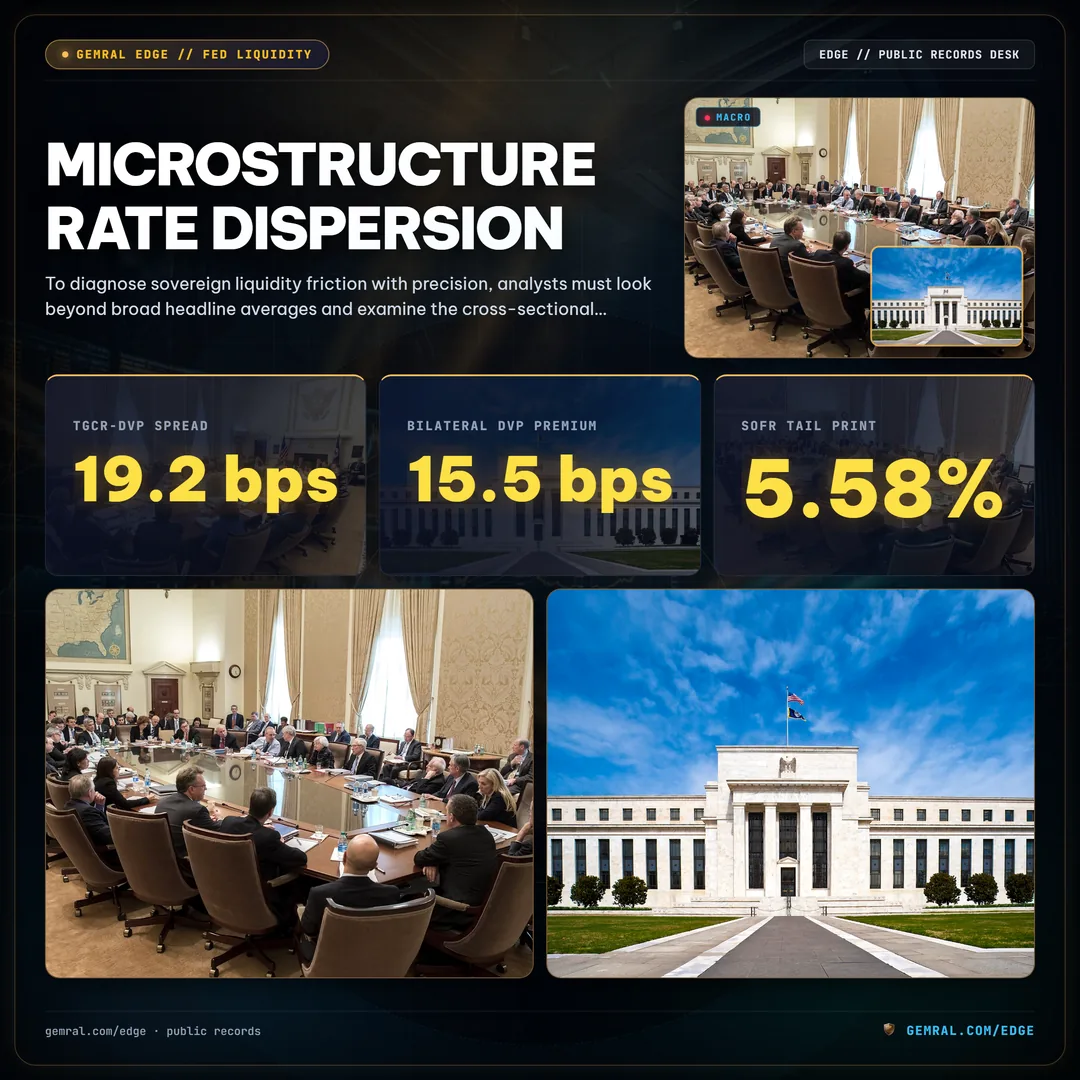
To diagnose sovereign liquidity friction with precision, analysts must look beyond broad headline averages and examine the cross-sectional dispersion between secured financing benchmarks. The Secured Overnight Financing Rate represents a volume-weighted median of transaction-level tri-party, General Collateral Financing, and bilateral repo trades cleared through the Fixed Income Clearing Corporation. Beneath this composite metric lie three distinct sub-segments of the overnight collateralized funding universe:
- Tri-Party General Collateral Rate (TGCR): Reflects pure institutional cash investing by prime money market funds and asset managers against general collateral in custodial tri-party platforms, typically maintaining the lowest yields.
- Broad General Collateral Rate (BGCR): Incorporates both tri-party transactions and centrally cleared GCF repo trades, capturing dealer-to-dealer liquidity distribution dynamics.
- FICC DVP Bilateral Repo: Captures cleared bilateral delivery-versus-payment trades between dealers and specialized hedge funds, quantitative market makers, and non-bank financial intermediaries.
During the mid-September 2026 settlement cycle, the spread between general tri-party collateral (TGCR) and top-tier bilateral cleared financing (FICC DVP) blew out to an elevated +19.2 basis points. While cash-rich asset managers continued lending at near-administered levels in tri-party baskets, dealers seeking bespoke financing for specific coupon issues in bilateral DVP were forced to concede up to +15.5 basis points over the benchmark IORB rate. The 99th percentile of SOFR prints registered sustained trades at 5.58%, demonstrating that liquidity distribution was severely bifurcated: cash remained abundant within segregated custodial pools, but structural pipes could not transfer that cash efficiently to non-clearing participants without severe risk premia.
This dispersion was further amplified by the ongoing implementation of the SEC Central Clearing Mandate for Treasury Repo transactions through the Fixed Income Clearing Corporation (FICC). While central clearing enhances multilateral netting efficiency over long horizons, the interim transition has introduced substantial operational friction. Smaller non-bank counterparties and relative value hedge funds face heightened margin call velocity and higher intraday clearing deposit requirements. During days of heavy settlement volume, clearing brokers adjust their internal haircuts upwards, forcing leveraged participants to bid aggressively for overnight cash in the bilateral market to prevent settlement failures.
4. Ranh Giới LCLOR: Kiểm Định Ngưỡng An Toàn Dự Trữ Ngân Hàng
The ultimate foundation of the modern floor operating system is the aggregate volume of central bank reserves maintained by depository institutions. Under the Federal Reserve's balance sheet normalization framework, quantitative tightening has systematically drained liquidity from the financial system by letting maturing securities roll off without reinvestment. Theoretical models formulated by central bank staff define the Lowest Comfortable Level of Reserves (LCLOR) as the structural threshold below which bank demand for reserves transitions from interest-inelastic abundance to steep, interest-sensitive scarcity.

According to official balance sheet releases published in Federal Reserve statistical release H.4.1, total institutional reserve balances declined to $3.07 trillion by mid-September 2026. This level directly approaches the consensus economic boundary of LCLOR, estimated by market economists and Federal Reserve staff surveys to reside between $3.00 trillion and $3.05 trillion.
As total reserves descend into the $3.07 trillion zone, the distribution of balances across the banking sector becomes highly asymmetrical. While the largest global systemically important banks maintain adequate structural buffers to satisfy internal liquidity stress tests, regional and mid-sized depository institutions experience acute balance sheet tightening. Under regulatory frameworks including the Liquidity Coverage Ratio and Resolution Liquidity Adequacy requirements, banks cannot freely lend excess reserves into overnight repo markets when aggregate reserves approach mandatory liquidity survival horizons. Consequently, the supply of private bank liquidity available to absorb sovereign debt shocks shrinks precisely when debt issuance reaches seasonal peaks.
When commercial banks approach their internal reserve thresholds, their behavioral response transforms instantly. Rather than lending reserves into the fed funds market or deploying liquidity into repo arbitrage to capture the positive spread over IORB, treasurers hoard cash to meet intraday Fedwire payment obligations. This defensive hoarding behavior breaks down inter-bank redistribution. A small handful of custodial mega-banks hold heavy excess balances, but regulatory ring-fencing prevents them from mobilizing this cash to fund primary dealer repo collateral lines, cementing rate spikes in secondary markets.
5. Cạn Kiệt Bộ Đệm Thanh Khoản Của Cơ Chế Overnight Reverse Repo
Between early 2023 and late 2025, the impact of quantitative tightening and expanding Treasury bill supply was largely insulated from commercial bank reserves by the drawdown of the Federal Reserve's Overnight Reverse Repo Facility (ON RRP). At its peak in December 2022, the ON RRP facility absorbed over $2.553 trillion in redundant cash from money market mutual funds. As the Treasury Department shifted debt composition toward short-term bills offering attractive yields relative to the ON RRP offering rate, money funds reallocated trillions of dollars from the central bank back into sovereign debt instruments.
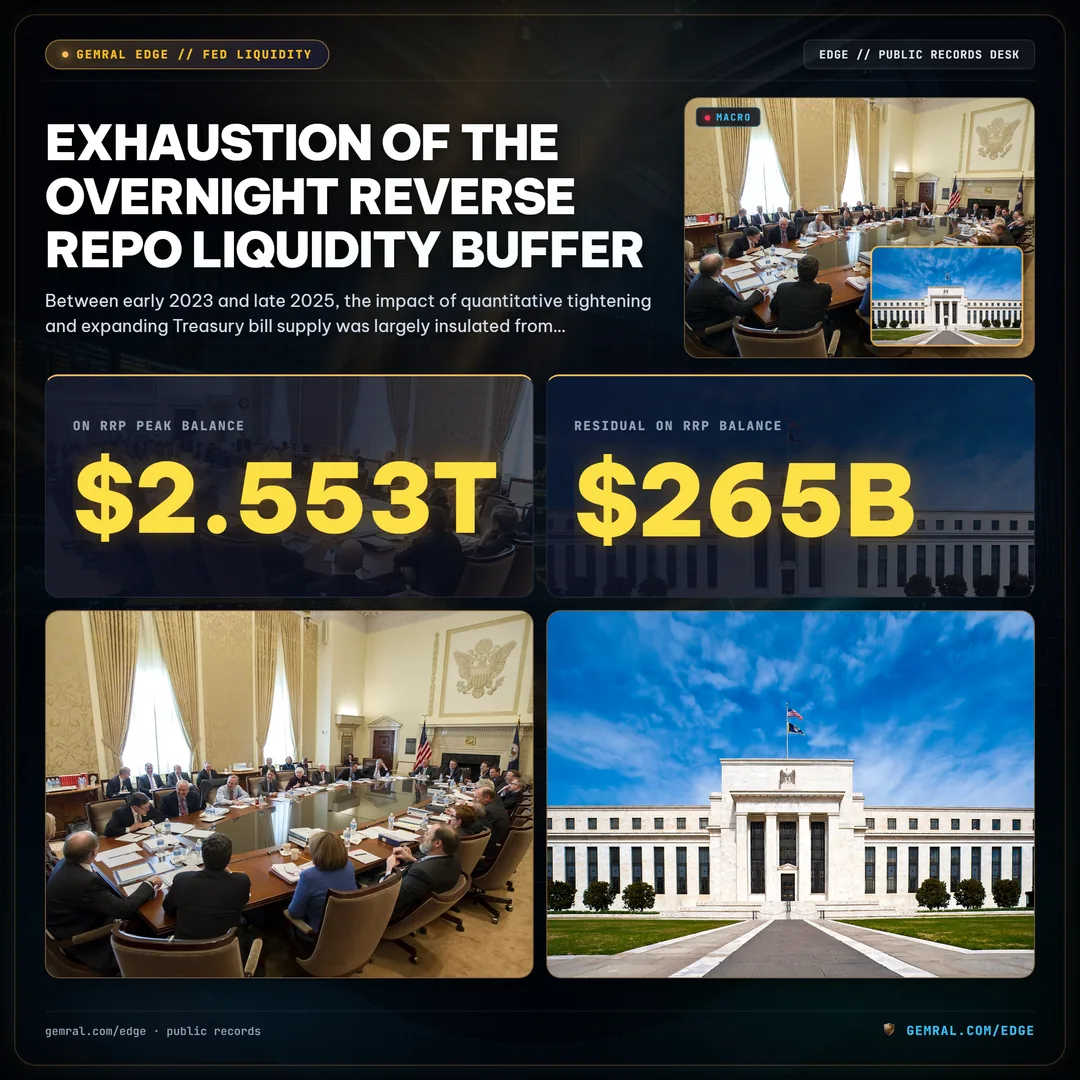
By September 2026, however, this monetary shock absorber had been virtually exhausted. Daily ON RRP balances compressed from the multi-trillion peak down to a residual, highly inelastic core of approximately $265 billion.
The practical consequence of this buffer exhaustion is observable. When the ON RRP held $2.0 trillion, every dollar of new Treasury debt or corporate tax drainage was funded by cash departing the Federal Reserve's liability side without reducing commercial bank deposits or reserves. With the ON RRP now at its structural floor, any incremental expansion in the Treasury General Account or continuation of quantitative tightening directly extracts liquidity from bank reserves on a one-for-one basis. The cushion is gone; the banking system now absorbs every dollar of sovereign fiscal and monetary drain directly on its balance sheets.
The remaining $265 billion parked at the ON RRP is structurally inelastic. It belongs predominantly to smaller government-only money market funds and specialized institutional cash managers whose investment mandates strictly prohibit unsecured commercial paper or long-dated debt, requiring overnight sovereign paper. Because this residual capital will not depart the facility regardless of attractive private market yields, it cannot be mobilized to relieve dealer warehouse pressures. The transition from buffer runoff to direct reserve depletion has thus removed the primary stabilizing shock absorber of the 2023-2025 monetary cycle.
6. Áp Lực Thanh Khoản Tiềm Ẩn: Vay Nợ FHLB và Cuộc Đua Của Các Ngân Hàng Khu Vực
When commercial banks experience localized reserve depletion during Treasury settlement cycles, their primary recourse before borrowing from official discount windows is accessing short-term liquidity through the Federal Home Loan Bank (FHLB) system. The eleven regional Federal Home Loan Banks function as the quintessential liquidity provider of second resort for the domestic banking industry, issuing consolidated debt obligations and transferring cash to member banks via collateralized advances.
Data compiled by the FHLB Office of Finance indicates that aggregate outstanding FHLB advances expanded rapidly throughout 2026, climbing to $845 billion by mid-September. This borrowing surge occurred concurrently with a widening in financial commercial paper yield spreads, reflecting intense competition among financial institutions for wholesale short-term funding.
The reliance of commercial banks on FHLB advances introduces critical secondary transmission channels into money market microstructure. To fund these advances, the Federal Home Loan Banks must issue vast quantities of short-term discount notes into the market. These discount notes compete directly with Treasury bills and private commercial paper for cash from prime money market funds. As FHLB funding rates increase, the cost of liquidity throughout the banking system rises, transmitting sovereign settlement pressures into broader corporate lending channels.
Moreover, the Federal Home Loan Banks maintain measurable liquidity balances of their own, which they frequently deploy into the overnight federal funds market. Because FHLBs are non-depository institutions, they cannot earn the Interest on Reserve Balances (IORB) rate at the Federal Reserve, creating an incentive to lend cash into the fed funds market at rates slightly below IORB. Foreign banking organizations typically borrow this cash to arbitrage the fed funds-IORB spread. However, when regional banks aggressively draw down FHLB advances, the pool of excess liquidity that FHLBs can lend into the fed funds market shrinks noticeably. This contraction reduces cross-market arbitrage efficiency, leaving overnight rate spikes unmitigated.
7. Vận Tốc Phát Hành Nợ Kho Bạc và Khả Năng Hấp Thụ Thanh Toán Đấu Thầu
The fundamental driver of balance sheet congestion remains the velocity and volume of United States sovereign debt creation. According to official announcements published by the United States Department of the Treasury, gross monthly issuance of Treasury bills, notes, and bonds climbed to $545 billion in September 2026, sustaining an annualized debt refinancing and expansion schedule that tests the capacity of primary dealer syndicates.
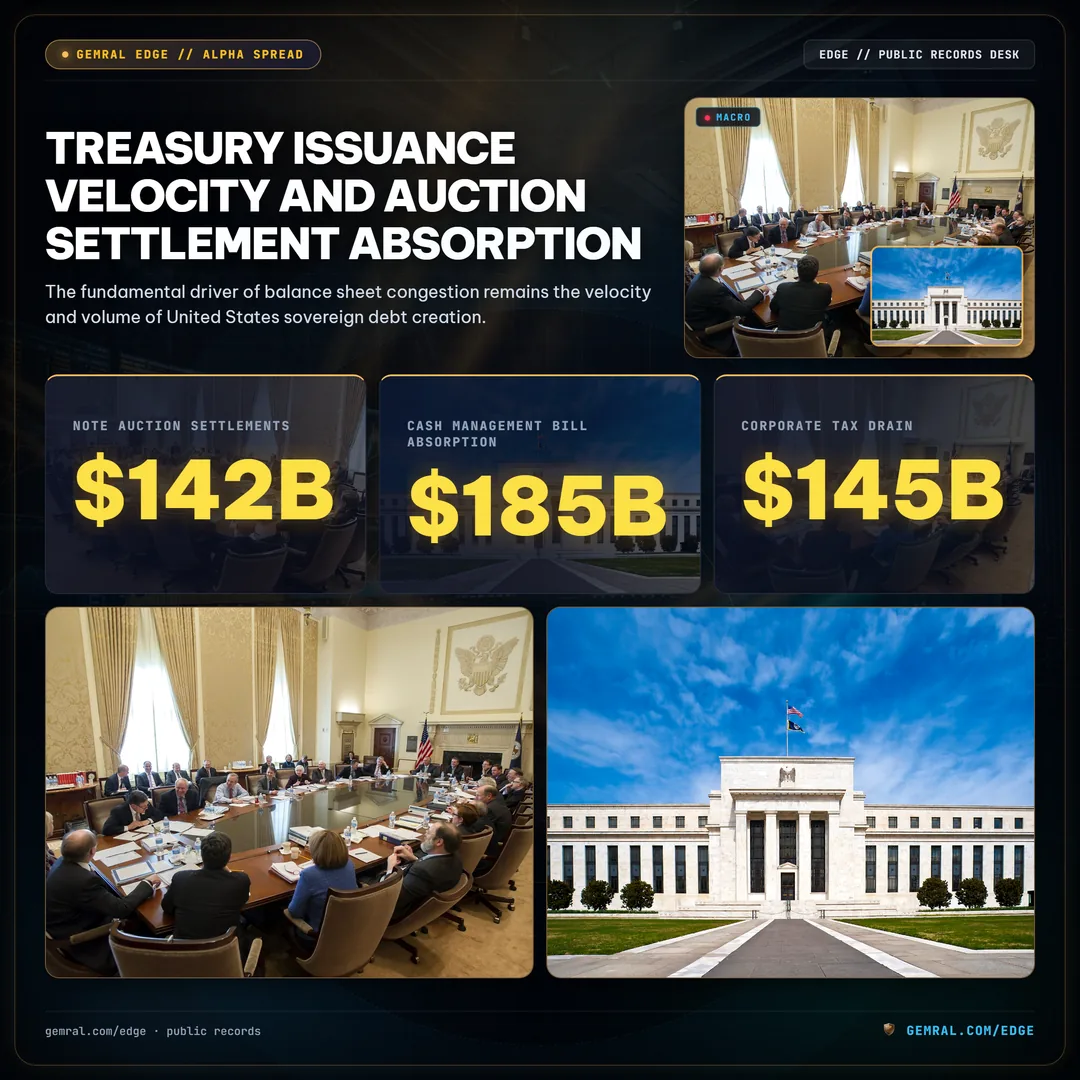
During the mid-September cycle, the market faced an intense cluster of debt settlements:
- Settlement of $142 billion in 2-year, 5-year, and 7-year Treasury note auctions occurring within a 48-hour window.
- Absorption of $185 billion in 4-week, 8-week, and 17-week cash management and benchmark Treasury bills.
- Simultaneous quarterly corporate tax drains exceeding $145 billion, which swept institutional deposits into the Treasury General Account at the Federal Reserve.
When the Treasury General Account swells with tax proceeds and auction receipts, cash is drained out of private bank accounts and locked in the government's account at the central bank. This liquidity drain is temporary, but its timing creates intraday and intraweek deficits in private clearing networks. Primary dealers must bridge this deficit by funding their auction commitments in the repo market, creating the precise collateral inventory spike documented in Form FR 2004 records.
An additional structural layer is the maturity composition of recent Treasury offerings. Under heavy coupon issuance, primary dealers must allocate greater balance sheet space to finance duration risk compared to short-term bills. Financing a 10-year Treasury note or 30-year bond requires higher repo margin and subjects dealers to interest rate volatility during holding periods. As the Treasury's Office of Debt Management expanded coupon auction sizes across 2025 and 2026 to stabilize debt duration, dealer balance sheets absorbed substantially greater risk-weighted exposure per unit of debt, rapidly exhausting aggregate elastic intermediation capacity.
8. Chỉ Số Co Giãn Đại Lý Của Văn Phòng Nghiên Cứu Tài Chính (OFR)
To quantify the composite stress across money market infrastructure, the Office of Financial Research (OFR) maintains tracking metrics evaluating primary dealer repo financing elasticity, collateral velocity, and settlement fail volumes. The OFR Primary Dealer Elasticity Index combines five structural indicators: dealer leverage utilization, fails-to-deliver volumes in Treasury securities, the spread of bilateral repo over tri-party benchmarks, Standing Repo Facility drawings, and the velocity of tri-party allocation adjustments.
In mid-September 2026, the OFR composite stress reading climbed to 78.4 out of 100, reaching levels characteristic of severe balance sheet constriction. A reading above 70 indicates that intermediate financial dealers have exhausted their voluntary balance sheet slack and are operating at the threshold of regulatory leverage constraints.
The elevation of the OFR index to 78.4 reflects an environment where structural settlement friction, rather than underlying credit risk, dictates money market pricing. When primary dealers operate under tight balance sheet elasticity, they enforce punitive haircut requirements on leveraged non-bank participants, including fixed income relative value arbitrage funds. This dynamic forces cash-constrained funds to liquidate basis trades, amplifying bond market volatility and transmitting overnight funding pressures into duration asset pricing across global financial markets.
Data from the Depository Trust & Clearing Corporation (DTCC) indicates that settlement fails in United States Treasury securities spiked concurrently with the OFR index elevation, surpassing $85 billion in gross daily failures. In a tight funding environment, market participants fail to deliver securities rather than paying elevated borrowing rates in the repo market to borrow collateral for delivery. Fails-to-deliver cascade through clearing networks, multiplying structural gridlock and compelling clearing houses to demand additional defensive liquidity margins from members.
9. Phân Tích Đối Chiếu Lịch Sử: Tháng 9/2019 và Tháng 9/2026
Market historians and macro analysts immediately draw comparisons between the current liquidity friction and the repo market spike of September 16-17, 2019, when overnight general collateral repo rates exploded to 10.0% intraday. While the superficial catalysts—corporate tax remittances colliding with heavy Treasury coupon settlements—are identical, the institutional architecture of September 2026 exhibits crucial structural differences:

- Presence of the Standing Repo Facility: In September 2019, no standing facility existed. The Federal Reserve was forced to reintroduce ad-hoc overnight repo operations after rates had already broken the ceiling. In September 2026, the SRF was active and fully operational, capping the headline SOFR median at 5.58% and absorbing $18.4 billion in collateral without disorderly market seizure.
- Absence of the ON RRP Buffer: In 2019, there was no multi-trillion-dollar ON RRP facility draining down; reserves bore the full brunt of quantitative tightening directly. In 2026, the ON RRP cushioned over $2.2 trillion of balance sheet runoff before finally reaching its residual floor, delaying the onset of reserve scarcity until reserves hit $3.07 trillion.
- Regulatory Scale and Dealer Capital: Primary dealers in 2026 operate with substantially higher Tier-1 common equity than in 2019, but face more stringent Supplementary Leverage Ratio and G-SIB surcharge constraints, creating an environment where solvency is unquestioned but elasticity is rigidly restricted.
- Central Clearing Penetration: The widespread adoption of FICC cleared repo has expanded multilateral netting capacity, preventing isolated counterparty defaults from paralyzing inter-dealer trading, even as bilateral rate dispersion widens.
The key insight from this comparative analysis is that the 2026 sovereign liquidity regime is not prone to sudden chaotic collapses; rather, it is characterized by chronic, grinding friction. The Standing Repo Facility prevents spikes to 10%, but at the cost of formalizing institutional dependency on central bank backstops whenever quarterly debt settlements occur.
10. Tác Động Chiến Lược Cho Nhà Phân Bổ Vốn và Các Bàn Giao Dịch Định Lượng
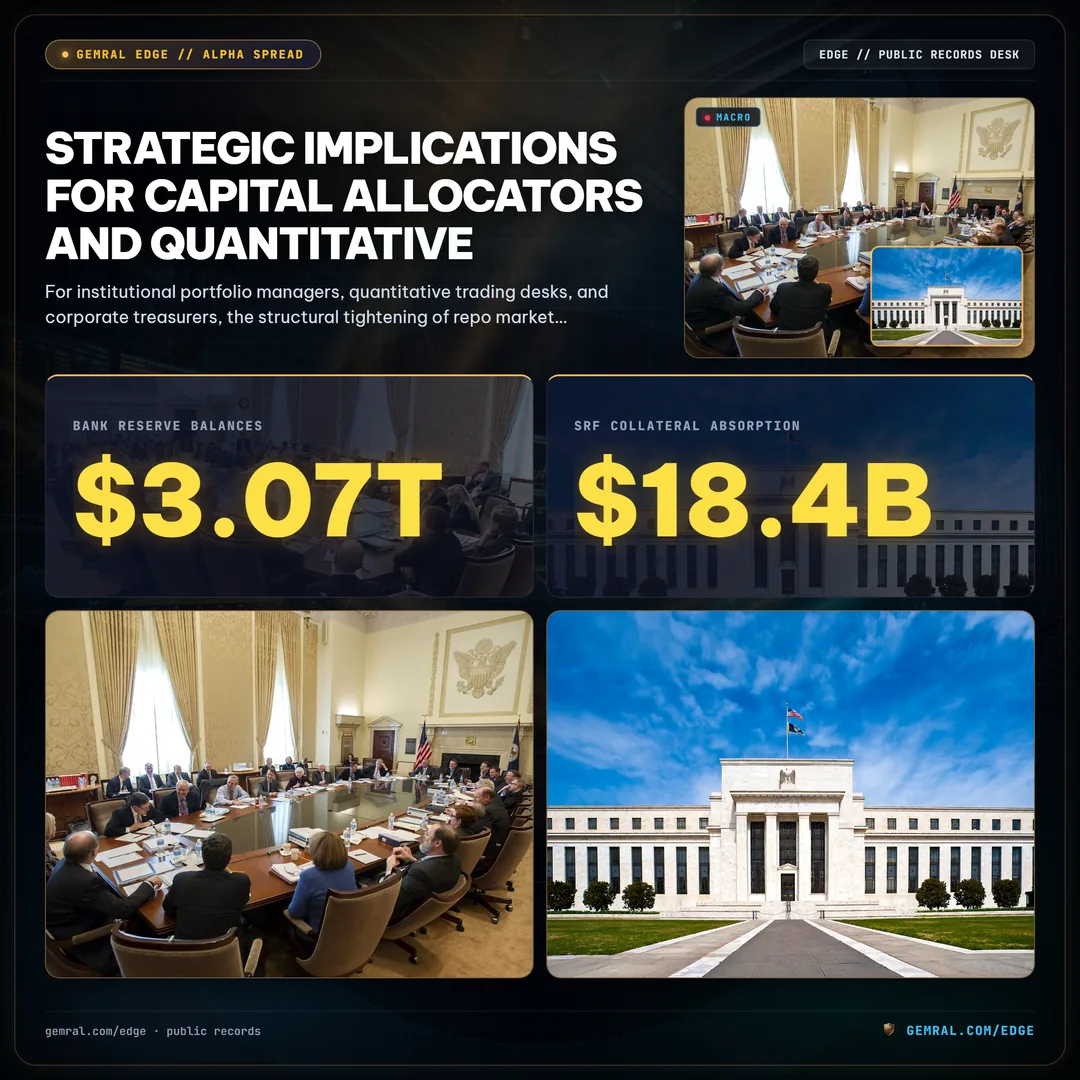
For institutional portfolio managers, quantitative trading desks, and corporate treasurers, the structural tightening of repo market liquidity carries vital tactical and strategic ramifications. The era of frictionless, near-zero-spread money market clearance has concluded. Sovereign debt issuance now regularly pushes intermediate financing plumbing to its operational boundaries.
The observable data yields four actionable conclusions for market participants navigating this regime:
- Predictable Settlement Volatility Windows: Rate dispersion between SOFR and administered benchmarks is heavily clustered around quarterly corporate tax deadlines (March 15, June 15, September 15, December 15) and mid-month Treasury coupon settlements. Quantitative desks can systematically trade widening basis spreads between cash Treasury instruments and futures contracts ahead of these settlement dates.
- Leverage Constrained Arbitrage Capacity: As primary dealers approach Supplementary Leverage Ratio limits, the capacity of hedge funds to execute Treasury cash-futures basis trades diminishes. Wider basis spreads will persist for longer durations, creating higher returns for unconstrained capital providers with direct clearing access.
- Central Bank Balance Sheet Reassessment: With total bank reserves touching $3.07 trillion and Standing Repo Facility usage surging to $18.4 billion, the Federal Reserve is rapidly approaching the terminal velocity of quantitative tightening. Historical precedents suggest that persistent rate spikes above IORB force central bank policymakers to taper or conclude balance sheet runoff earlier than consensus projections anticipate.
- Collateral Segregation Priority: Institutional treasurers must prioritize direct tri-party arrangements over uncommitted bilateral financing lines to insulate cash deployments from dealer balance sheet exhaustion shocks during month-end and quarter-end cycles.
11. Tổng Hợp Kết Luận: Giám Sát Thanh Khoản Chủ Quyền Theo Thời Gian Thực
The September 2026 liquidity event demonstrates that sovereign debt issuance is no longer an abstract fiscal metric; it is an active mechanical constraint on market microstructure. As the United States Treasury continues financing multi-trillion-dollar annual deficits in an environment where the central bank is no longer the buyer of first resort and the ON RRP cushion has been spent, the burden of intermediation falls entirely upon primary dealer balance sheets.
When dealer inventory reaches $388.5 billion and composite elasticity scores breach 78.4, even modest seasonal tax withdrawals trigger disproportionate funding spikes across money markets. Tracking these structural transitions in real time—monitoring Standing Repo Facility uptake, cross-benchmark rate dispersion, and primary dealer inventory accumulation—provides capital allocators with an indispensable analytical moat. By reading the public records of central bank facilities and Treasury settlement flows, disciplined investors can anticipate macro liquidity shifts before they manifest in equity and bond market pricing.
Truy Cập Thông Tin Tình Báo Thanh Khoản Vĩ Mô Thể Chế
Theo dõi vận tốc nợ công chủ quyền, độ co giãn bảng cân đối của primary dealer và độ phân tán vốn tài trợ thời gian thực trên toàn thị trường vốn toàn cầu với nền tảng phân tích.
Explore the Gemral Edge Liquidity Terminal →