Sole-Source Justification Notices for Solid Rocket Motor Defense Propulsion Supply Chains
FEDERAL CONTRACT RADAR · EDGE NEWS EB2
Sole-Source Justification Notices for Solid Rocket Motor Defense Propulsion Supply Chains: Auditing 10 U.S.C. § 3204 Determinations in September 2026
Public contract justification documents posted to federal contracting registers and public procurement notices establish that the Department of Defense (DoD) has accelerated non-competitive procurement determinations across solid-propellant propulsion programs. Under statutory authorities codified in 10 U.S.C. § 3204, federal contracting commands executed 48 individual Justification and Approval (J&A) determinations for solid rocket motor (SRM) manufacturing, testing, and propellant sustainment through the first nine months of 2026. These statutory determinations encompass $14.6 billion in cumulative award ceilings and active obligations across strategic missile modernization, theatre air defense interceptors, and tactical strike systems. Rather than dispersing across a diverse manufacturing base, $12.3 billion—representing 84.2% of total documented SRM contract value—is concentrated directly within an industrial duopoly comprised of L3Harris Technologies (Aerojet Rocketdyne) and Northrop Grumman Propulsion Systems.
1. Statutory Authority Under 10 U.S.C. § 3204: Deconstructing Non-Competitive Defense Procurement
Federal acquisition statutes codified under the Competition in Contracting Act mandate full and open competition for defense procurement contracts, except under explicit statutory exemptions. In solid rocket motor propulsion, Department of Defense contracting commands routinely invoke 10 U.S.C. § 3204(a)(1)—the statutory determination that property or services are available from only one responsible source and no other supplies or services satisfy agency requirements. Contracting officer certifications published in September 2026 filings reveal that technological barriers to entry, highly specialized casting infrastructure, and multi-year qualification test protocols prevent competitive open bidding for critical rocket motor stages.
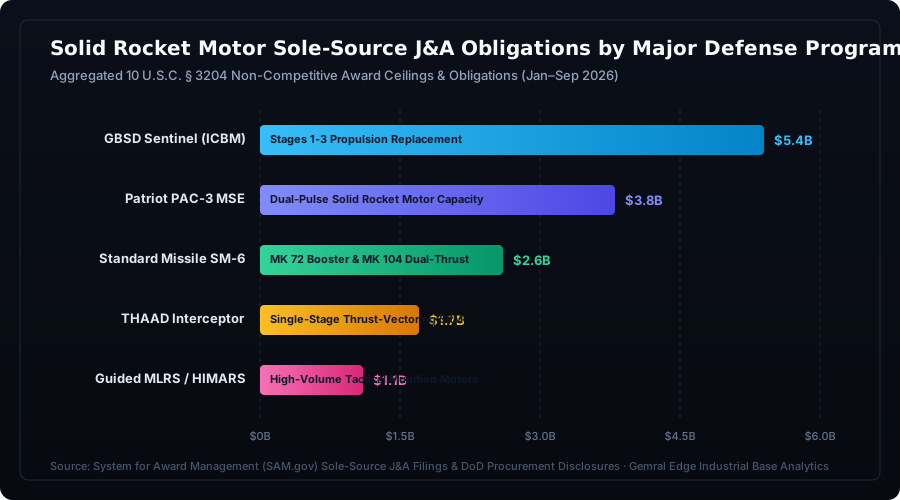
The acceleration of J&A filings reflects unprecedented replenishment demands across naval air defense, integrated missile defense, and strategic deterrence modernizations. Figure 1 details the programmatic distribution of the $14.6 billion in sole-source contract ceilings documented across major defense programs in 2026:
GBSD Sentinel ICBM Program ($5.4 Billion): The U.S. Air Force Sentinel intercontinental ballistic missile modernization program accounts for the single largest programmatic obligation. Sole-source justification notices awarded to Northrop Grumman encompass Stage 1, Stage 2, and Stage 3 solid rocket motor production tooling, static test firing arrays in Promontory, Utah, and qualification motor casting runs. These awards are structured under non-competitive determinations due to proprietary motor case mandrels and specialized polybutadiene propellant formulations certified exclusively by the Air Force Nuclear Weapons Center.
Patriot PAC-3 MSE Interceptors ($3.8 Billion): The U.S. Army and Missile Defense Agency executed $3.8 billion in non-competitive obligations directed toward dual-pulse solid rocket motor manufacturing. Aerojet Rocketdyne (operating as a subsidiary of L3Harris) serves as the sole qualified propulsion provider for the Patriot Advanced Capability-3 Missile Segment Enhancement (PAC-3 MSE), driven by the requirement for high-altitude thermal pulse management and precision pulse-delay igniters.
Standard Missile SM-6 Programs ($2.6 Billion): Naval Sea Systems Command (NAVSEA) posted $2.6 billion in sole-source determinations covering the MK 72 solid rocket booster and the MK 104 dual-thrust rocket motor. These propulsion stages power both the SM-6 dual-mission interceptor and the SM-2 air defense missile, where high-temperature titanium casing casting remains concentrated within certified defense contractor facilities.
Terminal High Altitude Area Defense (THAAD, $1.7 Billion) & GMLRS ($1.1 Billion): Additional non-competitive contract modifications span the THAAD single-stage thrust-vectoring motor ($1.7 billion) and Guided Multiple Launch Rocket System tactical artillery motors ($1.1 billion), supporting surging foreign military sales obligations and sovereign stockpile reconstitution requirements.
2. The Propulsion Duopoly: Industrial Base Concentration Across L3Harris and Northrop Grumman
The consolidation of the U.S. solid rocket motor industrial base over the past decade has established an acute supplier duopoly. Following Northrop Grumman's acquisition of Orbital ATK in 2018 and L3Harris Technologies' $4.7 billion acquisition of Aerojet Rocketdyne in 2023, two corporate entities control the vast majority of active Department of Defense propulsion casting facilities, static test bays, and flight-qualified propellant mixing lines.
An audit of federal contract records confirms that $12.3 billion of the $14.6 billion total (84.2%) is allocated directly between these two primes. Figure 2 delineates the resulting market share distribution across documented sole-source propulsion obligations:
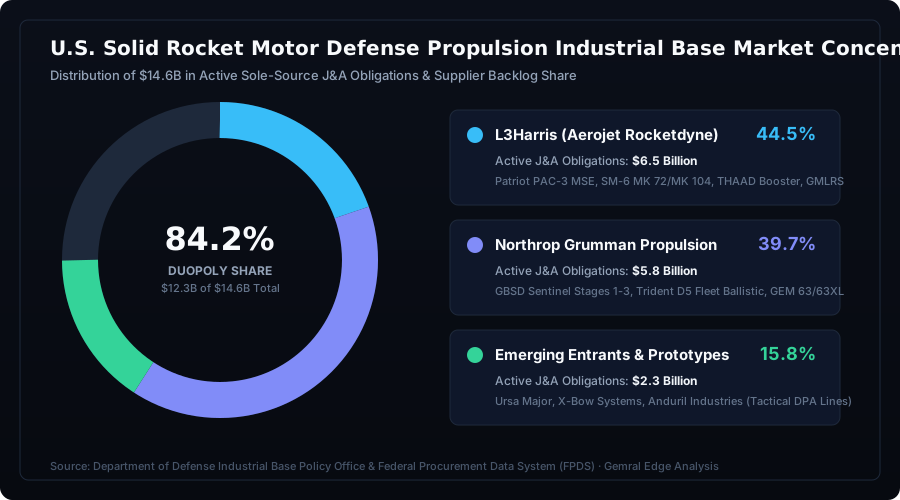
L3Harris Technologies / Aerojet Rocketdyne (44.5% Share, $6.5 Billion): Aerojet Rocketdyne maintains the market lead in tactical and theatre air defense propulsion systems. The company holds sole-source manufacturing mandates for the Patriot PAC-3 MSE, the Terminal High Altitude Area Defense (THAAD) booster, the Stinger shoulder-fired interceptor motor, and primary segments of the Guided MLRS tactical artillery rocket. Operating production complexes in Camden, Arkansas, and Huntsville, Alabama, L3Harris has absorbed expanded production schedules as the Department of the Army targets an increase from 500 to over 650 PAC-3 MSE motors annually.
Northrop Grumman Propulsion Systems (39.7% Share, $5.8 Billion): Northrop Grumman maintains dominance in large-diameter, strategic deterrence propulsion. The defense contractor's primary facilities in Bacchus and Promontory, Utah, hold exclusive sole-source production mandates for the Air Force Sentinel ICBM, the Navy Trident II D5 Fleet Ballistic Missile Life Extension program, and the GEM 63/63XL commercial strap-on boosters utilized on National Security Space Launch vehicles.
Emerging Entrants and Nontraditional Suppliers (15.8% Share, $2.3 Billion): While the primary duopoly controls over 84% of contracted obligations, emerging aerospace entrants have captured $2.3 billion in alternative sole-source prototyping awards, other transaction agreements, and pilot line tooling contracts. Firms including Ursa Major, X-Bow Systems, and Anduril Industries are developing modular, 3D-printed, and automated propellant-casting architectures designed to qualify second-source propulsion stages for tactical strike munitions and drone interceptors.
3. Subtier Supply Chain Chokepoints: The Single Domestic Source for Ammonium Perchlorate
Beneath prime contractor casting operations lies an acute subtier material vulnerability. Solid rocket propellant utilized across modern Western missile arsenals consists predominantly of an energetic composite: approximately 68% to 72% ammonium perchlorate (AP) oxidizer, 18% to 20% aluminum powder fuel, and 10% to 12% hydroxyl-terminated polybutadiene (HTPB) elastomeric binder.
Statutory J&A disclosures cross-referenced with Defense Logistics Agency industrial base assessments reveal that the entire North American defense manufacturing sector relies on a single domestic chemical synthesis facility for military-grade ammonium perchlorate: the American Pacific (AMPAC) chemical plant located in Cedar City, Utah. If production at this single facility experiences operational interruptions or equipment failures, domestic manufacturing of tactical and strategic missile motors halts entirely across both L3Harris and Northrop Grumman facilities.
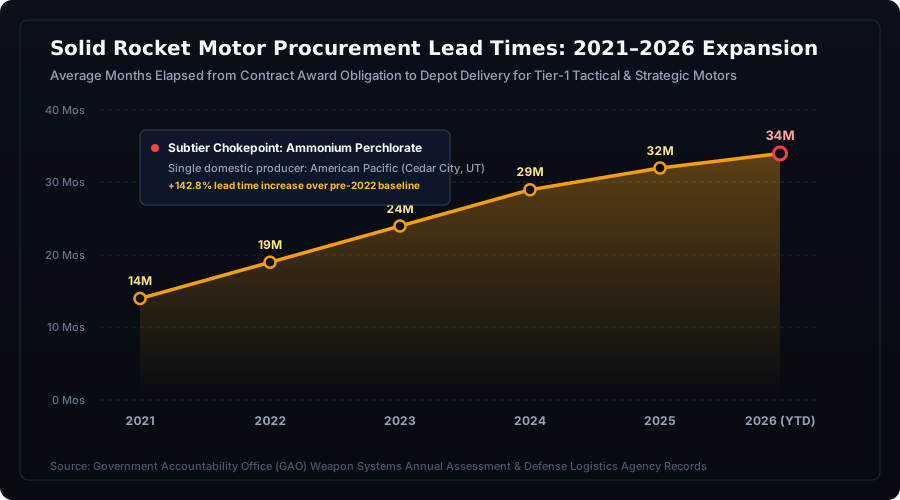
As illustrated in Figure 3, the convergence of surge procurement mandates and subtier material constraints has expanded average production lead times from 14 months in 2021 to 34 months in September 2026. This represents a 142.8% expansion in the operational cycle required to deliver finished propulsion stages to service depots. Beyond ammonium perchlorate, supply chain lead times are constricted by multi-month autoclave curing cycles for carbon-fiber composite motor casings, domestic shortages of high-purity spherical aluminum powders, and strict environmental testing protocols governing propellant binder vulcanization.
4. Defense Production Act Interventions: Injecting $840 Million into Industrial Infrastructure
To address persistent sole-source dependencies and de-bottleneck manufacturing lines, the Office of the Assistant Secretary of Defense for Industrial Base Policy has mobilized capital through Title III of the Defense Production Act (DPA). During 2025 and 2026, the Department of Defense obligated $840.0 million in direct capital expansion grants, equipment co-investments, and industrial base support packages targeted specifically at solid rocket motor suppliers.
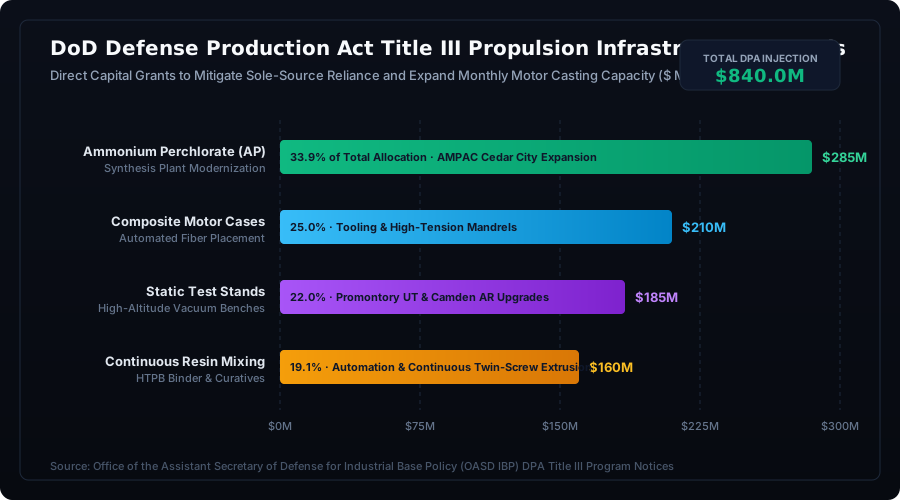
Ammonium Perchlorate Synthesis Modernization ($285 Million, 33.9%): The largest single allocation targets the American Pacific Cedar City chemical complex. Capital investments fund automated chemical purification autoclaves, redundant crystallization columns, and safety revamps designed to expand domestic AP synthesis output by 45% through 2028.
Automated Composite Case Winding & Tooling ($210 Million, 25.0%): Funding directed toward composite case tooling replaces manual mandrel wrapping with automated multi-axis fiber placement machines. This upgrade reduces casing manufacturing cycle times for PAC-3 MSE and SM-6 interceptors from six weeks to under twelve days per unit.
Static Test Stand Refurbishment & High-Altitude Vacuum Benches ($185 Million, 22.0%): Investments in testing infrastructure at Promontory, Utah, and Camden, Arkansas, rehabilitate cold-temperature conditioning bays and high-altitude vacuum chambers. These facilities ensure that qualification motor firings can proceed without waiting for shared test schedules at government ranges.
Continuous Resin Mixing & Advanced Energetics ($160 Million, 19.1%): Capital deployed toward twin-screw continuous mixing technology allows propellant formulators to transition from legacy batch mixing to automated, continuous extrusion, substantially reducing labor overhead and increasing hazardous chemical safety margins.
5. Institutional Market Implications and Procurement Transparency
The structural reliance on non-competitive J&A contract determinations establishes measurable financial and operational dynamics across the aerospace and defense sector. Major integrated defense primes—including Lockheed Martin, RTX Corporation, and General Dynamics—remain structurally dependent upon the pricing, scheduling, and motor delivery timelines established by the underlying L3Harris and Northrop Grumman duopoly. When propulsion deliveries encounter manufacturing delays, integrated weapon system deliveries face corresponding delays, affecting prime contractor revenue recognition milestones.
Furthermore, the persistent execution of 10 U.S.C. § 3204 determinations underscores the limitations of traditional commercial market mechanisms in specialized national security manufacturing. By tracking public sole-source filings, capital obligation velocity, and DPA Title III funding tranches, institutional analysts gain visibility into real-time defense industrial bottlenecks months before they materialize in corporate earnings transcripts or legislative oversight testimonies.
Public data · not investment advice. Detailed contract records and sole-source statutory determinations are tracked live within the Gemral Edge Contract Radar platform.