Hyperscaler Nuclear SMR Power Purchase Agreements and DOE Loan Guarantee Convergence
Hyperscaler Nuclear SMR Power Purchase Agreements and DOE Loan Guarantee Convergence
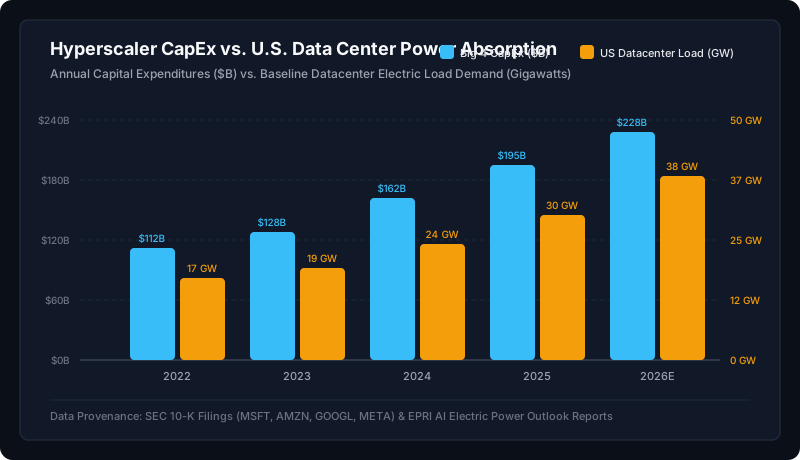
A structural inflection in enterprise artificial intelligence has quietly bypassed hardware architecture. For the past twenty-four months, corporate technology disclosures focused predominantly on GPU cluster yields, high-bandwidth memory packaging constraints, and network switch optical backplanes. Yet as annualized hyperscaler capital expenditures climb toward $228 billion across Microsoft, Amazon Web Services, Alphabet, and Meta, compute availability has run directly into a rigid thermodynamic ceiling: the physical capacity of the North American electric power grid.
Public regulatory records across regional transmission organizations, the Federal Energy Regulatory Commission, and the Department of Energy demonstrate that the defining constraint of the current compute cycle is no longer silicon fabrication. The critical path is now electric interconnection velocity. In response, enterprise hyperscalers have initiated a capital allocation shift, moving beyond standard regional utility contracts into direct, behind-the-meter nuclear power purchase agreements, multi-billion-dollar reactor repowerings, and sovereign-backed small modular reactor commercialization pacts.
The Grid Wall: Why AI Hyperscalers Are Abandoning Regional Interconnection Queues
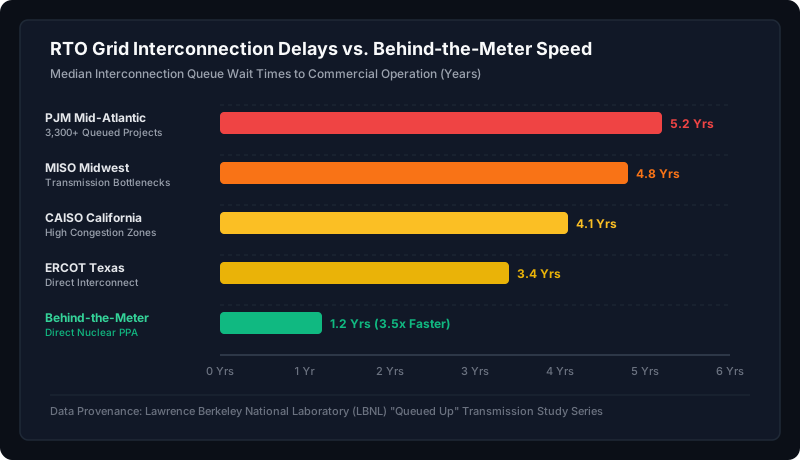
The operational reality confronting hyperscalers in major data center corridors is defined by severe administrative and transmission friction. Across the primary regional transmission organizations serving high-density server clusters—most notably the PJM Interconnection across the Mid-Atlantic and MISO across the industrial Midwest—median wait times for commercial grid interconnection have stretched beyond five years.
According to comprehensive transmission studies published by the Lawrence Berkeley National Laboratory, the aggregate capacity trapped in domestic interconnection queues exceeded 2,600 gigawatts by early 2026. In the PJM territory alone, where northern Virginia hosts approximately 35% of the world's hyperscale computing capacity, more than 3,300 commercial generation and transmission projects remain stalled in administrative review, with a median queue-to-operation lag of 5.2 years. For an enterprise deploying specialized accelerator silicon with an economic depreciation half-life of 36 months, waiting 60 months simply to energize a substation creates an unacceptable capital destruction dynamic.
Because utility transmission build-outs require extensive multi-state right-of-way approvals, environmental impact statements, and regional cost-allocation disputes, hyperscalers are actively abandoning traditional front-of-the-meter utility connections. Instead, capital is flowing directly toward existing, operational nuclear generation stations where large-scale electric generation capacity can be consumed behind-the-meter, circumventing the public transmission queue entirely.
Behind-the-Meter Architecture: The 960 MW Susquehanna Blueprint and Crane Center Repowering
The definitive corporate blueprint for behind-the-meter nuclear co-location emerged through Talen Energy's transaction with Amazon Web Services at the Susquehanna Nuclear Station in Luzerne County, Pennsylvania. Under material contracts filed in public regulatory dockets, AWS acquired the adjacent 960-megawatt Cumulus Data Center campus for $650 million, securing direct busbar electrical connections to the 2.5-gigawatt twin boiling-water reactor facility.
Under this arrangement, power is routed directly from the nuclear generator output terminals to the data center switchyards without wheeling electricity across the PJM high-voltage transmission network. Talen Energy contracted to supply AWS with up to 960 megawatts of dedicated zero-carbon baseload electricity in sequential 120-megawatt tranches, locking in a predictable, high-density energy source immune to wholesale locational marginal pricing spikes and regional transmission congestion charges.
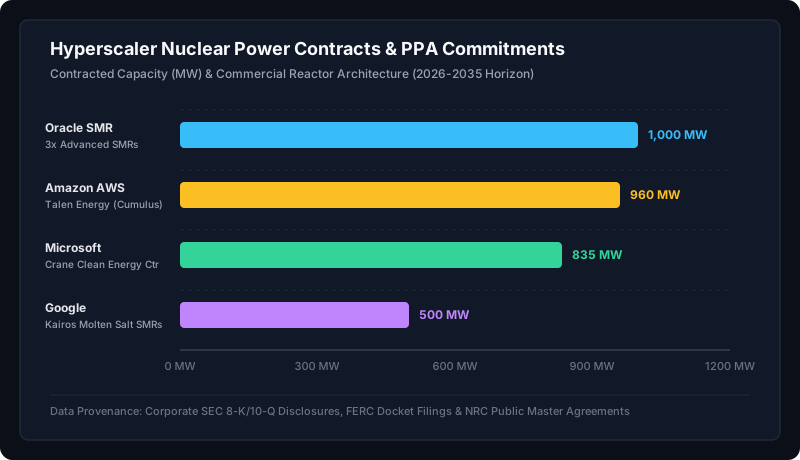
Following the Talen blueprint, Constellation Energy finalized an unprecedented 20-year power purchase agreement with Microsoft to resurrect Unit 1 of the Three Mile Island nuclear facility, officially designated the Crane Clean Energy Center. Shut down in 2019 due to unfavorable merchant power economics, the 835-megawatt pressurized water reactor will undergo an estimated $1.6 billion capital restoration program to recondition steam generators, replace cooling water loops, and rebuild main generator transformers.
Under the Microsoft off-take agreement, the entirety of the restored 835 megawatts of clean baseload electricity will be matched against Microsoft's regional data center operations. Crucially, the transaction economics are underpinned by federal Section 45U Clean Electricity Production Tax Credits, which provide a sovereign price floor of $15 per megawatt-hour for qualified nuclear generation, demonstrating how federal legislative frameworks converge with private balance sheets to re-monetize legacy nuclear assets.
The $400 Billion Federal Balance Sheet: DOE Title 17 and Sovereign Credit Guarantees
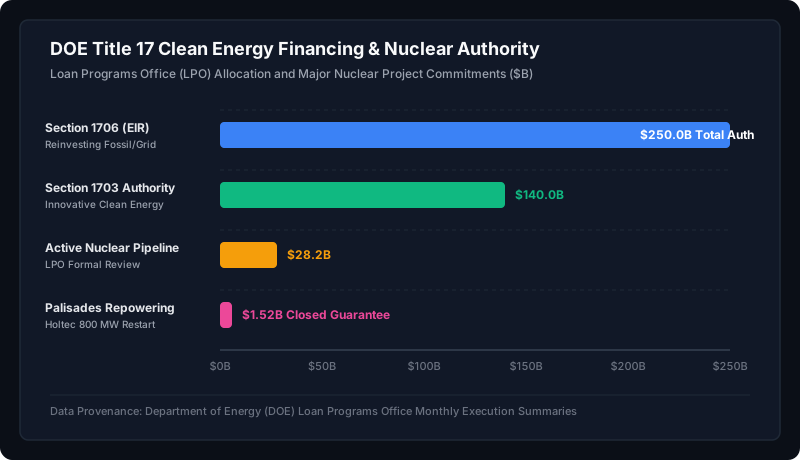
While private capital expenditure provides the commercial off-take commitments, the Department of Energy Loan Programs Office has transformed into the primary balance-sheet guarantor underwriting the nuclear revival. Operating under statutory authorizations expanded through the Inflation Reduction Act, the DOE Loan Programs Office manages over $400 billion in direct lending and conditional loan guarantee authority across two primary programs.
| Statutory Mechanism | Program Scope | Total Loan Authority | Key Nuclear Allocations |
|---|---|---|---|
| Title 17: Section 1706 | Energy Infrastructure Reinvestment (EIR) | $250.0 Billion | Repowering retired nuclear facilities and retooling fossil electric generation corridors |
| Title 17: Section 1703 | Innovative Clean Energy Financing | $140.0 Billion | Advanced small modular reactors, advanced nuclear fuel enrichment, and high-temperature gas reactors |
| Closed Nuclear Guarantees | Palisades Nuclear Restart (Holtec) | $1.52 Billion | Restoring 800 MW baseload capacity in Covert Township, Michigan |
| Active Nuclear Pipeline | Advanced Nuclear Loan Applications | $28.2 Billion | Commercial deployment proposals across SMR manufacturing, fuel supply, and utility reactors |
The definitive test case for federal balance sheet deployment is Holtec International’s repowering of the 800-megawatt Palisades Nuclear Generating Station in Covert Township, Michigan. Following a $1.52 billion conditional loan commitment from the DOE Loan Programs Office, Palisades represents the first decommissioned commercial nuclear reactor in United States history slated to achieve full operational restoration.
Federal lending terms under Title 17 provide long-term debt pricing tied directly to United States Treasury yields plus a minimal credit spread, effectively lowering the cost of capital for capital-intensive nuclear engineering by 300 to 450 basis points relative to commercial syndicated debt markets. This federal credit backstop lowers the hurdle rate for utility operators seeking to deploy advanced reactors for enterprise computing clients.
Small Modular Reactor Procurement: Kairos, Oracle, and the 2030 Commercial Horizon
While existing reactor restarts solve near-term capacity bottlenecks through 2028, hyperscalers with projected compute power requirements extending beyond 2030 are anchoring the commercial order books of advanced Small Modular Reactor developers. Unlike gigawatt-scale conventional light-water reactors requiring bespoke on-site civil construction, SMR architectures utilize factory-fabricated modular containment structures capable of serial production.
Alphabet structured a landmark commercial agreement with Kairos Power to deploy up to 500 megawatts of advanced nuclear generation across a fleet of molten-salt-cooled reactors. Under the master power purchase framework, the first 50-megawatt demonstration reactor is targeted for commercial operation by 2030, followed by subsequent 100-megawatt deployments through 2035. Kairos Power utilizes a low-pressure liquid fluoride salt coolant paired with ceramic pebble-bed fuel, enabling walk-away passive safety characteristics that allow reactors to be sited in close proximity to enterprise compute facilities.
Simultaneously, Oracle Corporation disclosed architectural plans for a gigawatt-scale AI computing campus engineered from inception to be energized by three advanced small modular reactors. By integrating reactor site engineering directly into data center design documents, Oracle is pioneering an islanded microgrid model that eliminates dependency on public utility transmission substations entirely.
The Power Economics of AI: Why Big Tech Pays a 170% Premium for Nuclear Baseload
The willingness of hyperscalers to commit to long-term nuclear off-take contracts priced between $85 and $115 per megawatt-hour—compared to prevailing wholesale locational marginal prices averaging $40 to $50 per megawatt-hour across Mid-Atlantic hubs—reflects a sophisticated understanding of infrastructure economics. For an AI compute cluster operating high-utilization inference and foundational training runs, electrical intermittency is catastrophic.
While utility-scale solar photovoltaic generation and onshore wind can clear at levelized costs below $35 per megawatt-hour, their low capacity factors (typically 22% for solar and 34% for wind) require multi-gigawatt battery energy storage systems to simulate continuous baseload operation. When solar or wind assets are overbuilt and paired with eight-hour battery storage to guarantee 99.5% clean power uptime, the all-in levelized cost escalates past $145 per megawatt-hour.
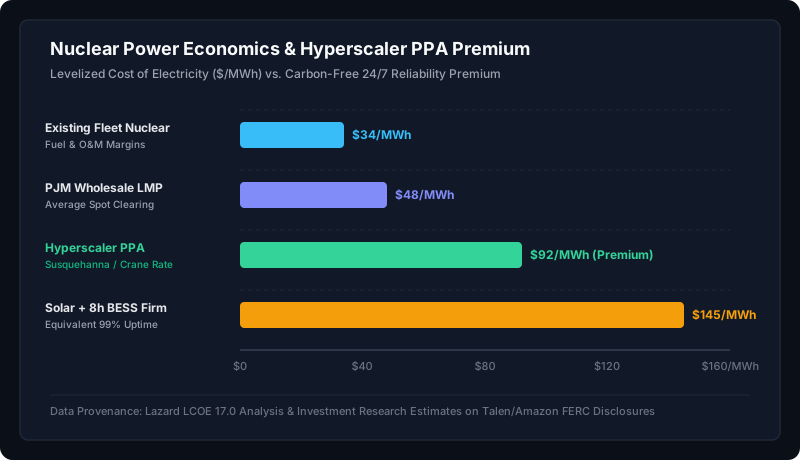
In contrast, commercial nuclear facilities operate at an industry-wide capacity factor exceeding 92%, delivering uninterrupted high-voltage electricity regardless of atmospheric weather conditions. With enterprise AI clusters burning through hundreds of millions of dollars in compute depreciation, the commercial penalty of downtime far outweighs any incremental premium paid for carbon-free nuclear baseload.
Regulatory Velocities: NRC Part 53 Rulemaking and the Post-ADVANCE Act Landscape
The regulatory bottleneck historically constraining nuclear deployment is undergoing structural realignment through federal statutory reform. In mid-2024, the United States Congress enacted the Accelerating Deployment of Versatile, Advanced Nuclear for Clean Energy (ADVANCE) Act, establishing statutory mandates for the Nuclear Regulatory Commission to modernize review procedures and lower licensing fees for commercial advanced reactor designs.
Historically, commercial reactors were licensed under 10 CFR Part 50 (a two-step construction permit and operating license process) or 10 CFR Part 52 (a one-step combined operating license). Both frameworks were fundamentally engineered for heavy, multi-billion-dollar light-water reactor stations, resulting in protracted administrative review timelines averaging 42 to 58 months.
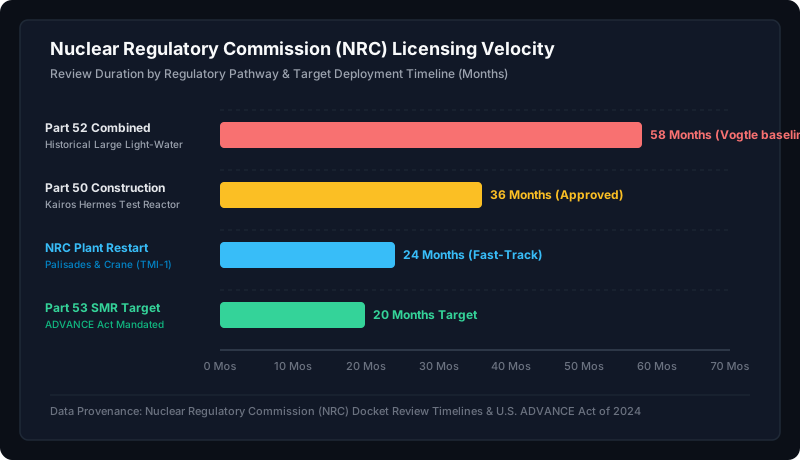
Under the ADVANCE Act directives and ongoing 10 CFR Part 53 rulemaking, the Nuclear Regulatory Commission is establishing a technology-inclusive, risk-informed regulatory framework specifically tailored for non-light water advanced reactors. The framework shortens standard review intervals to a target duration of 20 to 24 months, incorporates international safety data reciprocity, and eliminates punitive hourly review surcharges, removing critical regulatory friction for SMR deployment.
Infrastructure Convergence: How Energy Interconnection Defines the Sovereign AI Moat
The rapid convergence of hyperscaler capital expenditures, utility-scale nuclear power purchase agreements, and Department of Energy debt guarantees marks a fundamental transformation in enterprise computing. For the past decade, cloud competitive advantages were defined primarily by software ecosystems, virtualization software layers, and proprietary chip microarchitectures. Over the coming decade, competitive moats will be determined by physical energy ownership.
"The gating factor for frontier machine intelligence is no longer algorithmic parameter scaling or foundry wafer throughput. The critical constraint is the legal and physical right to consume hundreds of megawatts of continuous, uninterruptible electrical energy behind the transmission substation."
Enterprises that successfully secure multi-decade nuclear off-take agreements have locked in dedicated baseload energy at predictable long-term costs, insulating their computing clusters from public grid rationing, locational marginal price spikes, and carbon disclosure mandates. Conversely, organizations dependent on standard regional utility queues will face escalating multi-year delays, transmission upgrade surcharges, and volatile electricity rates.
As the $400 billion federal financing backstop accelerates commercial reactor restarts and modular fabrication pipelines, the intersection of nuclear energy and hyperscale computing represents one of the largest capital redeployments in modern industrial history. The future of intelligence is directly anchored to the physics of nuclear power.
Public data · not investment advice. Detailed PPA records and nuclear power interconnection filings are tracked live within the Gemral Edge Infrastructure Intelligence platform.