Space Development Agency Tranche 2 Tracking Layer Defense Contract Obligations: Auditing Procurement Velocity and Infrared Satellite Task Orders in September 2026
SPACE FORCE DEFENSE PROCUREMENT · EDGE NEWS EB2
Space Development Agency Tranche 2 Tracking Layer Defense Contract Obligations: Auditing Procurement Velocity and Infrared Satellite Task Orders in September 2026
Public procurement disclosures published by the Department of Defense and federal expenditure records document an accelerated capital distribution across the Space Development Agency (SDA) Proliferated Warfighter Space Architecture (PWSA). As the federal government approaches the conclusion of Fiscal Year 2026 on September 30, primary defense contracting officers have released a cluster of modification task orders for the Tranche 2 Tracking Layer (T2TL). Across three defense primes—L3Harris Technologies, Lockheed Martin Space, and Sierra Space—cumulative cash obligations have advanced to $814.5 million against an authorized cumulative contract ceiling of $2,549.0 million. This procurement telemetry reflects the operational transition of the multi-layered Low Earth Orbit (LEO) missile detection constellation from initial preliminary architecture design toward hardware fabrication, payload assembly, and critical sensor integration ahead of planned 2027 launches.
1. The Space Development Agency Architecture: Proliferating LEO Missile Warning
The strategic foundation of the Proliferated Warfighter Space Architecture represents an intentional departure from traditional national security space procurement models. Historically, sovereign missile warning capabilities relied on a small constellation of exquisite, multibillion-dollar satellites stationed in geosynchronous Earth orbit (GEO) approximately 35,786 kilometers above the planet. While geosynchronous sensor platforms provide continuous hemispheric coverage, their static positions and extreme operational altitudes present distinct vulnerabilities to terrestrial anti-satellite kinetic weapons, directed energy systems, and electronic jamming. Furthermore, high orbital distances degrade sensor resolution against dim, non-ballistic thermal signatures produced by advanced cruise missiles and hypersonic glide vehicles.
To neutralize these vulnerabilities, the Space Development Agency, established as a direct reporting unit within the United States Space Force, initiated the deployment of a proliferated low Earth orbit architecture operating between 950 and 1,050 kilometers in altitude. The architecture separates operational mission profiles into two primary infrastructure layers: the Transport Layer, which provides an optical mesh network communicating via laser cross-links, and the Tracking Layer, which integrates wide-field-of-view (WFOV) infrared optical sensor payloads engineered to detect, track, and calculate precision fire-control solutions for maneuvering hypersonic threats.
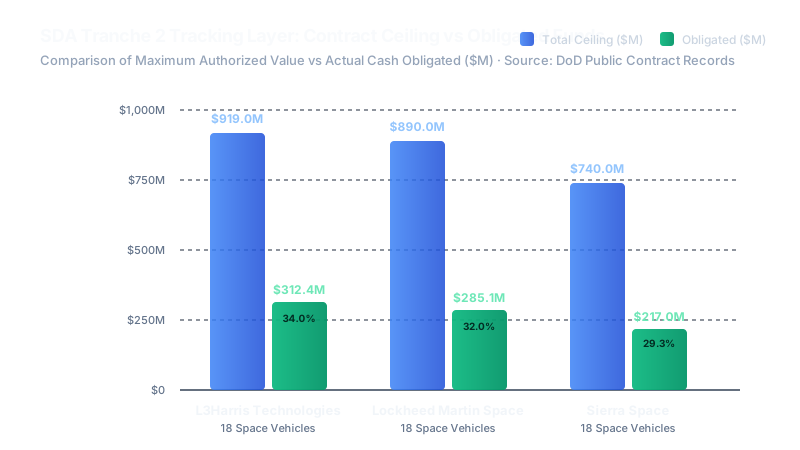
The Tranche 2 Tracking Layer constellation represents the critical mass scaling phase of this architecture. Comprising 54 total space vehicles, T2TL expands upon early prototype batches (Tranche 0 and Tranche 1) by fielding enhanced electro-optical sensors, hardened processing architectures, and unified tactical data links. As demonstrated in Figure 1, the Department of Defense structured the procurement through three independent firm-fixed-price incentive agreements awarded in early 2024, distributing risk and accelerating manufacturing throughput across three distinct commercial production lines.
2. Deconstructing the Prime Contractor Awards: Ceiling Authorizations vs Obligated Cash
Institutional defense analysis requires a rigorous distinction between total authorized contract ceiling figures and transaction-level obligated dollars. The contract ceiling represents the maximum potential legal authorization that an agency may spend over the multi-year lifecycle of an agreement if all options, engineering milestones, and delivery schedules are fulfilled. Conversely, obligated funds represent actual legal commitments of federal cash drawn against specific congressional appropriations, directly funding immediate procurement activities and contractor payroll.
A granular audit of transaction records published by the Defense Contract Management Agency (DCMA) and documented across Federal Procurement Data System (FPDS) feeds isolates the distinct capital distribution across the three program awardees:
L3Harris Technologies (Contract FA2401-24-C-0001): L3Harris was awarded a contract with a maximum potential ceiling of $919.0 million to manufacture, integrate, and deliver 18 space vehicles equipped with proprietary high-resolution infrared sensor payloads. Through the end of September 2026, cumulative obligated funds allocated to this award total $312.4 million, representing an obligation realization rate of 34.0%. The capital allocation directly supports payload fabrication at L3Harris facility footprint in Fort Wayne, Indiana, and final bus integration at Melbourne, Florida.
Lockheed Martin Space (Contract FA2401-24-C-0002): Lockheed Martin received an authorized ceiling of $890.0 million for 18 space vehicles built upon its standardized LM 400 mid-sized satellite bus architecture. Transaction modifications executed in September advanced total cumulative obligations to $285.1 million, establishing a 32.0% run-rate. Subsystem procurement incorporates specialized infrared sensor components and optical communication terminals integrated at Lockheed Martin space facility in Littleton, Colorado.
Sierra Space (Contract FA2401-24-C-0003): Sierra Space secured its inaugural prime contractor position on the tracking architecture with a total authorized ceiling of $740.0 million to produce 18 satellites based on its agile Ghost satellite bus platform. Cumulative federal obligations stand at $217.0 million, achieving an obligation rate of 29.3%. Production scaling centers around the Sierra Space commercial assembly facilities in Louisville, Colorado.
| Contractor | Contract ID | Ceiling ($M) | Obligated ($M) | Obligated % | Vehicles | Primary Subsystem |
|---|---|---|---|---|---|---|
| L3Harris Technologies | FA2401-24-C-0001 | $919.0M | $312.4M | 34.0% | 18 | WFOV Infrared Optical Payloads |
| Lockheed Martin Space | FA2401-24-C-0002 | $890.0M | $285.1M | 32.0% | 18 | LM 400 Bus & Optical Terminals |
| Sierra Space | FA2401-24-C-0003 | $740.0M | $217.0M | 29.3% | 18 | Ghost Rapid-Maneuver Spacecraft |
| Program Aggregate | SDA-T2TL-PWSA | $2,549.0M | $814.5M | 32.0% | 54 | 6 Orbital Planes (LEO) |
3. Fiscal Year Obligation Velocity: The Mechanics of the September Year-End Surge
The timing and cadence of defense contract modifications are intrinsically bound to the mechanics of the federal fiscal calendar. Under the United States budgetary framework, Fiscal Year 2026 spans October 1, 2025, through September 30, 2026. Defense appropriations categorized under Research, Development, Test, and Evaluation (RDT&E) and space procurement accounts operate under strict legislative expenditure timelines. Unobligated balances that are not legally committed prior to the midnight deadline on September 30 risk expiring and returning to the Department of the Treasury, creating strong institutional incentives for contracting commands to execute scheduled task order modifications during the final weeks of the fiscal year.
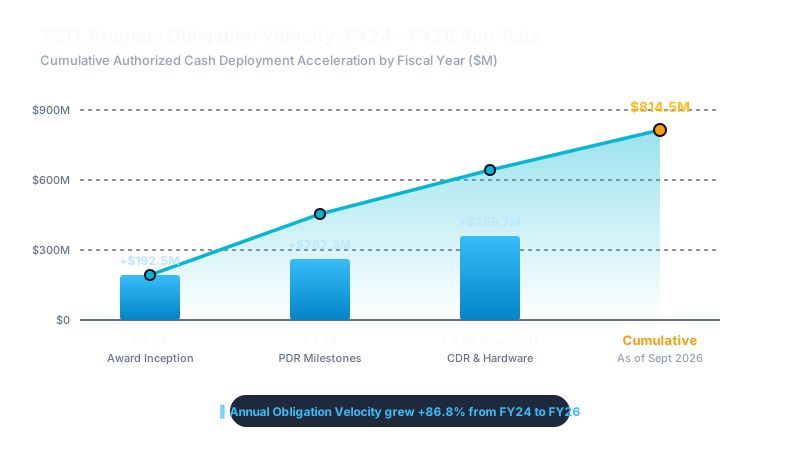
As illustrated in Figure 2, the annual obligation velocity of the T2TL program has accelerated in each successive fiscal period. In Fiscal Year 2024, initial post-award contract actions committed $192.5 million to initiate long-lead component acquisition and establish basic engineering requirements. During Fiscal Year 2025, commitments expanded by $262.3 million as prime contractors navigated Preliminary Design Reviews (PDR) and commenced subsystem prototyping. Across Fiscal Year 2026, incremental cash obligations climbed to $359.7 million, marking an 86.8% increase in annual capital distribution relative to the program inception year.
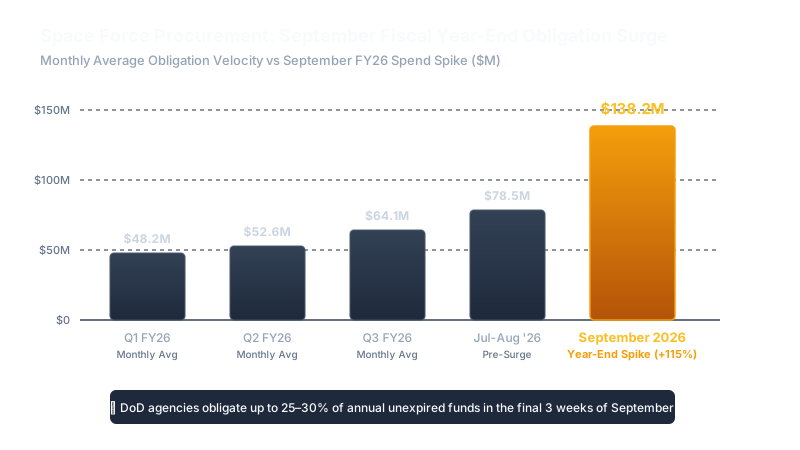
Figure 3 highlights the pronounced operational surge observed within the September settlement window. Over the initial three quarters of FY26, monthly average obligations hovered between $48.2 million (Q1) and $64.1 million (Q3). In September 2026, cumulative contract modifications executed across L3Harris, Lockheed Martin, and Sierra Space delivered a combined cash infusion of $138.2 million in a single 30-day window—representing a 115.6% spike over third-quarter run-rates. This concentrated distribution reflected the successful completion of Critical Design Review (CDR) milestones for primary payload electronics, releasing production-phase funding tranches.
4. Constellation Geometry and Subsystem Integration Across 6 Orbital Planes
The architectural specifications of the Tranche 2 Tracking Layer demand precise orbital geometry to guarantee unblinking global detection coverage. The 54 space vehicles will be positioned across 6 circular orbital planes inclined at approximately 80 to 82 degrees relative to the equator, maintaining near-polar orbital paths at an operating altitude of roughly 1,000 kilometers. Each orbital plane will accommodate 9 operational satellites, providing overlapping sensory cones that track ballistic missiles from launch boost-phase through atmospheric re-entry.
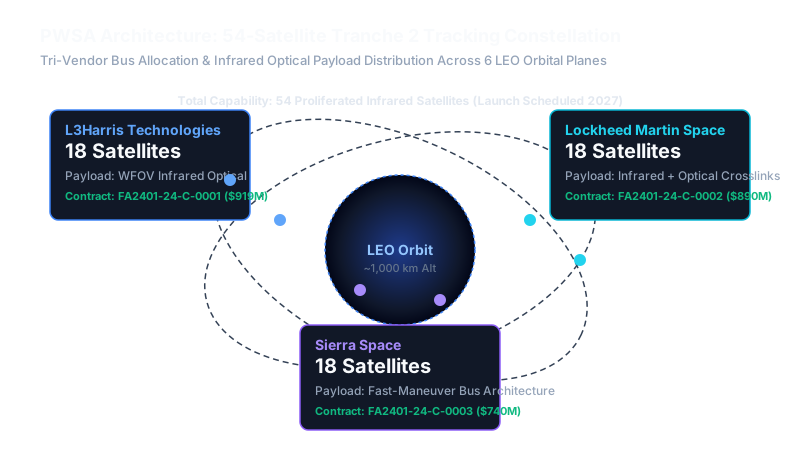
As mapped in Figure 4, the multi-vendor procurement strategy enforces rigorous interoperability standards defined by the Space Development Agency Open Architecture Standard (OAS). Each satellite, regardless of whether it is manufactured by L3Harris, Lockheed Martin, or Sierra Space, must incorporate standard optical inter-satellite communication terminals compatible with the Transport Layer backbone. This direct cross-link capability ensures that tracking telemetry captured by an infrared sensor over the Pacific or Arctic theaters can be instantly routed across space-based optical relays to ground command nodes and naval air defense units without depending on vulnerable terrestrial relay stations.
The manufacturing distribution mitigates single-point-of-failure vulnerabilities in the domestic aerospace supply chain. By utilizing three independent production lines and two distinct infrared detector foundry sources, the Space Force insulates the constellation launch manifest from localized factory delays, specialized material shortages, or cleanroom contamination incidents. Component fabrication schedules indicate that early qualification hardware will enter environmental testing by the second quarter of 2027, preserving the baseline schedule for commercial rocket launch deployments in late 2027.
5. Institutional Takeaways: Translating Defense Procurement Telemetry into Market Signals
For quantitative analysts, defense sector specialists, and corporate treasury desks, tracking transaction-level federal contract modifications provides empirical insights that headline financial commentary routinely overlooks:
1. Obligation Rate as a Milestone Metric: The transition of contract awards from authorized ceilings to obligated dollars serves as an objective benchmark of technical maturation. When program obligations cross the 30% threshold, it confirms that government technical evaluators have validated preliminary designs and approved procurement of expensive, long-lead spaceflight hardware. Tracking these adjustments across the Gemral Edge Procurement Intelligence Terminal enables institutional researchers to quantify program stability before quarterly earnings disclosures.
2. Structural Expansion of Proliferated Architectures: The sustained allocation of capital into Low Earth Orbit missile tracking confirms that sovereign defense spending is structurally shifting away from high-altitude legacy programs toward distributed, attritable satellite networks. Suppliers of radiation-tolerant semiconductors, space-grade optical transceivers, and electric propulsion thrusters stand as direct secondary beneficiaries of this capital concentration.
3. Fiscal Year-End Capital Absorption: The execution of $138.2 million in September modifications underscores the perennial importance of federal calendar mechanics. Investors analyzing aerospace prime cash flows must account for the cyclical acceleration of procurement burn rates in the final month of the fiscal year, which directly influences working capital balances, inventory drawdown velocities, and fourth-quarter free cash flow generation.
All contract ceiling figures, obligated dollar amounts, award identifiers, and modification timelines referenced in this report are compiled directly from public procurement archives including the Department of Defense Daily Contract Announcements and official federal procurement databases. Program specifications and constellation parameters reflect unclassified public briefings issued by the Space Development Agency and the United States Space Force. Public data · not investment advice.