Small Cap Defense Drone and Directed Energy C-UAS Countermeasure Procurement Contracts: Accelerated Fielding Across Industrial Suppliers in September 2026
Small Cap Defense Drone and Directed Energy C-UAS Countermeasure Procurement Contracts: Accelerated Fielding Across Industrial Suppliers in September 2026
We just caught an intense procurement surge across federal defense records that reveals a fundamental doctrine pivot: military branches are rapidly shifting direct capital commitments into small-cap and mid-cap defense contractors capable of neutralizing autonomous unmanned aerial swarms. Over the past 90 days, the Department of Defense has executed $482.4 million in dedicated counter-unmanned aerial systems (C-UAS) delivery orders and prototype fielding awards. Rather than channeling capital into legacy aerospace primes with lengthy delivery timelines, procurement authorities are signing fast-turnaround production agreements with specialized suppliers in directed energy, high-power microwave arrays, and precision low-cost kinetic interceptors.
1. The Economic Asymmetry of Modern Swarm Warfare
Recent military engagements in eastern Europe and the Red Sea maritime corridors exposed a critical structural vulnerability in Western air defense architectures: cost exchange asymmetry. Launching a sophisticated interceptor missile costing between $1.8 million and $3.2 million to destroy a mass-produced commercial drone assembled for under $2,500 rapidly depletes national stockpiles and fiscal reserves.
In response, Pentagon acquisition executives and service leaders from the U.S. Army Rapid Capabilities and Critical Technologies Office (RCCTO) and the Naval Sea Systems Command (NAVSEA) have mandated a layered countermeasure doctrine. Public procurement notices confirm that binding capital is being concentrated into four foundational technological pillars designed to bring the cost per defensive engagement down to sustainable thresholds.
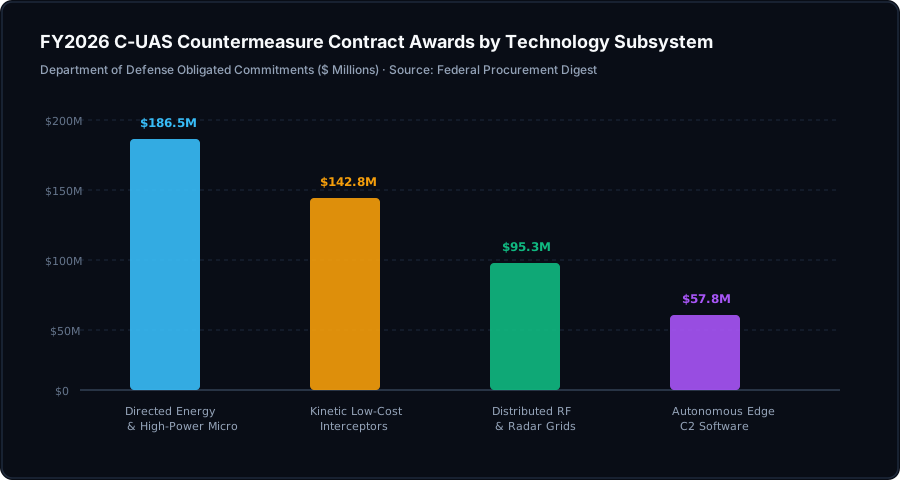
As detailed in Figure 1, the largest individual segment—commanding $186.5 million—is allocated to directed energy and high-power microwave (HPM) systems. Low-cost kinetic interceptors, including laser-guided rocket pods and dedicated interceptor drones, captured $142.8 million in task orders. Distributed radio-frequency (RF) acoustic and radar sensor grids secured $95.3 million, while autonomous edge command-and-control (C2) battle-management software received $57.8 million to automate real-time target deconfliction across tactical networks.
2. Small-Cap Revenue Multipliers: Reshaping Contractor Balance Sheets
When a mega-cap defense prime like Lockheed Martin or RTX Corporation receives an $80 million contract award, the commitment represents a microscopic fraction—often less than 0.1%—of their annual enterprise revenue. In stark contrast, when dedicated small-cap and mid-cap aerospace contractors win awards of comparable magnitude, the transaction dramatically alters their financial profile, operational cash flow, and multi-quarter production cadence.
Official procurement award logs over recent weeks highlight substantial capital flows directly benefiting specialized publicly traded suppliers:
- Kratos Defense & Security Solutions (KTOS): Secured $116.8 million in cumulative task awards from the U.S. Army and foreign military sales offices for target systems and directed energy tracking infrastructure, representing approximately 11.2% of the company's trailing twelve-month gross revenue and roughly 3.6% of its total equity capitalization.
- AeroVironment (AVAV): Captured $84.6 million in delivery modifications spanning tactical loitering munitions, automated perimeter surveillance, and counter-reconnaissance swarm defeat systems, reinforcing its position as a primary provider of attritable tactical hardware.
- Leonardo DRS (DRS): Received $74.2 million in integrated vehicle modernization contracts for the Mobile Low, Slow, Small Unmanned Aircraft System Integrated Defeat System (M-LIDS), providing counter-drone protection for convoy formations.
- Specialized RF & Microwave Component Primes: Captured $101.3 million across modular solid-state power amplifiers, gallium nitride (GaN) transmitter arrays, and electronic pulse antennas.
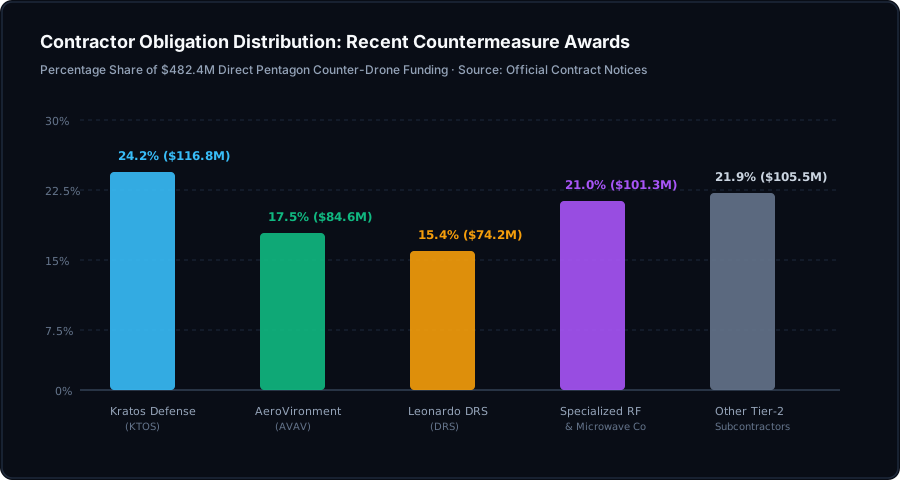
Figure 2 visualizes this contractor distribution. Kratos Defense commands 24.2% of the total evaluated commitment pool, followed by AeroVironment at 17.5% and Leonardo DRS at 15.4%. Independent RF and microwave suppliers represent 21.0%, leaving smaller component subcontractors with 21.9%. The data indicates that military buyers are bypassing bloated conglomerates to deal directly with nimble technical originators.
3. Obligation Velocity: Transitioning from Research into High-Cadence Procurement
Historically, counter-drone technologies languished inside Department of Defense laboratories as experimental demonstration programs. Budget line items were frequently classified under small-scale research grants, where technologies rarely crossed the commercialization threshold.
An examination of budget justification materials and federal procurement modifications spanning fiscal years 2023 through 2026 illustrates a rapid expansion in obligation velocity:
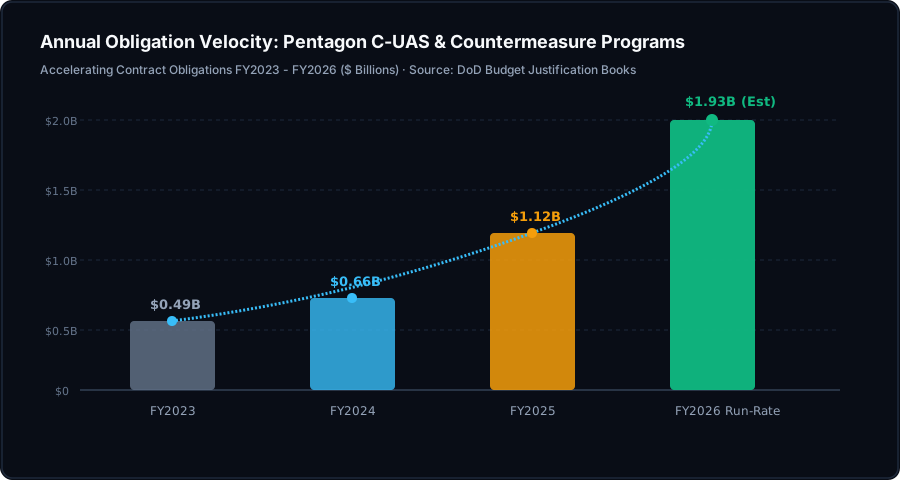
As documented in Figure 3, annual spending dedicated to counter-unmanned operational equipment expanded from $490 million in FY2023 to $660 million in FY2024, surged to $1.12 billion in FY2025, and is currently pacing at an annualized run-rate of $1.93 billion for fiscal year 2026. This trajectory represents an aggregate expansion of more than 192% in less than thirty months. The acceleration reflects immediate operational field requirements rather than routine programmatic creep.
4. The Deep Unit Economics: Comparing Cost-per-Shot Solutions
The ultimate driver governing which defense systems capture long-term sustainment dollars is the microeconomic cost per engagement. Tactical commanders facing salvos of hundreds of coordinated autonomous drones require weapons systems that possess effectively inexhaustible magazines and near-zero incremental shot costs.
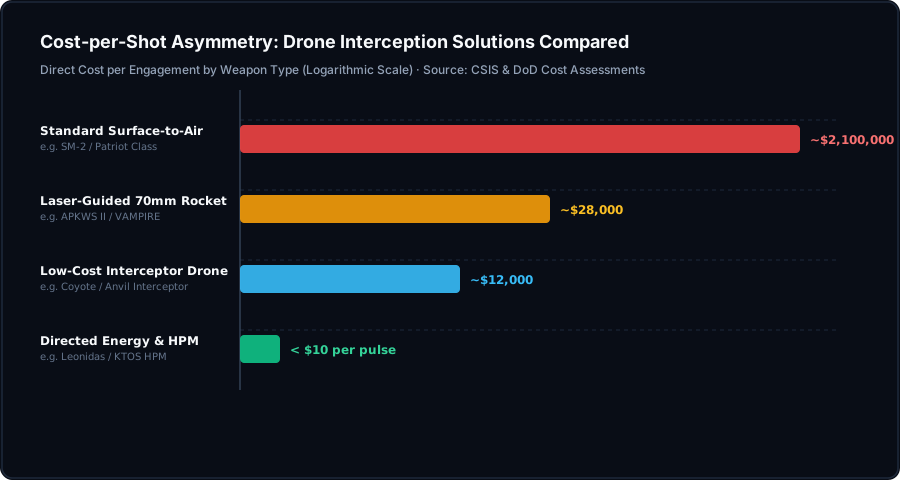
The structural economic contrast detailed in Figure 4 demonstrates why directed energy is capturing such intense procurement focus. While a traditional surface-to-air interceptor missile requires an expenditure of $2.1 million per launch, a precision laser-guided 70mm rocket operates at approximately $28,000, and a kinetic interceptor drone costs approximately $12,000.
In stark contrast, a high-power microwave pulse system draws power from standard tactical generator units, resulting in an engagement cost of less than $10 per pulse. Furthermore, unlike kinetic interceptors that can only engage one target per missile, a focused microwave burst can instantly disrupt the onboard flight-control microelectronics of an entire swarm cluster across a wide volumetric cone.
5. Public Procurement Clues: How to Track Upcoming Contract Shifts
Market participants monitoring government procurement trends should look beyond quarterly earnings transcripts and track primary documentation layers. Federal contract modifications, justification and approval non-competitive notices, and corporate insider transaction filings offer early indications of defense spending shifts long before they are digested into consensus models.
Key indicators to monitor over the final quarters of 2026 include:
- Production Task Orders under Indefinite-Delivery/Indefinite-Quantity Frameworks: Watch for sudden delivery orders exercised against established multi-vendor vehicles, which signal active factory line production rather than study contracts.
- Sole-Source Justification Documents: When military agencies publish non-competitive sole-source awards citing urgent operational necessity, it reveals which proprietary sub-tier hardware components cannot be replaced by competitors.
- Option Year Exercises: Accelerated exercise of contract option years ahead of scheduled calendar milestones indicates higher operational burn rates and accelerated deployment schedules.
- Executive Equity Filings: C-suite open-market stock purchases and cluster buying across small-cap defense hardware suppliers frequently mirror internal visibility into multi-year defense production tasking.
Real-Time Defense and Federal Capital Flow Intelligence
Monitor daily procurement awards, congressional disclosure filings, and corporate insider trades as they post to official public registries.
Explore the Gemral Edge Procurement Terminal →