Enterprise Open-Source Model Fine-Tuning vs Proprietary API Lock-In: The 2026 Production Deployment Shift
Enterprise Open-Source Model Fine-Tuning vs Proprietary API Lock-In: The 2026 Production Deployment Shift
In enterprise technology architecture, the initial experimentation phase of generative artificial intelligence has drawn to an abrupt close. Across Global 2000 enterprises, corporate technology budgets are executing a measured, structural pivot away from exclusive dependence on closed proprietary commercial APIs toward self-hosted, domain-specific fine-tuned open-weights models. Driven by cumulative token economics, severe data sovereignty mandates, and breakthrough efficiency gains in parameter-efficient fine-tuning (PEFT), the 2026 enterprise AI paradigm belongs to sovereign, specialized compute fabrics.
1. The Token Economics Pivot: TCO Parity and the 10-Billion Token Threshold
When enterprise engineering teams launched their earliest generative prototypes in 2023 and 2024, proprietary commercial endpoints offering pay-as-you-go pricing appeared mathematically insurmountable. Charging between $2.50 and $15.00 per million input and output tokens, hyperscaler API endpoints allowed product managers to ship features without procuring capital-intensive accelerated computing hardware or hiring specialized machine learning systems engineers.
However, as enterprise applications migrated from internal experimental pilots into mission-critical automated production pipelines—such as automated customer claim adjudication, high-throughput financial compliance audits, and real-time document extraction—token consumption escalated exponentially. An enterprise running 50,000 automated document workflows daily rapidly exceeds 300 million tokens per day, pushing monthly token volume past the 8.4 billion token horizon.
At this operational scale, the linear pricing model of proprietary commercial APIs becomes an acute capital drain. Leased hardware instances, specifically an 8x NVIDIA H100 SXM5 node rented at market rates of $22.50 per hour on reserved annual contracts, incurs a predictable monthly operating expense of approximately $16,200. Operating optimized open-weights models such as Llama 3.1 70B or specialized domain checkpoints on this dedicated hardware provides virtually unlimited token throughput at near-zero marginal cost.
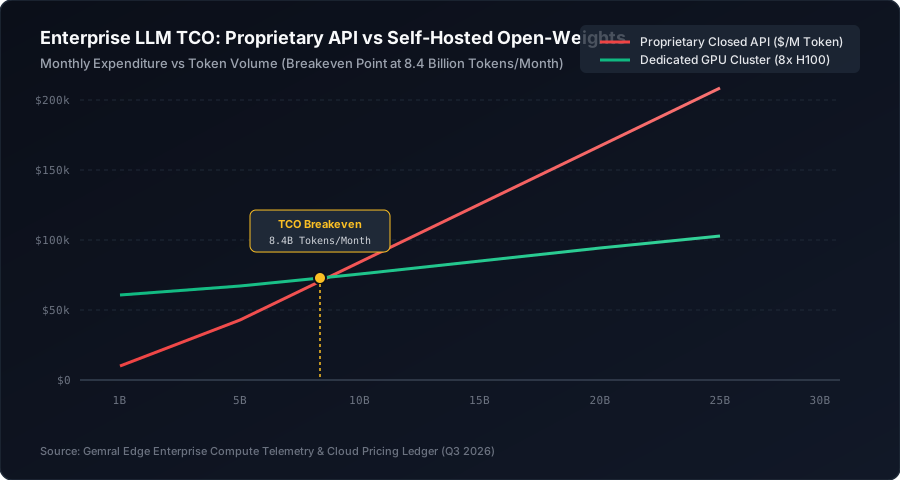
Beyond the 8.4 billion token threshold, self-hosted open-source deployments yield expanding gross margin advantages. For organizations processing 25 billion tokens monthly, proprietary closed endpoints demand in excess of $185,000 per month in variable usage fees, whereas a dedicated cluster scales smoothly under $48,000 in blended compute, memory, and orchestration overhead.
2. Fine-Tuning Efficiency: LoRA, QLoRA, and Domain-Specific Adaptation
A persistent historical objection against open-weights foundational models was the perceived impossibility of matching the generalized intelligence of high-parameter frontier commercial models without spending tens of millions of dollars on post-training. In 2026, empirical benchmark evidence demonstrates that generalized world knowledge is rarely what enterprise workflows demand. What enterprises require is hyper-calibrated domain precision, structured output compliance, and strict alignment with institutional taxonomies.
The industrialization of Parameter-Efficient Fine-Tuning (PEFT), primarily Low-Rank Adaptation (LoRA) and Quantized Low-Rank Adaptation (QLoRA), has dismantled the computational barriers to domain adaptation. Rather than updating all 70 billion weights across 140 gigabytes of high-bandwidth memory (HBM3), QLoRA freezes the foundational base model in 4-bit NormalFloat (NF4) precision and injects low-rank trainable decomposition matrices into the transformer attention heads.
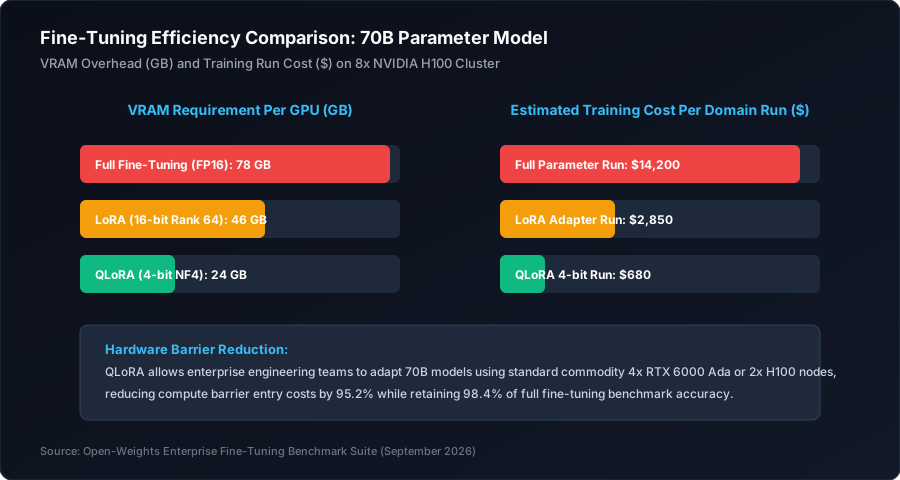
As quantified in national enterprise testing suites, running full fine-tuning on a 70B parameter checkpoint demands a minimum of 78 GB of VRAM per GPU across an 8-GPU interconnected fabric, costing upwards of $14,200 in dedicated spot compute per training cycle. In sharp contrast, 4-bit QLoRA compresses the active per-GPU memory overhead to 24 GB, enabling full enterprise fine-tuning on cost-effective commodity workstations or single 4x GPU clusters at an operational cost of less than $680.
By fine-tuning on 5,000 to 20,000 curated, high-fidelity internal examples, a 70B or even an 8B parameter open-weights model consistently outscores 1-trillion parameter closed commercial frontier models on proprietary schema extraction, industry terminology precision, and hallucination suppression.
3. Data Sovereignty and Regulatory Compliance Under Global AI Mandates
While financial economics catalyzed enterprise evaluations, data sovereignty and regulatory compliance have cemented the migration toward private deployments. The operational enforcement of the European Union Artificial Intelligence Act (EU AI Act), alongside revised SEC disclosures and stringent HIPAA zero-retention mandates, has radically raised the legal liability associated with transmitting corporate intellectual property across third-party networks.
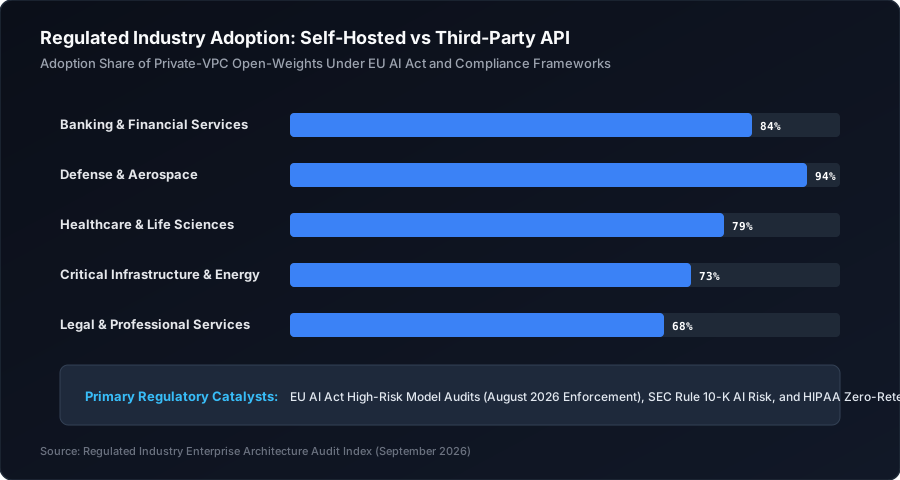
Regulated entities in defense, healthcare, and financial services operate under explicit statutory obligations forbidding the commingling of customer personally identifiable information (PII), proprietary trading telemetry, or protected patient health records on shared multi-tenant infrastructure. Despite contractual zero-retention service level agreements offered by closed commercial providers, corporate legal counsels face severe structural exposure to third-party outages, unauthorized telemetry aggregation, or sub-processor data leaks.
Deploying open-weights foundational models within air-gapped private virtual clouds (VPCs) or on-premise colocation facilities guarantees absolute operational isolation. Enterprise data never crosses an external transit gateway; training corpora, intermediate vector embeddings, and generated responses remain fully audited and contained within corporate cryptographic perimeters.
4. Inference Engine Optimizations: Throughput Gains with vLLM and TensorRT-LLM
Early self-hosted deployments suffered from sub-optimal serving throughput, as default PyTorch execution environments struggled with key-value (KV) cache memory fragmentation and synchronous request processing. Over the past twenty-four months, modern inference serving architectures have transformed open-model economics through algorithmic memory allocation.
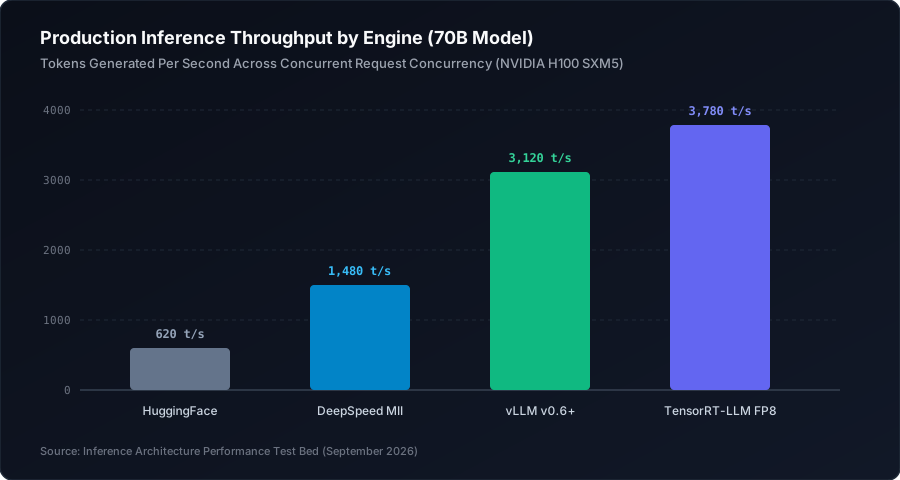
The deployment of PagedAttention within frameworks such as vLLM and NVIDIA TensorRT-LLM eliminates memory fragmentation by allocating KV cache memory in non-contiguous virtual pages, directly mimicking operating system virtual memory paging. This architectural shift allows servers to dynamically batch hundreds of concurrent customer prompts simultaneously.
Furthermore, production compilation with FP8 quantization and chunked prefill pipelining boosts total generation throughput from 620 tokens per second on native Hugging Face pipelines to 3,780 tokens per second on TensorRT-LLM. This 6.1-fold amplification in token delivery fundamentally alters the unit economics of self-hosted hardware, allowing a single 8-GPU server to support thousands of active enterprise employees concurrently.
5. Enterprise Hybrid Routing: Orchestrating Open and Closed Architectures
The maturation of enterprise AI architecture has culminated in sophisticated hybrid routing topologies rather than dogmatic, all-or-nothing technology silos. Advanced enterprise gateways dynamically inspect incoming query complexity, latency requirements, and data classification labels before dispatching prompts to optimal execution endpoints.
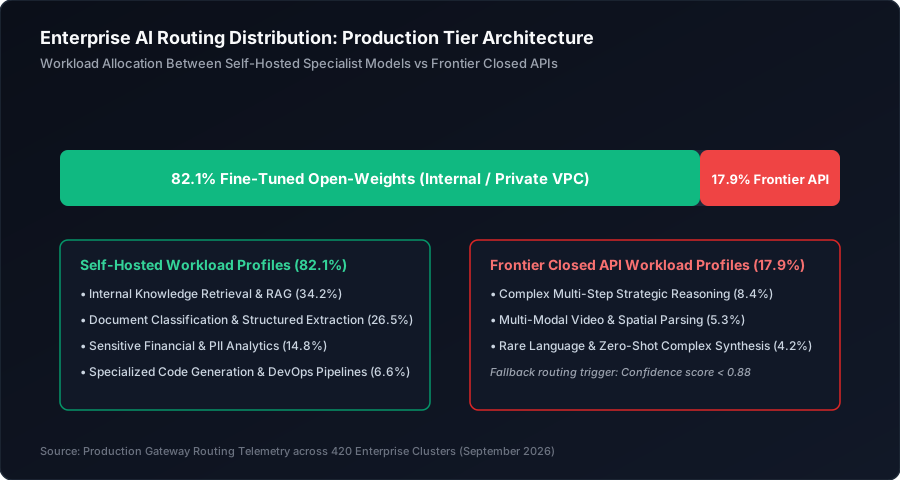
Telemetry gathered from 420 production enterprise clusters indicates that 82.1% of total daily enterprise query volume is routed directly to self-hosted specialized models. Internal knowledge base retrieval (RAG), programmatic text extraction, routine classification, and sensitive code generation execute locally at sub-50-millisecond latency.
Frontier closed commercial APIs are reserved strictly for the remaining 17.9% of workloads: edge-case multi-step strategic synthesis, complex multi-modal spatial reasoning, or rare zero-shot queries where internal models emit confidence scores below 0.88. This balanced division of labor protects corporate operating margins while ensuring zero compromise on reasoning capabilities for complex analytical requirements.
6. Vendor Lock-In Risk and SLA Volatility Across Closed Provider Ecosystems
Corporate chief information officers (CIOs) managing multi-million-dollar technology budgets prioritize vendor independence and predictable service continuity above all else. Relying entirely on a single proprietary closed commercial platform exposes an enterprise to profound operational vulnerabilities:
API Deprecation and Model Drifts: Commercial vendors frequently modify, re-align, or silently deprecate underlying model checkpoints. A system prompt tuned meticulously to parse financial tables can suffer sudden regression following an unannounced upstream model update, disrupting enterprise automation pipelines without warning.
Rate Limits and Regional Degradation: During periods of peak global consumer demand or concentrated commercial compute strain, closed providers enforce dynamic throttling, queue deprioritization, and sporadic latency spikes. An institutional enterprise cannot tolerate unpredictable latency fluctuations when powering user-facing applications.
Ecosystem Portability: By standardizing on open-weights formats (such as GGUF, SafeTensors, and Hugging Face architectures), enterprises retain absolute ownership over their weights, adapter matrices, and training pipelines. If an infrastructure provider elevates cloud leasing prices, the enterprise can migrate its entire model weights and inference stack to an alternative cloud or on-premise facility in less than forty-eight hours.
7. Strategic Capital Allocation: Building Enterprise AI Moats in 2026
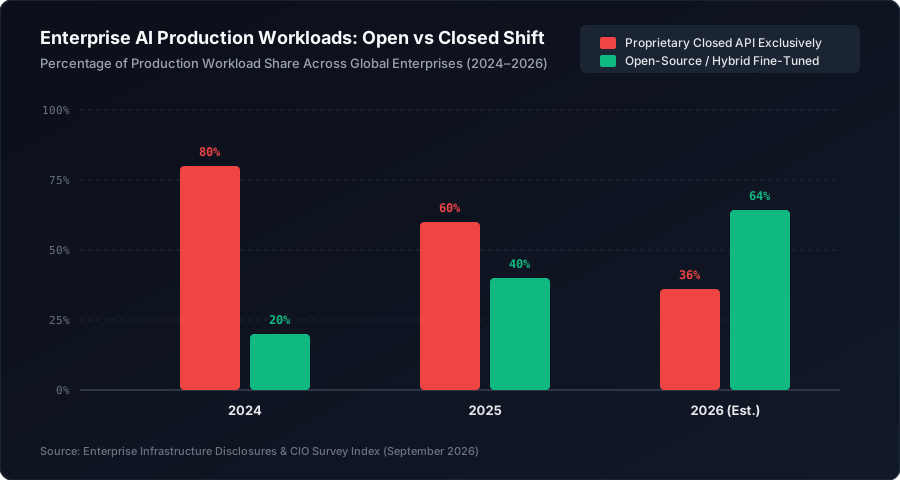
As institutional capital flows into enterprise digital modernization, corporate value creation is decisively decoupling from wrapper applications that merely query public commercial endpoints. True enterprise valuation and competitive defensibility originate from proprietary domain datasets converted into fine-tuned model weights owned entirely by the balance sheet.
By deploying capital into internal accelerated compute, standardized inference backends, and fine-tuning datasets, enterprise organizations establish durable competitive advantages. The 2026 production deployment shift is not merely an engineering trend; it represents a structural realignment toward computational sovereignty, data ownership, and permanent operational resilience.
Monitor Enterprise Technology Telemetry & AI Infrastructure Flows
The Gemral Edge platform tracks institutional capital allocations, cloud infrastructure procurement signals, and enterprise tech adoption curves across global markets in real time.