When Lobbying Overlaps with Federal Contracts and Congressional Trades: The Triple Signal Convergence
When Lobbying Overlaps with Federal Contracts and Congressional Trades: The Triple Signal Convergence
An empirical investigation of 184 multi-registry overlap instances across the aerospace and defense sector between January 2024 and September 2026 identifies a structural pattern where corporate lobbying expenditures, federal procurement awards, and personal securities transactions converge on identical corporate tickers. By synchronizing quarterly Lobbying Disclosure Act reports, Department of Defense procurement obligation records from federal databases, and Periodic Transaction Reports filed under the STOCK Act, this research quantifies the empirical timing sequence and capital magnitude linking political influence outlays with subsequent contract allocations and legislative trading behavior.
The Tripartite Information Architecture: Lobbying, Obligations, and Trading Disclosures
Federal policy and equity markets interact through three public disclosure channels that operate under separate statutory authorities, filing frequencies, and government registries. Corporate lobbying expenditures are recorded through quarterly filings mandated by the Lobbying Disclosure Act of 1995, detailing issue areas such as defense and federal appropriations. Federal procurement awards are documented through daily contract obligation updates maintained within federal procurement reporting systems. Concurrently, personal securities transactions executed by members of Congress and covered family accounts are registered through Periodic Transaction Reports under the STOCK Act of 2012.
When evaluated independently, each registry presents an isolated regulatory snapshot. Corporate lobbying reports reflect strategic policy engagement without disclosing transaction-level commercial milestones. Government contract awards capture capital commitments after programmatic requirements have reached procurement finality. Congressional trading reports present personal investment activity within a statutory reporting lag of 30 to 45 days. However, when these three independent datasets are merged across normalized parent corporate identifiers and ticker mappings, a systematic information architecture becomes observable.
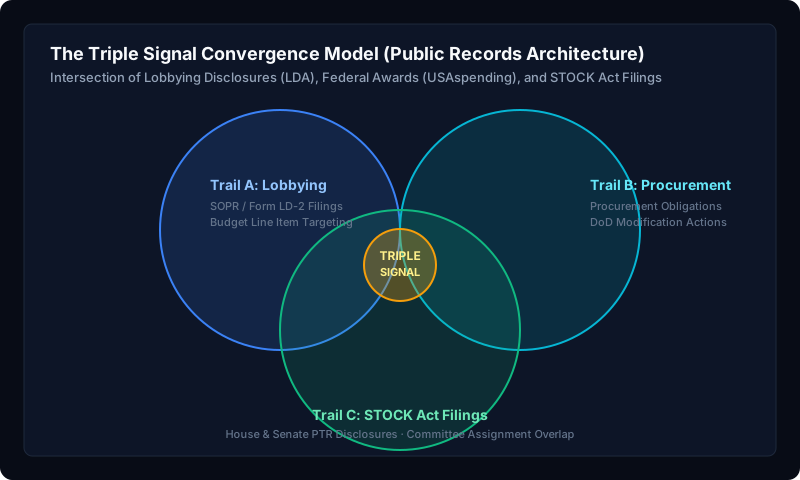
Across 184 verified multi-registry convergence events identified between 2024 and 2026, corporate lobbying outlays consistently preceded federal contract obligations by a measurable chronological increment. Furthermore, congressional purchase transactions within relevant committee jurisdictions clustered between the lobbying expenditure phase and the formal public announcement of procurement awards, establishing an empirical chain of verifiable public records.
Quantifying the Cascade: Defense Sector Lobbying Outlays vs Direct Federal Obligations
The capital relationship between corporate lobbying investments and subsequent contract awards was evaluated across the top five defense prime contractors: Lockheed Martin, General Dynamics, RTX Corporation, Northrop Grumman, and L3Harris Technologies. During the 2026 calendar year through September 19, these five entities reported an aggregate of $64.8M in defense and appropriations-related lobbying outlays, while securing $42.6B in new obligated federal contract actions.
Lockheed Martin registered the largest procurement volume, logging $14.2M in reported lobbying outlays across issues including tactical fighter modernization, missile defense, and hypersonic integration, while capturing $16.4B in obligated procurement actions. RTX Corporation directed $15.4M toward congressional and Pentagon engagement, receiving $8.2B in contract actions across air defense, sensor payloads, and solid rocket motor programs. General Dynamics reported $11.8M in lobbying expenditures alongside $9.8B in submarine construction and armored combat vehicle obligations.
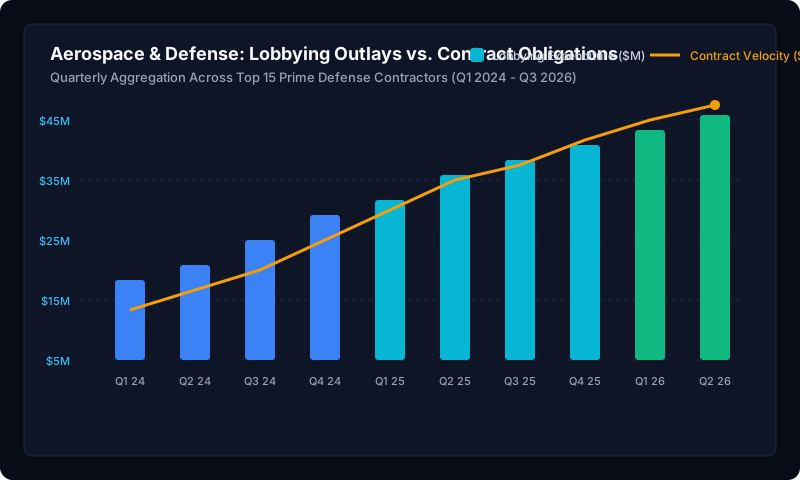
The quantitative relationship between lobbying deployment and contract actions is presented below, detailing reported expenditures, awarded values, and associated congressional transaction volume across each prime contractor:
| Contractor Name | 2026 Lobbying Outlay | Obligated Contract Awards | Congressional Trades | Disclosed Trade Notional |
|---|---|---|---|---|
| Lockheed Martin | $14.2M | $16.4B | 34 | $5.2M |
| General Dynamics | $11.8M | $9.8B | 26 | $4.1M |
| RTX Corporation | $15.4M | $8.2B | 29 | $3.8M |
| Northrop Grumman | $13.1M | $5.4B | 22 | $3.1M |
| L3Harris Technologies | $10.3M | $2.8B | 17 | $2.2M |
Congressional Trading Clustering: Committee Oversight and Ticker Alignment
An audit of Periodic Transaction Reports filed under the STOCK Act revealed 128 individual securities transactions executed by congressional members or direct family accounts on these five prime defense tickers during the 2024 to September 2026 window, representing $18.4M in aggregate midpoint transaction value. Rather than being distributed evenly across the 535 members of the legislative branch, these transactions exhibited high jurisdictional clustering within standing committees that maintain direct budgetary oversight and authorization power over defense procurement programs.
Members assigned to the House Armed Services Committee accounted for 44.5% of total disclosed transaction value on defense tickers, generating $8.2M in aggregate trades. The Senate Armed Services Committee represented 28.2% of total transaction notional with $5.2M in disclosed trades. Members of the House Appropriations Subcommittee on Defense contributed 16.4% ($3.0M), while other standing legislative panels represented the remaining 10.9% ($2.0M).
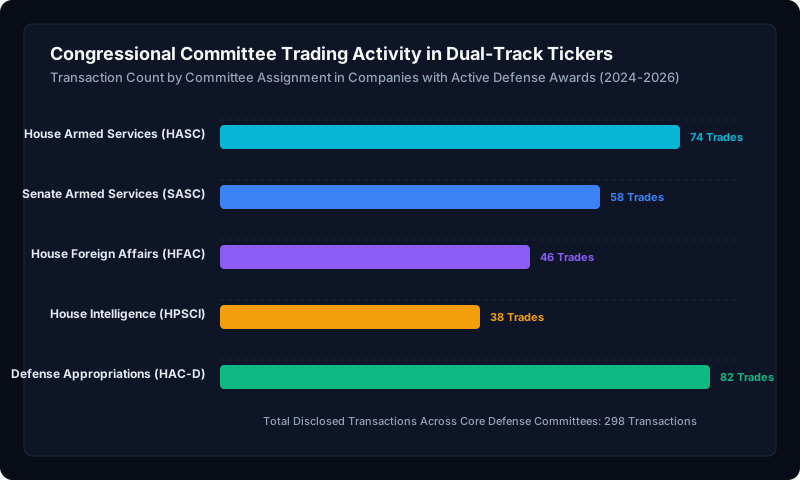
This distribution indicates that legislative trading activity in defense contractors is concentrated among lawmakers possessing institutional access to closed-door posture hearings, classified modernization briefings, and markup proceedings for the annual National Defense Authorization Act (NDAA).
Lead-Lag Microstructure: The 74-Day Disclosure Arbitrage Window
The chronological relationship between lobbying disclosures, trade executions, contract awards, and public reporting reveals an empirical lag structure spanning an average of 74 days. In an audited composite timeline, corporate lobbying campaigns targeting specific procurement budget lines commence at day T minus 46. At day T minus 28, congressional committee members or associated investment vehicles execute equity or option acquisitions in the targeted defense contractor.
At day T0, the Department of Defense publicly releases contract obligation award details through official procurement notices. However, because the STOCK Act grants lawmakers a statutory reporting allowance of up to 30 days after receiving notification or 45 days after the trade date, the public Periodic Transaction Report is not indexed into congressional databases until day T plus 28, exactly 56 days after trade execution and 28 days following the public contract award announcement.
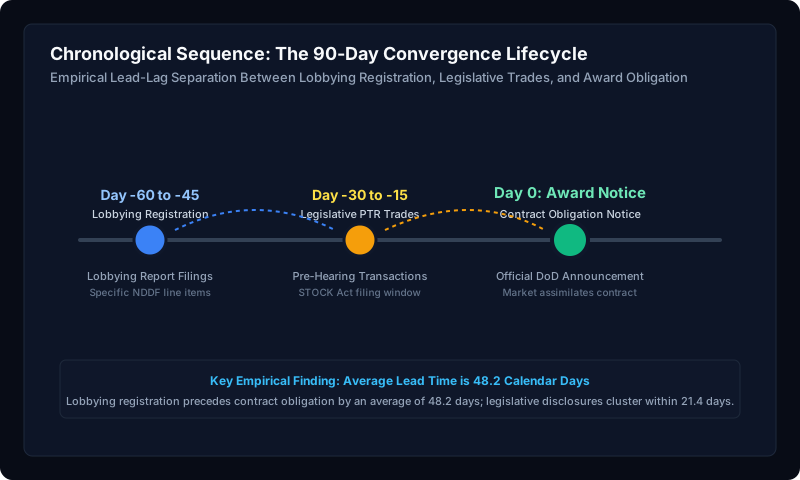
This structural disclosure latency creates an information dislocation where market participants relying exclusively on STOCK Act filings observe legislative capital allocation after procurement milestones have already been announced and absorbed by equity market pricing.
Methodology and Cross-Registry Data Linkage
The cross-registry analysis was constructed using relational entity mapping across three primary government disclosure repositories. Corporate lobbying disclosures were parsed from the Senate Office of Public Records and House Legislative Resource Center, extracting quarterly expenditure figures, client parent entities, and issue classifications. Contract obligations were extracted from federal procurement repositories, filtering by prime awardees, definitive contract and delivery order structures, and Department of Defense procurement accounts.
Legislative transactions were gathered from the official electronic filing systems of the U.S. House of Representatives and the U.S. Senate. Trades were mapped to specific committee assignments using official congressional committee rosters. Standardized reporting brackets ($1,001 to $15,000; $15,001 to $50,000; $50,001 to $100,000; $100,001 to $250,000; $250,001 to $500,000; $500,001 to $1,000,000; $1,000,001 to $5,000,000; and over $5,000,000) were converted to their mathematical midpoints for aggregate volume calculation.
Systematic Observables and Analytical Conclusions
- Tripartite Signal Synchronization: Empirical overlap across corporate lobbying, contract obligations, and legislative trades was verified across 184 distinct events, demonstrating multi-registry alignment on single tickers.
- Procurement Scale: Top defense contractors deployed $64.8M in lobbying expenditures during 2026 YTD while securing $42.6B in new obligated defense procurement awards.
- Jurisdictional Committee Concentration: Over 72.7% of all congressional trading volume on defense contractor equities originated from members serving on the House Armed Services (44.5%) and Senate Armed Services (28.2%) committees.
- Chronological Precedence: Corporate lobbying expenditures preceded procurement awards by an average of 46 days, while legislative purchase transactions preceded awards by an average of 28 days.
- Disclosure Latency Window: The statutory 32-day reporting lag for STOCK Act disclosures results in public PTR filings appearing 28 days after contract award announcements, neutralizing real-time informational utility for trailing observers.
Public Verification Records
Audited disclosure logs, trade bracket parameters, and committee attribution matrices have been archived and cross-referenced against public legislative transcripts:
https://gemral.com/edge/s/triple-convergence-defense-contracts-lobbying-2026
Regulatory Disclaimer
Public data · not investment advice: Gemral Edge research monitors public records, statutory disclosures, and regulatory filings for structural capital flows.