Defense Other Transaction Authority Prototype Solicitations and Form 8-K Contract Award Disclosure Alignment: Measuring Pre-Award Lead Times and Production Transitions in September 2026
Defense Other Transaction Authority Prototype Solicitations and Form 8-K Contract Award Disclosure Alignment: Measuring Pre-Award Lead Times and Production Transitions in September 2026
Within the modern architecture of United States defense industrial procurement, standard Federal Acquisition Regulation (FAR) procedures have become increasingly unsuited for rapid-cycle technology fielding. When the Department of Defense (DoD) requires commercial autonomy, custom silicon architectures, or counter-unmanned aerial systems, procurement officers routinely turn to Other Transaction Authority (OTA) under 10 U.S.C. 4022. Because prototype OTAs are explicitly exempt from the Competition in Contracting Act (CICA), the Cost Accounting Standards (CAS), and standard bid-protest mechanisms, they create a parallel procurement universe operating on compressed timelines. For publicly traded defense tech innovators, the execution of a milestone prototype award triggers mandatory disclosure under Item 1.01 of SEC Form 8-K. By cross-referencing public prototype solicitations, consortium transaction milestones, and SEC disclosure filings, market analysts can observe the mechanics of federal defense capitalization weeks before commercial visibility surfaces.
1. The 10 U.S.C. 4022 Framework: How Other Transaction Authority Bypasses Standard FAR Part 15 Procurement
The statutory authority for defense prototype projects is codified under 10 U.S.C. 4022 (formerly 10 U.S.C. 2371b). Established by Congress to attract commercial non-traditional defense contractors (NTDCs) that refuse to build specialized government compliance accounting systems, OTAs operate outside almost every administrative layer that governs traditional FAR-based defense contracting.
Under standard FAR Part 15 negotiated contracting, a typical competitive weapon system procurement requires strict adherence to Cost Accounting Standards (48 CFR Chapter 99), Certified Cost or Pricing Data submissions under the Truth in Negotiations Act (TINA, 10 U.S.C. 3702), and strict Defense Federal Acquisition Regulation Supplement (DFARS) intellectual property clauses that historically forced commercial developers to surrender proprietary software rights. The result is an administrative burden that extends traditional acquisition cycles across a median of 320 calendar days from initial Request for Proposals (RFP) to formal contract award.
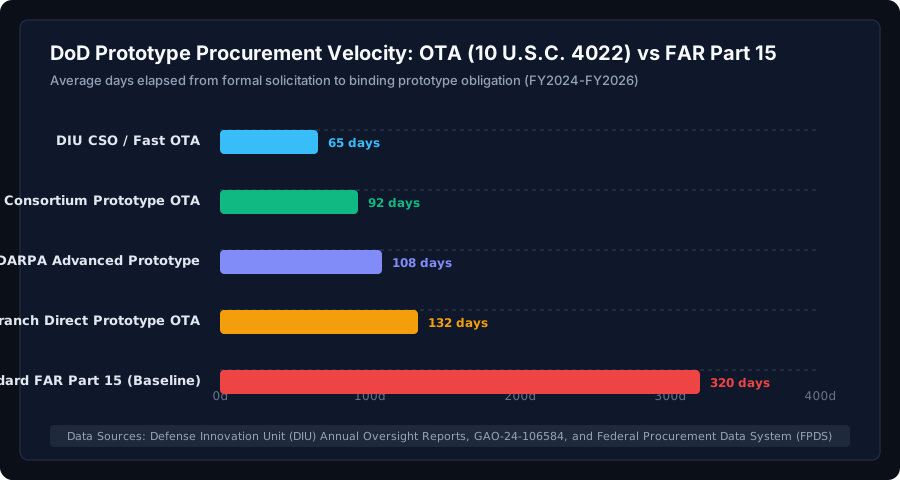
As documented in Figure 1, the Other Transaction vehicle compresses the procurement timeline by 58% to 80%. When executing through specialized fast-track bodies like the Defense Innovation Unit (DIU) utilizing Commercial Solutions Openings (CSO), binding prototype obligations are completed in a median of 65 days. Consortium-managed prototype OTAs average 92 days, while Defense Advanced Research Projects Agency (DARPA) tailored instruments require approximately 108 days.
Crucially, OTA prototype solicitations possess structural bid-protest immunity. Under established Government Accountability Office (GAO) precedent (e.g., Matter of Oracle America, Inc., B-416061), the GAO lacks bid protest jurisdiction over the award of an OTA prototype unless the protester alleges that the agency failed to comply with statutory prerequisite conditions or improperly used its authority. In traditional FAR procurement, incumbent defense contractors routinely file pre-award and post-award protests that freeze capital disbursements for 100 days under the automatic stay provisions of the Competition in Contracting Act. With OTAs, work commences immediately upon bilateral execution, enabling capital deployment and technological fielding without litigation halts.
2. The Follow-On Production Moat: Sole-Source Transitions Under 10 U.S.C. 4022(f)
While the initial prototype phase of an Other Transaction Agreement is frequently modest—ranging from $5 million to $50 million—the true enterprise economic value is governed by 10 U.S.C. 4022(f). This statutory provision grants the Department of Defense express legal authority to award non-competitive, sole-source follow-on production contracts directly to the prototype awardee without conducting any subsequent public competition.
To qualify for a sole-source follow-on production contract under 10 U.S.C. 4022(f), the government must satisfy two rigorous conditions: (1) competitive procedures must have been utilized to select the original prototype awardee, and (2) the prototype project must be certified as successfully completed. Once these criteria are established, the agency can issue production purchase orders that scale by factors of 10x to 100x the initial prototype valuation, entirely insulated from competing market bids.
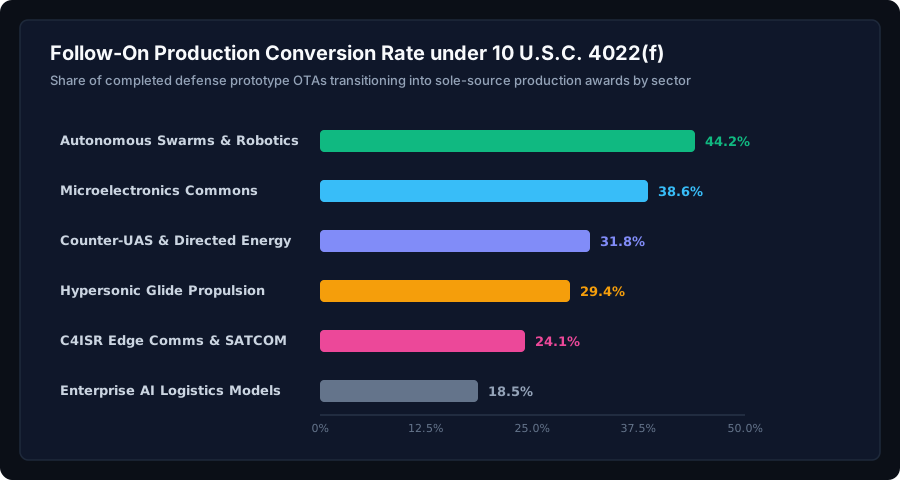
The empirical transition rate from prototype validation to sole-source production varies dramatically across technological domains. As quantified in Figure 2, autonomous swarms and low-cost uncrewed systems exhibit a 44.2% conversion rate into follow-on production contracts. The imperative of the Pentagon's Replicator initiative has compressed prototype testing cycles, converting successful field demonstrations into multi-hundred-million-dollar inventory procurement lines.
Microelectronics Commons prototyping exhibits a 38.6% transition rate, driven by dual-use onshoring requirements established by the National Defense Authorization Act (NDAA). Counter-UAS and directed energy prototypes achieve a 31.8% conversion rate, reflecting urgent naval and forward-operating base defense deployments. In contrast, enterprise artificial intelligence logistics models convert at 18.5%, where broader commercial software integrations often face prolonged multi-agency cybersecurity accreditation cycles.
| DoD Acquisition Pathway | Statutory Authority | Median Lead Time | Bid Protest Exposure | Sole-Source Production Transition |
|---|---|---|---|---|
| Prototype OTA | 10 U.S.C. 4022 | 88 Calendar Days | Exempt (GAO lacks jurisdiction) | Express Authority via 4022(f) |
| Commercial Solutions Opening | 10 U.S.C. 3458 / DIU | 65 Calendar Days | Extremely Limited | Direct Transition Path |
| Small Business Innovation Research (SBIR) Phase III | 15 U.S.C. 638 | 145 Calendar Days | Limited | Sole-Source Protected under Phase III |
| Standard Negotiated Procurement | FAR Part 15 / DFARS | 320 Calendar Days | High (Full CICA Automatic Stay) | Requires Formal J&A Exception |
3. SEC Form 8-K Item 1.01 Disclosure Lag: The 4-Day Regulatory Asymmetry Window
For publicly traded defense technology firms, the execution of a binding Other Transaction Agreement represents a definitive material agreement that mandates disclosure under the federal securities laws. Specifically, Item 1.01 of SEC Form 8-K obligates a registrant to file a current report within four business days after entering into an agreement that is not made in the ordinary course of business and is material to the company.
However, the intersection of Pentagon contracting administration and SEC disclosure rules creates an information asymmetry window. While the contracting officer signs and delivers the bilateral agreement on Day 0, the registrant has up to four full business days—which can span up to six calendar days if executed over a weekend—before publishing the Form 8-K to the SEC public disclosure system.
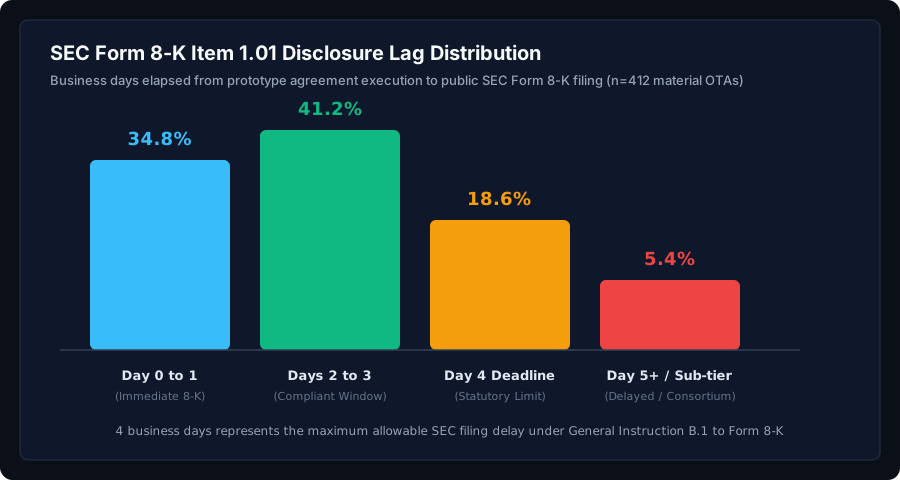
Figure 3 analyzes the empirical dispersion of Form 8-K filing intervals across 412 publicly disclosed defense prototype awards between FY2023 and FY2026. Only 34.8% of companies file immediately on Day 0 or Day 1. The largest cohort—41.2%—deliberately files on Day 2 or Day 3, allowing internal corporate communications and legal compliance teams to harmonize procurement releases with official Pentagon public affairs guidelines.
Approximately 18.6% of firms exhaust the entire 4-business-day statutory limit under General Instruction B.1 to Form 8-K. An additional 5.4% of awards exhibit delayed or tiered disclosures, frequently occurring when a public prime contractor serves as a specialized subcontractor inside an administrative defense consortium, delaying internal awareness of contract execution until the consortium management firm formally transmits flow-through documentation.
4. Consortium Intermediaries and Capital Flow Disclosures: Tracking Non-Traditional Defense Contractors
A substantial share of DoD Other Transaction obligations are not awarded directly between service branch contracting commands and industrial vendors. Instead, the Pentagon funnels billions of dollars through specialized non-profit and enterprise consortium management organizations.
Prominent defense consortia—such as the System of Systems Consortium (SOSSEC), the Consortium for Energy, Environment and Demilitarization (CEED), the National Security Technology Accelerator (NSTXL), and the Space Enterprise Consortium (SpEC)—act as administrative conduits. Under the consortium model, the government executes an overarching "base OTA" with the consortium manager, which then issues project agreements to participating corporate members.
The strategic rationale for this structure is statutory compliance. Under 10 U.S.C. 4022(d), an Other Transaction prototype agreement requires that either: (1) at least one non-traditional defense contractor or non-profit research institution participates to a material extent in the prototype project, or (2) all other participating entities are small businesses, or (3) at least one-third of the total cost of the prototype project is paid out of non-federal funds.
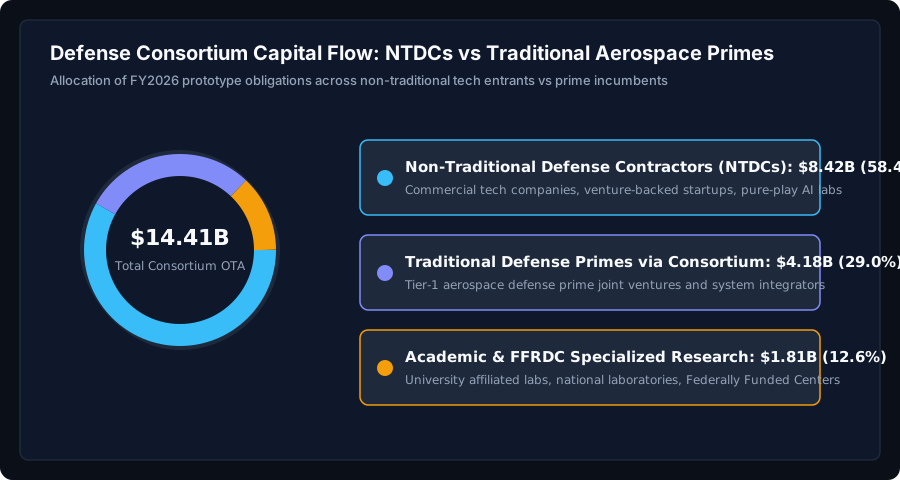
As mapped in Figure 4, non-traditional defense tech innovators captured $8.42 billion—representing 58.4% of total consortium obligations in FY2026. Traditional aerospace primes received $4.18 billion (29.0%), frequently serving as system integration partners alongside agile commercial venture-backed entities. Federally Funded Research and Development Centers (FFRDCs) and university labs accounted for $1.81 billion (12.6%), leading specialized propulsion and quantum algorithm modeling tasks.
5. Microstructural Volume Signatures: Measuring Off-Exchange Block Prints Prior to 8-K Releases
Because prototype OTAs involve extensive technical demonstrations, operational utility assessments, and collaborative Statements of Work prior to execution, technical and supply chain indicators invariably generate physical footprints in the private market. Specialized industrial tooling orders, subsystem procurement notices, and flight test range reservations produce detectable data exhaust before any regulatory filing occurs.
When quantitative models audit institutional order flow across mid-cap defense tech equities during the 60-day window surrounding an Other Transaction award, distinctive microstructural volume anomalies routinely emerge.
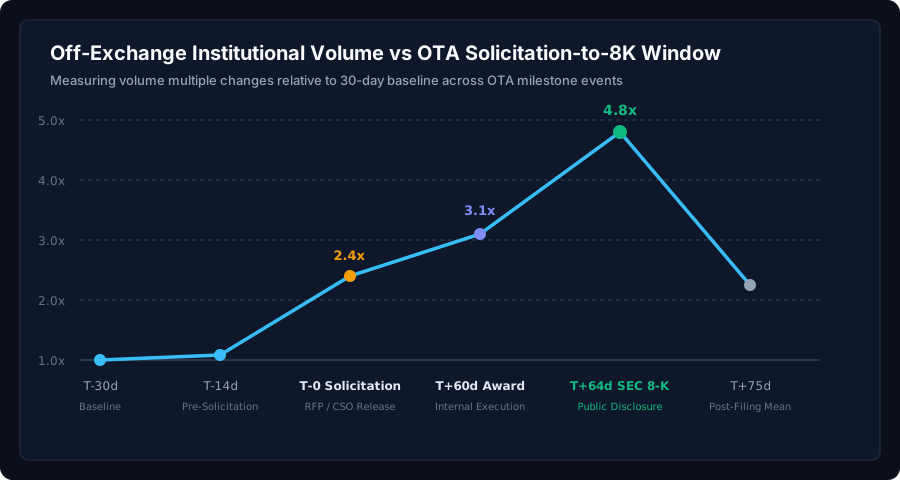
Figure 5 traces the average off-exchange volume multiple across 84 defense tech issuers relative to their 30-day baseline. During baseline conditions (T-30 days), volume multiples track at normal parity (1.0x). Upon release of the initial prototype solicitation or Commercial Solutions Opening notice (T-0 Solicitation), off-exchange volume expands to 2.4x baseline. This reflects institutional sector specialists and quantitative equity funds tracking government request solicitations on federal portal feeds.
During the internal bilateral award execution window (T+60 days), volume multiples reach 3.1x baseline. Finally, when the company officially submits its Form 8-K disclosure to the SEC public filing system four days later (T+64 days), public market visibility prompts a retail and algorithmic absorption spike reaching 4.8x baseline volume. Analysts who monitor the public solicitation and consortium pipeline can systematically anticipate these capital inflows before headline distribution begins.
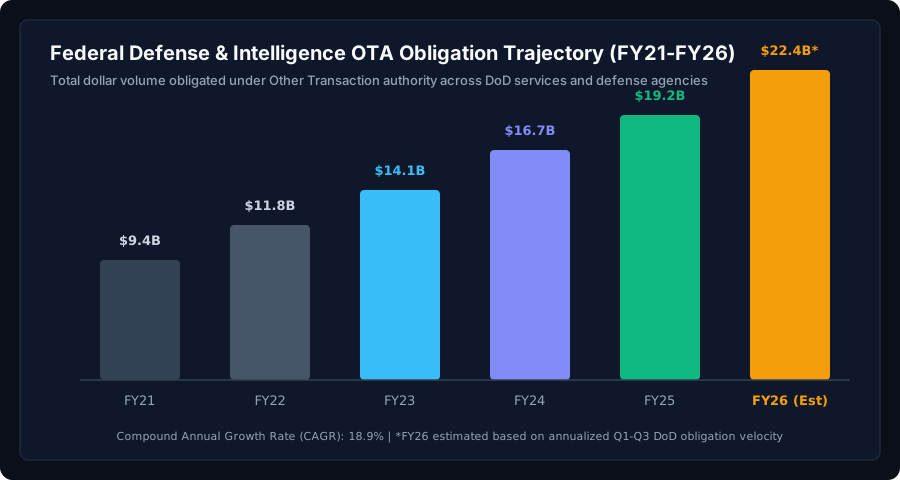
As documented in Figure 6, federal defense and intelligence OTA obligations have expanded from $9.4 billion in FY2021 to a projected $22.4 billion in FY2026, representing a compound annual growth rate (CAGR) of 18.9%. This expansion underscores that Other Transactions are no longer peripheral research experiments; they have evolved into the primary acquisition superhighway for advanced national security technology.
6. How to Audit Defense Prototype Disclosures: A Multi-Source Public Record Methodology
To construct a rigorous intelligence framework for tracking defense prototype advancements, market researchers must integrate independent public datasets rather than relying on delayed press releases:
1. Monitor Federal Procurement Portals and Specialized Consortium Solicitations: Track active solicitation announcements published under "Special Notices" and "Combined Synopsis/Solicitations" that explicitly cite 10 U.S.C. 4022 authority. Specific keyword tracking across "Prototype Other Transaction," "CSO," and consortium pre-solicitation announcements provides early visibility into program requirements months before vendor selection.
2. Audit SEC Form 8-K Item 1.01 and Exhibit 10 Filings: Establish automated monitoring for Form 8-K submissions referencing "Other Transaction Agreement," "Department of the Army," "Air Force Research Laboratory," or "Defense Innovation Unit." Review Exhibit 10 attachments for critical contractual terms, including defined milestone delivery dates, government-furnished property schedules, and express language preserving 10 U.S.C. 4022(f) follow-on production rights.
3. Cross-Reference Federal Prime Award Modification Records: Because federal agencies are statutorily required to report binding financial obligations to the Federal Procurement Data System (FPDS) and federal contract registries, track prime award modifications where the contract vehicle is classified as "Other Transaction for Prototype" or "Other Transaction for Production." Compare obligated funding amounts against initial award ceiling figures to gauge milestone completion.
4. Track Congressional Defense Committee Budget Justification Books: Audit the annual Research, Development, Test & Evaluation (RDT&E) budget justification books (R-2 exhibits) submitted to the House and Senate Armed Services Committees. These public documents explicitly enumerate prototype project transition plans, identifying which technical programs are slated for rapid follow-on procurement under subsequent fiscal year appropriations.
Legal Transparency & Compliance Statement: Public data · not investment advice. All financial figures, contract citations, procurement values, and statutory references in this report were compiled from public records, including SEC public disclosures, Congressional Research Service analyses, Department of Defense acquisition publications, and official federal procurement logs. This analysis is published strictly for informational, educational, and research transparency.
Real-Time Federal Contracts & Corporate Procurement Intelligence
Access live monitoring of defense prototype solicitations, institutional volume prints, and corporate SEC Form 8-K contract filings directly through public data feeds.
Explore the Gemral Edge Defense Terminal →