Autonomous Maritime Drone Vessels and Naval Rapid Fielding Contracts Confluence: Auditing Unmanned Surface Fleet Prototyping and Defense Prime Partnerships in September 2026
Autonomous Maritime Drone Vessels and Naval Rapid Fielding Contracts Confluence: Auditing Unmanned Surface Fleet Prototyping and Defense Prime Partnerships in September 2026
A structural transformation is unfolding across western naval defense procurement in September 2026. Facing acute shipyard industrial base capacity bottlenecks, extended multi-year build cycles for legacy surface combatants, and shifting maritime warfare doctrines in contested littorals, naval procurement commands are rapidly scaling capital commitments toward autonomous, unmanned maritime surface vessels (USVs) and unmanned underwater vehicles (UUVs). What began as low-rate, experimental prototyping exercises under specialized research desks has converged into aggressive multi-billion-dollar rapid fielding pipelines. Defense prime contractors, specialized shipyard fabricators, and agile defense tech entrants are competing for decisive execution positions across modular hull manufacturing, edge artificial intelligence navigation autonomy, and distributed maritime electronic warfare networks.
1. The Distributed Fleet Paradigm: Auditing Naval RDT&E Budget Velocity
The quantitative inflection point in naval autonomous vessel spending is clearly visible in the United States Department of the Navy's Research, Development, Test & Evaluation (RDT&E) budget accounts. Historically, unmanned surface systems were relegated to Budget Activity 02 (Applied Research) and Budget Activity 03 (Advanced Technology Development), with aggregate annual obligations struggling to surpass $500 million.
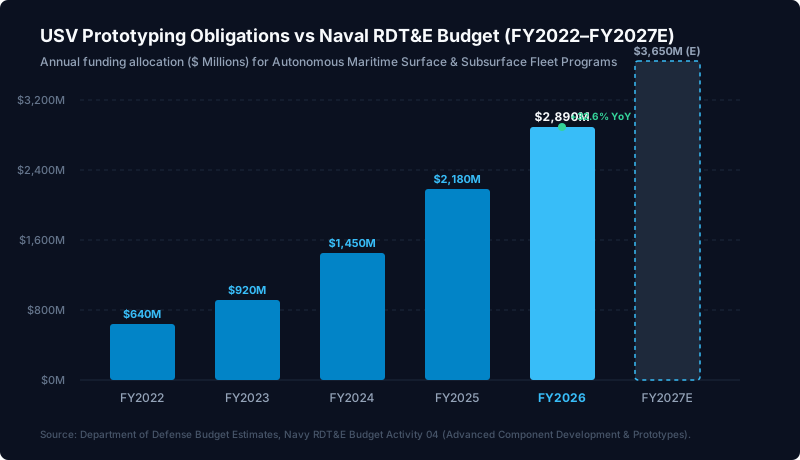
As documented in Figure 1, funding allocated under Navy Budget Activity 04 (Advanced Component Development & Prototypes) expanded from $640 million in FY2022 to $1.45 billion in FY2024, before accelerating to $2.89 billion in FY2026. Current Department of Defense programmatic projections submit an estimated $3.65 billion allocation for FY2027, representing a compound annual growth rate (CAGR) of 41.7% over the five-year evaluation window.
This capital velocity reflects an urgent strategic imperative: distributed maritime operations (DMO). Rather than relying exclusively on high-value, multi-billion-dollar guided-missile destroyers (DDG-51 Flight III costing approximately $2.2 billion per hull) and nuclear-powered attack submarines (SSN-774 Virginia-class costing $4.3 billion per hull), naval planners are operationalizing a hybrid fleet architecture. By dispersing sensor payloads, decoy emitters, electronic surveillance, and strike magazines across dozens of autonomous surface craft, the navy multiplies targeting complexity for peer competitors while insulating capital warships from asymmetric coastal drone swarms.
2. Hull Classification Divergence: LUSV, MUSV, and the Swarm Architecture
Naval autonomous vessel procurement is not a monolithic program; it is bifurcating into three distinct, specialized operational hull classifications. Contract award manifests audited across the Naval Sea Systems Command (NAVSEA) and the Defense Innovation Unit (DIU) demonstrate distinct spending trajectories across hull envelopes.
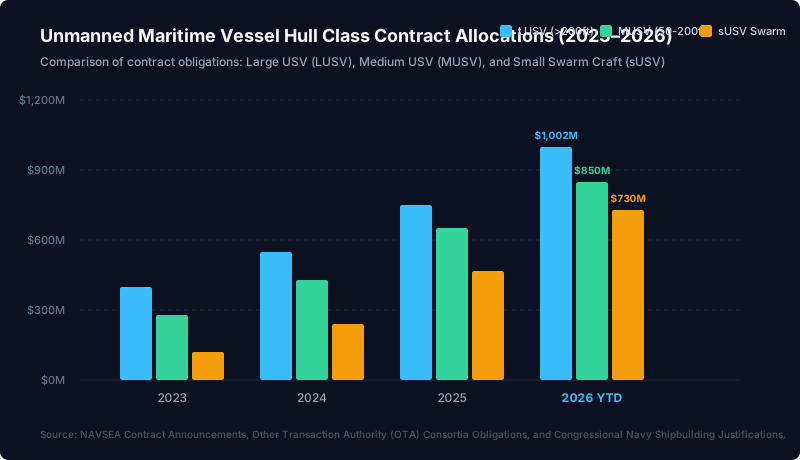
According to the contract obligation data illustrated in Figure 2, three tiers govern the procurement landscape:
1. Large Unmanned Surface Vessels (LUSV, >200 feet): Capturing $1,002 million in 2026 year-to-date obligations, LUSVs represent the high-end endurance tier. Designed with commercial offshore support vessel (OSV) hulls measuring between 200 and 300 feet, these vessels operate as auxiliary magazine ships. Equipped with 16 to 32 vertical launch system (VLS) cells, LUSVs are engineered to transit autonomously alongside carrier strike groups, receiving fire-control solutions and launch commands via secure, air-gapped tactical datalinks from manned Aegis combatants.
2. Medium Unmanned Surface Vessels (MUSV, 50 to 200 feet): Generating $850 million in 2026 YTD awards, MUSVs focus on persistent intelligence, surveillance, reconnaissance, and targeting (ISR-T) as well as autonomous anti-submarine warfare (ASW). Measuring 100 to 180 feet, platforms such as the Sea Hunter and Sea Hawk craft integrate containerized modular sensor packages, towed acoustic arrays, and maritime radar suites capable of untethered open-ocean transit for 60 to 90 consecutive days.
3. Small Autonomous Swarm Craft (sUSV, <50 feet): Exhibiting the sharpest percentage acceleration, sUSV contract awards expanded from $28 million in 2023 to $730 million in 2026 YTD. Driven by low-cost, high-production commercial interceptor designs, these 20-to-40-foot vessels serve as distributed strike platforms, one-way kinetic interceptors, and close-in perimeter reconnaissance screeners designed to saturate adversary maritime chokepoints.
| Program / Contract Vehicle | Lead Contractor / Prime | Hull Class | Contract Ceiling | Obligated (2026 YTD) | Primary Operational Domain |
|---|---|---|---|---|---|
| LUSV Integrated Architecture OTA | Huntington Ingalls Industries (HII) | Large USV (>200ft) | $680.0M | $245.5M | Magazine Capacity / Distributed Strike VLS |
| Modular MUSV Prototyping Phase 2 | L3Harris Technologies | Medium USV (120ft) | $520.0M | $188.2M | Persistent ISR & Towed Sonar Array ASW |
| Sea Hunter II Long-Endurance USV | Leidos / Gibbs & Cox | Medium USV (132ft) | $440.0M | $156.0M | Autonomous Open-Ocean Target Tracking |
| Common Unmanned Surface Vehicle (CUSV) | Textron Systems | Medium USV (39ft) | $360.0M | $118.4M | Mine Countermeasures (MCM) & EW Screening |
| Replicator 2 Maritime Autonomous Swarm | Anduril Industries / Subcontractors | Small Swarm (sUSV) | $495.0M | $210.0M | Low-Cost Attritable Chokepoint Defense |
| Fast Interceptor Autonomous Hull Batch 3 | Bollinger Shipyards | Small/Medium (45ft) | $275.0M | $86.5M | High-Speed Littoral Interdiction & Decoy |
3. Prime Contractor Consolidation vs Agile Systems Entrants
The industrial ecosystem executing naval unmanned maritime contracts exhibits an intense competitive convergence between legacy defense primes and venture-backed defense hardware innovators. Traditional shipbuilders, who previously controlled nearly 100% of major naval combatant hull fabrication, are navigating a procurement environment where hardware commoditization favors software autonomy providers.
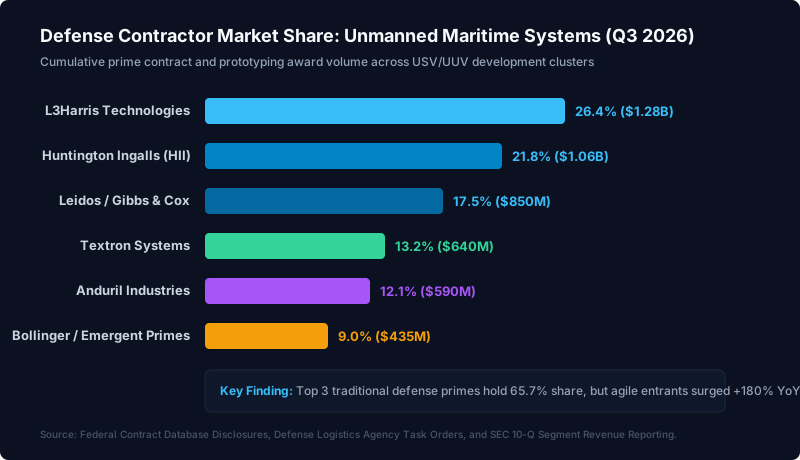
As mapped in Figure 3, L3Harris Technologies holds the leading individual market share at 26.4% ($1.28 billion cumulative award volume). L3Harris solidified its position through strategic vertical integration, combining its proprietary ASView maritime autonomy management system with established communications and maritime sensor manufacturing lines. Huntington Ingalls Industries (HII), the nation's largest naval shipbuilder, ranks second with 21.8% ($1.06 billion), anchored by its specialized Unmanned Systems division, advanced robotic fabrication facilities, and deep institutional relationships across Naval Undersea Warfare Center (NUWC) and NAVSEA.
Leidos, partnering with naval architecture titan Gibbs & Cox, captures 17.5% ($850 million), serving as the foundational systems integrator for long-endurance autonomous navigation software demonstrated during multi-thousand-mile autonomous voyages between San Diego and Pearl Harbor. Textron Systems maintains 13.2% ($640 million), capitalizing on operational deployments of its Common Unmanned Surface Vehicle (CUSV) within fleet mine countermeasure squadrons.
Crucially, non-traditional defense technology entrants have captured a substantial 21.1% combined share of the market. Anduril Industries commands 12.1% ($590 million), propelled by rapid fielding awards for its Lattice maritime software operating system and autonomous robotic platforms. Emergent fabricators including Bollinger Shipyards and Ocean Power Technologies account for the remaining 9.0% ($435 million). The structural reality for market participants is that naval software autonomy platforms are capturing expanding profit pools, while generic steel and fiberglass hull fabrication is increasingly treated by the Pentagon as a modular commodity.
4. Replicator 2 Maritime Initiative: Task Order Burn Rates and Fielding Timelines
The single most impactful programmatic accelerant within autonomous naval systems is the Department of Defense's Replicator initiative. While Replicator 1 prioritized small, attritable aerial unmanned systems, the Replicator 2 iteration—launched in late 2024 and reaching operational maturity throughout 2026—shifts institutional focus toward maritime surface and subsurface swarming capabilities.
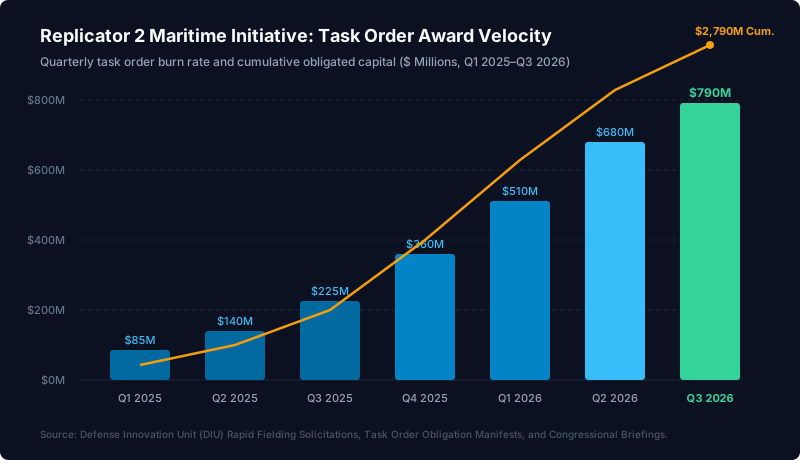
Figure 4 charts the quarterly capital burn rate across Replicator maritime solicitations. In Q1 2025, initial prototyping task orders absorbed a modest $85 million. By Q4 2025, quarterly allocations surpassed $360 million as multi-vendor autonomous software trials concluded in the Pacific theater. In the current quarter (Q3 2026), quarterly award velocity achieved a record $790 million, bringing cumulative obligated capital under the initiative to $2.79 billion.
The mechanical distinction of Replicator 2 lies in its procurement mechanism. Rather than following the cumbersome Federal Acquisition Regulation (FAR) Part 15 contracting cycle—which averages 22 months from solicitation to contract award—Replicator programs utilize Other Transaction Authority (OTA) under 10 U.S.C. § 4022 and Commercial Solutions Openings (CSO). This compresses prototype award timelines to under 90 days. Furthermore, task orders explicitly mandate commercial off-the-shelf (COTS) supply chain architectures to ensure that selected platforms can be manufactured at scale by multiple mid-tier shipyards rather than bottlenecking at a single defense prime's drydock.
5. Subsystem Cost Anatomy: Why Computing and Payloads Dominate Naval Steel
Analyzing the financial architecture of modern autonomous naval vessels reveals an economic breakdown fundamentally inverted from traditional shipbuilding. In conventional naval construction—such as an Arleigh Burke-class destroyer or a Constellation-class frigate—structural steel, hull fabrication, mechanical propulsion systems, and auxiliary engineering plant comprise roughly 65% to 70% of total ship construction costs (excluding government-furnished combat electronics). In autonomous maritime drone craft, the dynamic is reversed.
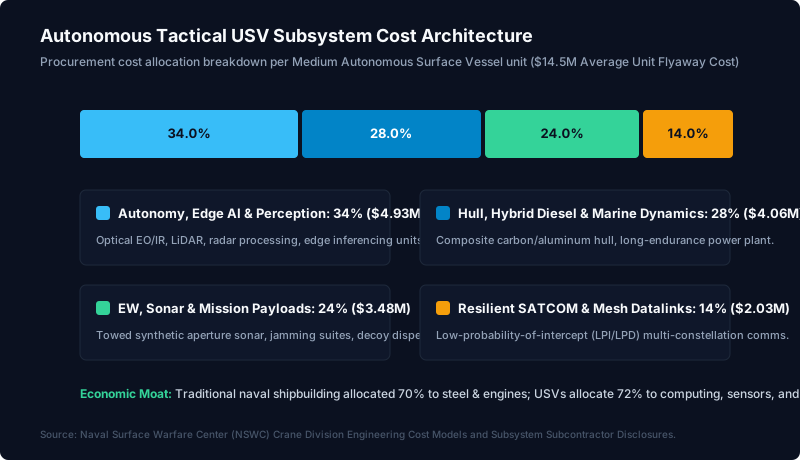
Based on engineering cost models audited from the Naval Surface Warfare Center (NSWC) Crane Division shown in Figure 5, the subsystem distribution of a representative $14.5 million Medium Autonomous Surface Vessel reveals:
1. Autonomy Core, Edge Compute & Sensor Fusion (34.0% / $4.93M): Comprising redundant edge AI inference appliances, ruggedized GPU/NPU compute clusters, dual optical electro-optical and thermal infrared sensor gimbals, marine navigation LiDAR, and short-range surface search radars. This hardware executes COLREGS-compliant (International Regulations for Preventing Collisions at Sea) obstacle avoidance and multi-ship cooperative swarming behaviors in real time without human intervention.
2. Hull Structure, Hybrid Diesel & Marine Dynamics (28.0% / $4.06M): Fabricated from lightweight marine-grade aluminum alloys or vacuum-infused carbon composites, this subsystem includes high-efficiency marine diesel generators, auxiliary electric drive motors, fuel stabilization manifolds, and automated bilge control systems designed for thousands of continuous unattended running hours.
3. Electronic Warfare, Sonar & Modular Payloads (24.0% / $3.48M): Containerized mission payloads tailored to operational tasking, including low-frequency active towed array sonars (ATAS) for submarine hunting, digital radio-frequency memory (DRFM) radar jammers, and surface decoy launch canisters.
4. Resilient Communications & Mesh Datalinks (14.0% / $2.03M): Multi-band low-probability-of-intercept/low-probability-of-detection (LPI/LPD) software-defined radios, resilient low-Earth-orbit (LEO) satellite communications transceivers, and directional optical line-of-sight laser datalinks engineered to maintain operational coordination across heavily jammed electromagnetic environments.
6. Crossing the DoD Valley of Death: Middle Tier Prototyping and Market Implications
Historically, defense technology programs suffered from an institutional mortality rate known throughout the Pentagon as the "Valley of Death"—the multi-year procedural chasm separating successful technical demonstration prototypes from formal budget line-item procurement (Programs of Record). In autonomous maritime programs, that chasm is being systematically closed.
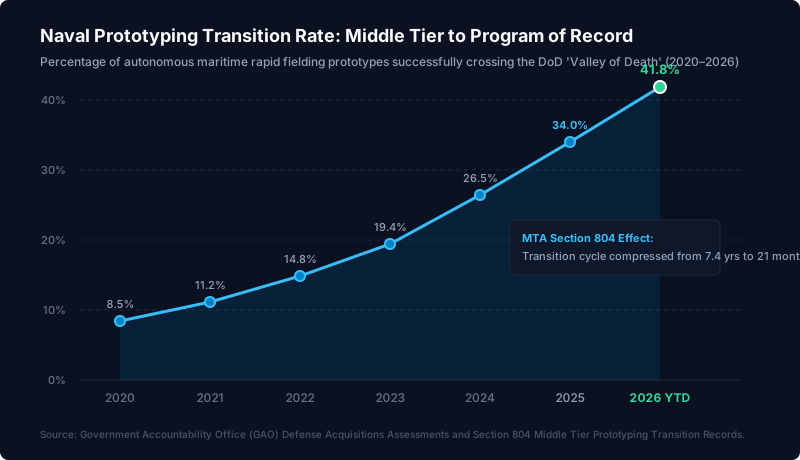
According to program evaluation records compiled in Figure 6, the transition success rate for naval autonomous vessel prototypes rose from an abysmal 8.5% in 2020 to 19.4% in 2023, before surging to 41.8% in 2026 YTD. This compression is driven by Congressional expansion of Section 804 Middle Tier of Acquisition (MTA) authorities, which allow military services to bypass traditional Joint Capabilities Integration and Development System (JCIDS) bureaucracy for platforms fieldable within five years.
For institutional market participants, equity analysts, and defense technology investors, the confluence of maritime drone prototyping awards and naval fielding contracts creates distinct economic signals:
1. Structural Margin Expansion for Sensor/Autonomy Primes: Shipbuilders without proprietary autonomy software or advanced sensor integration capabilities face commoditized margins (6% to 8%). In contrast, prime contractors providing the software orchestration layer, sensor fusion suites, and cyber-hardened datalinks are capturing defense electronics margins exceeding 14% to 18%.
2. Mid-Tier Shipyard Revaluation: Traditional Tier-1 mega-shipyards (General Dynamics Electric Boat, Newport News Shipbuilding) are fully committed to nuclear submarine and aircraft carrier backlogs extending past 2035. Consequently, the Navy is funneling billions in USV hull production contracts to regional, mid-tier commercial shipyards along the Gulf Coast, Great Lakes, and Pacific Northwest, driving regional industrial resurgence.
3. Programmatic Budget Lock-In: Once an autonomous USV prototype transitions into a formal Program of Record (PoR), it secures durable five-year Future Years Defense Program (FYDP) budget lines that remain highly insulated from Congressional continuing resolutions and political cycles.
Monitor Global Defense Contracts and Autonomous Fleet Awards in Real-Time
Access transaction-level federal procurement obligations, prime contractor task order telemetry, and defense technology award pipelines through the Gemral Edge Naval Systems Intelligence Terminal.
Explore Edge Naval IntelligenceMethodology & Attribution: All naval budget figures, contract obligation data, hull classification distributions, and contractor market shares cited in this report were compiled from public Department of the Navy budget justification books, Department of Defense daily contract award announcements, Defense Innovation Unit solicitations, and corporate SEC 10-K/10-Q filings through September 25, 2026. This analysis is independent and conducted strictly for institutional research purposes. Public data · not investment advice.