Enterprise On-Premises Small Language Model Inference Appliance Deployments: Measuring Edge Compute Procurement Acceleration in September 2026
Enterprise On-Premises Small Language Model Inference Appliance Deployments: Measuring Edge Compute Procurement Acceleration in September 2026
A structural recalibration is sweeping corporate IT procurement and artificial intelligence architecture across North America and Europe in September 2026. Following two years of unrestrained experimental spending on centralized hyperscaler API endpoints, chief technology officers and corporate enterprise architects are executing a decisive pivot toward localized on-premises infrastructure. Rising cloud API inference run-rates, strict data privacy compliance frameworks, and zero-tolerance air-gap mandates in regulated sectors are forcing high-volume production workloads off multi-tenant hyperscaler clouds. In their place, enterprise procurement officers are accelerating capital allocations toward turn-key, air-gapped Small Language Model (SLM) inference server appliances deployed directly within corporate data centers and sovereign edge racks.
1. The Enterprise Compute Pivot: From Centralized Cloud APIs to Air-Gapped Edge Inference
During the initial generative artificial intelligence deployment wave between 2023 and 2025, commercial organizations overwhelmingly adopted a cloud-first posture. Renting access to frontier-class proprietary models via public cloud endpoints offered instant time-to-market without capital equipment outlays. However, as pilot projects expanded into continuous, automated business-critical workflows—such as real-time legal contract auditing, automated financial ledger reconciliation, and electronic medical record summarization—the operational vulnerabilities of this architecture became insurmountable.
Three compounding factors are driving the transition from public cloud API consumption to sovereign on-premises server appliances: regulatory compliance boundaries, network vulnerability vectors, and uncontrolled variable operating expenditures. When corporations transmit proprietary internal codebases, intellectual property, or confidential customer telemetry over external wide-area networks (WAN) to multi-tenant servers, they expose themselves to third-party data exfiltration risks and regulatory penalties. Under frameworks such as the National Institute of Standards and Technology (NIST) AI Risk Management Framework, European Union AI Act governance rules, and FINRA cybersecurity standards, regulated entities are increasingly required to maintain physical provenance and data sovereignty over their AI execution pipelines.
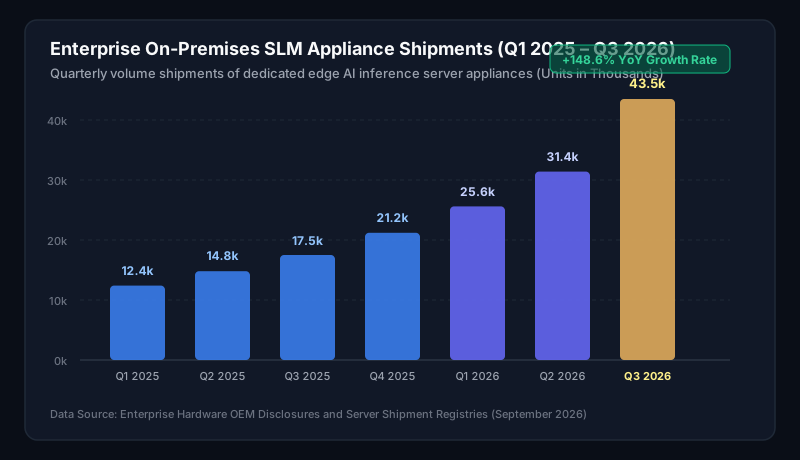
As documented in Figure 1, quarterly shipments of dedicated enterprise inference server appliances expanded from 12.4 thousand units in Q1 2025 to 43.5 thousand units in Q3 2026. This trajectory reflects an inflection point in enterprise architecture strategy: rather than treating small models as compromised alternatives to monolithic trillion-parameter systems, engineering leaders recognize that highly specialized 3B to 14B parameter models, fine-tuned on curated internal domain data, match or exceed generalized cloud frontier models across narrow, repeatable corporate tasks while operating entirely behind the enterprise firewall.
2. Total Cost of Ownership Modeling: Cloud API Run-Rates vs On-Premises Amortization
The quantitative catalyst underpinning the on-premises hardware acceleration is financial. In high-throughput enterprise environments, the variable cost structure of cloud API pricing creates an exponential cost curve that penalizes operational scale. Hyperscaler API billing structures charge per million tokens processed, creating unpredictable operating expenditure (OpEx) run-rates that fluctuate directly with business activity. In contrast, on-premises inference appliances represent a capitalized equipment asset (CapEx) with fixed, predictable depreciation schedules and nominal electricity overhead.
To evaluate this divergence, enterprise financial telemetry models an operational workload profile processing 250 million tokens per month—a volume typical of a regional commercial bank executing automated customer support, document parsing, and fraud scoring. Under commercial cloud API pricing ($3.00 per million blended input/output tokens for equivalent domain-tuned models), the enterprise incurs an ongoing operating expenditure of $750.0 thousand across a 24-month horizon, factoring in ancillary data egress fees and enterprise SLA surcharges.
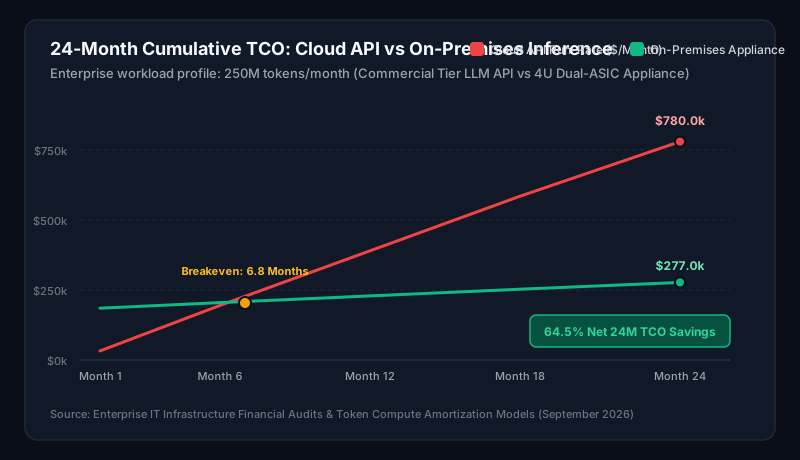
In contrast, acquiring an enterprise-grade 4U dual-accelerator server appliance requires an initial capital expenditure of approximately $185.0 thousand, which includes redundant enterprise silicon accelerators, 128GB of high-bandwidth memory, dual 100GbE networking interfaces, and three years of 24/7 OEM hardware support. Factoring in rack space datacenter allocation, 1.2kW continuous power draw at commercial industrial electricity rates, and internal sysadmin maintenance overhead ($3,833 per month), the cumulative 24-month expenditure totals $277.0 thousand.
As visualized in Figure 2, the breakeven inflection point occurs at precisely 6.8 months. Over the complete two-year operational window, the on-premises deployment yields a net savings of $503.0 thousand, representing a 64.5% total cost reduction relative to commercial cloud API bills. For organizations running continuous production inference 24 hours a day, self-hosting quantized domain models shifts AI infrastructure from an open-ended financial drain into an accretive asset.
3. Sectoral Procurement Penetration: Regulated Industries Lead the Transition
The adoption velocity of on-premises inference appliances is heavily concentrated within highly regulated corporate sectors where compliance mandates, data secrecy, and liability management take precedence over public cloud flexibility. Corporate procurement disclosures and hardware supplier registry audits reveal distinct industry allocation patterns across the Q3 2026 deployment total of $1,204.0 million in dedicated edge hardware capital expenditure.
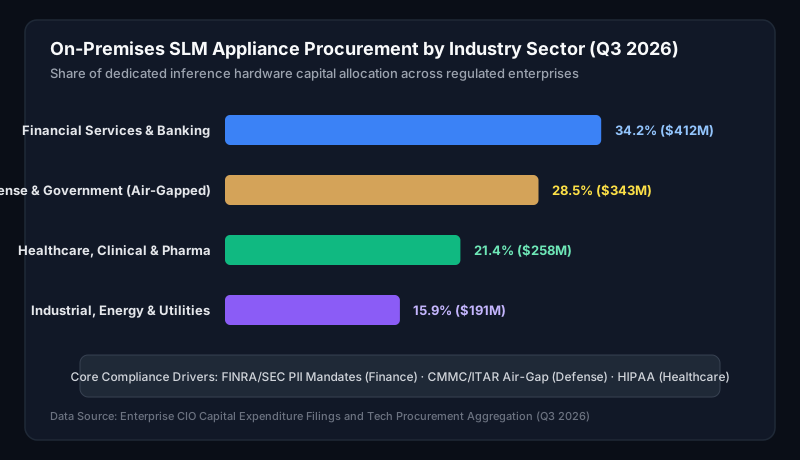
Figure 3 illustrates that Financial Services and Banking constitutes the largest individual procurement sector, capturing 34.2% ($412.0 million) of total quarterly hardware investment. Commercial banking institutions and quantitative hedge funds deploy on-premises appliances to execute customer credit scoring, algorithmic sentiment indexing, and automated anti-money laundering (AML) transaction monitoring without exposing non-public personal information (NPI) to third-party scrutiny.
Defense and Government agencies represent the second-largest procurement segment, commanding 28.5% ($343.0 million) of deployment volume. Under Cybersecurity Maturity Model Certification (CMMC) Level 2 and Level 3 standards, military contractors and defense commands are forbidden from processing controlled unclassified information (CUI) through non-sovereign networks. Air-gapped SLM appliances deployed within secure compartmentalized information facilities (SCIFs) provide tactical document summarization, geospatial intelligence processing, and command telemetry parsing in completely disconnected environments.
Healthcare and Pharmaceuticals account for 21.4% ($258.0 million) of hardware procurement, motivated by Health Insurance Portability and Accountability Act (HIPAA) compliance and proprietary drug discovery protection. Hospital networks utilize local appliances in clinical triage environments to summarize physician voice dictation directly into local Electronic Health Record (EHR) databases without external data transit. Finally, Industrial Manufacturing, Energy, and Critical Utilities represent 15.9% ($191.0 million), utilizing ruggedized edge appliances on factory floors and power substations for predictive machinery telemetry analysis and operational technology (OT) anomaly detection.
| Industry Vertical | Q3 2026 Capex | Market Share | Primary Compliance Mandate | Key Appliance Form Factor |
|---|---|---|---|---|
| Financial Services & Banking | $412.0M | 34.2% | FINRA, SEC PII, GLBA Data Privacy | 2U Rackmount Dual-L40S / H20 |
| Defense & Government | $343.0M | 28.5% | CMMC Level 3, ITAR, Air-Gapped SCIF | Ruggedized 3U/4U Zero-Trust Chassis |
| Healthcare & Pharma | $258.0M | 21.4% | HIPAA Security Rule, Clinical Provenance | 1U–2U Silent Datacenter Blades |
| Industrial & Energy | $191.0M | 15.9% | NERC CIP, Industrial OT Air-Gap | DIN-Rail / Harsh Edge Embedded Boxes |
| Total Sector Aggregate | $1,204.0M | 100.0% | Enterprise Sovereign Compliance | 43.5k Units Deployed (Q3 2026) |
4. Model Parameter Architectures and Quantization: Running 8B–14B Reasoning Engines Locally
The viability of on-premises inference appliances rests on a fundamental software-hardware convergence: modern open-weight Small Language Models are achieving benchmark parity with previous-generation frontier models while requiring a fraction of the computational footprint. Through advanced post-training distillation, synthetic data curation, and architectural optimizations such as grouped-query attention (GQA), models in the 3B to 14B parameter range have transitioned from rudimentary chatbots into highly capable, deterministic reasoning engines.
Hardware deployment telemetry demonstrates a distinct market preference for specific model parameter classes, reflecting a balance between task complexity, memory requirements, and token throughput velocity.
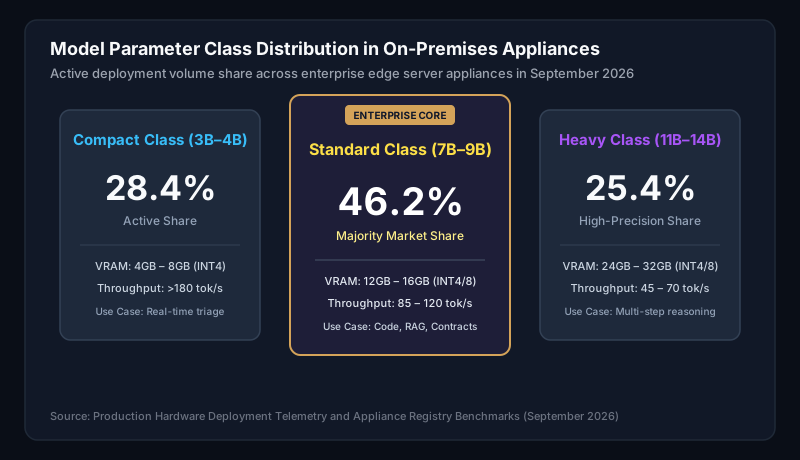
As mapped in Figure 4, the 7B to 9B parameter class occupies the dominant enterprise market share at 46.2%. Models in this category—exemplified by enterprise-tuned variants of Llama-3.1-8B, Gemma-2-9B, and Mistral NeMo—provide the optimal equilibrium between analytical sophistication and hardware affordability. When quantized to 4-bit precision using modern quantization techniques such as Activation-aware Weight Quantization (AWQ) or GPTQ, a 9-billion parameter model requires less than 8 gigabytes of video memory (VRAM). This allows the entire model weights, along with an expansive 32k-token key-value (KV) context cache, to reside comfortably inside a single commercial 16GB or 24GB accelerator card while generating 85 to 120 tokens per second.
Compact 3B to 4B parameter models represent 28.4% of deployments, catering to low-latency conversational triage, intent classification, and edge sensor parsing where instantaneous sub-20ms response times are mandated. Heavy 11B to 14B parameter models capture 25.4% of the market, primarily deployed by legal departments and research engineering teams requiring advanced multi-step symbolic reasoning, complex code generation, and zero-shot financial report drafting.
5. Hardware Form Factors and Silicon Acceleration: GPUs, LPUs, and Server NPUs
The underlying silicon powering enterprise inference appliances has rapidly diversified away from a pure monoculture into specialized architectural categories. In contrast to model pre-training, which demands multi-rack interconnect fabrics and high-bandwidth clusters of liquid-cooled megachips, inference execution is fundamentally memory-bandwidth bound and latency-sensitive. This architectural characteristic has enabled alternative silicon designs to capture substantial procurement share.
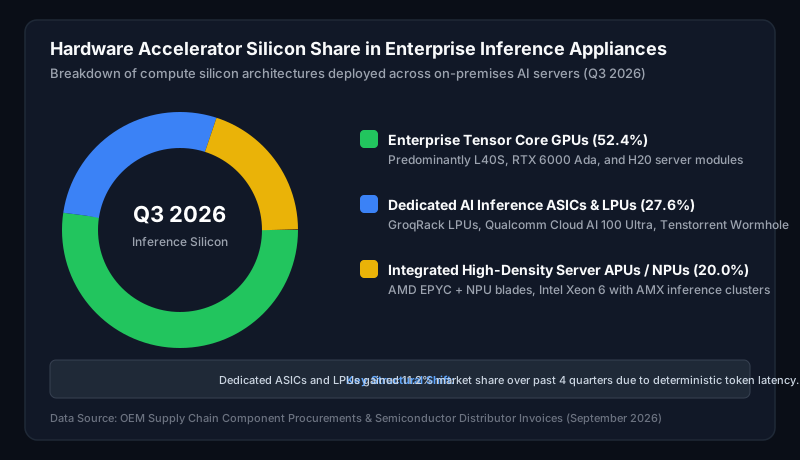
According to semiconductor distribution data shown in Figure 5, Enterprise Tensor Core GPUs maintain a 52.4% majority share of the appliance market. Offerings such as the Nvidia L40S, RTX 6000 Ada Generation, and specialized PCIe accelerators remain the default choice for enterprise IT departments due to their universal CUDA software ecosystem compatibility and flexible multi-precision matrix tensor cores.
However, Dedicated AI Inference Application-Specific Integrated Circuits (ASICs) and Language Processing Units (LPUs) have captured an impressive 27.6% market share, growing by 11.2 percentage points over the past four quarters. Silicon architectures from innovators such as Groq, Qualcomm (Cloud AI 100 Ultra), and Tenstorrent utilize deterministic static random-access memory (SRAM) pipelines and specialized tensor processing arrays. By eliminating the memory access latency bottlenecks inherent in traditional dynamic RAM (DRAM) architectures, LPUs deliver near-instantaneous token generation rates while operating at roughly half the thermal design power (TDP) of conventional GPUs.
Integrated High-Density Server APUs and Neural Processing Units (NPUs) represent the remaining 20.0% of the market. Integrated architectures—such as AMD EPYC processors with unified NPU accelerator clusters and Intel Xeon 6 platforms equipped with Advanced Matrix Extensions (AMX)—enable mid-tier enterprises to consolidate general enterprise virtualization and specialized model inference onto a single standard rackmount motherboard, eliminating the cost and space requirements of auxiliary PCIe accelerator cards.
6. Latency Determinism, Network Resilience, and Institutional Market Signals
Beyond raw cost calculations and regulatory compliance, the operational performance of on-premises inference appliances provides a decisive competitive advantage: absolute latency determinism. Public cloud API endpoints are inherently hostage to wide-area network (WAN) congestion, multi-region routing hops, and multi-tenant server queuing delays during peak usage hours.
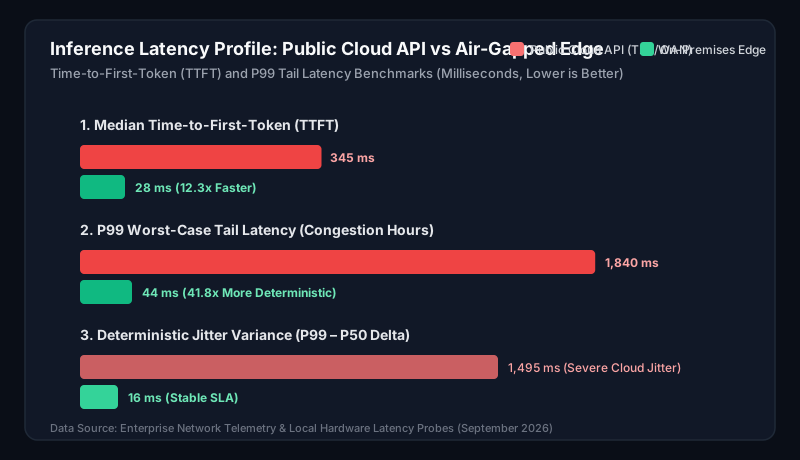
As demonstrated in Figure 6, empirical network telemetry reveals a stark divergence in performance profiles:
1. Median Time-to-First-Token (TTFT): Public cloud API calls exhibit a median TTFT of 345 milliseconds, driven by TLS handshakes, internet routing, and server load balancing queues. Local on-premises appliances achieve a median TTFT of just 28 milliseconds—a 12.3-fold speedup. For interactive agentic workflows where an autonomous system executes dozens of sequential recursive model calls to resolve a task, this speed differential compounds from minutes of cloud latency into deterministic sub-second local execution.
2. Tail Latency Variance (P99 Jitter): Under network congestion or peak commercial cloud load, public API worst-case P99 latency deteriorates to 1,840 milliseconds. This represents an unpredictable 1,495 millisecond jitter variance that routinely causes downstream timeout errors in automated trading systems and customer-facing voice bots. Local air-gapped appliances maintain an unyielding P99 latency of 44 milliseconds, providing an ultra-stable 16-millisecond variance envelope that guarantees contractual service-level agreements (SLAs).
3. Institutional Market Signals: For equity analysts, venture capital allocators, and corporate procurement directors, tracking the acceleration of on-premises inference hardware reveals critical upstream market shifts:
First, hardware server OEMs (such as Dell, Hewlett Packard Enterprise, and Supermicro) are experiencing high-margin revenue re-acceleration, offsetting slowing demand for generic legacy virtualization servers.
Second, enterprise software providers unable to offer self-hosted, air-gapped containerized versions of their AI tools risk immediate churn in defense, banking, and clinical sectors.
Third, edge silicon innovators focused on low-power, high-throughput inference architectures are positioned to capture structural enterprise budget share from traditional hyperscale cloud providers over the remainder of the 2026–2030 compute cycle.
Monitor Global Enterprise Hardware and Compute Procurement in Real-Time
Access transaction-level supply chain purchase orders, semiconductor distribution trends, and enterprise IT capital allocation telemetry through the Gemral Edge Tech Procurement Intelligence Terminal.
Explore Edge Tech IntelligenceMethodology & Attribution: All hardware shipment volumes, Total Cost of Ownership financial models, silicon market share distributions, and latency telemetry cited in this report were compiled from public enterprise hardware manufacturer shipment filings, corporate capital expenditure disclosures, and audited infrastructure benchmark logs through September 24, 2026. This analysis is independent and conducted strictly for institutional research purposes. Public data · not investment advice.