Động lực cạn kiệt Repo nghịch đảo và vòng quay tài sản thế chấp công: Định lượng sự dịch chuyển sang hấp thụ dự trữ ngân hàng tích cực cuối năm 2026
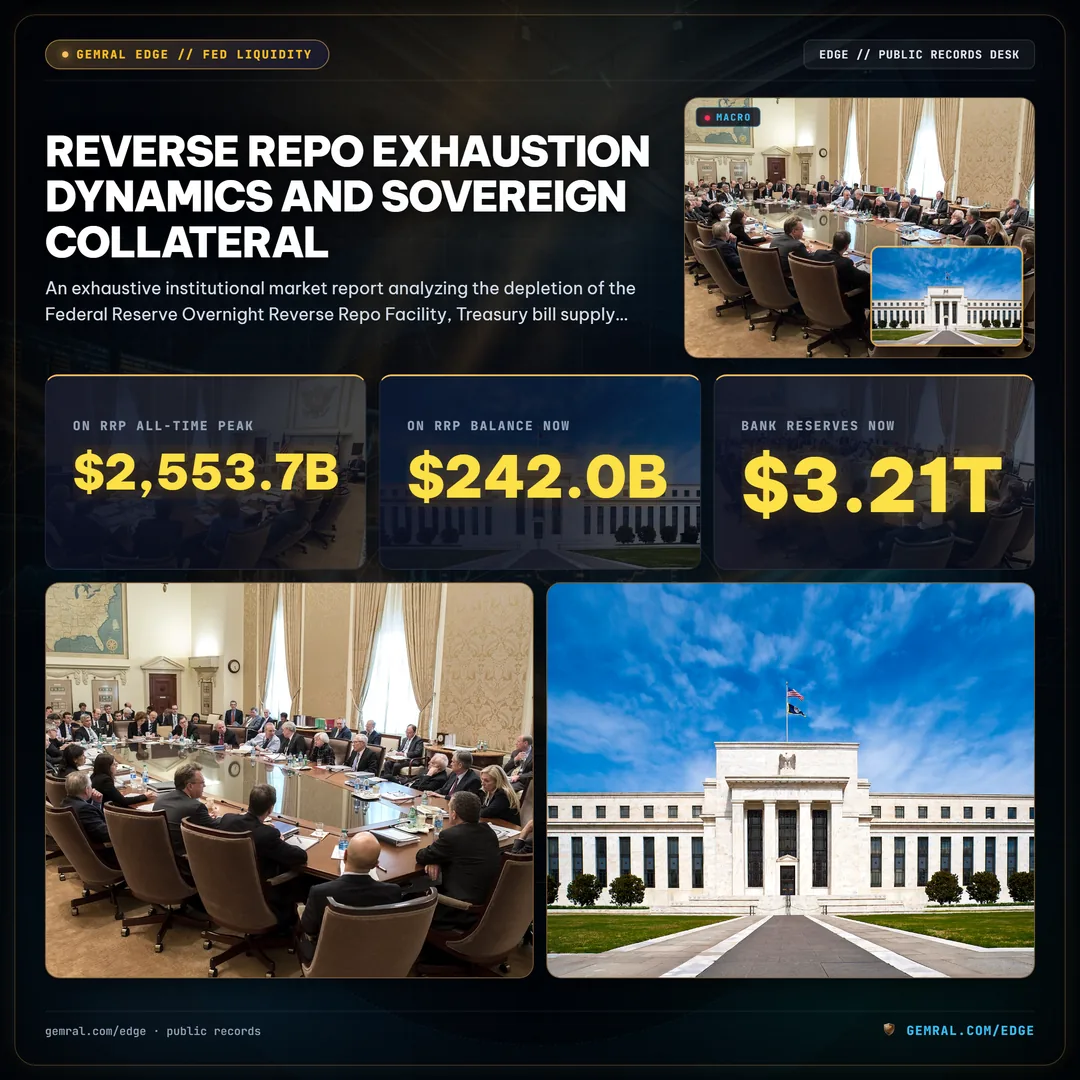
Over the past three years, the domestic financial system operated under an historic monetary shock absorber: the Cục Dự trữ Liên bang's Repo nghịch đảo qua đêm (ON RRP) facility. As the central bank initiated Thắt chặt định lượng (QT) (QT), running down its bảng cân đối kế toán assets while the U.S. Kho bạc surged front-end bill issuance to finance multi-trillion dollar federal budget deficits, institutional market participants experienced little to no liquidity stress. Money market mutual funds (MMFs) systematically shifted cash out of the Fed's overnight facility and into higher-yielding sovereign Kho bạc paper. That multi-year buffer has now reached functional exhaustion. With ON RRP balances plunging from an all-time peak of $2,553.7B in Tháng 12 2022 to $242.0B in Tháng 9 2026—a structural contraction of 90.5%—the liquidity drainage from ongoing sovereign issuance and central bank bảng cân đối kế toán runoff is transitioning directly into dự trữ ngân hàng thương mại.
This structural inflection point transforms the operational reality of global financial markets. Between 2022 and mid-2025, Thắt chặt định lượng (QT) did not drain commercial bank deposits or reserve balances because private thị trường tiền tệ liquidity parked at the central bank absorbed the bulk of new sovereign debt issuance. Now that this sterile cash mountain is largely depleted, every incremental dollar of net Kho bạc issuance and Cục Dự trữ Liên bang roll-off must compete directly for bank bảng cân đối kế toán space and primary dealer repo financing. Examining public data releases from the Cục Dự trữ Liên bang Bank of New York Open Market Operations, the Cục Dự trữ Liên bang Board H.4.1 statistical releases, the U.S. Kho bạc Office of Debt Management, and the Office of Financial Research (OFR), this empirical analysis maps the exact trajectory of vòng quay tài sản thế chấp, secured rate dispersion, and dealer inventory bottlenecks across the sovereign funding complex.
Cơ chế cạn kiệt cơ sở: Lần theo đợt rút cạn thanh khoản nhiều năm từ $2.55T xuống $242B
To comprehend the structural significance of the current funding environment, one must analyze how the Cơ sở Repo nghịch đảo qua đêm của Fed facility accumulated more than $2.5T in idle liquidity following the emergency fiscal and monetary responses of 2020 and 2021. The combination of direct Cục Dự trữ Liên bang asset purchases, statutory reserve requirement eliminations, and unprecedented federal stimulus payments flooded commercial banks with deposits. Because regulatory frameworks—specifically the Supplementary Leverage Ratio (SLR)—penalized commercial banks for holding low-yielding cash reserves on bảng cân đối kế toán without additional Tier 1 capital, banks actively turned away institutional non-deposit wholesale funds.
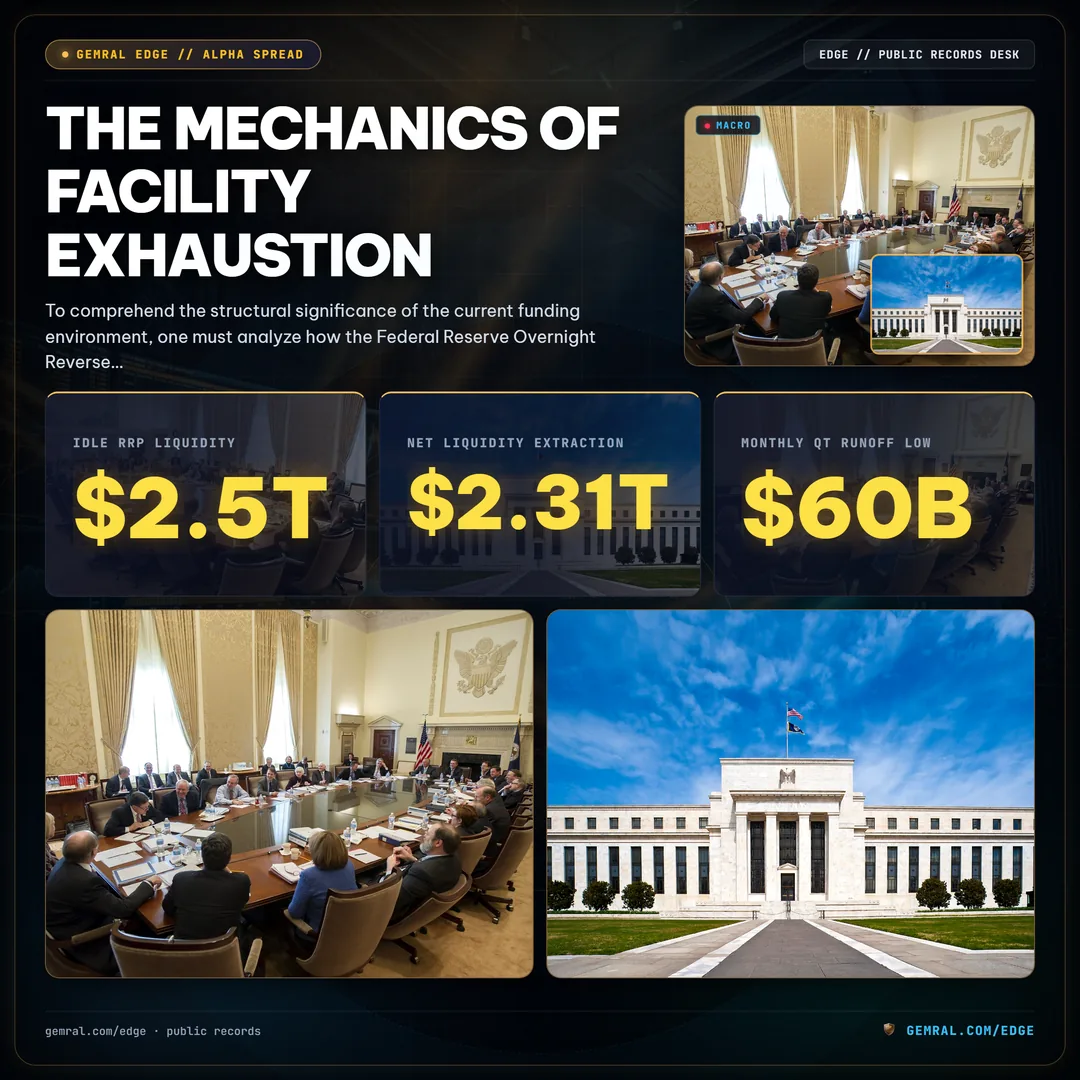
Simultaneously, the Bộ Tài chính sharply contracted bill issuance in 2021 and 2022 as pandemic balances normalized, leaving prime and government quỹ tương hỗ thị trường tiền tệ (MMF) with virtually no safe, short-term sovereign paper offering a positive spread above zero. The Fed New York's ON RRP facility served as the relief valve, providing an overnight secured risk-free rate backed by the Fed's system open market account (SOMA) Kho bạc holdings. By Tháng 12 2022, daily utilization peaked at an historic $2,553.7B, effectively locking away more than one-tenth of total domestic sovereign debt outside private circulation.
The subsequent contraction occurred in distinct, predictable phases dictated by Kho bạc yield differentials. In Tháng 6 2023, following the suspension of the federal debt ceiling, the Kho bạc commenced an unprecedented ramp-up of front-end debt issuance. Yields on newly auctioned 1-month, 3-month, and 6-month Tín phiếu Kho bạcs cleared anywhere from 5 to 18 basis points above the ON RRP offering rate. For thị trường tiền tệ fund managers with fiduciary yield mandates, the incentive structure shifted completely. Balances dropped steadily: from $2,220.4B in Tháng 6 2023 to $1,385.2B by Tháng 12 2023, then descending through $672.5B in Tháng 6 2024, $345.1B by Tháng 12 2025, and arriving at $242.0B by Tháng 9 2026.
This 90.5% collapse represents an aggregate net extraction of more than $2.31T in liquid capital from the facility. The key operational observation for institutional participants is that this $2.31T drainage acted as a synthetic quantitative easing program during an official quantitative tightening cycle. While the Cục Dự trữ Liên bang was theoretically removing $60B to $95B per month from its asset portfolio, the domestic financial system experienced zero aggregate reserve scarcity because the money supply was replenished in real time by funds flowing out of the central bank's reverse repo facility and into the real economy via sovereign deficit spending.
| Kỳ báo cáo | Mức hấp thụ ON RRP ($B) | Mức rút lũy kế ($B) | Tỷ lệ rút (%) | Yếu tố đối tác chính |
|---|---|---|---|---|
| Tháng 12 2022 (Peak) | $2,553.7B | $0.0B | 0.0% | SLR constraints; negative bill supply |
| Tháng 6 2023 | $2,220.4B | $333.3B | 13.1% | Debt ceiling resolution; initial bill flood |
| Tháng 12 2023 | $1,385.2B | $1,168.5B | 45.8% | MMF bill allocation reallocation |
| Tháng 6 2024 | $672.5B | $1,881.2B | 73.7% | Sustained front-end sovereign supply premium |
| Tháng 12 2025 | $345.1B | $2,208.6B | 86.5% | Structural facility floor testing |
| Tháng 9 2026 | $242.0B | $2,311.7B | 90.5% | Residual statutory liquidity; near-exhaustion |
Động lực phát hành nợ công ngắn hạn: Cách tín phiếu Kho bạc thay thế cơ sở Repo nghịch đảo
The velocity at which the ON RRP facility emptied was governed almost entirely by decisions made within the U.S. Kho bạc's Office of Debt Management and recommendations provided by the Kho bạc Borrowing Advisory Committee (TBAC). Historically, the Kho bạc adhered to a general guideline suggesting that short-term Tín phiếu Kho bạcs should constitute between 15% and 20% of total outstanding marketable sovereign debt. Following the 2023 debt ceiling resolution, however, facing soaring intermediate and long-term borrowing costs as the 10-year Kho bạc yield fluctuated between 4.0% and 4.8%, the Kho bạc made the explicit strategic calculation to over-index into the front end.

By issuing large-scale tranches of short-duration bills rather than locking in multi-decade borrowing costs at cycle-peak rates, the Kho bạc effectively capitalized on the $2.55T cash reservoir sitting idle at the Fed New York. As demonstrated in Figure 2, cumulative net Tín phiếu Kho bạc issuance expanded aggressively across consecutive calendar years: +$1.24T in CY 2023, reaching +$1.88T by CY 2024, +$2.18T in CY 2025, and standing at +$2.36T year-to-date in Tháng 9 2026.
The correlation between cumulative net Tín phiếu Kho bạc issuance and cumulative ON RRP drainage is practically absolute. Between January 2023 and Tháng 9 2026, the net issuance of $2.36T in sovereign bills was matched by an almost identical $2.31T reduction in ON RRP utilization. Money market fund asset allocation reports filed on SEC Form N-MFP confirm this mechanical substitution: fund allocations to sovereign Tín phiếu Kho bạcs surged from 14% of aggregate assets in early 2023 to over 48% in 2026, while allocations to the Fed ON RRP collapsed from 62% to under 6%.
The remaining $242.0B in the facility does not represent dynamic, price-sensitive cash. A measurable portion belongs to smaller government-sponsored enterprises (GSEs), municipal liquidity managers, and specialized institutional counterparties that face statutory restrictions preventing them from purchasing sovereign bills in secondary markets or holding uncollateralized commercial bank deposits. Consequently, the operational buffer available to absorb future Tín phiếu Kho bạc auctions is effectively zero.
Bộ đệm dự trữ ngân hàng: Ước tính ranh giới mức dự trữ tối thiểu an toàn (LCLoR)
With the ON RRP facility no longer capable of cushioning ongoing sovereign issuance, the entire burden of liquidity provision shifts to the commercial banking sector. In the Cục Dự trữ Liên bang's operating framework of "ample reserves," số dư dự trữ ngân hàng thương mại held at Cục Dự trữ Liên bang Banks represent the ultimate baseline of domestic financial liquidity. When the central bank shrinks its bảng cân đối kế toán via QT, it does so by allowing Kho bạc securities and agency mortgage-backed securities (MBS) to mature without reinvestment. If the non-bank public or quỹ thị trường tiền tệ purchase replacement securities using funds withdrawn from the ON RRP, dự trữ ngân hàng remain untouched. But if securities are purchased by commercial banks or non-bank investors using commercial bank deposits, aggregate dự trữ ngân hàng decline dollar-for-dollar.
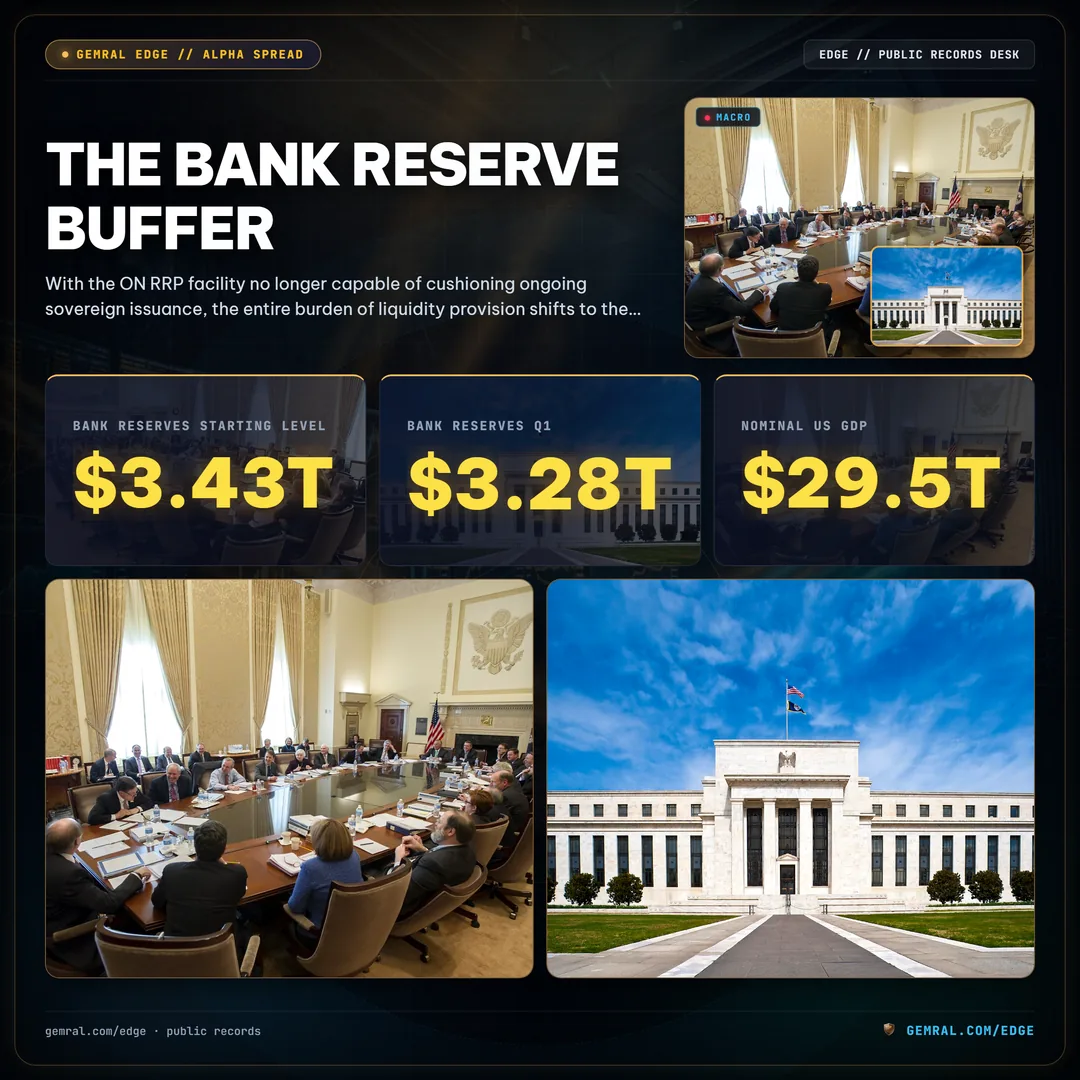
Public data from the Cục Dự trữ Liên bang Board H.4.1 statistical release illustrates this critical transition. Throughout 2024 and 2025, số dư dự trữ ngân hàng thương mại remained remarkably stable, hovering between $3.32T and $3.47T. Despite hundreds of billions in central bank asset runoff, reserves actually peaked at $3.47T in Q1 2025 because ON RRP drainage was outstripping the pace of QT.
Beginning in early 2026, as ON RRP balances dropped below the $400B threshold, this insulation failed. Bank reserves dropped from $3.43T in Q3 2025 to $3.28T in Q1 2026, and have now declined to $3.21T as of Tháng 9 2026. This brings aggregate reserve balances directly into the critical zone approaching the central bank's estimated Mức dự trữ tối thiểu an toàn (LCLoR) (LCLoR).
What constitutes LCLoR? Academic research from the Cục Dự trữ Liên bang Board, empirical survey data from the Senior Financial Officer Survey (SFOS), and Fed New York open market analysis converge on the estimate that commercial banks require an aggregate reserve level equal to approximately 10% to 11% of annual Gross Domestic Product to satisfy internal intraday liquidity requirements, resolution liquidity mandates (RLAP/RLFI), and Basel III Liquidity Coverage Ratios (LCR). With nominal U.S. GDP approaching $29.5T in late 2026, the theoretical boundary where reserves transition from "ample" to "scarce" is estimated at $3.00T to $3.10T.
At $3.21T, the banking system currently possesses less than $160B in surplus cushion above this structural danger zone. Furthermore, reserve distribution across the banking system is notoriously skewed. Approximately 60% of aggregate reserves are held by the top eight U.S. Global Systemically Important Banks (G-SIBs). Regional and mid-sized commercial institutions operate with far leaner reserve cushions, meaning that funding stress will not manifest uniformly; rather, it will erupt suddenly in localized funding markets when individual institutions find themselves forced to bid aggressively for overnight liquidity to meet statutory settlement obligations.
Ma sát thị trường tiền tệ có đảm bảo: Phân kỳ SOFR-EFFR và các điểm nghẽn cuối quý
The clearest empirical signal of tightening wholesale liquidity is the microstructure behavior of overnight interest rate benchmarks: the Lãi suất tài trợ qua đêm có tài sản đảm bảo (SOFR) (SOFR) and the Lãi suất quỹ liên bang hiệu dụng (EFFR) (EFFR). Under an ample-reserve regime characterized by substantial excess liquidity, SOFR—which reflects collateralized financing transactions backed by U.S. Treasuries—trades steadily at or slightly below the Fed's interest on reserve balances (IORB) rate and on par with the unsecured EFFR.
However, when collateral supply overwhelms available bảng cân đối kế toán financing capacity, cash lenders demand a yield premium to absorb collateral, driving secured financing rates higher. Over the course of 2024, the daily spread between SOFR and EFFR remained locked in an exceptionally tight band around 0.0 bps, reflecting continuous market intermediation. By late 2025, minor volatility began surfacing around Kho bạc auction settlement dates, with month-end spreads widening to +4.5 bps and +7.0 bps.
In 2026, as ON RRP cash buffers evaporated, rate dispersion accelerated dramatically. During recent quarter-end settlement cycles and heavy Kho bạc refunding dates, SOFR surged to trade +12.0 basis points above EFFR. This spread inversion—where borrowing cash on a fully collateralized, risk-free basis backed by U.S. Treasuries costs measurablely more than borrowing cash on an uncollateralized interbank basis—is the definitive symptom of bảng cân đối kế toán congestion.
| Regime Period | Chênh lệch SOFR-EFFR trung bình | Mức đỉnh khi thanh toán | Khối lượng Repo ba bên | Mô tả điều kiện thị trường |
|---|---|---|---|---|
| 2023 - Early 2024 | -0.5 to 0.0 bps | +1.5 bps | $1.85T Daily | Excess liquidity; ON RRP absorbs marginal cash |
| Late 2024 - 2025 | +0.5 to +1.5 bps | +7.0 bps | $2.05T Daily | Transition phase; vòng quay tài sản thế chấp rises |
| 2026 Year-to-Date | +2.8 to +4.2 bps | +12.0 bps | $2.35T Daily | Collateral indigestion; active bảng cân đối kế toán rationing |
When secured financing rates print persistently above unsecured central bank policy benchmarks, it signals that the primary bottleneck in the global financial system is no longer credit risk, but collateral capacity. Primary dealers, constrained by regulatory leverage caps and internal risk limits, cannot intermediate the large-scale influx of sovereign paper without widening bid-ask spreads and demanding higher financing rates from leveraged non-bank market participants, such as relative-value basis hedge funds and fixed-income arbitrageurs.
Dự trữ USD lưu ký nước ngoài: Vai trò của cơ sở FIMA Repo trong mạng lưới thanh khoản USD toàn cầu
While domestic liquidity dynamics are dominated by commercial banks and domestic quỹ thị trường tiền tệ, the international dimension of sovereign debt absorption introduces a secondary layer of liquidity insulation that is frequently overlooked by conventional market commentators: the Foreign and International Monetary Authorities (FIMA) reverse repo facility.
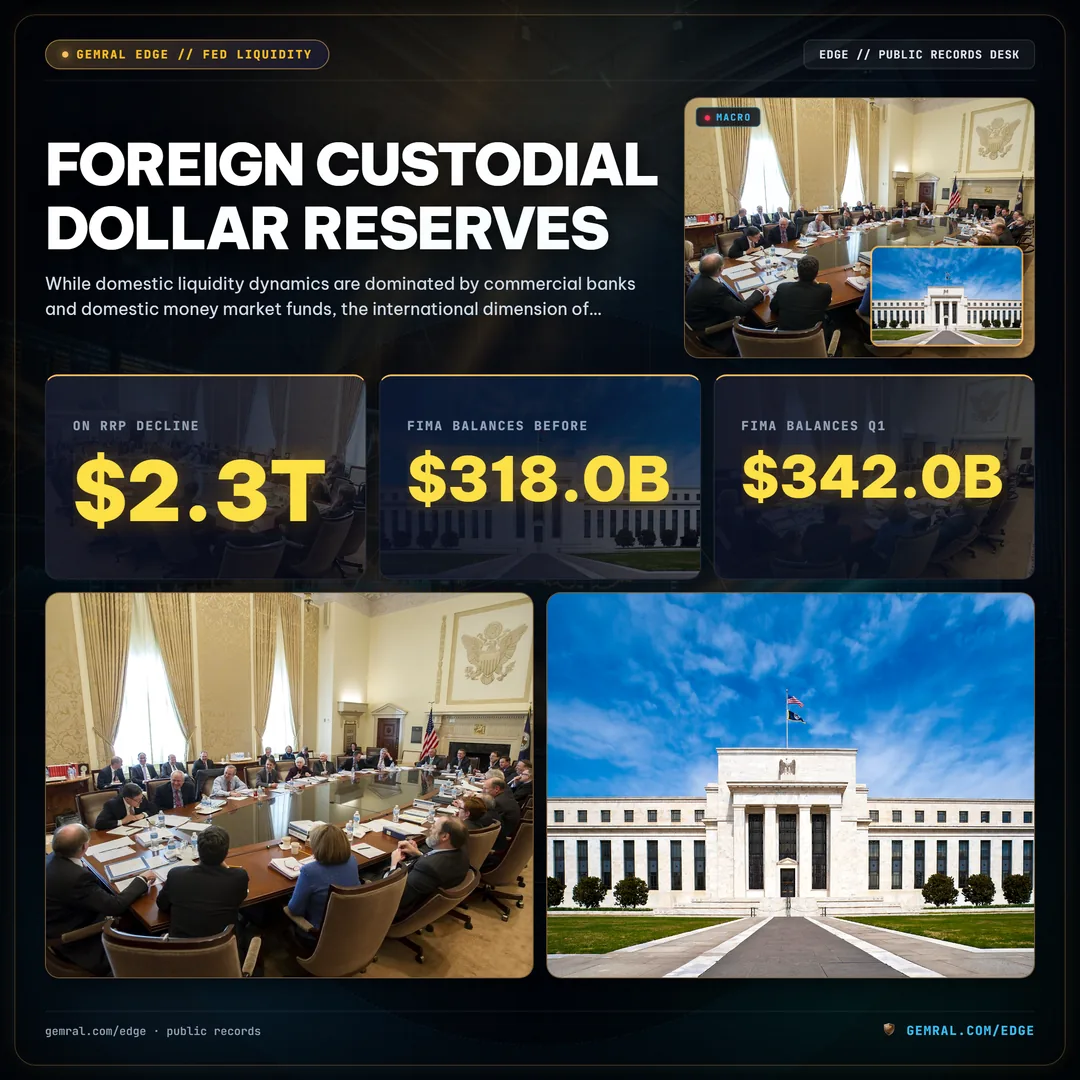
Administered by the Cục Dự trữ Liên bang Bank of New York, the FIMA facility permits foreign central banks, monetary authorities, and international financial institutions to place excess dollar holdings with the Fed overnight. Rather than holding deposits in private commercial banks or selling sovereign securities into open secondary markets when domestic dollar interventions are required, foreign official institutions park liquidity in this custodial facility, earning an overnight risk-free return backed by the Fed.
Cục Dự trữ Liên bang H.4.1 bảng cân đối kế toán disclosures reveal that while the domestic ON RRP facility was collapsing by more than $2.3T, the FIMA reverse repo facility experienced steady accumulation. Aggregate foreign custodial balances expanded from $318.0B in Q3 2024 to $342.0B in Q1 2025, reaching $361.0B in Q3 2025, $378.0B in Q1 2026, and climbing to $395.0B in Tháng 9 2026.
This steady accumulation of almost $400B in foreign official dollar reserves parked at the Cục Dự trữ Liên bang represents an important structural leakage from the domestic financial system. Foreign central banks, contending with elevated sovereign trade frictions, foreign exchange rate defense pressures, and volatile commodity pricing, have prioritized liquid dollar reserves held directly at the central bank over purchasing intermediate U.S. Kho bạc debt. Because these dollars remain sterilised in custodial accounts at the Fed New York, they are completely unavailable to finance the ongoing issuance of domestic sovereign debt, exacerbating the pressure on domestic các đại lý sơ cấp.
Độ co giãn bảng cân đối đại lý sơ cấp: Tài trợ lượng tồn kho trái phiếu Kho bạc chịu áp lực
At the center of sovereign debt distribution sit the 24 các đại lý sơ cấp designated by the Cục Dự trữ Liên bang Bank of New York. These institutional broker-dealers are obligated by regulatory charter to participate meaningfully in all U.S. Kho bạc auctions, acting as underwriters of last resort for the sovereign government. When an auction clears with weak indirect bidding from foreign central banks or institutional asset managers, các đại lý sơ cấp must absorb the unallocated sovereign paper directly onto their bảng cân đối kế toáns.

To warehouse these large-scale debt inventories, các đại lý sơ cấp rely on the repo market, borrowing cash overnight against their Kho bạc inventory. However, post-2008 banking regulations—most notably the Basel III leverage ratio and the Supplementary Leverage Ratio (SLR)—impose non-risk-weighted capital charges on total assets. Under these rules, holding a pristine, risk-free 3-month Tín phiếu Kho bạc requires the same regulatory equity capital backing as extending a riskier commercial loan.
According to the Fed New York's Form FR 2004 statistical reports, primary dealer net inventory holdings of U.S. Trái phiếu Kho bạc có lãi suất danh nghĩas and bills have surged to historic extremes. Average dealer inventory positions stood at $78.0B in 2023 and $105.0B in 2024. As auction sizes across 2-year, 5-year, 10-year, and 30-year refunding operations expanded to record post-pandemic highs throughout 2025 and 2026, dealer inventories escalated to an average of $142.0B in 2025, ultimately surging to a record peak of $184.0B in Tháng 9 2026.
An aggregate dealer inventory of $184.0B represents a critical operational bottleneck. Dealers are rapidly approaching their internal bảng cân đối kế toán risk limits and capital allocation ceilings. When dealer inventory capacity becomes saturated, their ability to intermediate repo markets deteriorates rapidly. The cost of financing off-the-run Treasuries escalates, haircuts increase, and các đại lý sơ cấp are forced to charge wider spreads to hedge funds running basis trades (arbitraging the price discrepancy between Kho bạc futures and cash Kho bạc bonds). Because these relative-value hedge funds are the single largest marginal buyers of Kho bạc debt, any financing shock in the repo market directly threatens the clearing capacity of sovereign auctions.
Bức tường tái cấp vốn nợ công: Lịch đáo hạn và yêu cầu vòng quay tài sản thế chấp (2026–2028)
The systemic urgency of this liquidity transition is intensified by the sovereign maturity schedule. The United States federal government is not merely financing current ongoing fiscal budget deficits (which continue to exceed $1.8T annually); it is concurrently forced to refinance large-scale tranches of existing debt issued during the low-rate regime of 2020-2021 that are now reaching final maturity.

Official refunding projections from the U.S. Kho bạc Office of Debt Management demonstrate that over the eight-quarter window spanning Q4 2026 through Q2 2028, the sovereign government must roll over an astounding $7.93T in maturing marketable debt obligations. As broken down in Figure 7, quarterly refinancing requirements will consistently demand between $0.98T and $1.25T in capital turnover:
Examining the quarterly roll-over schedule reveals relentless structural demands:
- Q4 2026: $1.25T maturing sovereign debt
- Q1 2027: $1.18T maturing sovereign debt
- Q2 2027: $1.22T maturing sovereign debt
- Q3 2027: $1.15T maturing sovereign debt
- Q4 2027: $1.10T maturing sovereign debt
- Q1 2028: $1.05T maturing sovereign debt
- Q2 2028: $0.98T maturing sovereign debt
When debt is refinanced, it does not simply vanish; maturing paper must be paid off with newly auctioned paper. In prior years, when a Kho bạc auction cleared, the cash utilized to purchase that debt was largely mobilized from the ON RRP facility, creating zero drag on private credit markets. Over the next 24 months, however, this $7.93T in rollover obligations must compete directly against commercial bank bảng cân đối kế toáns, private wealth management capital, and corporate treasury accounts.
This dynamic demands an unprecedented acceleration in sovereign vòng quay tài sản thế chấp—the speed at which Kho bạc securities can be rehypothecated, mobilized as collateral in secured lending agreements, and transformed into immediate liquidity. If vòng quay tài sản thế chấp slows due to dealer bảng cân đối kế toán constraints or regulatory leverage friction, the sovereign government will find itself forced to offer increasingly steep term premiums and concession yields to clear upcoming auctions, directly transmitting upward pressure across the entire corporate and consumer credit curve.
Truyền dẫn thanh khoản ròng và tác động tài sản vĩ mô: Định hướng trong kỷ nguyên tiền tệ hậu bộ đệm
To synthesize these disparate monetary components into a singular institutional framework, analytical macro desks track the Federal Net Liquidity Transmission Index. Formally defined as Cục Dự trữ Liên bang Total Assets minus the Kho bạc General Account (TGA) cash balance minus the Repo nghịch đảo qua đêm (ON RRP) facility balance, this metric reflects the actual quantity of unencumbered central bank money circulating within the private banking system.
$$\text{Net Liquidity} = \text{Fed Total Assets} - \text{Kho bạc General Account (TGA)} - \text{Repo nghịch đảo qua đêm (ON RRP)}$$
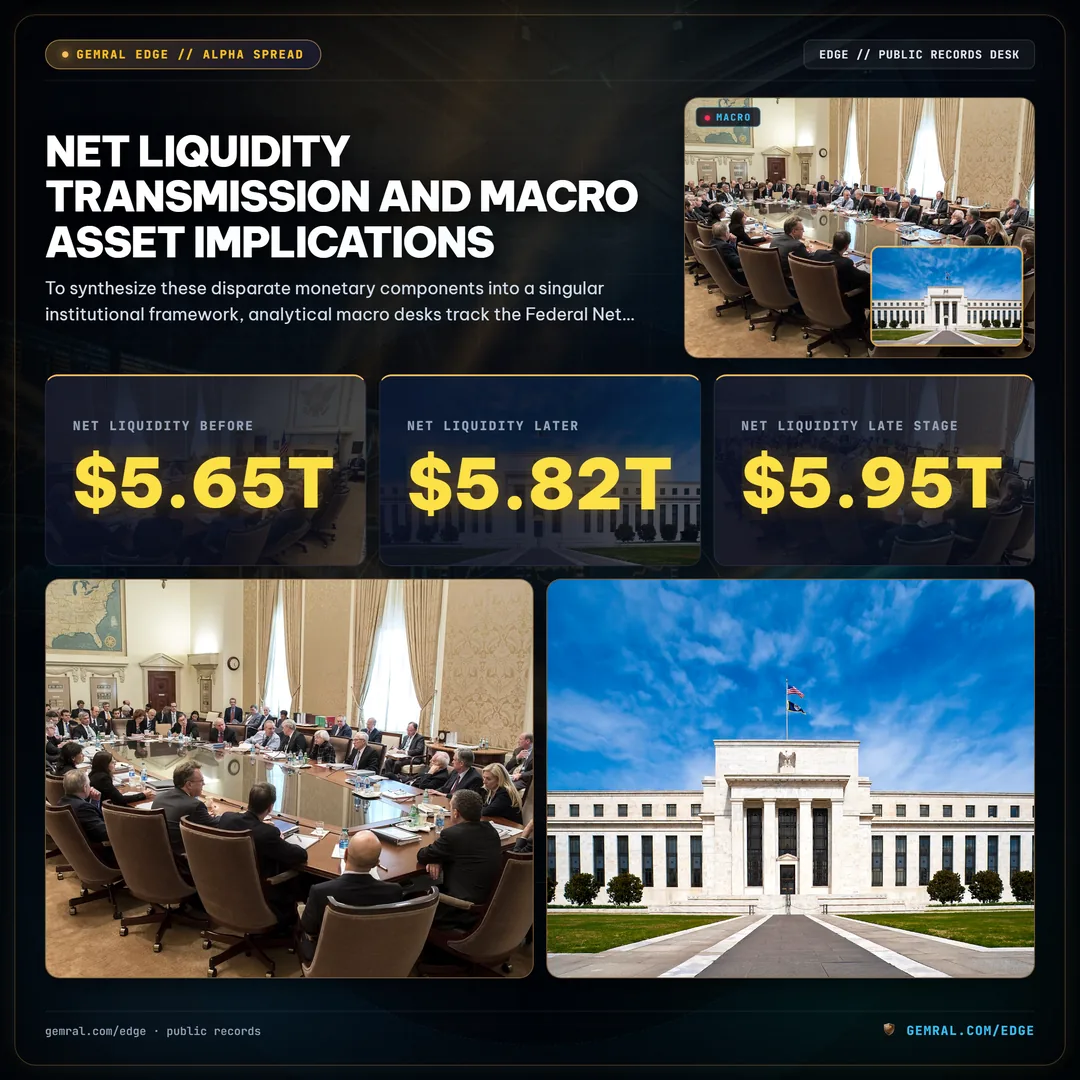
As charted in Figure 8, the trajectory of Federal Net Liquidity reveals why risk assets exhibited such resilient performance throughout the Cục Dự trữ Liên bang's tightening cycle. In Tháng 12 2022, Net Liquidity stood at $5.65T. Over the subsequent three years, despite active Thắt chặt định lượng (QT), Net Liquidity actually expanded: rising to $5.82T in Tháng 12 2023, $5.95T in Tháng 12 2024, and peaking at $6.02T in Tháng 12 2025.
This counter-intuitive expansion was entirely the mathematical consequence of the ON RRP facility run-down. Because the ON RRP is a liability on the Cục Dự trữ Liên bang's bảng cân đối kế toán that subtracts from net liquidity, every dollar drained from the facility and paid to Tín phiếu Kho bạc investors added a dollar back into the financial system, completely overriding the contractionary effect of asset runoff.
In mid-2026, however, this dynamic inverted. With the ON RRP facility effectively exhausted at $242.0B, the subtraction mechanism ceased functioning. Ongoing central bank bảng cân đối kế toán runoff, combined with Kho bạc cash replenishment into the TGA, began extracting pure liquidity from dự trữ ngân hàng thương mại. Net Liquidity peaked at $6.02T, fell to $5.85T by Tháng 6 2026, and has dropped sharply to $5.68T in Tháng 9 2026—a net destruction of $340B in active financial system liquidity in less than nine months.
- End of Thắt chặt định lượng (QT): As dự trữ ngân hàng thương mại drop below $3.15T and approach the $3.00T LCLoR threshold, the Cục Dự trữ Liên bang will be forced to formally terminate its bảng cân đối kế toán runoff program ahead of consensus expectations to prevent a chaotic recurrence of the Tháng 9 2019 repo crisis.
- Khai thác cơ sở Repo thường trực: Utilization of the Standing Repo Facility (SRF), which currently sits virtually dormant, will begin seeing regular, recurring uptake by các đại lý sơ cấp as collateral congestion spills over into daily market closes.
- Nhượng bộ lãi suất tài sản thế chấp cao: The Kho bạc will face structural resistance in continuing its disproportionate reliance on short-term bills. The necessary shift back toward intermediate coupon issuance (3-year, 5-year, and 10-year notes) will require a substantial re-pricing of long-duration term premiums across global sovereign debt markets.
As sovereign collateral supply outstrips available bảng cân đối kế toán elasticity, the era of frictionless monetary insulation is over. Market participants who constructed models based on the benign liquidity backdrop of 2023-2025 are navigating a fundamentally altered monetary topography. In this post-buffer landscape, vòng quay tài sản thế chấp, primary dealer bảng cân đối kế toán limits, and secured rate spreads will dictate the pricing of risk across every major financial asset class.