General Dynamics Collected $4.38 Billion From Eight Federal Agencies in 10 Days. The List Includes the EPA.
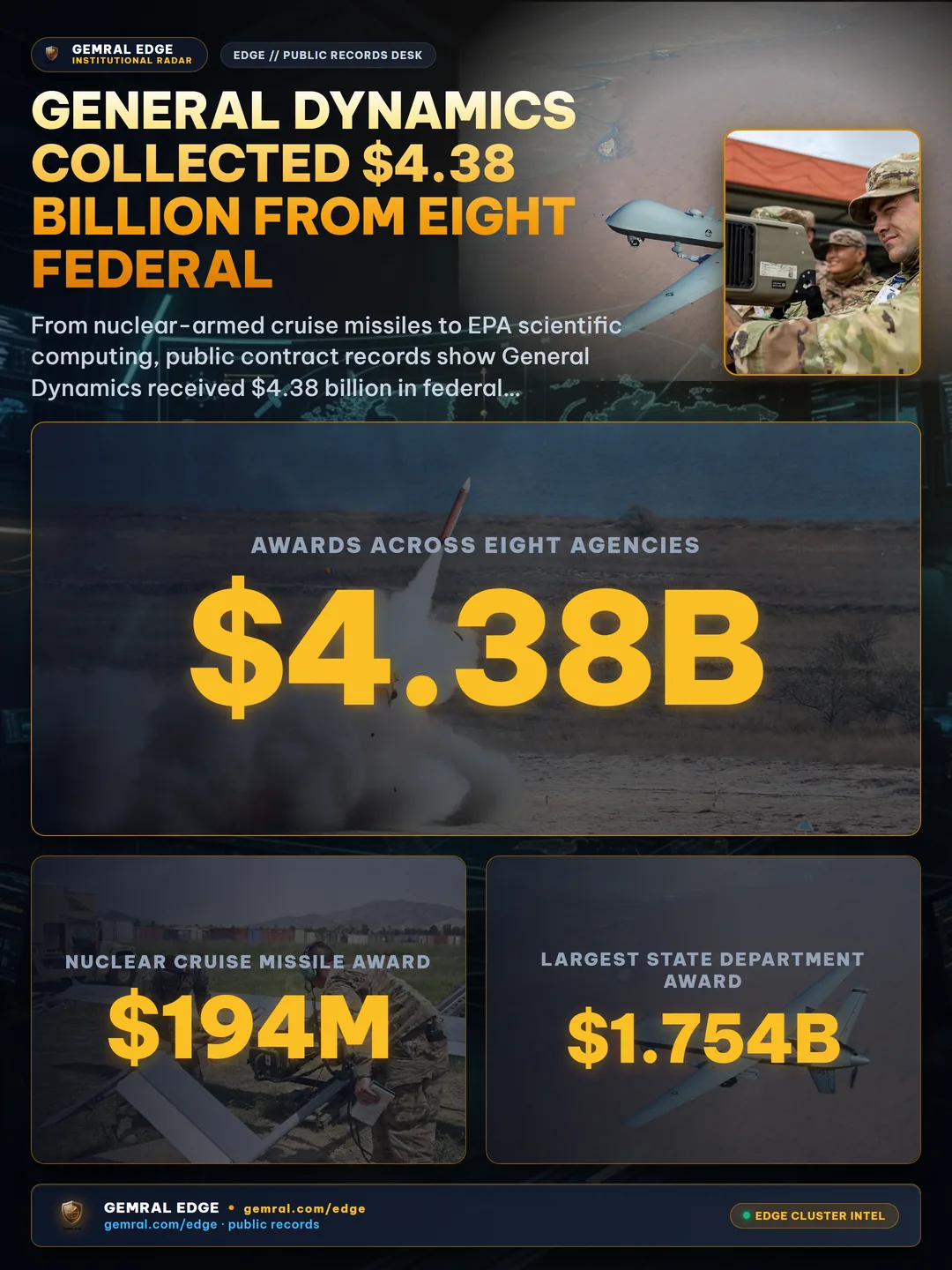
Between August 28 and September 4, 2026, public federal contract award records show General Dynamics receiving $4.38 billion in contract actions across eight distinct agencies — from the Pentagon to the Environmental Protection Agency. The nuclear weapons program was in there. So was NOAA's aircraft fleet. So was an EPA scientific computing contract. Nobody expected those last two to share a table with a $194 million nuclear-armed cruise missile award.
When you pull a company's federal contract activity for a 10-day window and get eight agencies back, the first instinct is to assume data error. The Pentagon awarding billions to a company like General Dynamics is not news. The EPA doing it is. So is the VA. So is the Department of Commerce. What stands out in the August 28–September 4 window is not any single contract — it's $4.38 billion spread across 8 agencies in a span of 10 calendar days, touching weapons systems, aircraft, civilian IT, environmental science, and veteran healthcare IT simultaneously.
All of this is in public contract award records. The question is whether anyone was reading all eight feeds at the same time.
The Three Biggest Awards and What They Tell You
The largest single action in the window was a $1.754 billion award from the Department of State on August 28. The contract covers Global Security Engineering and Supply Chain services — a broad classification that encompasses technical security systems, supply chain integrity for sensitive government operations, and engineering support for embassies and classified facilities worldwide. General Dynamics Ordnance and Tactical Systems is the primary awardee. The State Department contract category is less visible than Pentagon awards but represents a multi-billion-dollar and growing segment of defense-adjacent spending that runs through the diplomatic side of the federal budget.
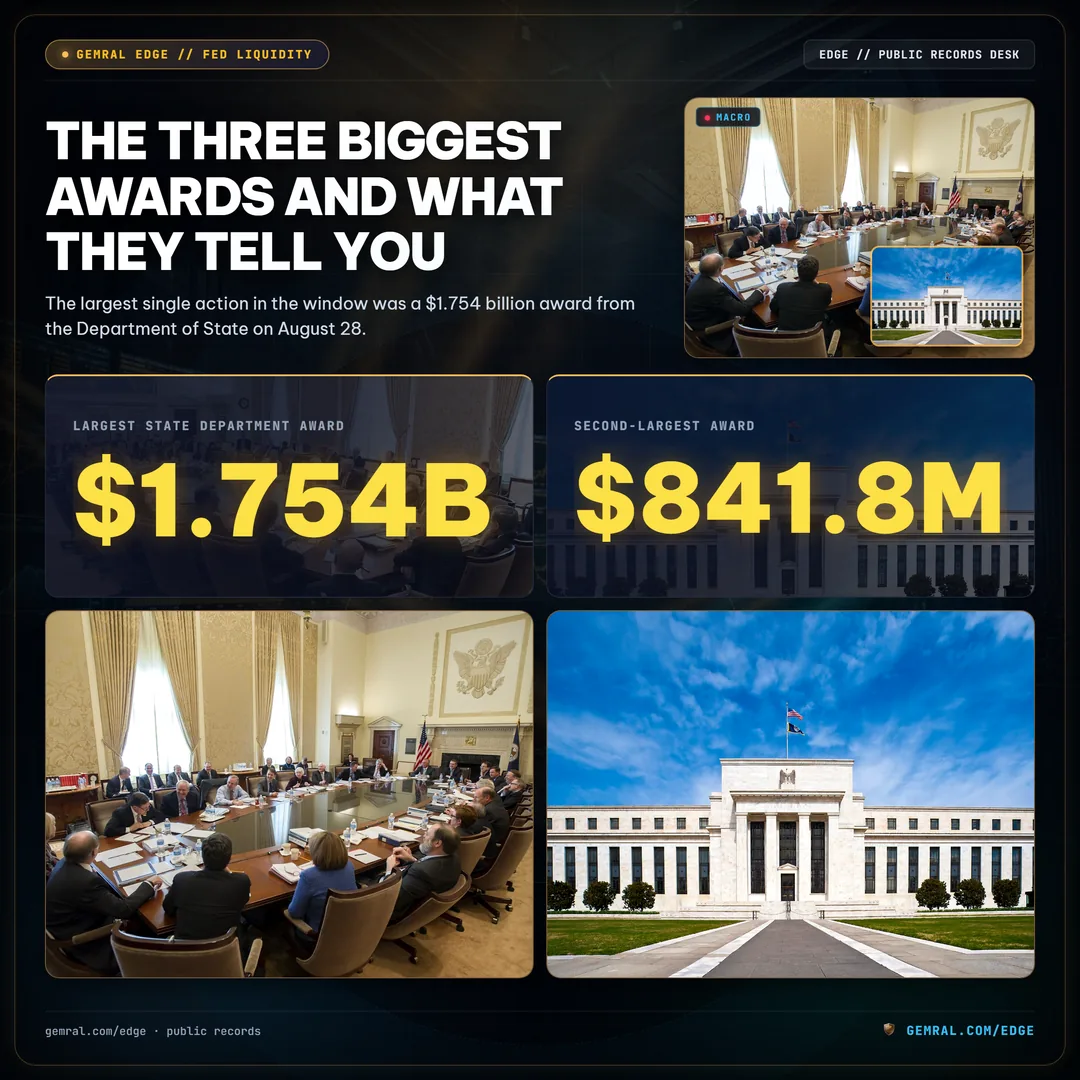
The second-largest action was $841.8 million, also on August 28, awarded through GSA on behalf of the Navy. The program: C5ISR, which stands for Command, Control, Communications, Computers, Cyber, Intelligence, Surveillance and Reconnaissance — the integrated networking and communications backbone of modern naval operations. General Dynamics Mission Systems, the company's defense electronics and C2 systems subsidiary, took this award. C5ISR modernization has been a recurring contract category as the Navy works to update communications infrastructure across surface vessels and shore facilities.
Third in size: $577.1 million for EMITS, the Enterprise Managed IT Services program, awarded through GSA on the same date. EMITS is a broad federal IT services vehicle that covers managed services, cloud migration support, cybersecurity operations, and helpdesk functions across multiple agencies. GD Information Technology (GDIS), now rebranded as GDIT, is among the largest federal IT contractors in the United States by revenue — and this award is a continuation of that positioning.
September 1: The Day Eight Agencies Filed Simultaneously
September 1 is where the agency diversity becomes most visible. On a single day, public records show GD receiving awards from at least seven agencies simultaneously. The full list from that date: $280.5 million from the Department of Transportation (FAA IT services), $251.6 million from the Department of Commerce (NOAA Gulfstream G550 aircraft maintenance and logistics), $125.1 million from the FAA's FAVES program, $91.7 million from GSA's EMITS-2 vehicle, $66.8 million from Commerce under NWOW, $66.4 million from the Department of Veterans Affairs for VICCS, $58.5 million from DoT, and $31.3 million from the Environmental Protection Agency for scientific computing infrastructure.
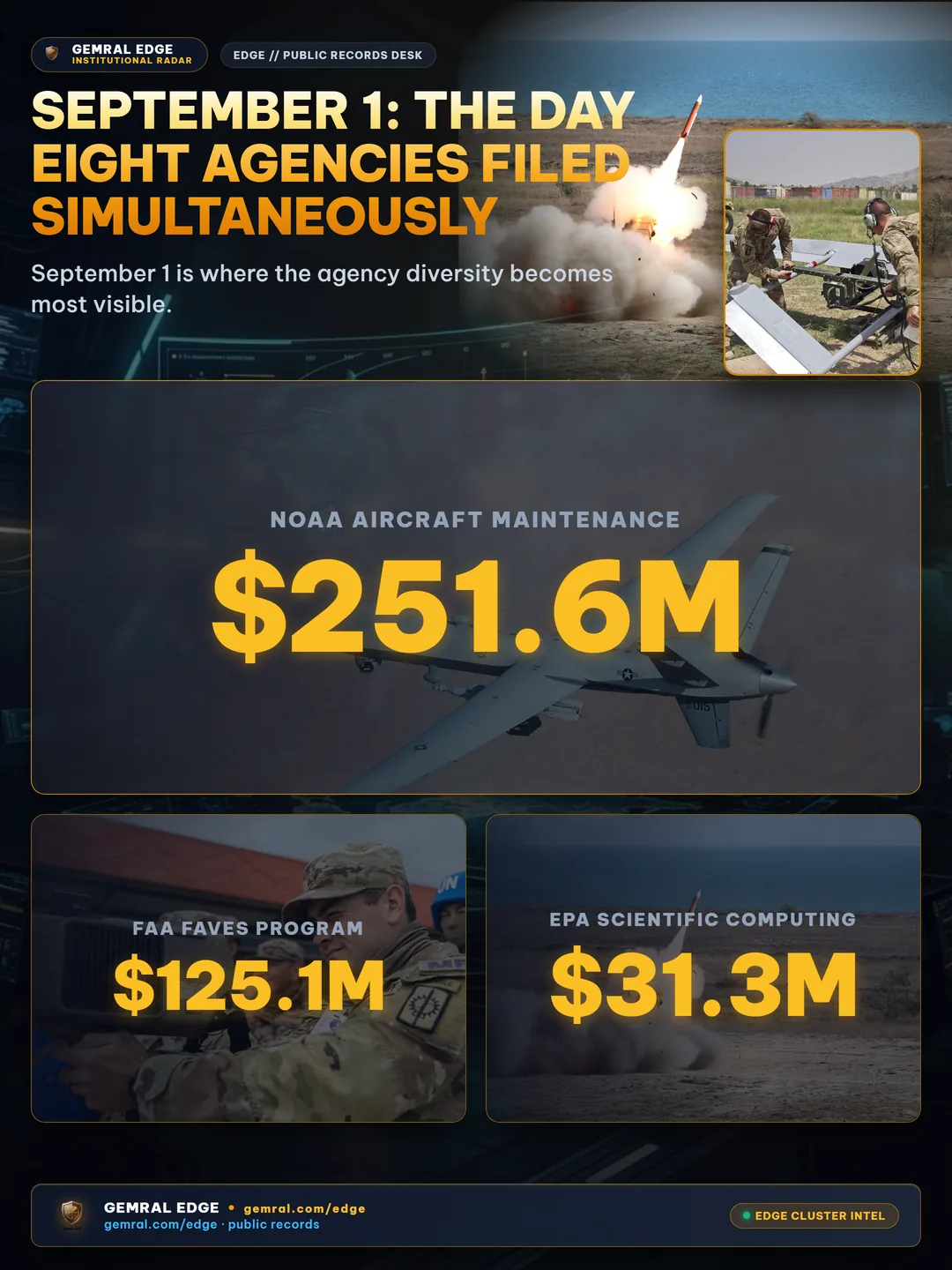
That EPA contract is worth pausing on. The EPA's scientific computing infrastructure — the systems used for environmental modeling, data analysis from air and water monitoring networks, and regulatory modeling — runs on federal IT contractor infrastructure. GD's IT services subsidiary has been active in the civilian science agency space for years. The $31.3 million EPA award is not anomalous in context; what makes it anomalous is appearing in the same 10-day window as a nuclear weapons program. Both are in public records. The juxtaposition is simply a function of reading all the feeds at once rather than siloed by agency.
The NOAA Gulfstream award represents a different GD business line entirely: Gulfstream Aerospace, the business jet manufacturer that GD acquired in 1999. NOAA operates a fleet of research and surveillance aircraft, including Gulfstream jets used for atmospheric research, hurricane tracking, and coastal monitoring. The $251.6 million award covers maintenance, logistics, and support for that fleet. When you look at the $4.38 billion total, Gulfstream contributed a quarter-billion of it — as an aircraft maintenance contract from a weather agency.
| Date | Agency | Program / Description | Amount | GD Division |
|---|---|---|---|---|
| Aug 28 | State Dept | Global Security Engineering & Supply Chain | $1,754M | GD Ordnance & Tactical Systems |
| Aug 28 | Navy / GSA | C5ISR systems (NAWCAD) | $841.8M | GD Mission Systems |
| Aug 28 | GSA | EMITS enterprise IT | $577.1M | GDIT |
| Sep 1 | DoT / FAA | IT services (VCES) | $280.5M | GDIT |
| Sep 1 | Commerce / NOAA | Gulfstream G550 aircraft support | $251.6M | Gulfstream Aerospace |
| Sep 4 | DoD | SLCM-N nuclear cruise missile fire control | $194.1M | GD Mission Systems |
| Sep 1 | FAA | FAVES program | $125.1M | GDIT |
| Sep 1 | GSA | EMITS-2 | $91.7M | GDIT |
| Sep 1 | Commerce | NWOW | $66.8M | GDIT |
| Sep 1 | VA | VICCS IT services | $66.4M | GDIT |
| Sep 1 | EPA | Scientific computing infrastructure | $31.3M | GDIT |
| Sep 1 | GSA | AFNORTH IT | $21.2M | GDIT |
| Aug 31 | HHS / CMS | Drug data services | $8.8M | GDIT |
| Aug 31 | EPA | Environmental data systems | $8.4M | GDIT |
| Aug 31 | Commerce | NESCC | $4.3M | GDIT |
The Nuclear Weapons Program Award on September 4
Four days after the August 28 cluster, the Department of Defense filed a $194.1 million contract action for the Sea-Launched Cruise Missile — Nuclear (SLCM-N) program. SLCM-N is the program to develop a new nuclear-armed sea-launched cruise missile for the US Navy — a capability that was retired in the 1990s and is being reconstituted as part of the 2018 and 2022 Nuclear Posture Reviews. The contract covers fire control subsystems — the electronics and software that manage targeting and employment of the weapon.
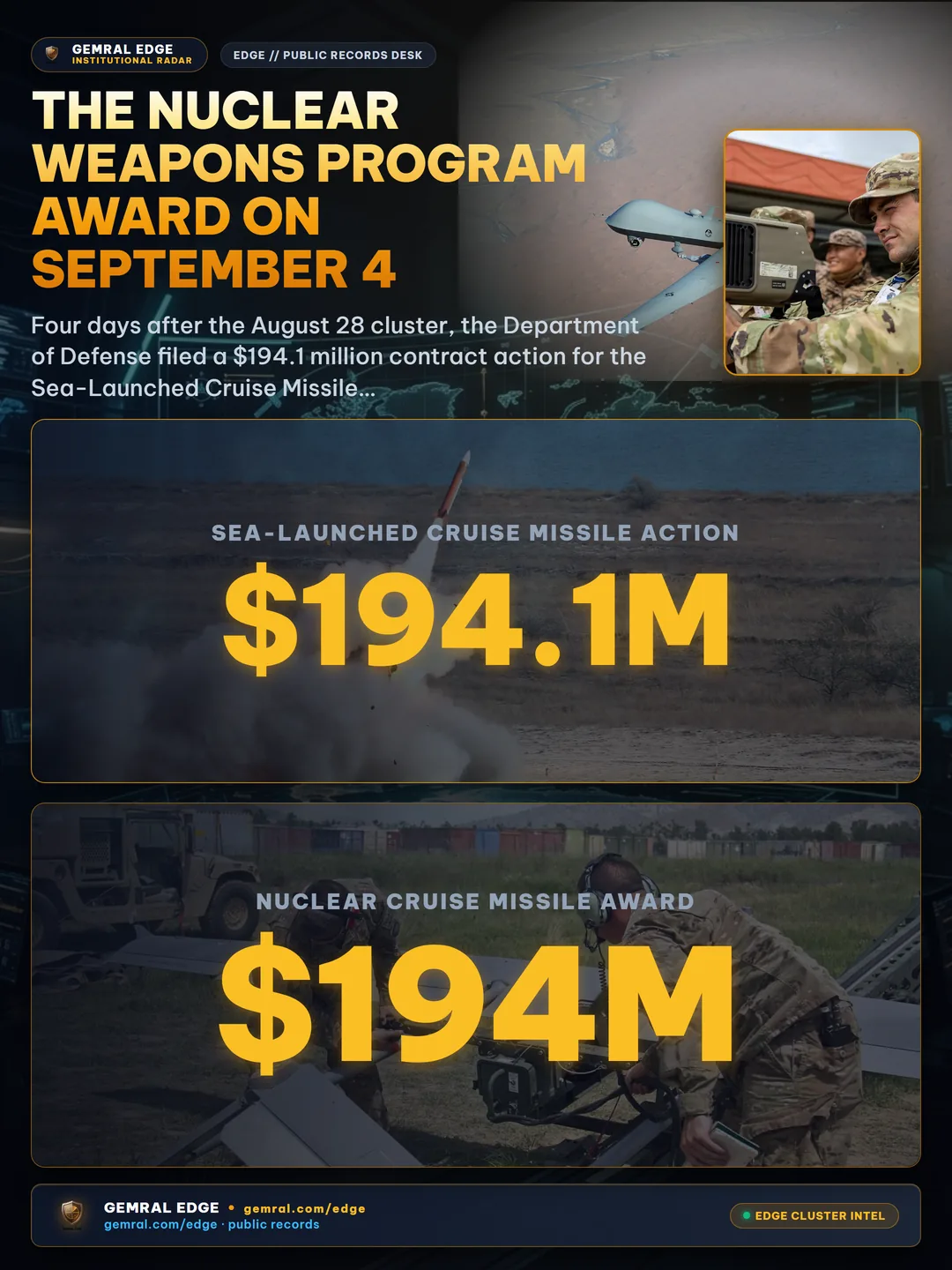
GD Mission Systems has been involved in naval weapons systems for decades. The SLCM-N award is consistent with the company's long-standing role in naval combat systems and fire control. What makes it notable in this context is timing: it arrived on September 4, after the August 28 multi-billion-dollar wave and the September 1 civilian agency cluster. A $194 million nuclear weapons program contract would normally be the headline item for any company in any week. In this window, it was the sixth-largest action by dollar amount.
Context: What Does $4.38 Billion in 10 Days Mean for a $100 Billion Company?
General Dynamics reported approximately $47.7 billion in total revenue for 2025, with roughly 65–70% coming from US government customers in various forms. That implies something in the range of $30–33 billion in annual US government revenue — or $820–900 million per 10-day period on an even-distribution basis. The $4.38 billion in this window is therefore roughly 5x what an even distribution would suggest for the same time span.
That comparison is imprecise — contract activity is inherently lumpy, not evenly distributed. Large multi-year contracts don't award every 10 days; they tend to cluster at the end of fiscal quarters and fiscal years. September is the end of the US federal fiscal year (the fiscal year runs October–September), which makes late August and early September a historically high-concentration period for federal contract activity across all defense and IT contractors. GD is not unique in seeing elevated contract activity in this window. The scale of this particular cluster is what separates it from the baseline.
Even accounting for fiscal year-end concentration, the agency breadth in this particular window is notable. Contracts from the Defense Department, State Department, NASA-adjacent programs, civilian IT agencies, and EPA in the same 10-day stretch reflect the scale of GD's federal footprint across divisions. Most defense contractors have a narrower agency profile — concentrated in DoD or Defense-adjacent agencies, with limited civilian presence. GD's IT services subsidiary (GDIT) has systematically expanded into civilian agency work over the past decade, which is why the VA, EPA, FAA, NOAA, Commerce, and HHS all show up in this window alongside the Pentagon and State Department.
None of this requires speculative interpretation. The contracts are in public records. The agencies are what they are. The divisions are named in the award documents. The story the data tells is that a company people primarily associate with tanks (Abrams), submarines (Virginia-class), and business jets (Gulfstream) is also one of the US government's largest IT service providers — and in a single 10-day window in September 2026, all of those businesses received major federal awards simultaneously — $4.38 billion across 16 contract actions.
The full award data is available in public federal contract records searchable by recipient, date, and agency. The 10-day window used here runs August 28–September 4, 2026.
Defense Procurement & Contract Intelligence:
• Federal Prime Awards: Search live Pentagon and civilian agency contract awards across all defense contractors on the Federal Contracts & Prime Contractor War Chest.
• DEEP FLOW Pre-Award Intelligence: Discover prototype OTA awards, SAM.gov solicitation drafts, and 8-K contract filings on the DEEP FLOW Institutional Radar.
• Prototype Defense Events: Track ongoing DoD Other Transaction Authority (OTA) contract milestones on the DoD Prototype OTA Pre-Award Contract Horizon.
Gemral Edge tracks federal contract flows, congressional disclosures, and lobbying filings across the full government procurement universe — in one place. Explore the data at gemral.com/edge