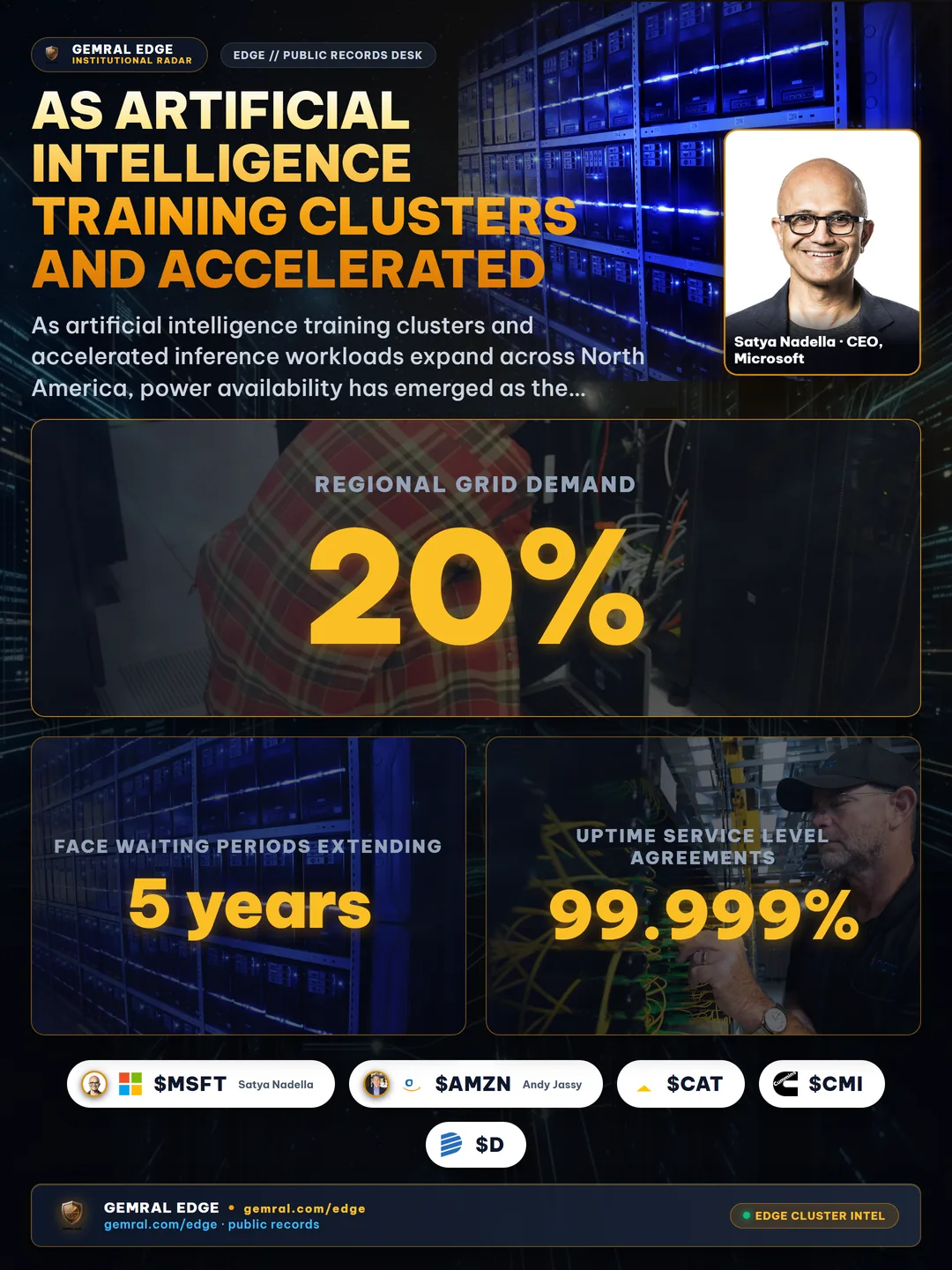
As artificial intelligence training clusters and accelerated inference workloads expand across North America, power availability has emerged as the primary operational bottleneck for hyperscale cloud operators. Nowhere is this physical reality more acute than in Northern Virginia, the world's largest concentration of digital infrastructure, where operating data center capacity exceeds 3,400 megawatts. To support high-density computing campuses while navigating multi-year utility transmission queues, hyperscalers rely on extensive arrays of heavy industrial backup generators authorized through state environmental regulators.
The Hyperscale Power Crunch: Sizing AI Data Center Electricity Demand
The transition from general-purpose enterprise computing to dense artificial intelligence architectures has fundamentally altered the power profile of modern data center campuses. Conventional cloud data halls historically operated at power densities between 5 and 10 kilowatts per rack. In contrast, modern high-density AI clusters deploying accelerated server architectures routinely demand between 40 and 100 kilowatts per rack, with next-generation liquid-cooled deployments targeting in excess of 120 kilowatts per cabinet.

This step-function surge in compute density concentrates unprecedented electrical load into single geographic campuses. Within Northern Virginia—spanning Loudoun, Prince William, Fairfax, and Mecklenburg counties—hyperscale facilities collectively consume more than 3,400 megawatts of active electrical power, representing roughly 20 percent of total regional grid demand managed by PJM Interconnection. Long-term regional transmission expansion studies project that contracted data center demand in the Dominion Energy service territory will double before 2030, exceeding 7,000 megawatts and potentially reaching 10,000 megawatts by 2035.
Consequently, regional transmission organizations face mounting backlogs. High-voltage interconnection queues for new multi-hundred-megawatt substations frequently face waiting periods extending from 3 to 5 years. For cloud infrastructure providers racing to deploy compute clusters for commercial clients, securing physical land and building shell envelopes is no longer the pacing constraint. The critical path is defined entirely by power energization schedules, substation capacity, and regulatory air permits required for on-site emergency generation.
Inside Virginia DEQ Air Permits: Why Backup Generator Capacity Sets Physical Ceilings
Because utility grid interconnections are subject to regional constraints and occasional transmission contingencies, hyperscale data centers are engineered to meet stringent uptime service level agreements exceeding 99.999% availability. To achieve Tier 3 and Tier 4 reliability standards, operators deploy utility-scale emergency diesel generators capable of sustaining entire data hall operations during grid brownouts, voltage sags, or localized blackouts.
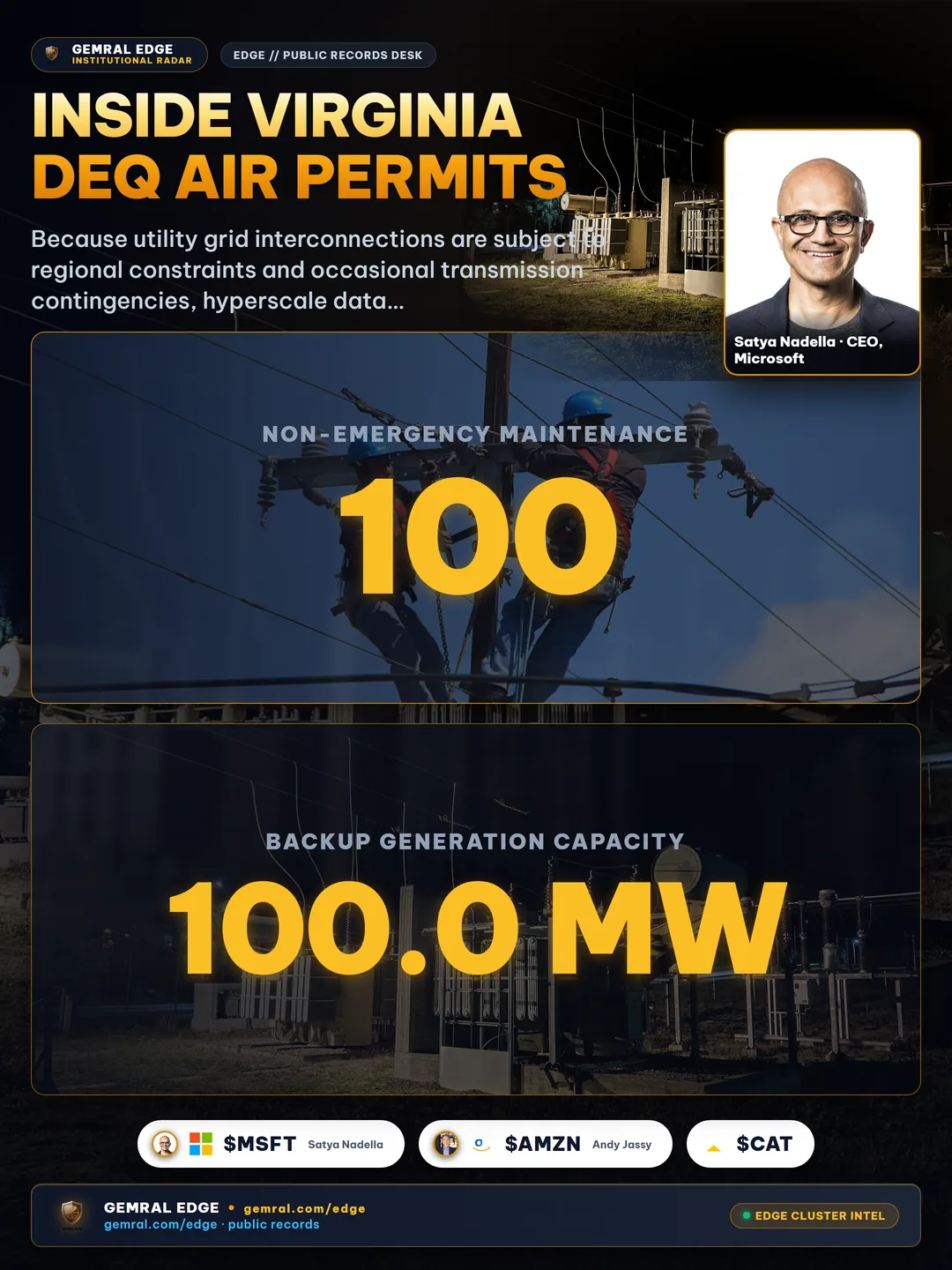
Before installing and operating stationary internal combustion engines of this magnitude, data center developers must obtain air quality permits from the Virginia Department of Environmental Quality (DEQ). Under Virginia State Air Pollution Control Board regulations and Title V minor New Source Review (NSR) frameworks, data centers must disclose the precise technical specifications of all combustion equipment, while non-emergency maintenance is restricted to 100 hours per engine annually. These filings detail engine manufacturer, cylinder configuration, nameplate electrical rating, fuel storage volume, exhaust stack height, and cumulative facility emission limits for nitrogen oxides, carbon monoxide, and particulate matter.
Because air permits are legal prerequisites for installing physical generation assets, public DEQ air permits serve as an indispensable, verifiable source of telemetry regarding campus scale. When an operator permits 40 heavy industrial diesel engines on a single parcel, that regulatory filing establishes a definitive physical upper bound often exceeding 100.0 MW of backup generation capacity.
Methodology & Infrastructure Boundary: Permitted backup-generator MW is an upper bound on on-site backup capacity, not IT load; we do not convert it. Operating power draws vary dynamically based on server utilization, power usage effectiveness, and grid availability.
Understanding this technical distinction is paramount for institutional researchers. While emergency backup capacity reflects the maximum electrical generation available during utility failure, operational IT load is bounded by transformer ratings, cooling subsystem overhead, and dynamic server utilization cycles. Nonetheless, tracking permitted generator capacity provides transparent visibility into the physical scaling targets of major hyperscale developers years before revenue recognition.
Comparing Genset Deployments: Microsoft vs Amazon Hyperscale Campuses
An audit of publicly issued Virginia DEQ air permits highlights distinct engineering and procurement strategies among Tier-1 hyperscale operators. In Southern and Northern Virginia, major cloud providers such as Microsoft Corporation (NASDAQ: MSFT) and Amazon Data Services (NASDAQ: AMZN) have permitted thousands of megawatts of emergency generation across purpose-built campuses.
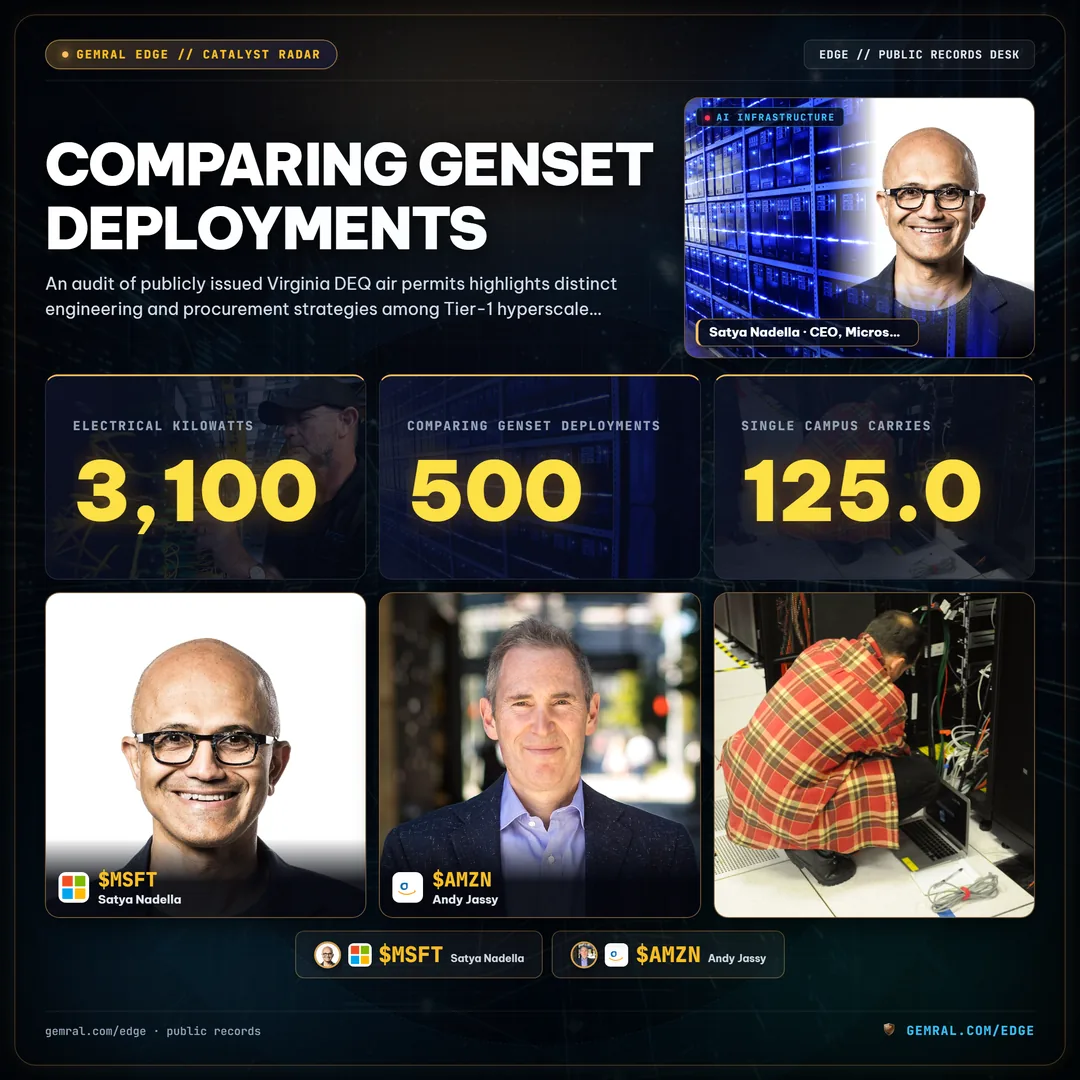
In Mecklenburg County, Virginia, public regulatory records document multi-generator installations supporting Microsoft's enterprise cloud hubs. On July 12, 2023, Virginia DEQ issued an NSR Air Permit (Registration No. 53071) for the Microsoft AVC43 Data Center campus. The regulatory document authorizes the installation of 40 primary Caterpillar C175-16 diesel generator sets, each rated at 3,100 electrical kilowatts (kWe), alongside two Caterpillar C15 emergency station-service units rated at 500 kWe. In aggregate, this single campus carries 125.0 megawatts of permitted backup generation capacity.
Just one day later, on July 13, 2023, Virginia DEQ issued an NSR Air Permit (Registration No. 53072) for the adjacent Microsoft LYH10 Data Center facility. The LYH10 permit authorizes 20 primary Cummins C3000 D6e diesel generator units, each rated at 3,000 kWe, accompanied by one Cummins DFEK 500 kWe emergency unit, representing 60.5 megawatts of permitted on-site backup power. Combined, these two neighboring Microsoft facilities in Mecklenburg County represent 185.5 megawatts of permitted emergency diesel generation across 63 individual heavy industrial engines.
| Campus Name | Operator | Jurisdiction | DEQ Permit Reg No. | Issue Date | Primary Generator Configuration | Permitted Backup MW |
|---|---|---|---|---|---|---|
| Microsoft AVC43 | Microsoft (MSFT) | Mecklenburg County, VA | 53071 | July 12, 2023 | 40x Caterpillar C175-16 (3,100 kWe) + 2x C15 (500 kWe) | 125.0 MW |
| Microsoft LYH10 | Microsoft (MSFT) | Mecklenburg County, VA | 53072 | July 13, 2023 | 20x Cummins C3000 D6e (3,000 kWe) + 1x DFEK (500 kWe) | 60.5 MW |
| Amazon Data Services IAD-50 Cluster | Amazon (AMZN) | Loudoun County, VA | 74049 | Active Record | Modular Multi-Engine Hyperscale Array | >100.0 MW |
| Amazon Data Services IAD-51 Cluster | Amazon (AMZN) | Loudoun County, VA | 74063 | Active Record | Modular Multi-Engine Hyperscale Array | >100.0 MW |
Simultaneously, in the dense data corridor of Loudoun County—centered in Sterling and Ashburn—Amazon Data Services operates major multi-building clusters under Virginia DEQ permits such as Registration No. 74049 (covering facility nodes IAD-50, IAD-60, IAD-71, IAD-78, IAD-79, and IAD-80) and Registration No. 74063 (covering nodes IAD-51, IAD-56, IAD-88, and IAD-89). In these Northern Virginia hubs, generator banks are often integrated into modular acoustic enclosures with integrated sub-base fuel storage tanks providing between 48 and 72 hours of continuous run-time at full rated load.
Caterpillar vs Cummins: Industrial Engine Telemetry in Northern Virginia
The extensive buildout of emergency backup power across Northern Virginia has funneled billions of dollars in specialized capital expenditures toward heavy equipment manufacturers. Regulatory disclosures indicate that two industrial giants dominate the data center backup market: Caterpillar Inc. (NYSE: CAT) and Cummins Inc. (NYSE: CMI).
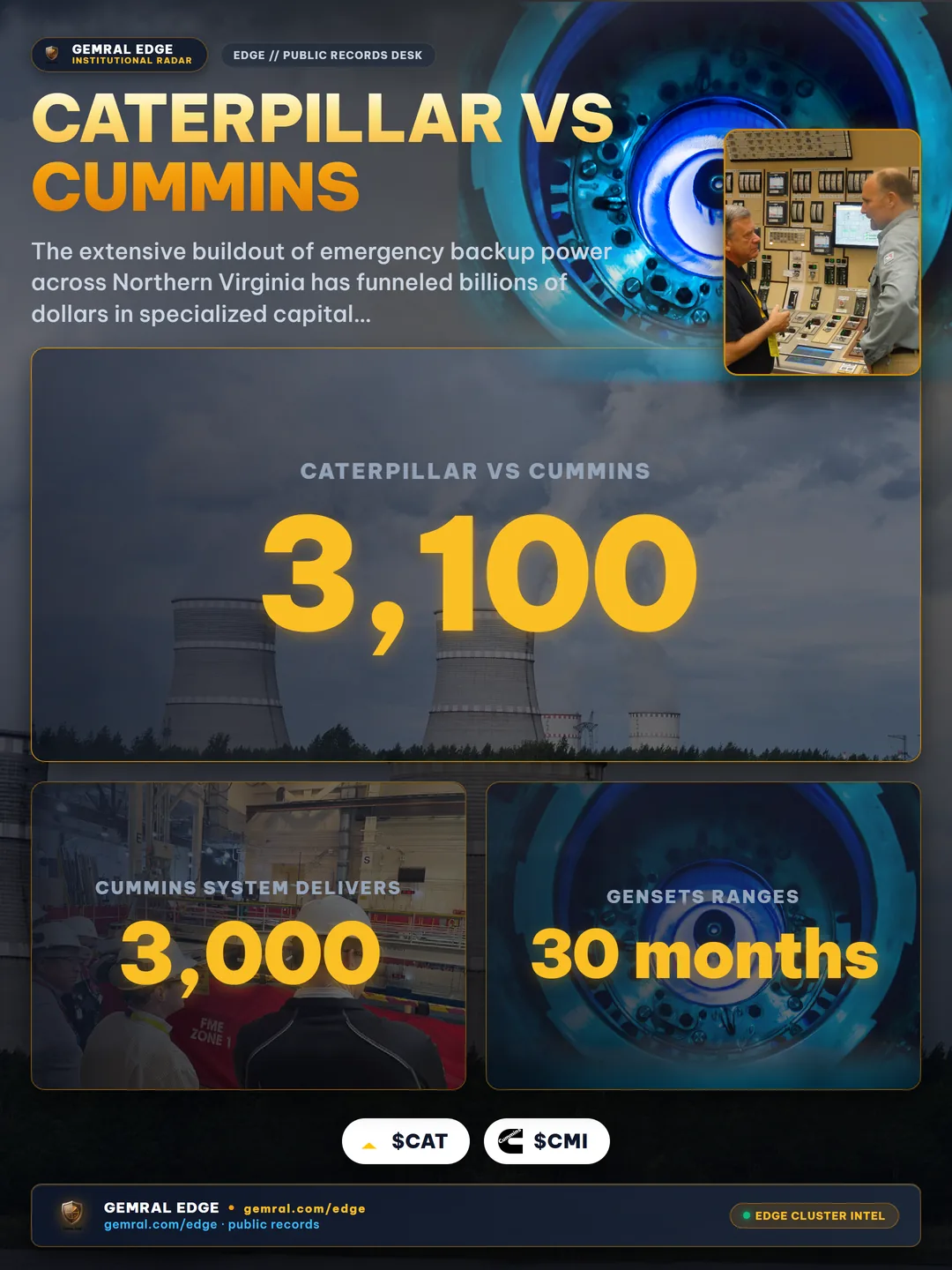
Caterpillar's flagship data center platform is the C175-16 diesel engine. Featuring a 16-cylinder, four-stroke turbocharged design with an 85-liter displacement, the C175-16 is engineered specifically for mission-critical standby applications, delivering up to 3,100 kWe of net electrical output. The engine incorporates advanced electronic common-rail fuel systems that meet EPA Tier 2 and Tier 4 emission standards while achieving rapid start times—delivering full rated load within 10 seconds of utility power loss.
Competing directly in the high-output mission-critical segment, Cummins deploys its C3000 D6e generator sets powered by the QSK78 industrial diesel engine. Utilizing a 78-liter V18 configuration, the Cummins system delivers 3,000 kWe of reliable standby power. Cummins units feature full authority electronic controls and high-pressure modular common rail systems, engineered to support block loading capabilities required when large server rows and central chiller plants demand instantaneous energization.
For equipment manufacturers, data center power systems represent a high-margin, multi-year revenue driver. The procurement lead time for large 3-megawatt class reciprocating engine gensets currently ranges from 18 to 30 months, requiring hyperscale developers to issue advance purchase orders and commit capital long before breaking ground on facility foundations.
From Permitted Engines to Substation Energization: Overcoming Transmission Queues
While permitted on-site generators provide life-safety and operational resilience, they are designed exclusively for standby and testing operations under state air permits, which typically restrict non-emergency maintenance operations to 100 hours per engine per calendar year. Consequently, commercial deployment of AI compute clusters remains bound to the physical pace of high-voltage transmission infrastructure.
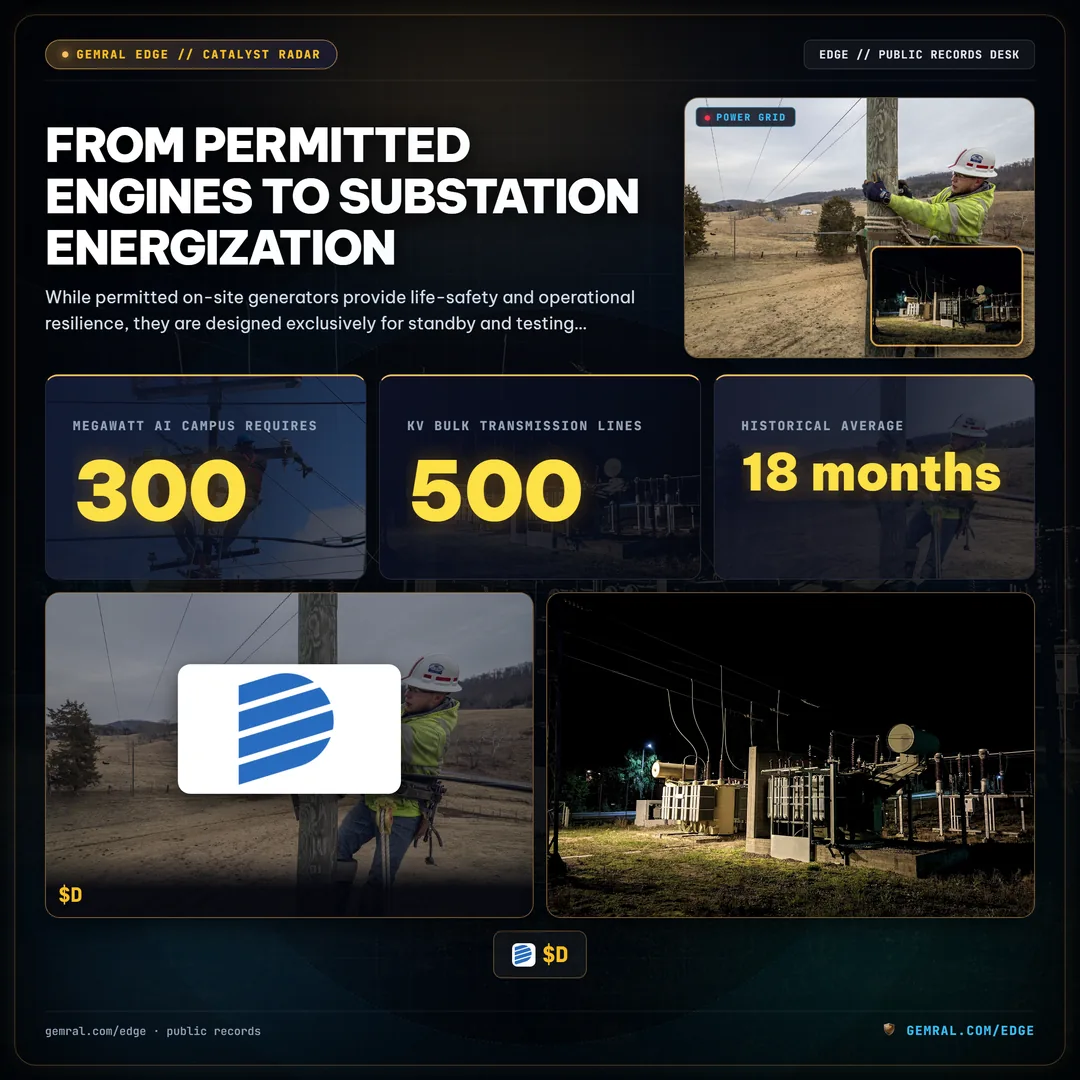
Energizing a 100-megawatt to 300-megawatt AI campus requires dedicated high-voltage substations stepping power down from 230 kV or 500 kV bulk transmission lines to 34.5 kV distribution feeders. The global supply chain for extra-high voltage autotransformers, gas-insulated switchgear, and high-capacity circuit breakers is severely constrained. Standard manufacturing lead times for large power transformers have stretched from an historical average of 18 months to between 36 and 60 months in 2026.
As a result, utility infrastructure planning has become the definitive leading indicator for cloud capacity expansion. When operators coordinate with regional transmission utilities such as Dominion Energy (NYSE: D) or American Electric Power, substation construction and rights-of-way approvals frequently precede server delivery by three to four years. By cross-referencing public air permits, substation distances, and utility capital expenditure filings, market participants can map out the actual geographical trajectory of artificial intelligence infrastructure with rigorous physical precision.
Institutional Telemetry: Tracking Physical Infrastructure Signals via Edge Systems
Evaluating the artificial intelligence buildout requires moving beyond self-reported corporate press releases and high-level cloud capital expenditure figures. Institutional investors and infrastructure operators need verifiable, bottom-up physical telemetry tied directly to public records.
For AI-infrastructure companies we also track data-center sites, air permits, permitted backup-generator MW, substations, grid demand, equipment imports, capex and satellite measurements. Every record is tied to the company and ticker that were valid on the day it became public. Publication lags are applied, so the data can be joined without look-ahead.
By systematically tracking Virginia DEQ environmental dockets, PJM interconnection study releases, and equipment import customs manifests, specialized physical telemetry surfaces granular infrastructure catalysts across the compute supply chain. Whether auditing backup generator nameplate capacities for Microsoft and Amazon or monitoring utility transmission lead times, physical telemetry provides the empirical foundation needed to understand the true constraints of the AI infrastructure cycle.
Explore Hyperscale Infrastructure Telemetry
Access verified physical site data, permitted generator capacities, and utility grid constraints across global hyperscale data centers.
Official Data Sources
- Virginia Department of Environmental Quality (DEQ): Issued Air Permits for Data Centers and Stationary Internal Combustion Source Registers (https://www.deq.virginia.gov).
- PJM Interconnection: 2026 Long-Term Load Forecast, Regional Transmission Expansion Plan, and Interconnection Queue Analytics (https://www.pjm.com).
- Dominion Energy Virginia: Integrated Resource Plan Filings and Large Load Interconnection Substation Planning (https://www.dominionenergy.com).
- U.S. Energy Information Administration (EIA): Electric Power Monthly and Form EIA-861 Detailed Data Files (https://www.eia.gov).
Related Market & Infrastructure Intelligence:
Frequently asked questions
Why is Virginia air permitting critical for tracking AI data center power demand?
Because electric utilities often face multi-year transmission study delays, hyperscalers must secure Virginia DEQ minor New Source Review (NSR) air permits years in advance to authorize on-site diesel emergency backup generators before energizing server halls. These public regulatory filings provide granular engineering specifications on campus generator MW capacity, generator engine counts, and physical substation interconnections.
Does permitted backup generator megawatts equal data center IT power consumption?
No. Permitted backup-generator MW is an upper bound on on-site backup capacity, not IT load; we do not convert it. Backup generators are sized with redundancy (such as N+1 or 2N architectures) to support emergency operations during grid outages, whereas IT load reflects continuous server compute demand.
Which generator manufacturers dominate Northern Virginia hyperscale campuses?
Public Virginia DEQ air permits indicate that Caterpillar (NYSE: CAT) and Cummins (NYSE: CMI) provide the vast majority of hyperscale emergency power units. Frequent configurations include Caterpillar C175-16 engines rated at 3,100 kWe and Cummins C3000 D6e engines rated at 3,000 kWe, alongside smaller station-service units.
How long are substation and transmission interconnection lead times for new AI data centers?
In Northern Virginia (PJM Interconnection territory and Dominion Energy service area), high-voltage substation transformers and 230 kV/500 kV transmission interconnection lead times currently extend from 3 to 5 years, making physical site permits and generator procurement essential leading indicators of energization.