Beyond Model Hype: What 1,000 Technical Hiring Signals Reveal About the Real Production AI Stack

Tracking technical disclosures across 1,000 distinct engineering hiring requirements reveals a structural divergence: while benchmark leaderboards obsess over marginal evaluation scores, enterprise engineering teams are voting with their infrastructure budgets. The data shows Anthropic cited across 40 distinct enterprise technology stacks compared to 21 for OpenAI — a 1.9x breadth ratio that challenges prevailing market assumptions.
Every quarter, venture capital decks and enterprise software marketing promote a narrative of total generative AI dominance. Yet outside vendor conference keynotes, the actual production machinery deployed by enterprise engineering organizations tells a far more nuanced, disciplined story. When an enterprise software company recruits senior infrastructure engineers, staff platform architects, or backend systems leads, the mandatory technical qualifications disclosed in their public hiring specifications represent binding operational commitments. Companies do not recruit for expensive distributed infrastructure frameworks on a whim. They recruit for the exact libraries, cloud primitives, runtimes, and model endpoints that their core software requires to run in production today.
Across our longitudinal catalog of 1,000 public engineering signals spanning 336 distinct technologies, we analyzed the active operational footprints of leading enterprise software, artificial intelligence, and cloud infrastructure companies. The resulting dataset provides an unvarnished audit of where enterprise technology budgets are currently committed, which model APIs have achieved genuine multi-tenant enterprise breadth, and how high-efficiency inference runtimes are quietly overtaking legacy serving architectures.
1. The Breadth Divergence: Why Anthropic Now Spans 40 Enterprise Engineering Stacks While OpenAI Concentrates in 21
The most consequential discovery in the foundation model layer is the decoupling of gross requirement volume from organizational breadth. When measuring public engineering hiring disclosures, OpenAI accounts for 1,208 active technical postings, whereas Anthropic accounts for 861. At surface level, casual observers might interpret OpenAI's gross posting count as proof of market leadership. However, examining the distinct enterprise count reveals the opposite distribution.
Anthropic's model APIs are explicitly required across 40 independent enterprise engineering organizations in our public dataset. In contrast, OpenAI's API requirements are concentrated across just 21 organizations. That represents a 1.9x wider enterprise adoption breadth for Anthropic. While OpenAI's requirements are concentrated heavily within a smaller group of aggressive early adopters and specialized AI studios, Anthropic has systematically penetrated a broader, more diversified cross-section of enterprise software engineering environments.
Behind Anthropic and OpenAI, the long tail of foundation model providers highlights the steep consolidation underway in enterprise software. Google Gemini ranks third with 6 unique enterprise organizations citing its APIs across 23 technical postings. Open-weight and hybrid alternatives exhibit even sharper drop-offs in commercial enterprise requirements: Meta Llama appears across 4 organizations with 12 postings, DeepSeek is cited by 3 organizations with 8 postings, and European foundation model creator Mistral appears in 2 organizations with 5 postings. Cohere likewise maintains an active presence in 2 enterprise stacks with 6 postings.
This distribution reveals that enterprise multi-model strategies remain largely aspirational. The vast majority of production engineering teams select one primary proprietary model provider for mission-critical reasoning workflows, with Anthropic establishing an early lead in enterprise developer preference for complex coding, structured document processing, and deterministic tool-calling pipelines.
2. Postings Volume vs. Customer Breadth: Unpacking the 57.5 vs. 21.5 Requirement Concentration
To understand why gross requirement counts can distort the true competitive landscape, one must analyze the organizational concentration ratio — defined as the average number of job requirements generated per deploying company. Calculating this metric exposes a stark divergence between centralized hyperscale adoption and distributed ecosystem adoption.
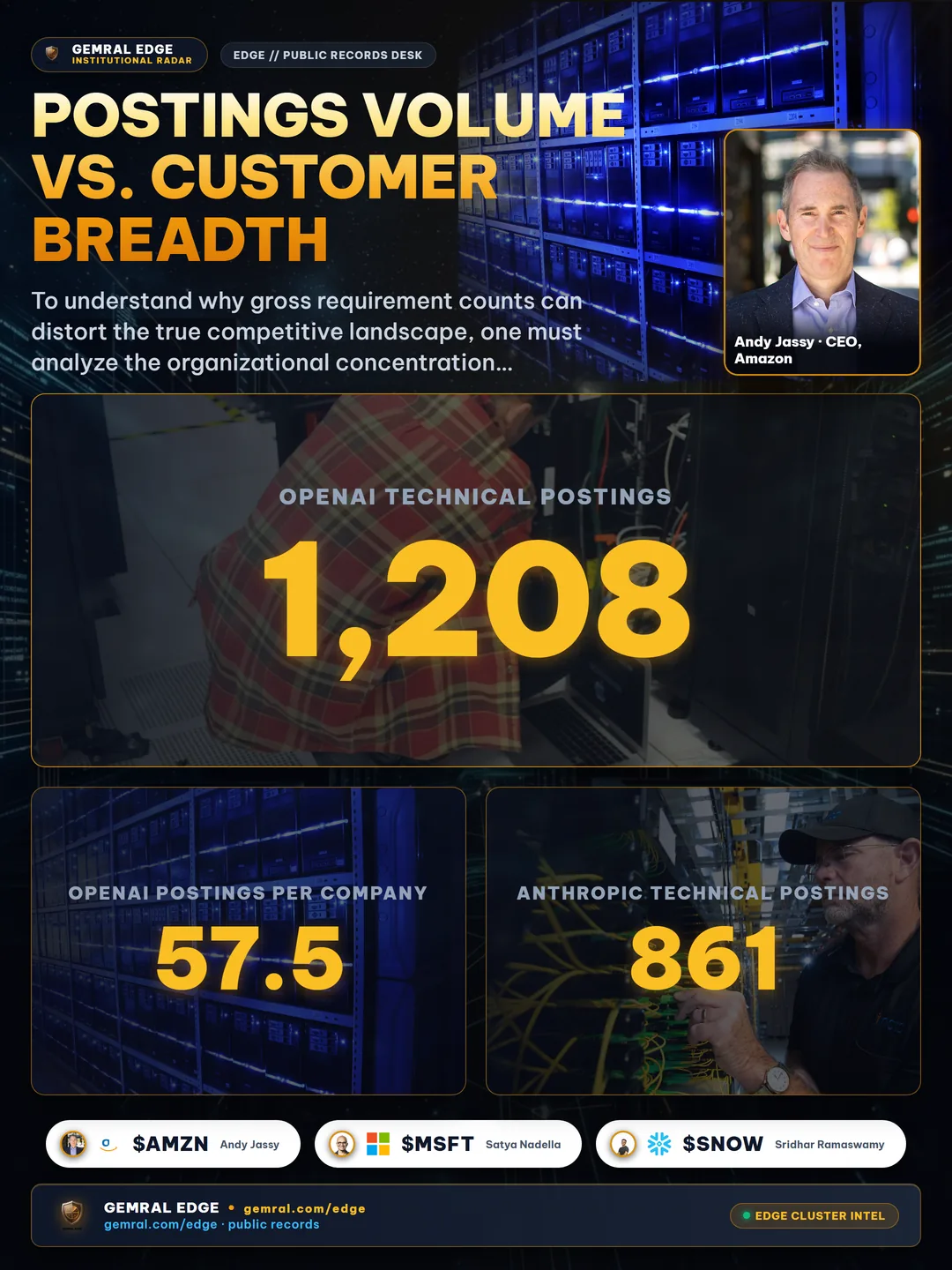
OpenAI's 1,208 postings across 21 companies yield an average concentration ratio of 57.5 job postings per company. A small number of hyper-growth software firms are hiring dozens of engineers simultaneously to build consumer-facing conversational agents and specialized vertical workflows around OpenAI's API. When a single firm opens 60 or 80 software engineering positions requiring OpenAI API familiarity, it inflates gross ecosystem metrics while representing only a single institutional customer.
Anthropic presents a strikingly different operational profile: 861 postings distributed across 40 enterprises yields a concentration ratio of 21.5 postings per company. This pattern reflects organic, decentralized adoption where multiple distinct engineering departments across different market sectors — spanning enterprise communication platforms, automated customer intelligence providers, and developer productivity toolmakers — are embedding Claude into their core technical baselines.
This dynamic extends across the broader data platform tier as well. Databricks displays an even more pronounced concentration profile, generating 1,020 postings across 13 companies (78.4 postings per enterprise), reflecting large-scale data engineering platform overhauls within large-scale enterprise environments. Scale AI exhibits 504 postings across 13 companies (38.7 postings per enterprise). Recognizing the difference between high-volume single-entity hiring and broad multi-entity adoption is essential for evaluating enterprise software durability.
3. The Inference Shift: How vLLM and SGLang Are Displacing Legacy Model Serving Frameworks
While closed APIs dominate public discussion, the internal engineering stacks of tier-1 technology firms reveal a rapid operational pivot in how proprietary and open-weight models are hosted and served. In late 2024 and early 2025, standard enterprise serving architectures relied primarily on general-purpose containerized wrappers or early serving engines. By September 2026, public technical hiring disclosures demonstrate that high-throughput, memory-optimized inference runtimes have become standard operational requirements.
Leading this shift is vLLM, which now registers 9 unique enterprise adopters across 43 active technical job postings. Directly competing is SGLang, originating from academic research on structured generation and RadixAttention, which has accelerated to 8 unique enterprise engineering adopters across 26 technical postings. Together, these two next-generation open inference runtimes account for 17 enterprise engineering deployments, establishing clear operational momentum over earlier serving architectures.
The economic imperative driving this transition is GPU memory bandwidth efficiency. In production multi-tenant environments, standard model serving suffers catastrophic throughput degradation during concurrent token generation due to unoptimized key-value (KV) cache management. Through innovations like PagedAttention in vLLM and RadixAttention in SGLang, engineering teams are achieving 2x to 4x increases in effective token serving throughput on identical physical GPU hardware clusters.
Meanwhile, hardware-vendor optimized solutions continue to hold stable positions in specialized high-scale deployments: NVIDIA's Triton Inference Server is required across 7 enterprise organizations with 21 postings, while TensorRT-LLM appears in 7 organizations with 19 postings. Rather than choosing between open-source flexibility and hardware optimization, sophisticated infrastructure teams frequently deploy Triton Server as the external orchestration gateway while utilizing vLLM or TensorRT-LLM execution backends for raw tensor computation.
4. The ML Framework Hierarchy: PyTorch Retains an Uncontested 32-to-18 Edge Over TensorFlow
In the foundational layer of machine learning computation and deep neural network execution, the decade-long rivalry between deep learning frameworks has officially settled into an entrenched hierarchy. In public technical disclosures, PyTorch stands as the undisputed lingua franca of enterprise AI development, required by 32 distinct enterprise software organizations across 247 active engineering roles.
TensorFlow, by contrast, registers 18 enterprise adopters across 66 postings — less than one-third of PyTorch's active posting volume. More critically, an analysis of technical context indicates that TensorFlow requirements are overwhelmingly tied to legacy recommendation systems, computer vision pipelines, and existing production maintenance, whereas PyTorch is universally specified for new generative model architecture development, parameter-efficient fine-tuning (PEFT), and multimodal transformer experimentation.
Direct hardware programming interfaces tell an equally compelling story. NVIDIA CUDA is explicitly mandated across 17 distinct enterprise engineering stacks across 83 specialized postings. These roles are not entry-level data science positions; they represent high-compensation systems programming roles focused on custom kernel development, FlashAttention implementations, and distributed tensor communication primitives. Hugging Face's open-source library ecosystem is required by 12 enterprises across 68 postings, serving as the universal model packaging layer, while Google's JAX maintains a specialized footprint across 10 companies with 48 postings, primarily favored by high-throughput research laboratories and compiler-oriented distributed training teams.
5. The Hardware Abstraction Layer: CUDA Dominance and the Pragmatic Reality of Alternative Accelerators
Over the past 24 months, extensive financial commentary has speculated on the imminent erosion of NVIDIA's CUDA software moat by competing silicon providers and open abstraction standards. However, rigorous inspection of production engineering hiring specifications reveals that the hardware abstraction moat remains formidable.
While CUDA appears across 17 enterprise engineering organizations, alternative hardware ecosystems show limited penetration in active commercial hiring. AMD's ROCm software stack appears in only 4 enterprise organizations across our dataset. Specialized cloud silicon alternatives show even narrower commercial footprints: custom cloud accelerators like AWS Trainium and Inferentia appear in only 1 to 2 enterprise disclosures outside of cloud provider internal teams, while specialized hardware architectures from startups such as Cerebras and SambaNova appear in 1 organization each.
This technical inertia explains why GPU cloud platforms like CoreWeave (3 companies) and specialized hosting providers continue to command enterprise traction. Rather than re-architecting complex deep learning pipelines to run on unproven custom silicon architectures, engineering leaders overwhelmingly prefer paying standard market rates for reliable, well-understood NVIDIA GPU clusters backed by mature CUDA software primitives.
6. The Production Backbone: Why Kubernetes (53), AWS (50), and GCP (49) Anchor the Enterprise Machine
A frequent error among technology analysts is treating artificial intelligence applications as isolated software artifacts that operate independently of traditional cloud infrastructure. In reality, generative AI capabilities exist as application-tier extensions built directly atop enterprise cloud foundations.
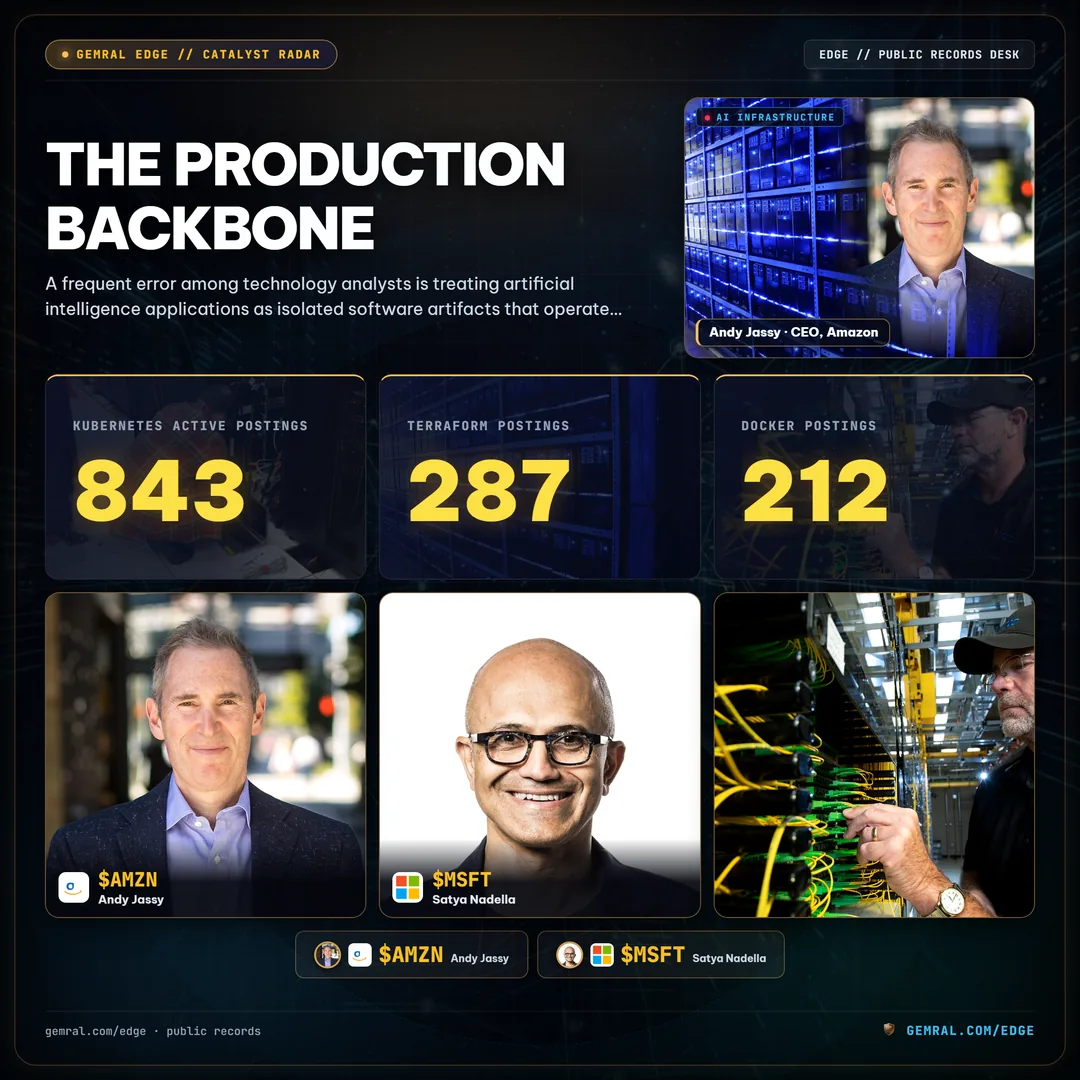
The single most ubiquitous technology across the entire 1,000-signal dataset is Kubernetes, mandated across 53 distinct enterprise companies and 843 active postings. Whether an enterprise is orchestrating microservices, managing distributed vector retrieval clusters, or scheduling GPU compute jobs across multi-node clusters, container orchestration via Kubernetes represents the universal foundation of modern software engineering.
Cloud infrastructure displays intense multi-cloud competition at the top tier. Amazon Web Services (AWS) leads with 50 enterprise engineering organizations (1,406 postings), closely followed by Google Cloud Platform (GCP) with 49 organizations (1,236 postings), and Microsoft Azure with 41 organizations (1,149 postings). The narrow spread among the three hyperscalers confirms that tier-1 enterprise software engineering organizations operate sophisticated multi-cloud architectures by default, avoiding single-vendor lock-in at the infrastructure layer.
Supporting this multi-cloud reality are declarative infrastructure-as-code and container packaging standards. HashiCorp Terraform is required by 38 enterprises across 287 postings, Docker is cited by 37 enterprises across 212 postings, and PostgreSQL maintains its position as the premier relational database standard, required across 30 enterprise engineering stacks with 274 postings. Without this robust underlying platform layer, reliable model serving and high-availability AI applications cannot function in production.
7. Observability and Data Pipelines: Telemetry Across Grafana (24), Prometheus (20), and dbt (20)
Deploying large language models into production introduces non-deterministic failure modes that traditional unit testing cannot catch: latency spikes caused by autoregressive generation, context window overflow, GPU thermal throttling, and semantic drift. As a direct consequence, telemetry, observability, and data transformation architectures have become mandatory pillars of modern enterprise software engineering.
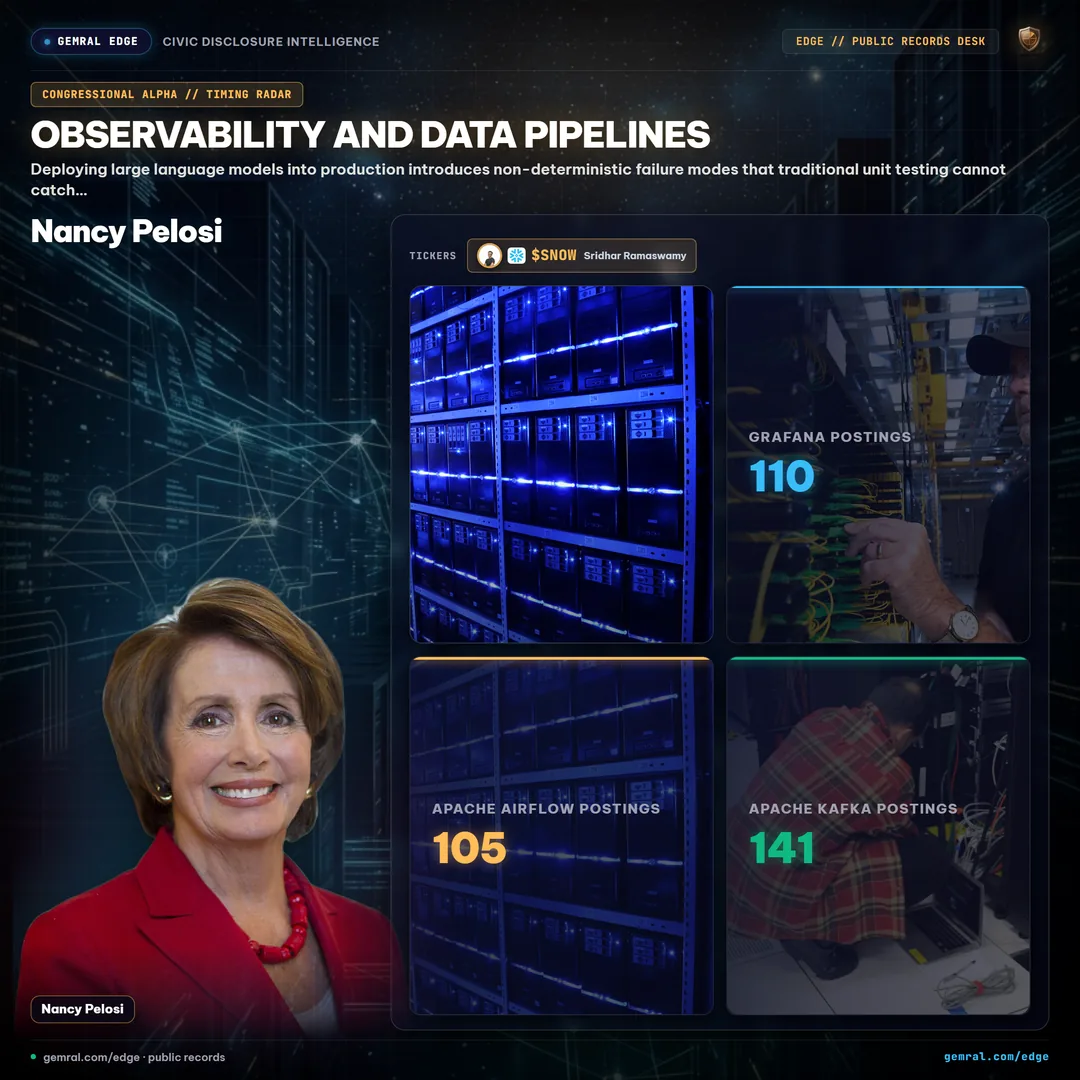
In operational telemetry, open-source metrics and visualization frameworks command the broadest enterprise footprint. Grafana is specified across 24 enterprise engineering organizations (110 postings), while Prometheus is mandated across 20 organizations (86 postings). Commercial monitoring platform Datadog maintains a substantial presence with 18 enterprise adopters, though its gross posting volume is exceptionally high at 558 postings, indicating deep organizational reliance within its customer base.
Simultaneously, the data transformation and pipeline tier has consolidated around modular open standards. Analytics engineering framework dbt is required by 20 enterprise companies across 79 postings, transforming raw ingestion streams into clean semantic models. Cloud data platforms Snowflake and Google BigQuery register 16 and 14 enterprise adopters respectively, while Apache Airflow orchestrates complex scheduled batch workflows across 16 enterprises (105 postings), and Apache Kafka anchors real-time event streaming across 13 enterprises with 141 postings.
This observability and data processing framework demonstrates that the real challenge of enterprise AI has evolved from model selection to continuous operational reliability. Organizations that succeed in commercializing generative AI are not those with the most exotic model architectures, but those with the operational discipline to monitor token consumption, trace execution latency, and maintain clean, audited underlying data pipelines.
The public record is clear: while headline narratives focus almost exclusively on benchmark wars between frontier model labs, the real enterprise infrastructure battle is being waged across cloud container orchestration, high-efficiency inference serving runtimes, and observable data transformation pipelines. Monitoring these technical shifts at the hiring layer provides a verifiable, data-backed window into the future of enterprise software before financial earnings reports reflect the transition.
Track live enterprise technology migrations, technical hiring shifts, and cross-signal intelligence across 300+ tracked software frameworks in real time.
Explore the full public dataset on Gemral Edge Technical Radar →
Tech Architecture: Core semiconductor and server infrastructure holdings form the bedrock of the disclosed Nancy Pelosi stock holdings, capturing continuous tailwinds in enterprise AI hardware.