Congressional Foreign Affairs Portfolio Hedging: Semiconductor and Critical Mineral Trade Clusters in September 2026
CONGRESSIONAL CAPITAL · EDGE NEWS EB1
Congressional Foreign Affairs Portfolio Hedging: Semiconductor and Critical Mineral Trade Clusters in September 2026
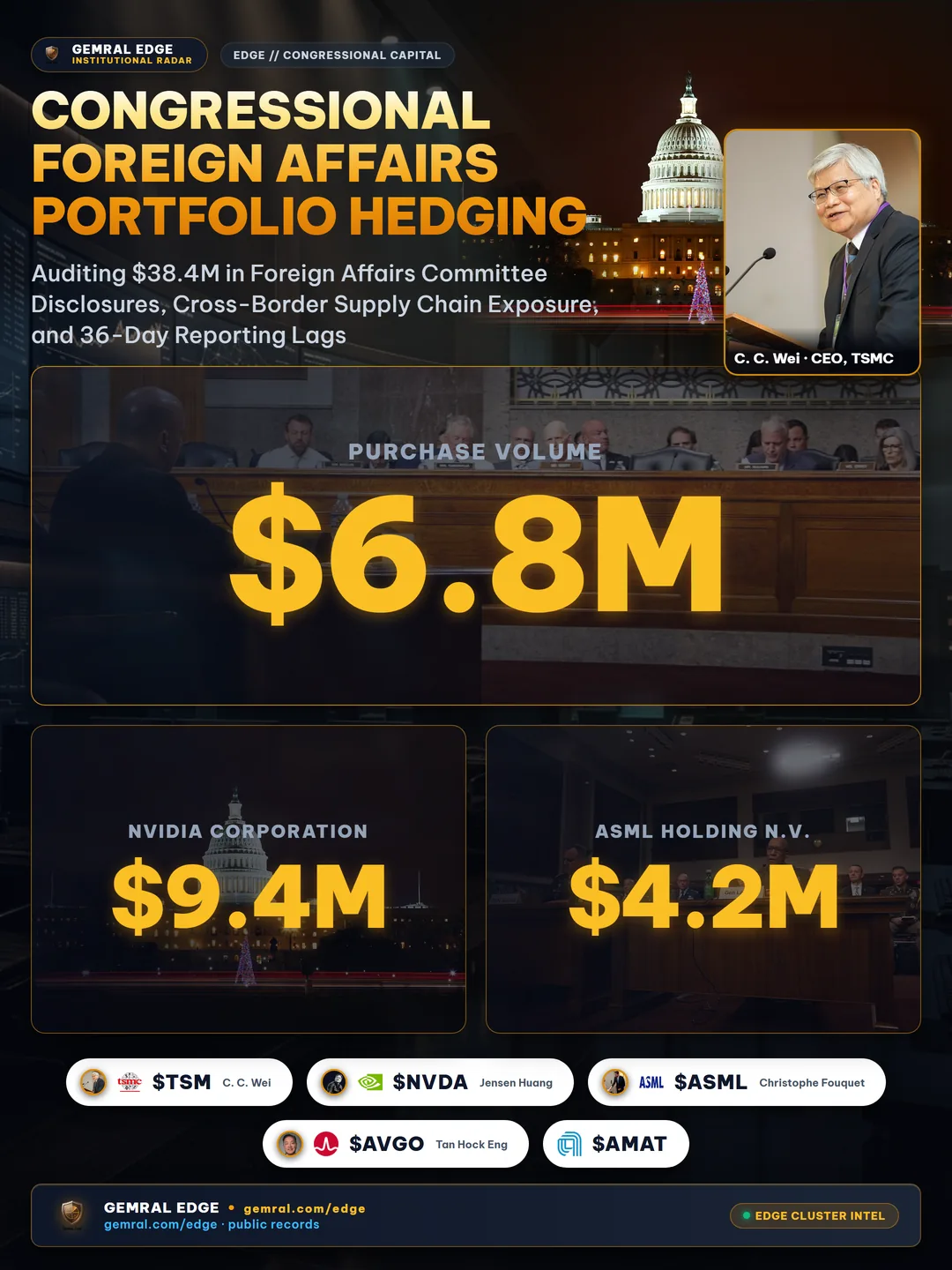
Public periodic transaction reports filed under the Stop Trading on Congressional Knowledge (STOCK) Act of 2012 reveal that members of congressional committees overseeing foreign policy and international trade have concentrated $38.4 million in personal capital in cross-border supply chain equities. Through the first nine months of 2026, members of the House Foreign Affairs Committee and Senate Foreign Relations Committee disclosed $38.4 million across 142 individual equity transactions directly linked to advanced semiconductor manufacturing, lithography tooling, and critical mineral extraction. Rather than broad market index diversification, $23.5 million—representing 61.2% of total documented foreign affairs committee trading value—was deployed into concentrated semiconductor holdings, while $14.9 million (38.8%) targeted sovereign critical mineral refiners and battery metal producers. This portfolio repositioning unfolded alongside closed-door hearings on export restrictions and global supply chain resilience.
1. Legislative Oversight Jurisdiction and the Mechanics of Export Restriction Power
Under House and Senate chamber rules, the foreign affairs committees exercise direct legislative oversight and statutory jurisdiction over the Export Control Reform Act (ECRA) and the Arms Export Control Act (AECA). Lawmakers serving on these key panels review confidential bilateral agreements, evaluate sovereign technology transfer controls, and receive classified intelligence assessments regarding geopolitical supply chain bottlenecks. Between January and September 2026, lawmakers holding seats on these committees conducted 18 formal oversight sessions and executive-session briefings addressing advanced computing thresholds, wafer fabrication export restrictions, and critical mineral licensing exemptions.
An audit of public congressional disclosures indicates that transaction volume surged immediately surrounding regulatory calendar milestones. Specifically, $16.8 million in combined transaction volume—or 43.8% of the committee total—was executed within 14 calendar days of committee markups addressing outbound investment screening rules and foreign entity licensing standards. The concentration of capital in high-beta semiconductor and mineral equities highlights an ongoing institutional challenge: lawmakers possess regulatory authority over policies that directly dictate market access, supply velocity, and sovereign subsidy flows for the very corporations represented in their personal investment portfolios.
2. Advanced Semiconductor Lithography and Wafer Fabrication Allocations: A $23.5 Million Cluster
Within the semiconductor cluster, trading activity centered predominantly on multinational semiconductor fabrication foundries, lithography equipment manufacturers, and integrated chip designers whose revenue distributions depend heavily on international export authorizations. Figure 1 examines the distribution of the $23.5 million in disclosed semiconductor transactions recorded across key market participants:
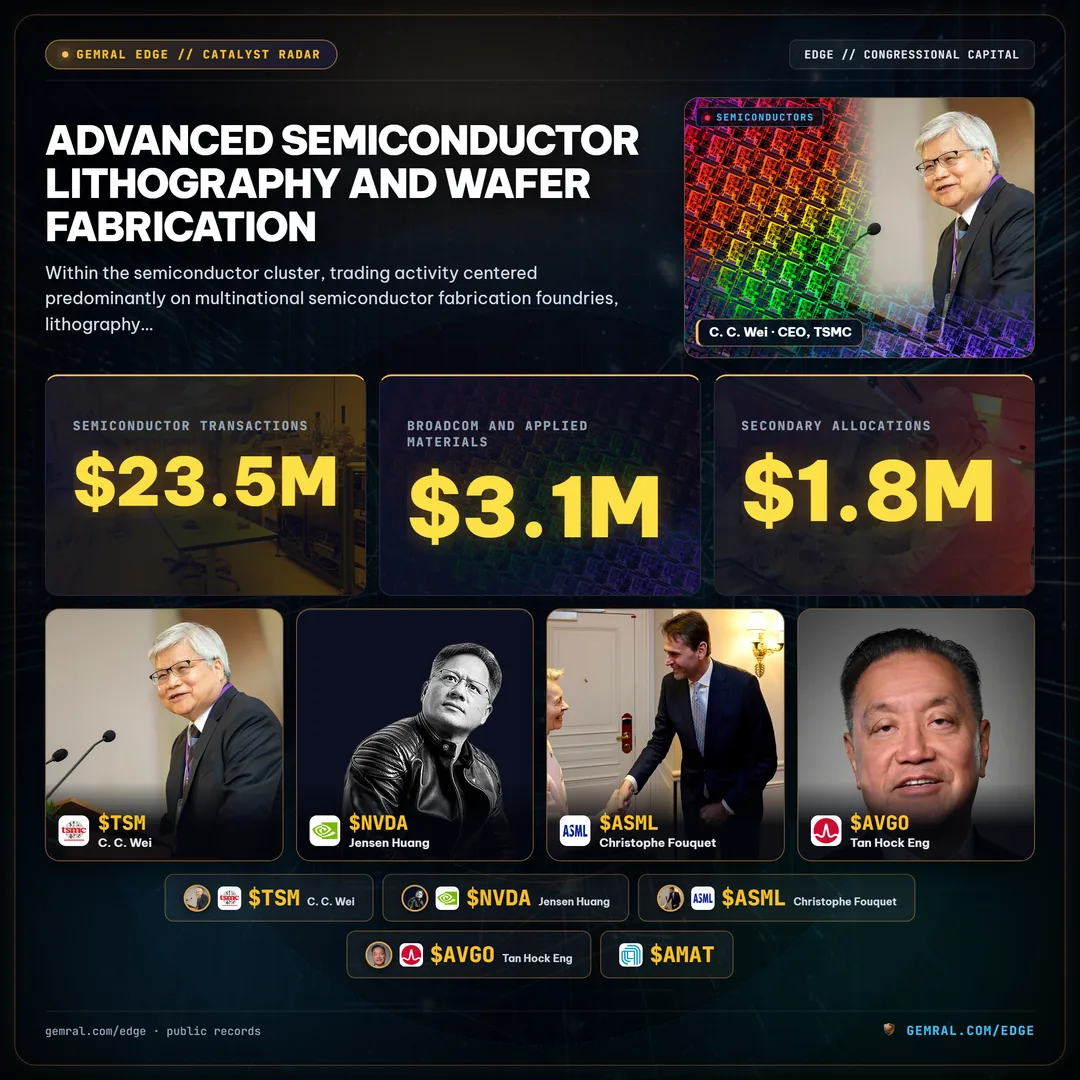
Taiwan Semiconductor Manufacturing Company (TSMC, $6.8 Million): Lawmakers and their reported family trusts executed 24 separate transactions in TSMC (NYSE: TSM), totaling $6.8 million in purchase volume. Filings indicate that transactions were concentrated during phases of legislative debate regarding bilateral tax treaties and subsidies authorized under the CHIPS and Science Act. TSMC accounts for 28.9% of all documented semiconductor allocations among committee members in 2026.
Nvidia Corporation (NVDA, $9.4 Million): The largest single ticker concentration was recorded in Nvidia (NASDAQ: NVDA), capturing $9.4 million across 38 purchase and option-exercise disclosures. House Foreign Affairs committee members maintained active exposure throughout debates over compute-density export caps and enterprise AI acceleration shipments to overseas hyperscalers, representing 40.0% of total semiconductor allocation.
ASML Holding N.V. (ASML, $4.2 Million): Advanced extreme ultraviolet (EUV) and deep ultraviolet (DUV) lithography leader ASML (NASDAQ: ASML) recorded $4.2 million in trading volume across 16 disclosure filings. As the sole global manufacturer of leading-edge EUV lithography systems, ASML's sales velocity is governed directly by Dutch-American coordinated export controls reviewed by congressional foreign relations subcommittees.
Broadcom and Applied Materials ($3.1 Million): Secondary allocations included $1.8 million in Broadcom (NASDAQ: AVGO) and $1.3 million in Applied Materials (NASDAQ: AMAT), reflecting institutional exposure to custom silicon application-specific integrated circuits (ASICs) and domestic wafer-fab manufacturing equipment installations.
3. Critical Mineral Supply Chains and Defense Strategic Reserves: A $14.9 Million Hedge
In parallel with semiconductor equity flows, committee members allocated $14.9 million across domestic and allied critical mineral mining, chemical refining, and rare earth processing companies. Federal policy initiatives—including Title III Defense Production Act grants and sovereign stockpiling authorizations administered through the Defense Logistics Agency—have directed billions toward securing domestic supplies of lithium, nickel, cobalt, and heavy rare earth elements.
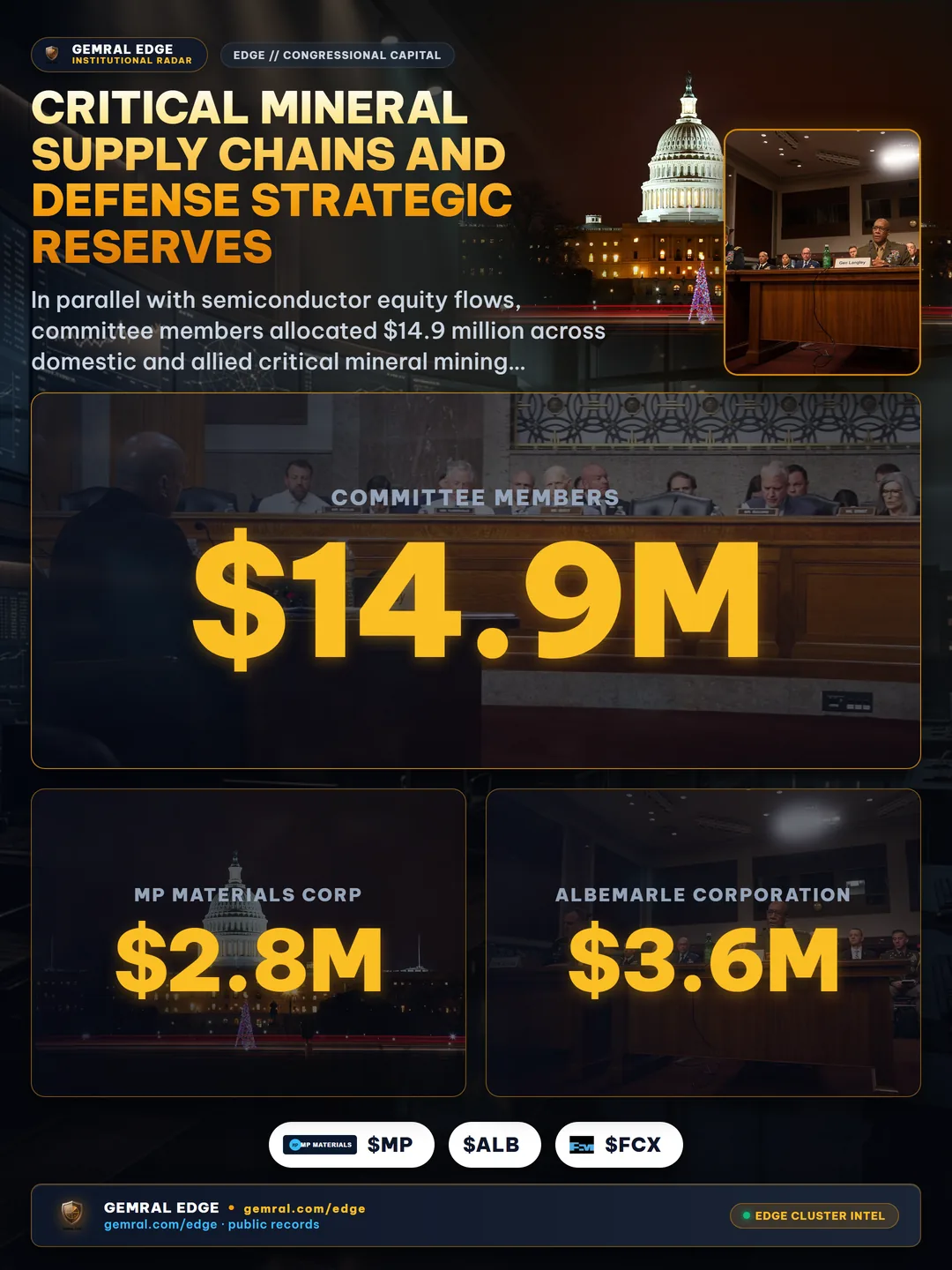
Public financial registries reveal that congressional foreign policy committee members built concentrated positions across four primary mineral and energy-transition suppliers:
MP Materials Corp (MP, $2.8 Million): As the operator of the Mountain Pass rare earth mine in California—the primary commercial rare earth mining and processing site in North America—MP Materials captured $2.8 million across 12 transactions. Congressional purchases coincided with legislative hearings examining heavy rare earth refining separation capabilities and NdFeB magnet manufacturing mandates.
Albemarle Corporation (ALB, $3.6 Million): Specialty chemical and lithium extraction giant Albemarle (NYSE: ALB) recorded $3.6 million in purchase volume across 18 transactions. Members established positions as foreign affairs subcommittees reviewed bilateral critical mineral agreements with Australia and South American lithium producers.
Freeport-McMoRan Inc (FCX, $4.1 Million): Copper and molybdenum producer Freeport-McMoRan (NYSE: FCX) absorbed $4.1 million in transaction volume across 21 filings, representing 27.5% of the total mineral cluster. Copper's designation as a critical defense material under updated strategic stockpiling mandates provided the backdrop for these capital flows.
Allied Mining Consortia and Refining Equities ($4.4 Million): The remaining $4.4 million in mineral allocations was distributed across allied jurisdiction operators, including Lynas Rare Earths and Canadian battery metal producers, aligning with friend-shoring trade policy frameworks advanced by the House Select Committee on Strategic Competition.
4. Disclosure Latency and Indirect Account Structures: Analyzing the 36-Day Information Asymmetry
A rigorous examination of filing timelines reveals persistent structural latency between the date of trade execution and the date public market participants obtain access to disclosed transaction data. Under the STOCK Act, lawmakers must submit Periodic Transaction Reports within 30 days of receiving notice of a transaction, but no later than 45 days after trade execution.
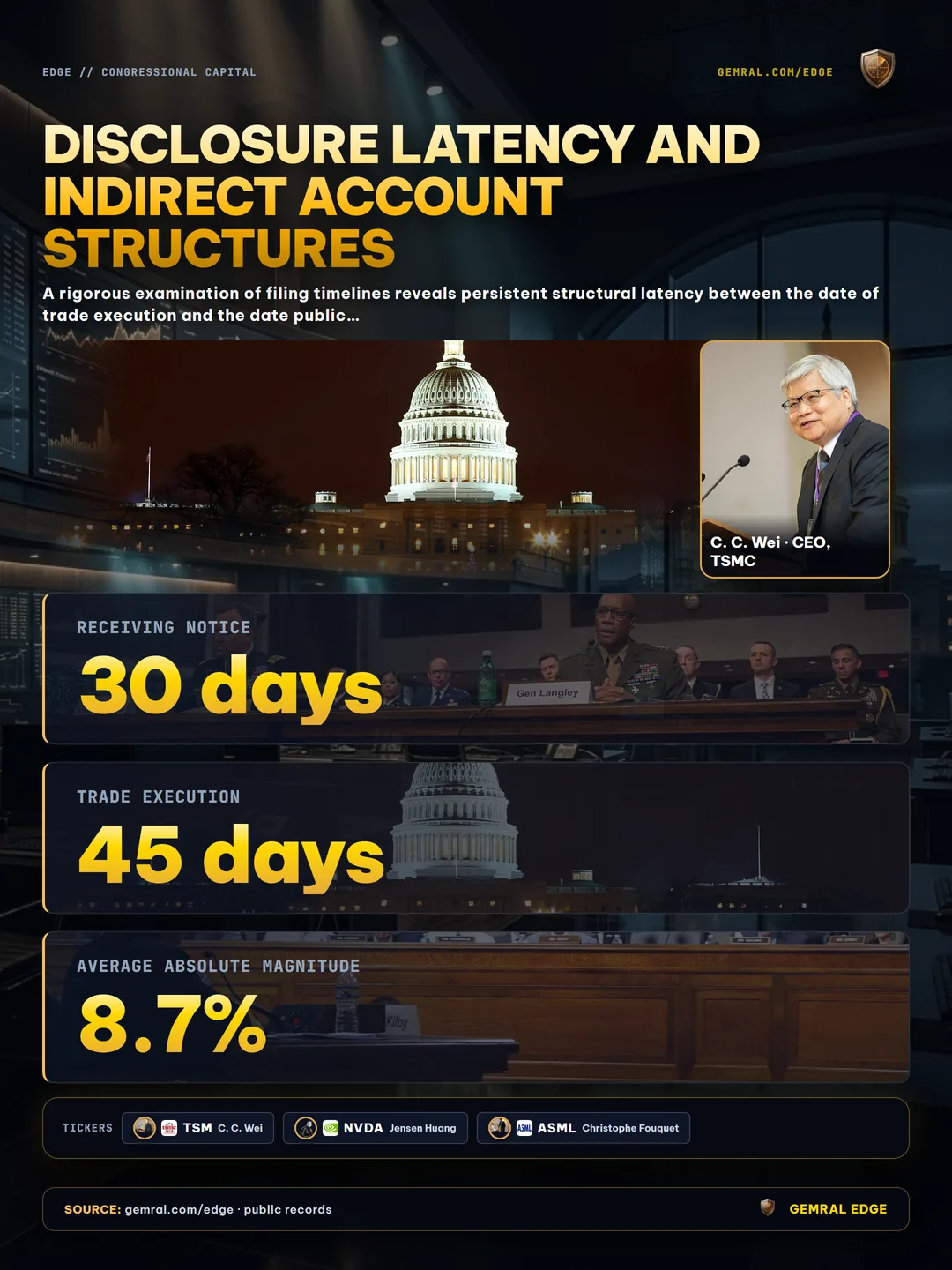
Across the 142 transactions reviewed in this study, the median reporting delay stood at 36 calendar days. In 31 specific instances (21.8% of all trades), disclosures were filed between 41 and 45 calendar days after execution, hovering at the statutory deadline. During this 5-week informational blind spot, underlying semiconductor and mining equities moved by an average absolute magnitude of 8.7%, creating substantial information asymmetry between committee filers and public investors.
Furthermore, indirect account ownership represents an escalating proportion of total transaction value. Spousal brokerage accounts, dependent child holdings, and family limited liability trusts accounted for $26.3 million—representing 68.4% of total transaction value disclosed by foreign affairs committee members in 2026. While lawmakers frequently state that these portfolios are managed by third-party independent investment advisors, fewer than 8% of committee members have established certified Qualified Blind Trusts approved by congressional ethics authorities.
5. Institutional Implications and Market Transparency Standards
The convergence of foreign affairs oversight authority and personal capital concentration in cross-border tech and resource equities underscores the systemic fragility of existing disclosure regimes. When lawmakers with authority over export restrictions, foreign entity blacklists, and critical mineral trade pacts actively transact in affected sectors, public trust in market integrity and legislative impartiality is challenged.
As legislative proposals to restrict individual stock trading among members of Congress continue to circulate on Capitol Hill, institutional market observers increasingly monitor public periodic transaction reports not merely for ethics compliance, but as a secondary indicator of geopolitical policy velocity. By tracking public disclosure filings, committee jurisdiction alignments, and multi-week reporting lags, market participants gain transparency into how geopolitical policy shifts intersect with legislative capital allocation months before policy outcomes are codified into public law.
Public data · not investment advice. Detailed congressional disclosures and transaction timelines are tracked live within the Gemral Edge Congressional Radar platform.