Congress Stock Tracker vs Corporate Insider Filings: Multi-Trail Convergence Audit
Modern algorithmic equity research relies heavily on alternative data trails left by institutional participants. Among the most closely monitored regulatory disclosures are those generated by corporate insiders under Securities and Exchange Commission (SEC) mandates and federal lawmakers under Capitol Hill transparency statutes. While market participants frequently deploy a congress stock tracker or an insider monitoring terminal in isolation, evaluating both data streams simultaneously provides unprecedented clarity into corporate sentiment versus legislative policy direction. In 2026, corporate executives filed 12,688 insider transactions representing $5.86B in open-market purchases and $57.24B in sales, while 98 federal lawmakers recorded 9,932 stock transactions across 903 equity tickers.

Understanding how a professional congress stock tracker interfaces with corporate insider filings requires dissecting two contrasting regulatory frameworks. Corporate executives, directors, and 10% beneficial owners are governed by Section 16(a) of the Securities Exchange Act of 1934, which enforces strict two-business-day filing windows. Conversely, members of the U.S. Senate and House of Representatives disclose their equity allocations under the Stop Trading on Congressional Knowledge Act of 2012 (STOCK Act), which permits up to 45 days of latency between trade execution and public visibility. By analyzing where these distinct data streams intersect, researchers uncover multi-trail convergence signals that transcend individual reporting anomalies.
Congress Stock Tracker vs Corporate Insider Filings: Structural Architecture and Regulatory Frameworks
The structural divergence between corporate insider disclosures and congressional trading disclosures stems directly from their statutory intent. Regulatory insider filings are designed to prevent corporate officers and directors from exploiting non-public material information regarding earnings, mergers, product pipelines, and balance sheet solvency. When a corporate insider trades company stock, the filing must explicitly categorize the nature of the transaction using standard transaction codes, separating discretionary open-market purchases (Code P) and open-market sales (Code S) from option exercises (Code M) and tax-withholding dispositions (Code F).

In contrast, congressional disclosures mandated by the STOCK Act focus on legislative transparency rather than corporate governance. Lawmakers are not officers of the companies they trade; instead, they possess legislative and regulatory oversight over entire economic sectors through committee assignments and federal budget authorizations. A comprehensive comparison of the two reporting regimes illustrates their fundamental structural differences:
| Regulatory Dimension | Corporate Insider Disclosures | STOCK Act PTR (U.S. Congress) |
|---|---|---|
| Governing Statute | Securities Exchange Act of 1934 (§ 16) | Stop Trading on Congressional Knowledge Act of 2012 |
| Covered Persons | Corporate Officers, Directors, >10% Owners | U.S. Senators, Representatives, Senior Staff |
| Reporting Window | 2 business days (48 hours) | 30 days from notice / 45 days from trade |
| Value Granularity | Exact share count and exact execution price | Categorical dollar ranges ($1,001-$15,000 to >$50M) |
| Rule 10b5-1 Defense | Statutory check-box and adoption date | Not applicable (all trades discretionary/trust) |
| Enforcement Agency | Securities and Exchange Commission | House and Senate Ethics Committees |
| Non-Compliance Penalty | Civil injunctions, disgorgement, SEC fines | Standard $200 late filing fee (waivable) |
Because corporate insider filings record exact share counts and exact execution prices, quantitative analysts can calculate precise cost bases for executive transactions. Congressional Periodic Transaction Reports (PTRs), however, bucket transaction values into broad statutory brackets: $1,001 to $15,000; $15,001 to $50,000; $50,001 to $100,000; $100,001 to $250,000; $250,001 to $500,000; $500,001 to $1,000,000; and extending to $5,000,000, $25,000,000, and over $50,000,000. Researchers utilizing a congress stock tracker must therefore model both lower-bound and upper-bound capital flows to evaluate portfolio adjustments accurately.
The Disclosure Latency Gap: 48-Hour Corporate Insider Filings vs 45-Day STOCK Act Periodic Transaction Reports
The primary analytical constraint in tracking political capital is disclosure latency. Under Section 16(a), corporate insiders must submit official ownership disclosures before the end of the second business day following the day on which the transaction was executed. In 2026, corporate filings maintained an effective reporting freshness of 48 hours, enabling quantitative market models to ingest executive accumulation patterns in near-real time.

Conversely, the STOCK Act establishes a bifurcated reporting deadline: lawmakers must disclose reportable transactions exceeding $1,000 within 30 days of receiving notification of the transaction from their broker or financial manager, but in no case later than 45 days after the trade execution date. Empirical analysis of the 9,932 congressional transactions filed in 2026 reveals measurable practical delays:
- Average Disclosure Latency: 36.0 days across all House and Senate filings.
- Median Disclosure Latency: 26 days from trade execution to public regulatory repository and Clerk ingestion.
- Statutory Deadline Violations: 1,498 filings—representing 15.2% of all 2026 congressional transactions—were disclosed past the statutory 45-day deadline.
- Enforcement Friction: Violations incur a standard $200 administrative penalty, which is routinely waived by congressional ethics officials upon submission of reasonable-cause explanations.
This disclosure gap creates a distinct market dynamic. Corporate insider filings provide rapid, micro-level feedback regarding executive confidence inside specific firms. Congressional disclosures provide macro-level and sector-level signals that reflect legislative posture and committee-level economic intelligence, but with an inherent 26 to 45-day temporal lag. Our initial baseline analysis on auditing 9,841 congressional stock trades across committee allocations demonstrated how late filings concentrate around complex household trusts and multi-broker accounts.
Buy-to-Sell Skew Divergence: Why Corporate Executives Sell While Lawmakers Accumulate
One of the most striking divergences between corporate insider data and congressional trading data lies in the aggregate buy-to-sell transaction ratio. In corporate finance, executive compensation packages are heavily weighted toward equity grants, restricted stock units (RSUs), and non-qualified stock options. As a consequence, corporate executives systematically liquidate equity to diversify personal wealth, satisfy personal liquidity requirements, and cover statutory tax withholding liabilities.
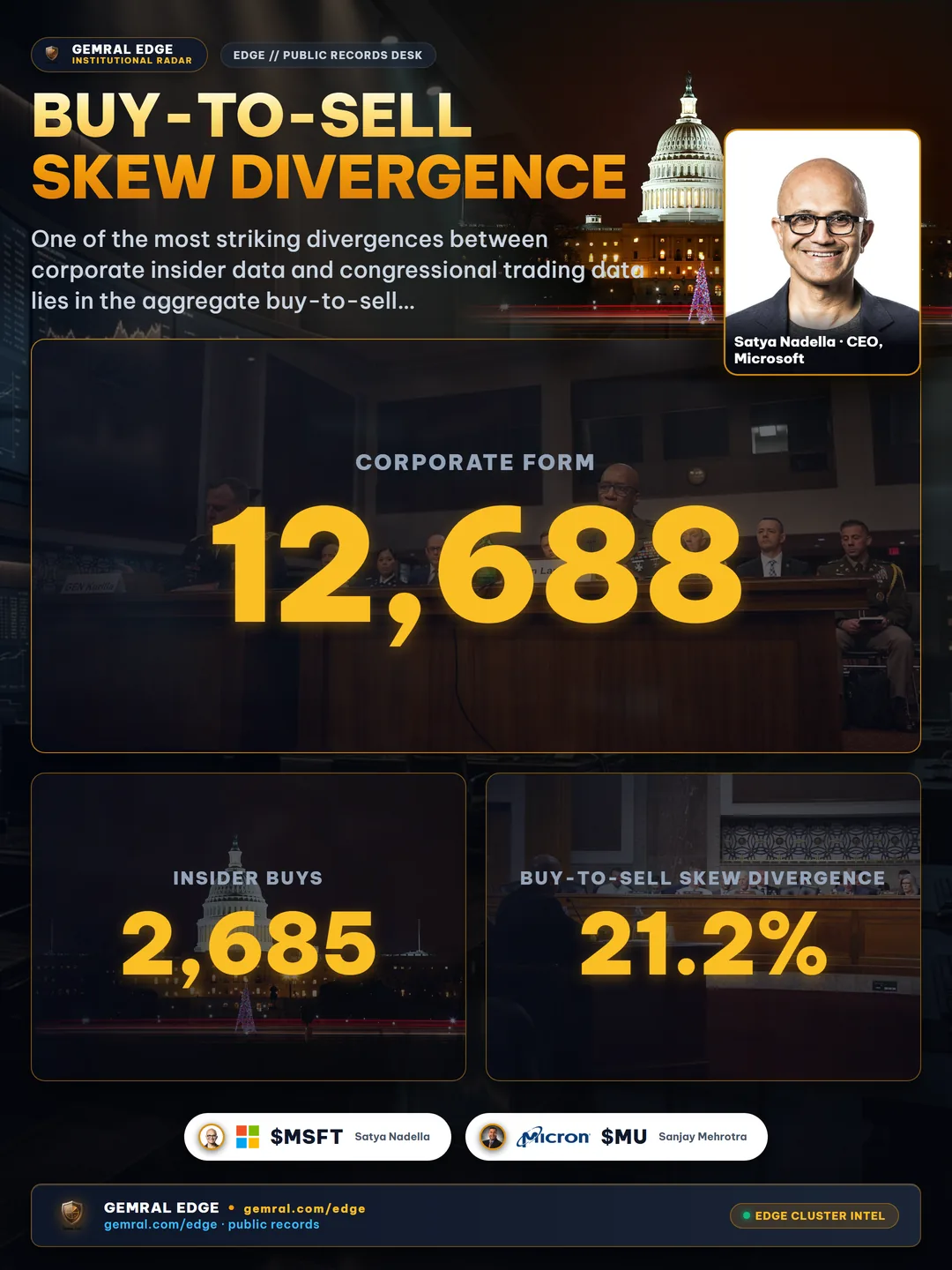
Our related investigation on evaluating the insider buy vs sell ratio across federal contractors established how statutory compensation structures systematically bias executive trading flow. Data from 12,688 corporate insider filings in 2026 confirms this structural selling bias:
Corporate executives executed 10,003 sale transactions totaling $57.24B against only 2,685 open-market purchase transactions totaling $5.86B, resulting in a buy ratio of just 21.2%. Because selling is the default operational state of corporate executives, an open-market purchase by an officer or director represents a rare, capital-committing event that carries strong positive informational value.
In contrast, federal lawmakers exhibit an accumulation skew. Congressional compensation consists entirely of cash salaries, meaning lawmakers do not receive equity compensation from public companies. Any stock acquired by a member of Congress represents an affirmative capital allocation decision. In 2026, congressional lawmakers filed 5,831 purchases compared to 3,959 sales—a buy-to-sell ratio of 1.47, with buy executions comprising 59.3% across all recorded transactions. While corporate insiders are net liquidators of public equities, Capitol Hill portfolios are persistent net accumulators.
Rule 10b5-1 Scheduled Plans vs Opportunistic Capitol Hill Disclosures
To differentiate routine selling from conviction-driven transactions, equity researchers filter corporate filings through Rule 10b5-1 trading plans. Established by the SEC in 2000 and substantially reformed in 2023, Rule 10b5-1 provides an affirmative defense against insider trading liability if the insider establishes a predetermined trading schedule when they possess no material non-public information. Under revised SEC regulations, corporate insiders must observe mandatory cooling-off periods (up to 90 days for directors and officers) before scheduled executions can commence.
In the 2026 corporate insider dataset:
- Rule 10b5-1 Pre-Scheduled Filings: 4,366 transactions (34.4% of total filings) were executed pursuant to established 10b5-1 plans. These transactions represent pre-programmed liquidity events that provide minimal directional predictive signal.
- Opportunistic Discretionary Trades: 8,322 transactions (65.6% of total filings) were executed outside formal 10b5-1 plans, representing discretionary market decisions where timing reflects immediate executive sentiment.
For congressional lawmakers, Rule 10b5-1 does not apply. Capitol Hill disclosures do not feature statutory cooling-off mandates or pre-cleared trading schedules filed with the SEC. Every purchase executed by a member of Congress represents a discretionary, opportunistic trade conducted either directly by the lawmaker or through managed brokerage accounts. While some lawmakers utilize blind trusts, the vast majority of congressional portfolios operate under discretionary broker-directed or self-directed mandates, making their transaction timing a direct reflection of real-time capital deployment.
The Multi-Trail Convergence Signal: Auditing 102 Tickers with Dual Insider and Congressional Purchases
The true power of alternative data emerges at the intersection of independent capital streams. When a corporate executive risks personal capital through an open-market insider purchase, they signal intimate operational confidence in their firm's product margins, customer renewals, and balance sheet durability. When a congressional lawmaker simultaneously purchases that same ticker under STOCK Act disclosures, they signal alignment with macroeconomic policy, regulatory tailwinds, or federal procurement budgets.

Cross-referencing the 9,932 congressional transactions of 2026 with the 2,685 open-market corporate insider purchases reveals exactly 102 equity tickers that recorded dual accumulation signals. The table below details the top 10 convergence tickers by combined transaction frequency and capital commitment:
| Ticker | Company Name | Congress Buys | Congress Vol Band | Insider Buys | Insider Capital | Convergence Rationale |
|---|---|---|---|---|---|---|
| MSFT | Microsoft Corporation | 52 | $2.38M - $5.39M | 1 | $1.99M | Enterprise AI infrastructure & federal cloud security |
| UBER | Uber Technologies Inc | 42 | $0.31M - $1.27M | 1 | $1.60M | Autonomous fleet deployment & urban logistics density |
| SPGI | S&P Global Inc | 31 | $0.12M - $0.68M | 1 | $1.00M | Debt issuance rating velocity & commodity benchmarks |
| MU | Micron Technology Inc | 20 | $0.26M - $0.88M | 1 | $7.82M | Domestic semiconductor subsidies & HBM memory cycle |
| CRM | Salesforce Inc | 18 | $0.13M - $0.55M | 2 | $1.00M | Public sector enterprise workflows & federal procurement |
| NOW | ServiceNow Inc | 17 | $0.12M - $0.50M | 1 | $3.00M | Department of Defense IT modernization contracts |
| PANW | Palo Alto Networks Inc | 16 | $0.06M - $0.34M | 1 | $10.00M | Federal zero-trust mandates & critical infrastructure |
| TSM | Taiwan Semiconductor | 13 | $0.11M - $0.43M | 5 | $0.54M | Advanced foundry fabrication & packaging technology |
| KKR | KKR & Co Inc | 9 | $0.02M - $0.17M | 8 | $50.93M | Private credit asset expansion & infrastructure funds |
| ABT | Abbott Laboratories | 14 | $0.08M - $0.39M | 2 | $3.10M | Healthcare procurement & diagnostic device programs |
Among the top convergence names, enterprise infrastructure and cybersecurity exhibit the strongest dual-accumulation profiles. Palo Alto Networks (PANW) saw $10.00M in open-market insider buying alongside 16 congressional purchases, coinciding with expanded federal cybersecurity procurement mandates. Micron Technology (MU) recorded $7.82M in executive purchases paired with 20 congressional transactions, mirroring federal semiconductor manufacturing incentives. In alternative asset management, KKR & Co (KKR) recorded 8 separate insider acquisitions totaling $50.93M in executive commitment alongside 9 congressional purchases.
Operationalizing Multi-Trail Intelligence: Cross-Signal Synthesis and Anomaly Detection
Deploying multi-trail intelligence inside modern investment workflows requires structuring disparate data feeds into a unified analytical funnel. Relying solely on either corporate insider filings or congressional PTRs produces incomplete market context. To institutionalize multi-trail tracking, investment desks implement three core operational disciplines:

- Latency-Adjusted Lead-Lag Analysis: Because corporate insider filings appear within 48 hours while congressional filings arrive after an average latency of 36.0 days, analysts treat executive insider data as a high-frequency confirmation layer and congressional disclosures as a medium-term positioning layer. When executive purchases precede congressional accumulation, the signal indicates company-specific inflection prior to broader regulatory endorsement.
- Discretionary Filtering: Quantitative screens strip away all corporate sales executed under Rule 10b5-1 plans and routine equity grants, isolating the 8,322 opportunistic insider filings. Similarly, congressional data is normalized to separate routine custodial trust activity from high-conviction discretionary allocations made by key committee chairs.
- Federal Procurement Integration: The highest-conviction convergence signals occur when a dual-buy ticker also receives sizable federal procurement obligations. By cross-referencing multi-trail signals with intelligence from the federal contract radar and executive movements tracked on corporate insider tracking, researchers establish whether capital inflows are supported by tangible government contract awards.
By connecting public regulatory data streams through platforms like the Congressional & Insider Intelligence Terminal (gemral.com/edge/s/congress-stock-tracker-vs-corporate-form-4-filings) and specialized research tools like congressional portfolio analysis, market participants eliminate information asymmetries and trade with institutional-grade structural conviction.
Frequently asked questions
What is the difference between a congress stock tracker and corporate insider filings?
A congress stock tracker monitors Periodic Transaction Reports (PTRs) filed by elected federal lawmakers under the STOCK Act of 2012, while corporate insider filings track purchases and sales made by corporate officers, directors, and 10% shareholders under Section 16 of the Securities Exchange Act of 1934.
How does disclosure latency compare between corporate insiders and Congress?
Corporate insiders face a strict 2-business-day (48-hour) statutory deadline to file ownership disclosures after trade execution. In contrast, members of Congress have up to 30 days after receiving notification and up to 45 days after the trade date, resulting in an average disclosure latency of 36.0 days in 2026.
What is Rule 10b5-1 and does it apply to members of Congress?
Rule 10b5-1 allows corporate executives to establish predetermined trading plans to avoid insider trading allegations. In 2026, 34.4% of corporate insider trades were executed under 10b5-1 plans. Rule 10b5-1 does not govern congressional lawmakers, whose trades are filed opportunistically under the STOCK Act.
What does multi-trail convergence mean in financial market tracking?
Multi-trail convergence occurs when independent public capital flows align on the same asset. In 2026, exactly 102 tickers recorded dual purchases from both corporate executives (corporate insider filings) and congressional lawmakers (STOCK Act), creating high-conviction institutional signals.