Defense Microgrid and Tactical Mobile Nuclear Reactor Prototype Procurement: Auditing $398.5M in Project Pele Awards and Forward Operating Base Power Resilience

FEDERAL CONTRACT RADAR · EDGE NEWS EB2
Defense Microgrid and Tactical Mobile Nuclear Reactor Prototype Procurement: Auditing $398.5M in Project Pele Awards and Forward Operating Base Power Resilience
Public procurement disclosures and federal defense budget execution records confirm that the Department of Defense Strategic Capabilities Office has cumulative obligations totaling $398.5 million toward the engineering, fabrication, and integration of mobile tactical nuclear microreactors under Project Pele. Executed primarily through Other Transaction Authority agreements under statutory provision 10 U.S.C. 4022, this targeted capital deployment represents a historic transformation in forward military infrastructure. Rather than relying on legacy diesel generator configurations that demand continuous liquid fuel supply convoys, the Pentagon is moving toward transportable, high-temperature gas-cooled microreactors designed to deliver between 1.0 and 5.0 megawatts of electrical output. With prime development contracts concentrated in specialized nuclear engineering firms alongside a companion $142.6 million tactical microgrid program, these procurement flows underscore how operational energy resilience has evolved from a secondary logistical consideration into a primary capability requirement across modern distributed theater architectures.
1. Operational Imperatives: Energy Density, Battlefield Logistics, and Convoy Vulnerability
Modern military doctrine increasingly demands decentralized, expeditionary forward operating bases equipped with power-intensive combat systems, including directed energy air-defense interceptors, counter-unmanned aerial system radars, tactical electronic warfare suites, and air-gapped compute nodes for autonomous command-and-control. Historically, powering these high-demand forward environments required continuous, recurring bulk deliveries of refined petroleum. Public military logistics assessments document that the United States Army consumes approximately 100 million gallons of fuel annually to sustain non-tactical base operations and forward installations. In past expeditionary conflicts, fuel resupply logistics created acute operational vulnerabilities: an estimated 52.0% of total personnel casualties sustained during ground operations were directly tied to attacks on logistical resupply convoys escorting petroleum and water tankers through contested corridors.
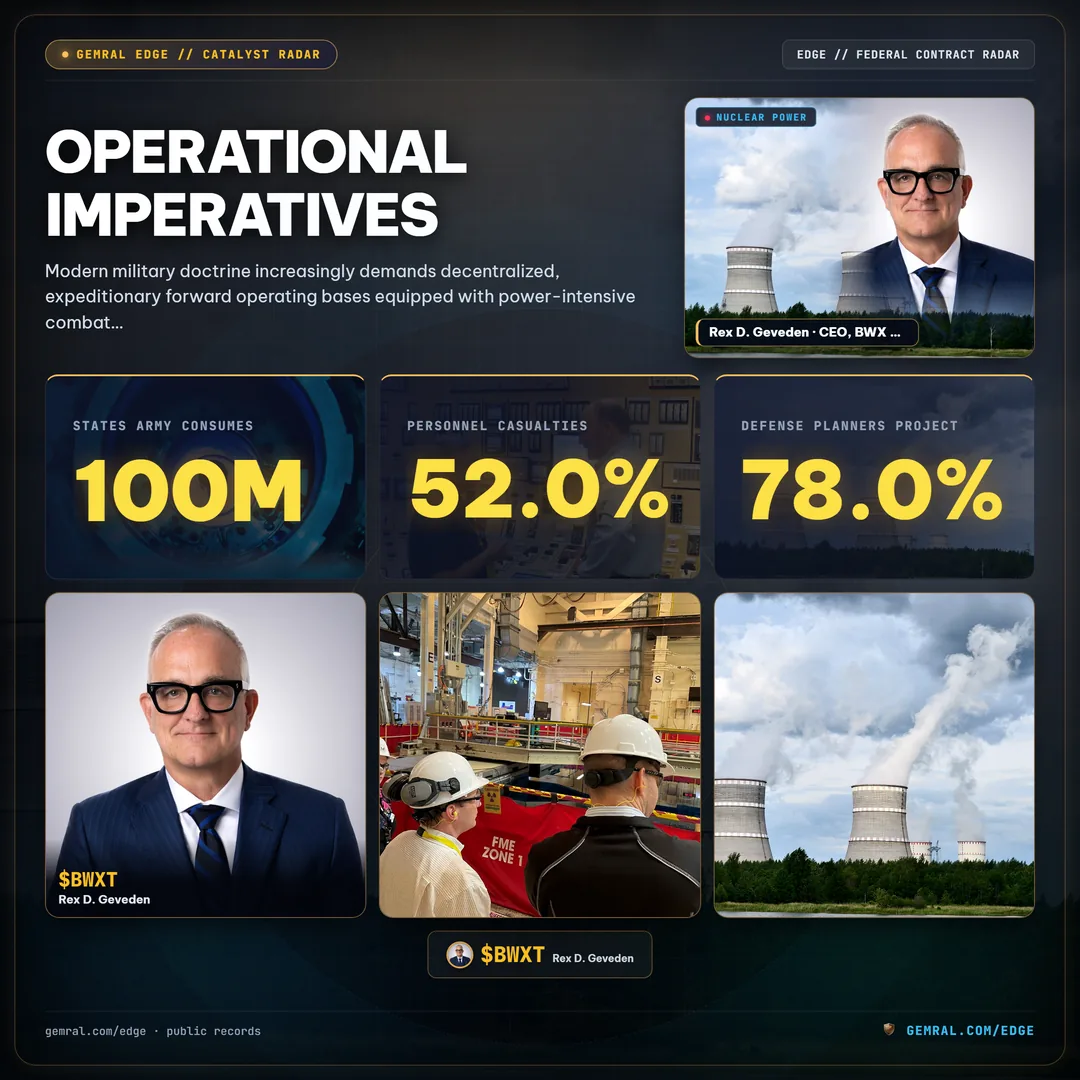
By transitioning forward operating base base-load power generation from volatile liquid diesel deliveries to localized nuclear fission, defense planners project a 78.0% reduction in logistical fuel transport requirements for sustained base operations. A single compact mobile microreactor operating within the 1.0 to 5.0 MWe threshold generates sufficient continuous power to energize an entire forward installation supporting between 1000 and 5000 personnel alongside advanced sensor networks, without requiring a single fuel tanker resupply for a minimum of 3 years of continuous full-power operations.
2. Project Pele Architecture: Auditing the $300.0M BWXT Prime Prototype Contract
The centerpiece of the Department of Defense tactical nuclear initiative is Project Pele, managed by the Strategic Capabilities Office in close coordination with the Department of Energy at the Idaho National Laboratory. Procurement records and Federal Award ID disclosures indicate that BWX Technologies, operating through its subsidiary BWXT Advanced Technologies, captured the primary prototype construction award valued at $300.0 million. This single transaction accounts for 75.3% of total tracked Project Pele funding allocations. The contract was formally awarded under 10 U.S.C. 4022 Other Transaction Authority, an acquisition pathway designed to expedite rapid prototyping, dual-use technology adoption, and non-traditional defense contractor integration outside the rigid constraints of the Federal Acquisition Regulation.

The engineering specifications embedded within public program disclosures mandate strict physical transportability and inherent walk-away safety characteristics:
Physical Modularity and Transit Constraints: The complete nuclear power generation plant—including the core reactor module, power conversion system, heat rejection architecture, and automated digital control cab—must fit entirely within 4 standard 20-foot ISO intermodal containers. This dimensional profile guarantees transportability via standard military logistics vehicles, commercial rail, maritime sealift, and Air Force C-17 cargo aircraft. Once delivered to a theater staging point, the system is designed for operational connection within 72 hours and safe deactivation, cooling, and package transport preparation within 7 days.
Passive Safety and TRISO Fuel Chemistry: The reactor core utilizes High-Assay Low-Enriched Uranium fabricated into Tristructural-Isotropic fuel pellets. Each micro-fuel particle is encased in multiple ceramic and silicon carbide layers capable of withstanding extreme core operating temperatures exceeding 1610 degrees Celsius. Because the helium gas-cooled system exhibits a strongly negative temperature coefficient of reactivity and structural integrity beyond 1610 degrees, the physical design prevents meltdown scenarios even in the event of complete coolant loss or structural breach from conventional weapon fragmentation.
3. The Specialized Defense Supply Chain: Valves, Instrumentation, and Tactical Transport Integration
While BWXT serves as the primary system integrator for the nuclear core, transactional procurement data demonstrates that Project Pele has catalyzed a broader defense industrial supplier ecosystem spanning systems engineering, ruggedized fluid controls, and tactical mobility:

Jacobs Solutions ($48.2 Million): Regulatory filings and award listings confirm that Jacobs Solutions captured $48.2 million in architectural engineering, nuclear facility licensing support, and independent environmental assessment task orders. Jacobs provides specialized technical oversight at the Idaho National Laboratory test facility, validating thermal-hydraulic modeling, instrumentation compliance, and containment shield integrity prior to scheduled fueled system criticality evaluations.
Curtiss-Wright Corporation ($28.4 Million): Specializing in extreme-environment naval and defense hardware, Curtiss-Wright received $28.4 million across multiple component delivery orders. The company supplies specialized helium isolation valves, primary coolant circulation pump hardware, and radiation-hardened instrumentation channels engineered to withstand shock loads, ballistic vibration, and tactical field handling.
Oshkosh Defense ($21.9 Million): Bridging the gap between stationary nuclear technology and tactical mobility, Oshkosh Defense secured $21.9 million to engineer specialized heavy tactical wheeled vehicle interfaces. This includes reinforced palletized load system integration, vibration-dampening transit racks, and heavy-equipment transport configurations ensuring the 4 ISO container modules can traverse rugged forward terrain without compromising structural or nuclear alignment tolerances.
4. Tactical Microgrid Standardization: Coordinating $142.6M in Distributed Battlefield Power
A transportable power plant is operationally ineffective without a resilient distribution network capable of routing high-density energy to sensitive mission equipment. To address this integration bottleneck, the United States Army Communications-Electronics Command and the C5ISR Center have obligated $142.6 million across 14 standardized task orders during fiscal year 2026. This parallel procurement effort is dedicated to operationalizing the Tactical Microgrid Standard across expeditionary commands.
The Tactical Microgrid Standard establishes an open architecture framework that automatically coordinates heterogeneous energy generation assets. Rather than operating isolated generator sets, the military microgrid autonomously balances base-load inputs from mobile nuclear reactors, supplemental photovoltaic solar arrays, and high-capacity battery energy storage systems. Disclosed contract awards specify autonomous power-routing algorithms that isolate damaged transmission lines within milliseconds, prioritize primary radar and air defense loads during surge events, and eliminate single-point-of-failure vulnerabilities across forward operating bases.
5. Institutional Significance and Procurement Trajectory
The convergence of Project Pele prototype delivery milestones and standardized tactical microgrid contracts highlights a foundational shift in how the United States military approaches energy security in contested logistics environments. In contemporary theater scenarios characterized by long-range precision fires and maritime interdiction, the assumption of uncontested logistical lines of communication is obsolete. Forward infrastructure must achieve energy autonomy to survive.
From a procurement perspective, the execution of $398.5 million in prototype funding under 10 U.S.C. 4022 provides a clear precedent for how advanced nuclear technology will enter operational service. Following anticipated full-power testing validation at the Idaho National Laboratory, defense authorization markups project transitions toward multi-unit production contracts across service branches. As commercial hyperscalers and industrial data centers grapple with similar grid interconnection constraints and clean power demands, the mobile nuclear prototypes developed for defense forward operating bases offer critical engineering proofs for the broader advanced reactor economy.
Public data · not investment advice. Real-time federal defense obligations and tactical energy contracts are tracked within the Gemral Edge Defense Contract Radar platform.