Defense Lobbying in 2026: $77.83M in Disclosures vs $464.27B in Awards
Across 14 listed defense contractors in 2026, defense lobbying disclosures totaled $77.83M across 343 filings (measured through November 12, 2026) alongside $464.27B in daily defense contract announcements across 665 notices (measured through November 25, 2026).
For institutional research teams, connecting policy expenditures to procurement volume requires point-in-time entity resolution. Subsidiary filings, multi-client external registrants, and statutory reporting lags—20 days median for quarterly lobbying versus 90 days for defense contract transactions—create blind spots when datasets are joined using static corporate hierarchies.
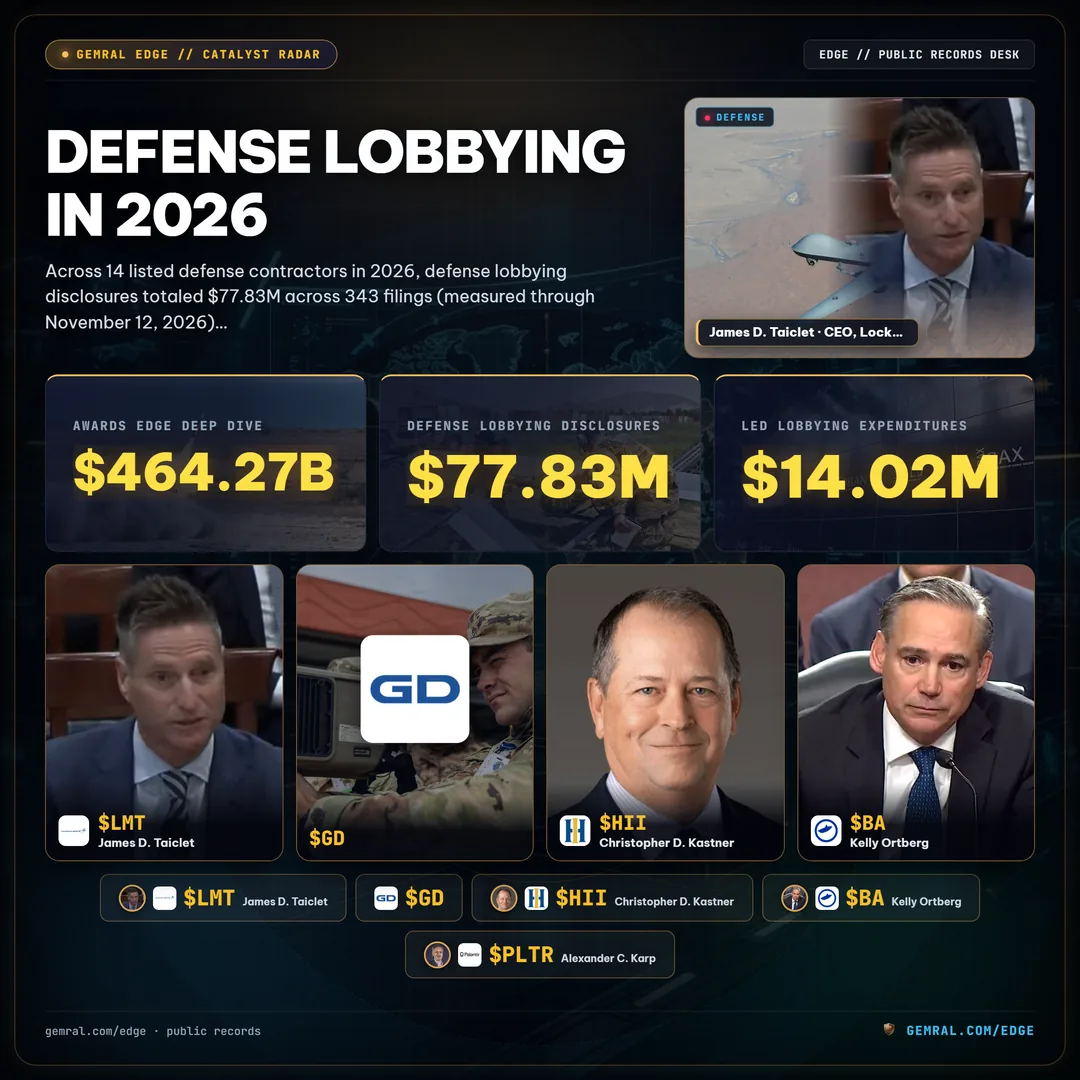
Defense Lobbying in 2026: $77.83M Across 14 Listed Contractors and $464.27B in Awards
In 2026 public defense lobbying disclosures, 14 listed defense contractors reported $77.83M in spending across 343 filings through November 12, 2026, while 10 of those primes accumulated $464.27B across 665 daily defense contract announcements through November 25, 2026. Lockheed Martin (LMT) led lobbying expenditures at $14.02M across 51 filings, followed closely by General Dynamics (GD) at $13.30M across 70 filings and Huntington Ingalls Industries (HII) at $12.68M across 8 filings.
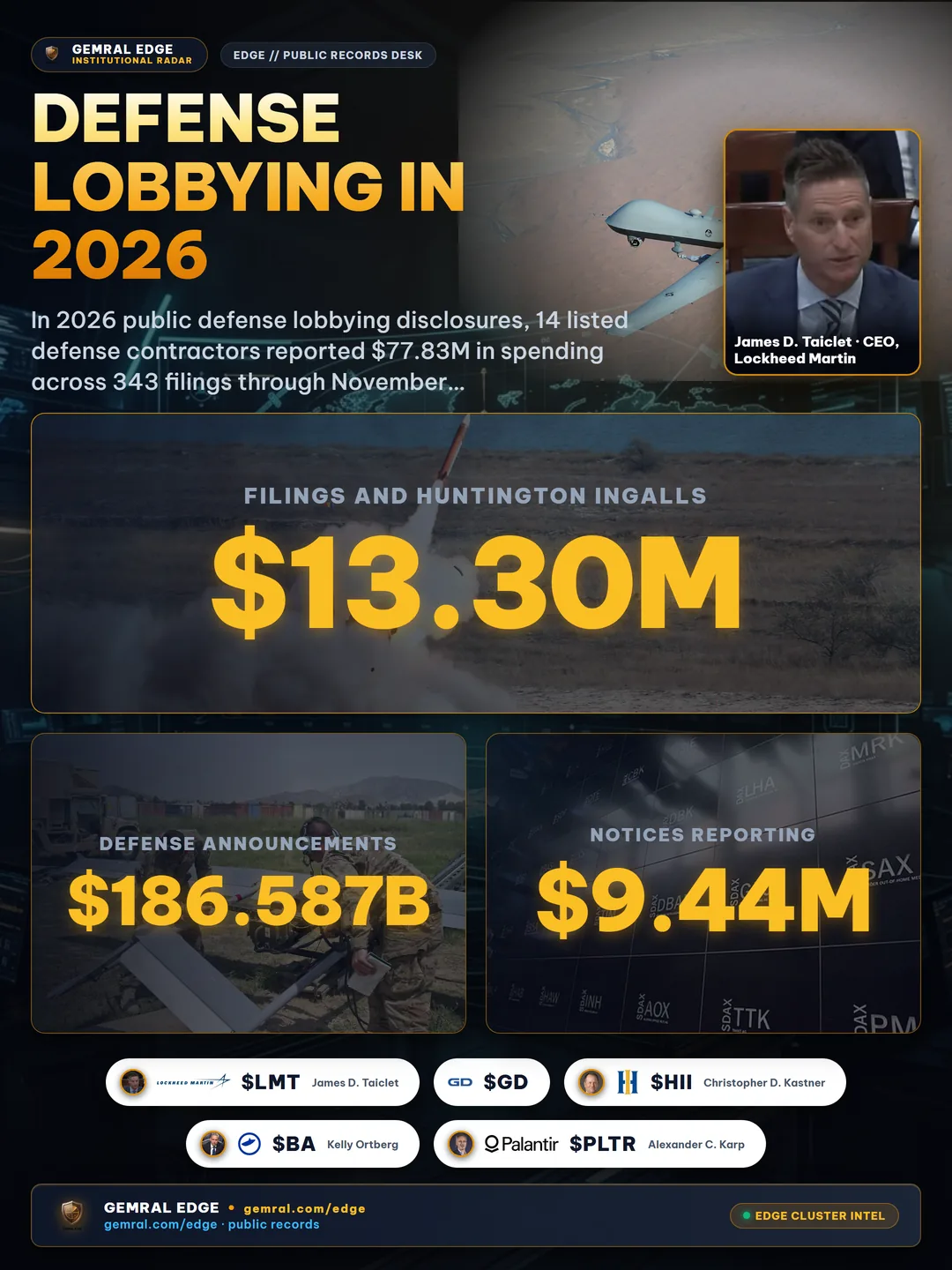
The contrast between lobbying cadence and contract announcement volume highlights how different contractors structure their Washington presence. Boeing (BA) ranked first in 2026 defense announcements at $186.587B across 91 notices while reporting $9.44M in lobbying across 37 filings. Palantir Technologies (PLTR) ranked fifth in lobbying spend at $9.26M across 43 filings and 14 distinct firms, reflecting sustained policy engagement around software procurement and defense modernization.
| Ticker | 2026 Lobbying ($M) | Filings | Distinct Firms | 2026 Defense Notices ($B) | Notice Count |
|---|---|---|---|---|---|
| LMT | $14.02M | 51 | 18 | $135.268B | 192 |
| GD | $13.30M | 70 | 24 | $31.662B | 83 |
| HII | $12.68M | 8 | 7 | $11.617B | 28 |
| BA | $9.44M | 37 | 12 | $186.587B | 91 |
| PLTR | $9.26M | 43 | 14 | — | — |
| NOC | $7.07M | 36 | 12 | $17.288B | 77 |
| LDOS | $5.09M | 34 | 12 | $1.386B | 16 |
| BAH | $2.98M | 22 | 9 | $1.551B | 10 |
| LHX | $2.15M | 15 | 7 | $5.089B | 38 |
| SAIC | $0.71M | 8 | 7 | $0.203B | 4 |
| RTX | $0.38M | 8 | 3 | $73.619B | 126 |
| TDG | $0.31M | 3 | 3 | — | — |
| AVAV | $0.30M | 5 | 5 | — | — |
| KTOS | $0.14M | 3 | 3 | — | — |
Smaller-cap defense technology firms such as AeroVironment (AVAV) at $0.30M across 5 filings and Kratos Defense (KTOS) at $0.14M across 3 filings maintain targeted external representation rather than large in-house policy teams. Meanwhile, General Dynamics (GD) engaged 24 distinct lobbying registrants across 70 filings in 2026—the widest external network among the 14 tracked contractors.
Top Defense Lobbying Firms in 2026: External Registrants vs In-House Spending
External defense lobbying firms captured substantial retainer volume in 2026, led by Miller Strategies, LLC at $760K across 4 filings for 2 listed defense clients and Ballard Partners at $640K across 8 filings for 4 defense clients. Yet single-quarter in-house disclosures from prime contractors still dwarf individual external retainers: on October 20, 2026, Boeing Company (BA) reported $2.70M in in-house third-quarter lobbying alone.
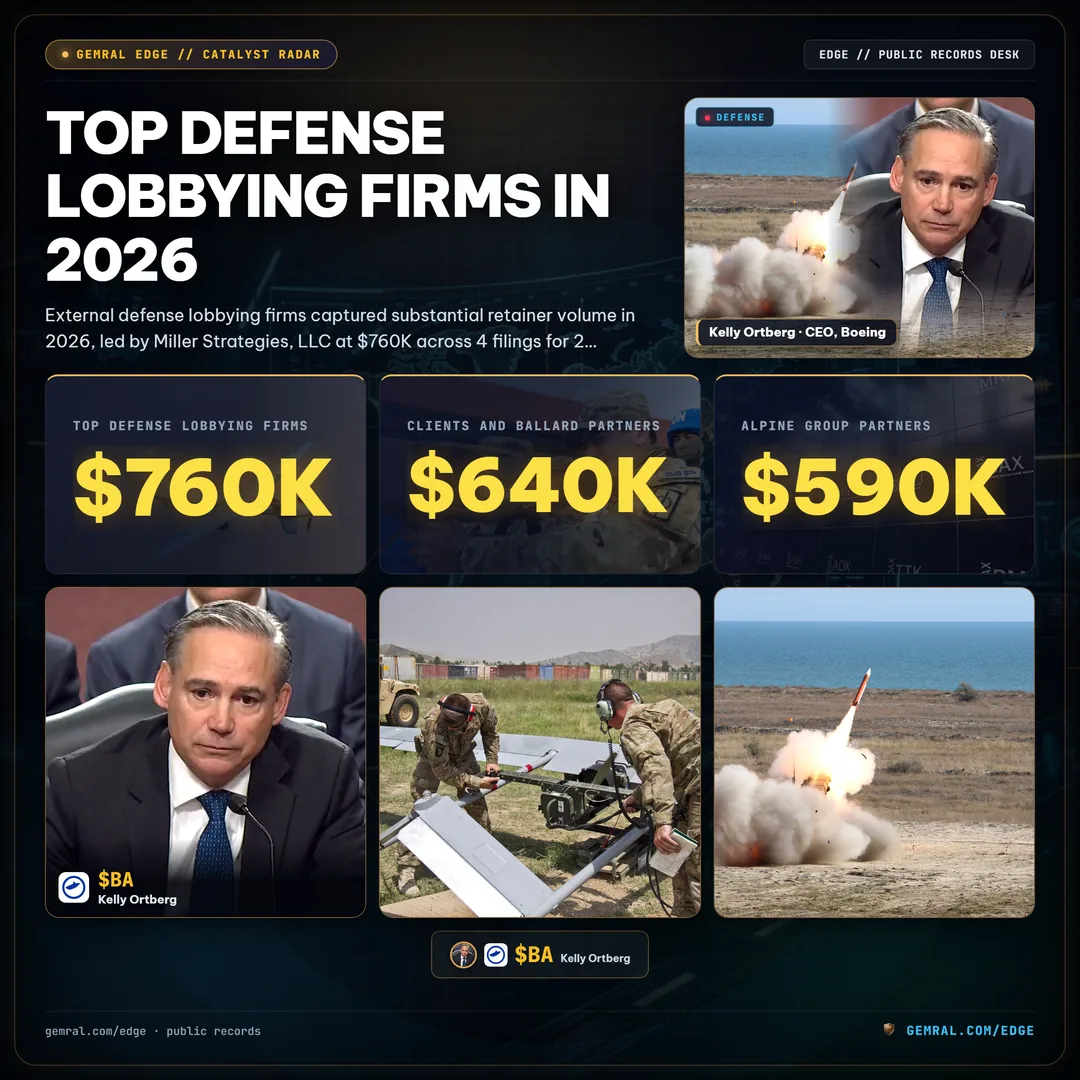
Separating in-house policy departments from external boutique firms is essential when measuring policy momentum. External registrants often specialize in specific appropriations subcommittees, armed services authorization bills, or export-control rules, whereas in-house filings aggregate salaried government-relations staff and executive travel.
| External Lobbying Registrant | 2026 Defense Spend ($K) | Filings | Listed Defense Clients |
|---|---|---|---|
| MILLER STRATEGIES, LLC | $760K | 4 | 2 |
| BALLARD PARTNERS | $640K | 8 | 4 |
| CORNERSTONE GOVERNMENT AFFAIRS, INC. | $590K | 9 | 4 |
| ALPINE GROUP PARTNERS, LLC. | $540K | 6 | 2 |
| CHECKMATE GOVERNMENT RELATIONS | $450K | 3 | 1 |
| AMERICAN DEFENSE INTERNATIONAL | $390K | 8 | 3 |
| SQUIRE PATTON BOGGS | $390K | 6 | 2 |
| ETHERTON AND ASSOCIATES, INC. | $370K | 12 | 4 |
| BROWNSTEIN HYATT FARBER SCHRECK, LLP | $360K | 3 | 1 |
In-house spending concentrates total dollar volume, while external firm rosters reveal where contractors seek specialized access. When a prime contractor adds a new external registrant mid-year, that change appears in quarterly filings weeks before any resulting procurement modification surfaces in federal contract tables.
Defense Lobbying Jobs in DC: Revolving-Door Talent and Multi-Client Firms
Public disclosure records show that multi-client defense lobbying firms—such as Ballard Partners ($640K across 4 defense clients), Cornerstone Government Affairs ($590K across 4 defense clients), and Etherton and Associates ($370K across 12 filings and 4 defense clients)—serve as hubs for former legislative and Pentagon staffers. Tracking individual lobbyists and their disclosed former government positions alongside bill numbers reveals how Washington talent networks span competing primes.
For analysts evaluating defense lobbying jobs in DC or mapping institutional influence, the key signal is client overlap. A single boutique firm representing 4 listed defense contractors simultaneously holds visibility across multiple program budgets, defense authorization markups, and appropriations cycles.
Rather than treating lobbying spend as a monolithic annual figure, structured disclosure records preserve each registrant's named lobbyists, their prior federal roles, and the specific legislative bills lobbied in each quarter. This granularity allows researchers to distinguish routine compliance renewals from targeted campaigns around contested defense programs. When a firm like Ballard Partners or Cornerstone Government Affairs represents four competing defense primes in the same quarter, analysts can cross-reference which appropriations committees and policy issues overlap across those client rosters without relying on anecdotal commentary.
Tracking revolving-door disclosures also clarifies how in-house government relations teams coordinate with external specialists. Prime contractors frequently retain boutique Washington firms for niche legislative windows—such as defense authorization markups, export-control reviews, or supplemental funding bills—while relying on salaried in-house teams for year-round agency coordination. Separating these two channels in structured filings prevents analysts from conflating fixed corporate overhead with sudden, event-driven policy campaigns.
Point-in-Time Entity Resolution: Tracing Subsidiary Lobbying and 90-Day Contract Lags
Joining lobbying disclosures to federal contract awards without look-ahead bias requires respecting two distinct publication clocks: quarterly lobbying reports post a median 20 days (90th percentile 21 days) after quarter end across 8,975 filings since 2018, whereas federal defense contract actions carry a statutory 90-day publication delay. Across 9,158 matched defense contracts since FY2018, daily defense contract announcements appear first in 93.5% of cases—a median 90 days earlier, covering $1.07T in announced awards.

Entity resolution is equally critical on the procurement side. Across ticker-linked federal contract transactions, $191.9B (7.1% of dollars across 13,465 transactions, measured October 24, 2026) resolves to a listed company only through a dated subsidiary link. Joining historical contract awards through today's static parent table instead of the parent valid on each publication date would miscredit $89.6B (3.3% of $2.7T across 8,568 transactions) to the wrong ticker.
Effective-dated hierarchy mapping also preserves corporate transitions: 659 federal contract actions signed before an acquisition closed but published afterward roll cleanly to the acquirer valid on the publication date (651 to listed acquirers, 8 to unlisted acquirers), while 254 actions by companies that changed tickers between signing and publication carry the new symbol. For further detail on how these transitions are modeled, see our deep dive on federal procurement data and subsidiary links.
Real 2026 Disclosure Records: General Dynamics, Lockheed Martin, and Leidos
Recent fourth-quarter filings illustrate why subsidiary-aware resolution matters in practice. On November 12, 2026, CT Group (formerly CTF Global LLC) reported $40,000 in third-quarter lobbying for Idaho Scientific Corp. alongside $20,000 for General Dynamics Corp.—both resolving to GD—while The OB-C Group, LLC reported $70,000 for Leidos (LDOS) on the same day.
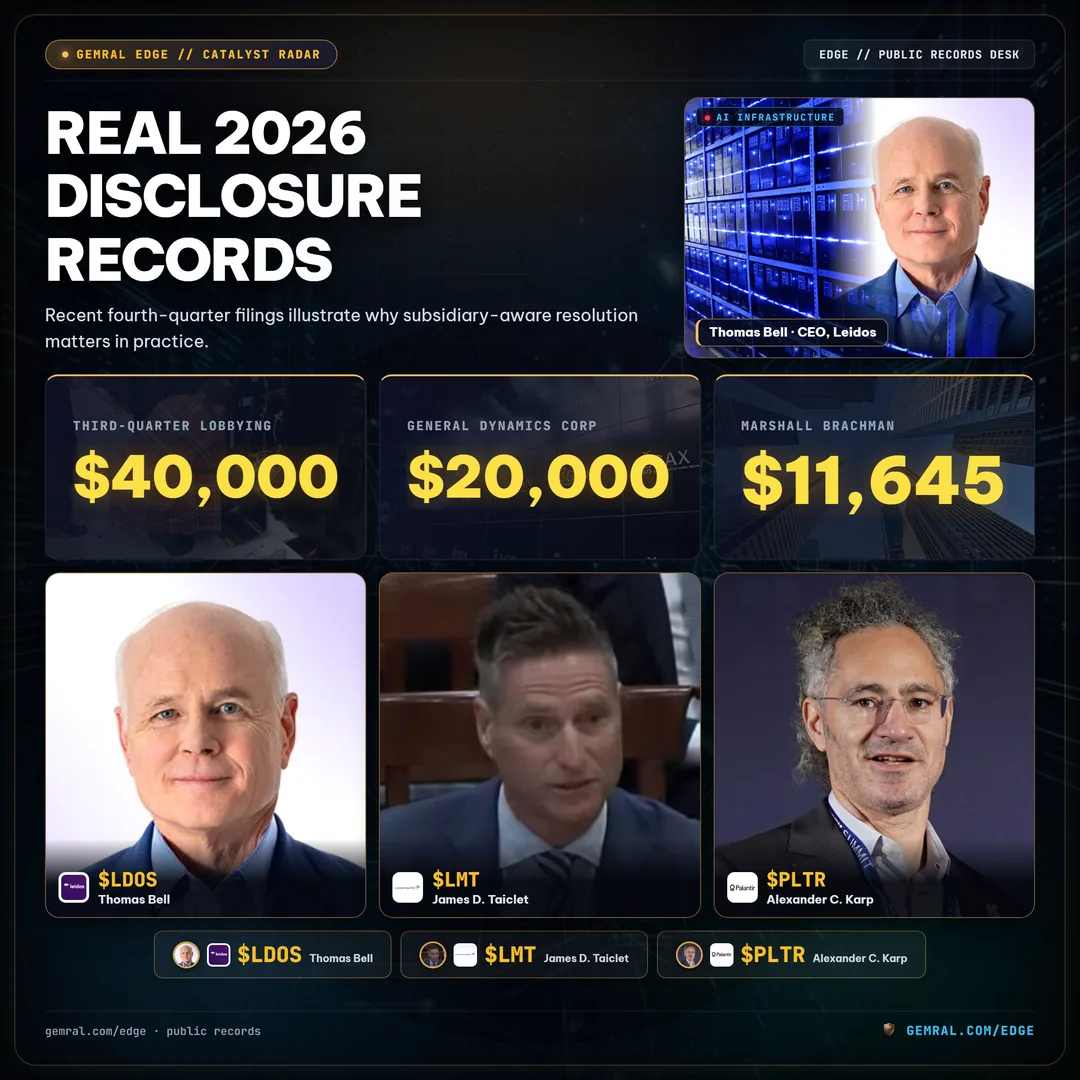
Earlier in November, on November 2, 2026, Marshall Brachman reported $11,645 for Lockheed Martin Aeronautic Sector (LMT). On October 20, 2026, Palantir Technologies Inc. (PLTR) logged $100,000 third-quarter filings with both Invariant LLC and Avoq, LLC. None of the subsidiary or sector-level client names—such as Idaho Scientific Corp. or Lockheed Martin Aeronautic Sector—would match a naive ticker-only string filter.
Researchers tracking how policy spending aligns with prime-to-subcontractor award networks can cross-reference these filings on the federal contracts hub, or review our related analyses on corporate lobbying velocity in 2026 and defense contractor subcontractor supply chains.
Data Coverage, Sampled Accuracy, and Known Limitations for Institutional Research
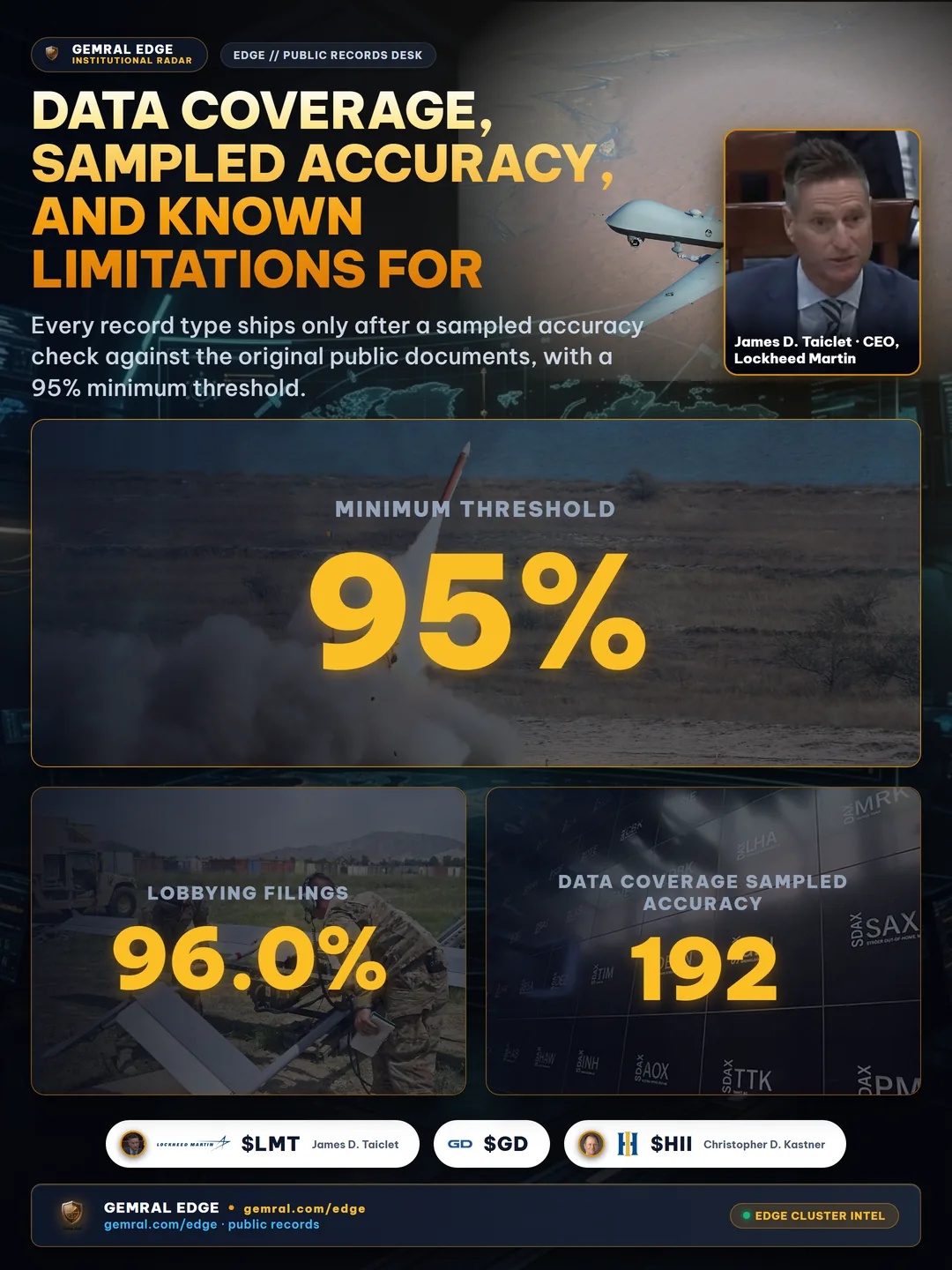
Every record type ships only after a sampled accuracy check against the original public documents, with a 95% minimum threshold. In the latest graded batch (measured October 23, 2026), lobbying filings scored 96.0% precision (192 of 200 sampled rows) and federal contract transactions scored 98.5% precision (193 of 196 checkable rows), with all 10 of 10 Feed 1 record types passing the 95% gate.
Institutional teams should also note known coverage boundaries before running quantitative simulations. About 49.3% of FY2018+ federal contract transaction dollars are linked to a listed ticker (measured October 23, 2026); the remaining 50.7% flows to private or unlisted awardees or is not yet attributed. Cumulative precision across all historical batches is lower for contracts (91.2%), pre-award notices (76.4%), subcontractor links (94.0%), and bid protests (92.5%) because early batches were graded before the entity resolver was fixed. Our revision log started in October 2026.
All records come exclusively from public sources, contain no material non-public information, and are delivered as Parquet files with a SHA-256 manifest, a read-only REST API, and an MCP server for AI assistants. Fund licensing is quoted on request by email; institutional data teams can inspect schema coverage, point-in-time documentation, and sample rows at point-in-time methodology and data preview.
By aligning quarterly lobbying disclosures, daily defense contract announcements, and effective-dated corporate parent tables on a single point-in-time timeline, quantitative and fundamental research desks can evaluate policy-to-procurement relationships without survivorship bias, static-table misattribution, or retroactive look-ahead leakage across historical market cycles.
Frequently asked questions
How much did major listed defense contractors spend on defense lobbying in 2026?
Across 14 listed defense contractors in 2026 (through November 12, 2026), reported defense lobbying totaled $77.83M across 343 filings. Lockheed Martin (LMT) led at $14.02M across 51 filings, followed by General Dynamics (GD) at $13.30M across 70 filings, Huntington Ingalls (HII) at $12.68M, Boeing (BA) at $9.44M, and Palantir (PLTR) at $9.26M.
Which external defense lobbying firms handle the most listed contractor clients?
In 2026 disclosures, Miller Strategies, LLC led external defense registrants at $760K across 4 filings (2 clients), followed by Ballard Partners at $640K across 8 filings (4 defense clients), Cornerstone Government Affairs at $590K across 9 filings (4 clients), and Alpine Group Partners at $540K across 6 filings (2 clients).
Why do defense lobbying disclosures and Pentagon contract awards have different reporting lags?
Quarterly lobbying disclosures post a median of 20 days (90th percentile 21 days) after quarter end, whereas federal defense contract actions carry a statutory 90-day publication delay. Daily defense contract announcements appear a median 90 days before the underlying contract transaction record.
How does point-in-time entity resolution prevent misattribution in defense data?
Effective-dated hierarchy mapping links subsidiary filings—such as General Dynamics' Idaho Scientific Corp. ($40,000 on November 12, 2026)—to the parent ticker valid on the publication date. In federal procurement data, joining via static current parent tables miscredits $89.6B (3.3% of $2.7T across 8,568 transactions).