Federal Bid Protest Filings in 2026: 1,546 Challenges & Listed Contractors
Tracking bid protest filings across 13,940 federal procurement challenges recorded from September 18, 2018 through November 23, 2026 shows how contested awards move through the federal pipeline. In 2026 alone, 1,546 bid protest filings have been logged, resolving in an average of 43.8 days, with 58.9% dismissed, 17.9% denied, and 45.6% targeting defense agencies.
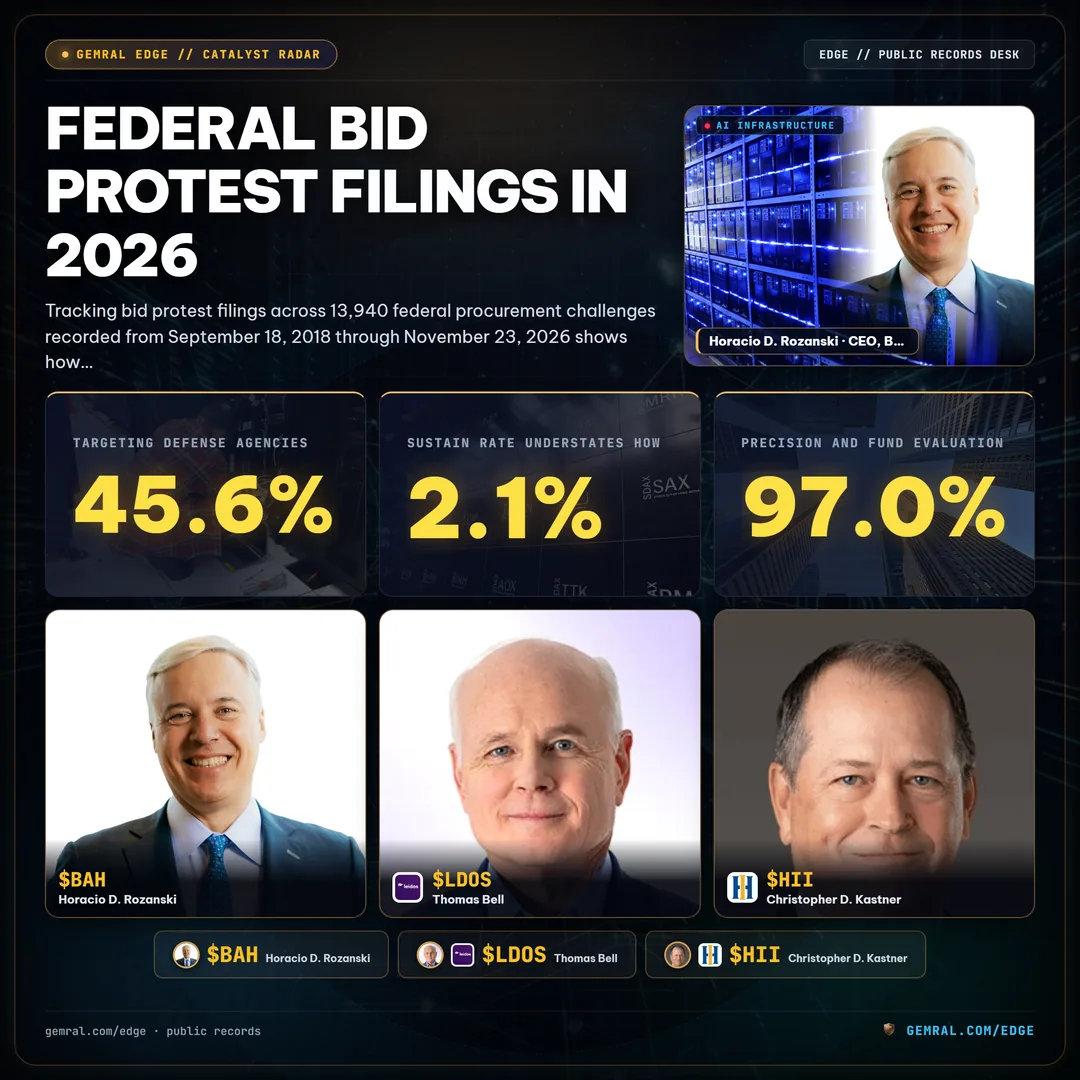
Bid Protest Activity in 2026: 1,546 Filings and a 43.8-Day Resolution Cycle
A bid protest is a formal legal challenge filed by an unsuccessful or prospective bidder contesting the terms of a federal solicitation or the award of a government contract. Across 13,940 filings recorded between September 18, 2018 and November 23, 2026—including 1,546 filings in 2026—cases resolve in 43.8 days on average from filing date to decision date.
For institutional analysts tracking government contractors, bid protest records capture friction that headline award announcements omit. When a losing bidder files a challenge, contract performance is frequently stayed pending review, delaying revenue recognition and obligation burn rates for the winning prime contractor. Conversely, a sustained protest can reopen a multi-year award competition entirely.
Because 43.8 days is shorter than a standard 90-day defense reporting lag, protest dockets often surface competitive disputes around major awards before those disputes appear in quarterly earnings commentary. Pairing protest timestamps with federal procurement data provides an early operational signal on contested awards.
How Bid Protests Resolve: 58.9% Dismissed, 17.9% Denied, and 2.1% Sustained
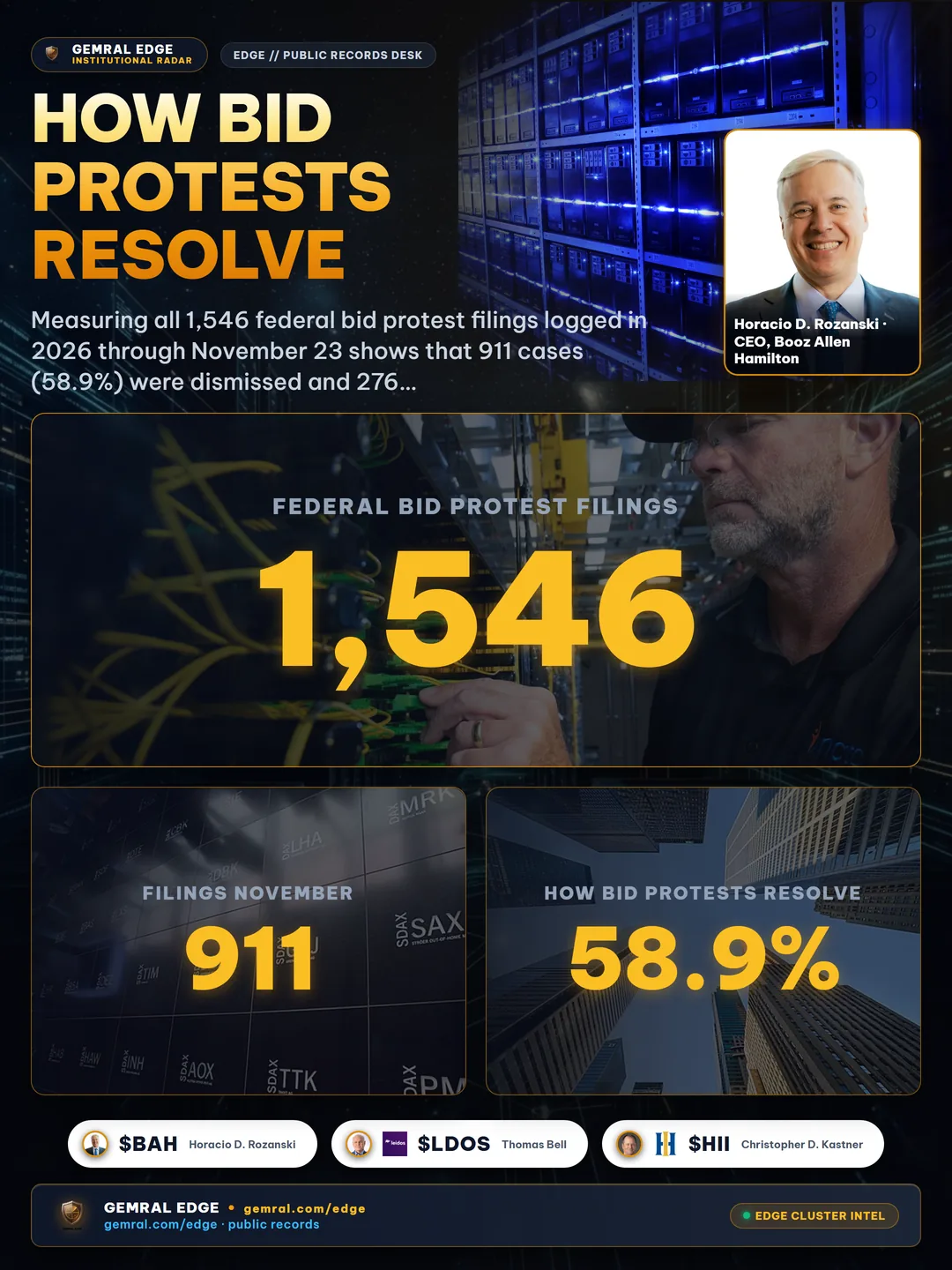
Measuring all 1,546 federal bid protest filings logged in 2026 through November 23 shows that 911 cases (58.9%) were dismissed and 276 cases (17.9%) were denied, while only 33 cases (2.1%) were sustained and 3 cases (0.2%) were granted. Another 157 filings (10.2%) were withdrawn, and 166 filings (10.7%) remain open.
| 2026 Outcome / Status | Filings | Share of 2026 Total |
|---|---|---|
| Dismissed | 911 | 58.9% |
| Denied | 276 | 17.9% |
| Open | 166 | 10.7% |
| Withdrawn | 157 | 10.2% |
| Sustained | 33 | 2.1% |
| Granted | 3 | 0.2% |
The 2.1% sustain rate understates how often protests reshape procurement outcomes. Many of the 911 dismissals and 157 withdrawals occur after the contracting agency announces voluntary corrective action—meaning the agency agrees to re-evaluate proposals or amend the solicitation without waiting for a formal sustain ruling. Tracking both sustained decisions and pre-decision withdrawals gives analysts a clearer view of procurement friction.
Federal Bid Protest Docket: 45.6% Defense Share and 53 Listed Contractors
Defense-related agencies account for 705 of the 1,546 filings in 2026 (45.6%), led by the Department of the Army (220 filings, 14.2%), Department of Defense (195, 12.6%), Department of the Air Force (151, 9.8%), and Department of the Navy (139, 9.0%). Across the full 2018–2026 docket, 337 filings link directly to 53 listed protester tickers—with 35 linked filings in 2026—while 336 filings link to listed awardees.
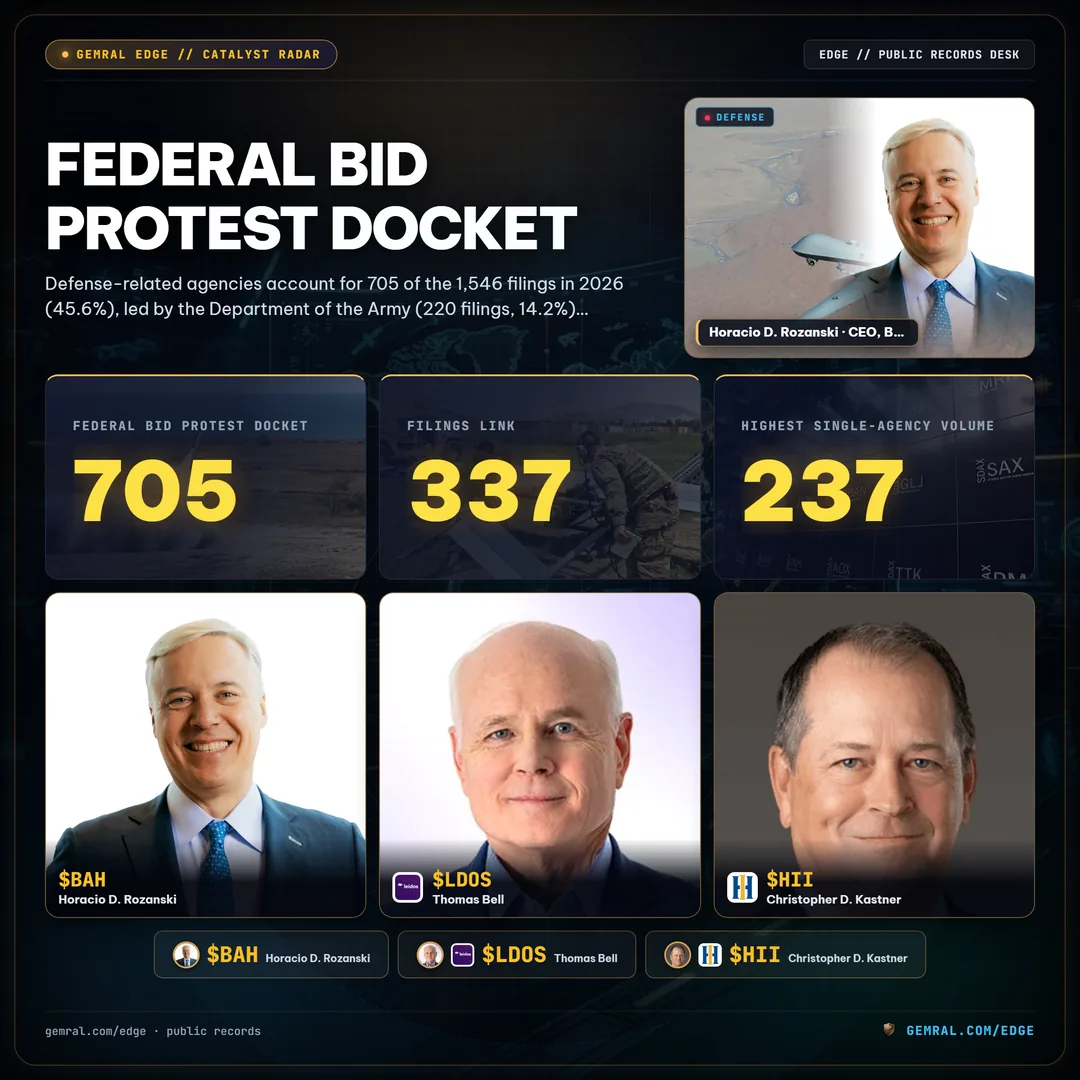
Among civilian agencies, the Department of Veterans Affairs recorded the highest single-agency volume in 2026 with 237 filings (15.3%), followed by the Department of Homeland Security with 143 filings (9.2%), Independent Government Entities with 141 filings (9.1%), and the Department of Health and Human Services with 99 filings (6.4%).
| Listed Protester Ticker | Total Filings (2018–2026) | 2025–2026 Filings | 2026 Filings | Latest Filed Date |
|---|---|---|---|---|
| BAH | 35 | 5 | 3 | 2026-09-04 |
| LDOS | 24 | 2 | 0 | 2025-03-31 |
| CACI | 23 | 1 | 0 | 2025-05-27 |
| VVX | 20 | 2 | 0 | 2025-01-21 |
| KBR | 19 | 4 | 2 | 2026-07-13 |
| ICFI | 18 | 4 | 3 | 2026-08-03 |
| HII | 12 | 2 | 1 | 2026-07-29 |
| ACN | 11 | 4 | 2 | 2026-11-23 |
| ACM | 9 | 1 | 1 | 2026-07-13 |
Booz Allen Hamilton (BAH) leads all listed protesters with 35 historical filings (including 3 in 2026, most recently on September 4), followed by Leidos (LDOS) with 24, CACI with 23, V2X (VVX) with 20, KBR with 19 (2 in 2026), ICF International (ICFI) with 18 (3 in 2026), Becton Dickinson (BDX) with 18, IBM with 14, Huntington Ingalls (HII) with 12 (1 in 2026), Accenture (ACN) with 11 (2 in 2026, latest November 23), and AECOM (ACM) with 9 (1 in 2026). Linking these challenges with defense contractor supply-chain networks helps analysts map which prime awards face active re-competition risk.
Point-in-Time Protest Data: 97.0% Audited Precision and Fund Evaluation
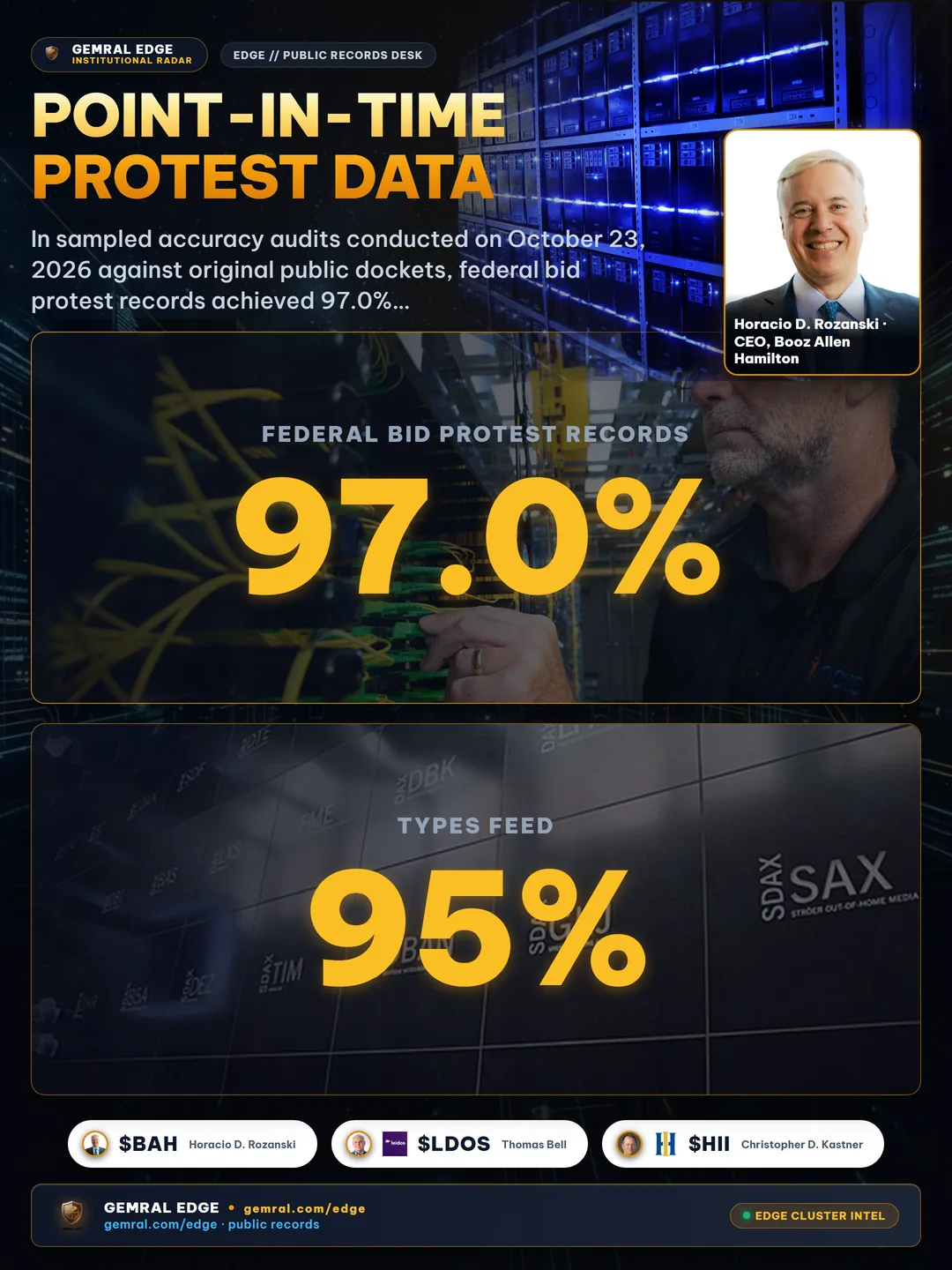
In sampled accuracy audits conducted on October 23, 2026 against original public dockets, federal bid protest records achieved 97.0% precision (194/200), while 10/10 core record types in Feed 1 cleared the 95% minimum accuracy gate. Every record preserves filing, due, and decision timestamps so quantitative models avoid look-ahead bias.
Institutional research teams can inspect sample rows directly on Edge Data Preview or explore listed contractor awards on the Federal Contract Hub. Full historical Parquet deliveries and REST API access are available for internal fund use; fund licensing is quoted on request by email.
By integrating bid protest dockets alongside prime-to-subcontractor dependency maps and pre-award notices, quantitative and fundamental research teams gain a complete view of federal procurement execution. Rather than treating contract award announcements as immediate revenue certainty, tracking active challenges, voluntary corrective actions, and agency-level dispute concentrations allows analysts to model award timelines with verifiable public-record precision.
Every Parquet delivery ships with a SHA-256 manifest, row-count verification, a structured data dictionary, and quickstart notebooks designed for point-in-time joins without look-ahead bias.
Frequently asked questions
How long does a federal bid protest take to resolve?
Across measured federal bid protest records from 2018 through November 23, 2026, the average resolution window between filing date and decision date is 43.8 days.
What percentage of federal bid protests are sustained in 2026?
Among 1,546 federal bid protest filings in 2026 through November 23, 33 filings (2.1%) were sustained and 3 (0.2%) were granted, while 911 (58.9%) were dismissed, 276 (17.9%) were denied, 157 (10.2%) were withdrawn, and 166 (10.7%) remain open.
Which federal agencies receive the most bid protests in 2026?
The Department of Veterans Affairs leads in 2026 with 237 filings (15.3%), followed by the Department of the Army (220, 14.2%), Department of Defense (195, 12.6%), Department of the Air Force (151, 9.8%), Department of Homeland Security (143, 9.2%), and Department of the Navy (139, 9.0%).