Corporate Lobbying Velocity in 2026: $536.52M Across 4,066 Listed-Company Filings
Across 4,066 listed-company filings in 2026 through November 20, corporate lobbying reached $536.52M across 1,253 public tickers ($536.88M total across all filers). Just 10 listed companies—led by Meta Platforms (META) at $22.11M and Amazon (AMZN) at $16.50M—accounted for $128.38M, or 23.9% of all listed-company policy spending.
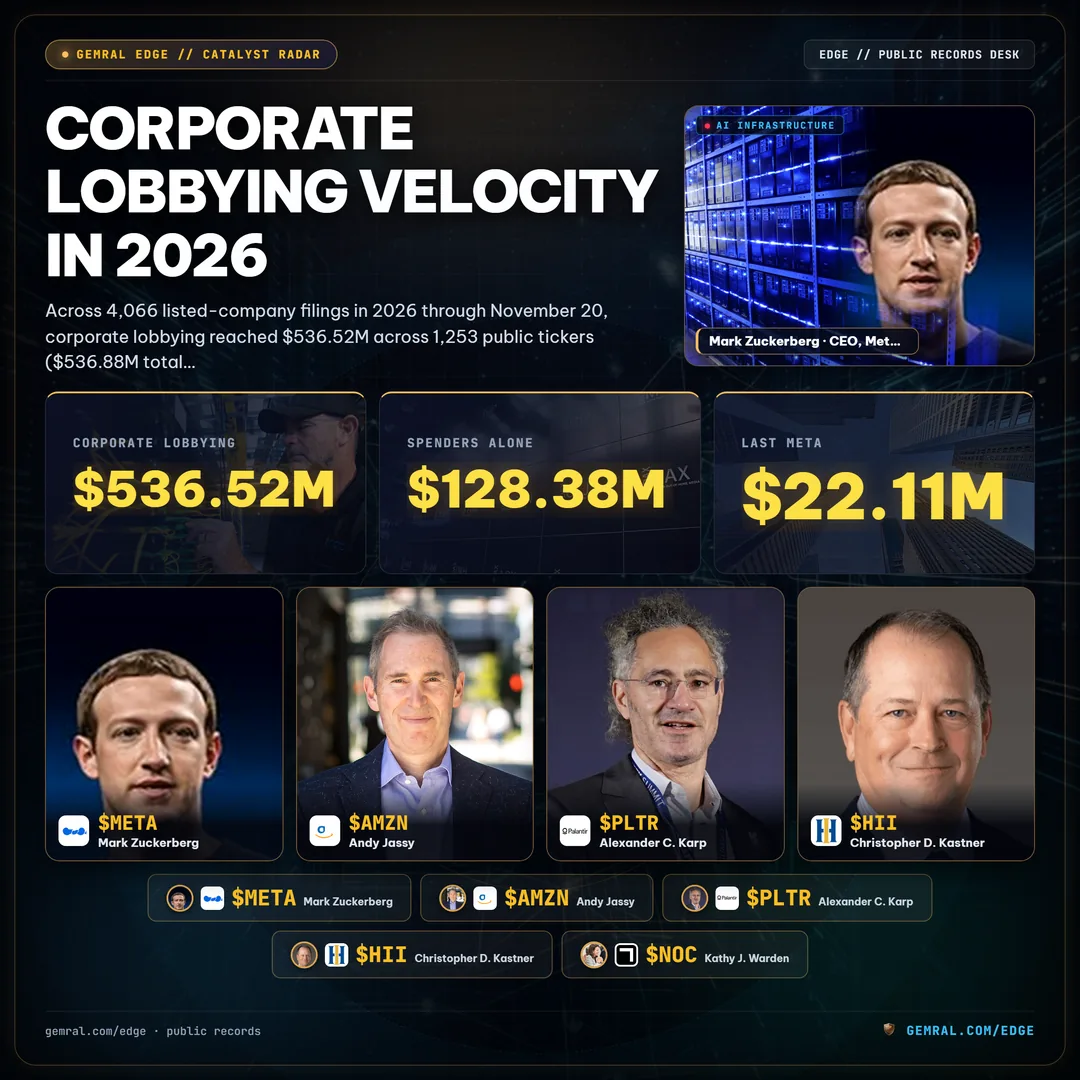
Corporate Lobbying in 2026: $536.52M Across 4,066 Listed-Company Filings
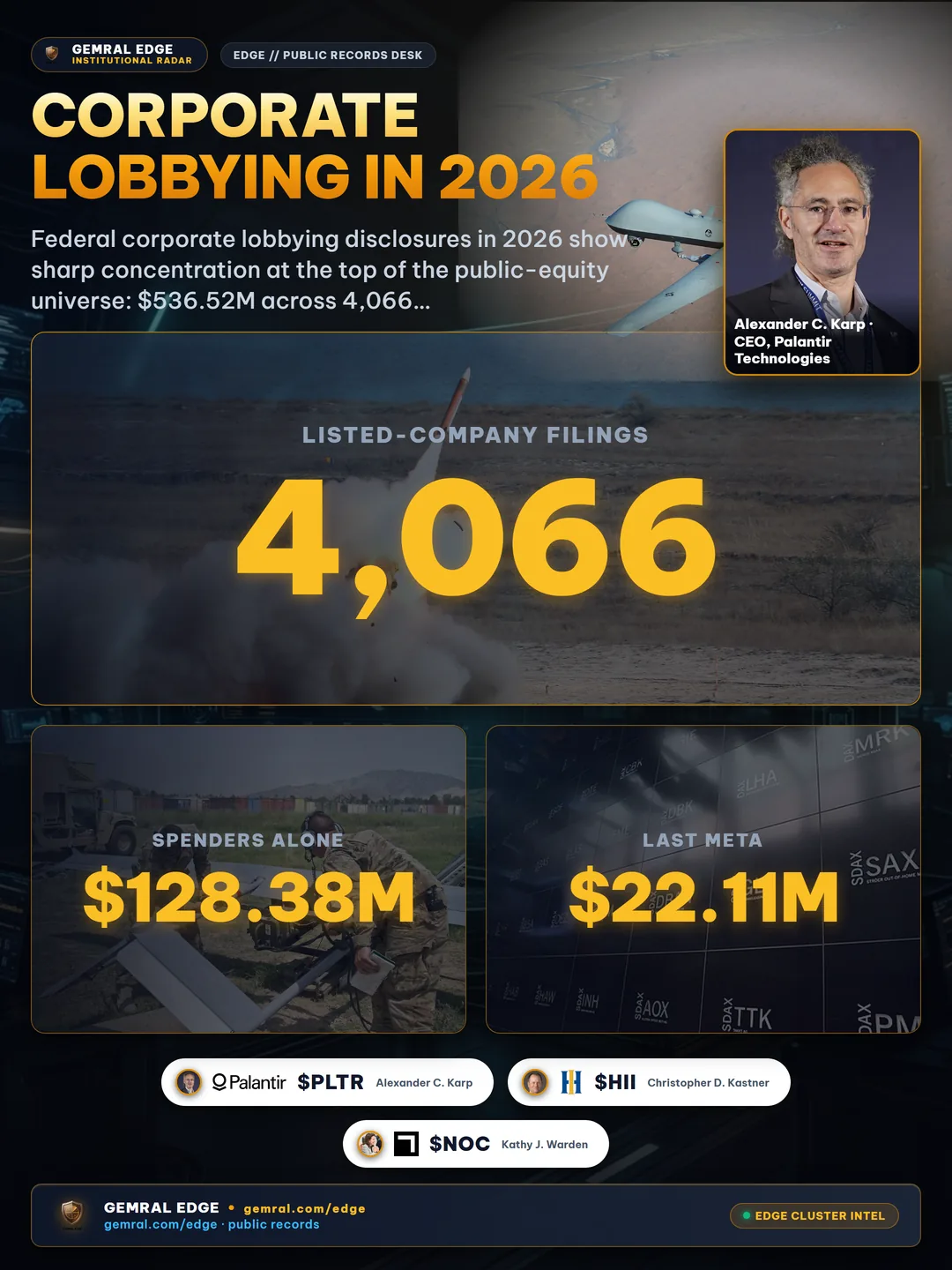
Federal corporate lobbying disclosures in 2026 show sharp concentration at the top of the public-equity universe: $536.52M across 4,066 listed-company filings through November 20, 2026, compared with $220.79M across 983 filings in 2025. The top 10 listed spenders alone deployed $128.38M—23.9% of total listed spend—split between mega-cap technology platforms and prime defense contractors.
| Ticker | 2026 Spend ($M) | 2026 Filings | 2025 Spend ($M) | 2025 Filings | Last Posted |
|---|---|---|---|---|---|
| META | $22.11M | 68 | $35.84M | 85 | 2026-10-21 |
| AMZN | $16.50M | 67 | $27.06M | 99 | 2026-10-20 |
| LMT | $14.02M | 46 | $21.55M | 60 | 2026-11-02 |
| GD | $13.30M | 68 | $17.35M | 87 | 2026-11-12 |
| HII | $12.68M | 8 | $0.00M | 0 | 2026-11-03 |
| ORCL | $10.69M | 59 | $14.28M | 82 | 2026-11-04 |
| MSFT | $10.55M | 58 | $12.94M | 74 | 2026-10-21 |
| GILD | $9.83M | 14 | $0.00M | 0 | 2026-10-21 |
| BA | $9.44M | 35 | $13.15M | 40 | 2026-10-21 |
| PLTR | $9.26M | 37 | $9.68M | 44 | 2026-10-20 |
Notice the velocity divergence inside the top 10. Palantir Technologies (PLTR) has already disclosed $9.26M across 37 filings in 2026 through October 20—reaching 95.7% of its $9.68M full-year 2025 total with Q4 filings still ahead. Meanwhile, Huntington Ingalls Industries (HII) logged $12.68M across 8 filings in 2026, and Northrop Grumman (NOC) added $7.07M across 29 filings, keeping aerospace and defense primes heavily represented alongside cloud hyperscalers.
How Corporate Lobbying Disclosures Work: Quarterly Filings, 20-Day Windows, and Issue Codes
Under the Lobbying Disclosure Act of 1995, registered organizations and external lobbying firms must file quarterly activity reports within 20 days after the end of each calendar quarter. That statutory 20-day window means Q3 2026 policy spending becomes public in late October, while Q4 2026 disclosures will not post until January 2027—creating a structured reporting lag that researchers must respect alongside the 45-day congressional trade window and 90-day defense contract lag.
Each quarterly filing lists the client organization, the external or in-house registrant, the rounded dollar amount spent, the specific federal agencies or legislative chambers contacted, and standardized policy issue codes. Indexing historical records by their public posting timestamp—rather than the quarter-start or quarter-end date—prevents look-ahead bias in quantitative panels, a discipline we also detail in our congressional stock trade lag analysis and our November 2026 Pentagon awards report.
Why Corporate Lobbying Velocity Concentrates in Tax, Trade, Defense, and AI Policy
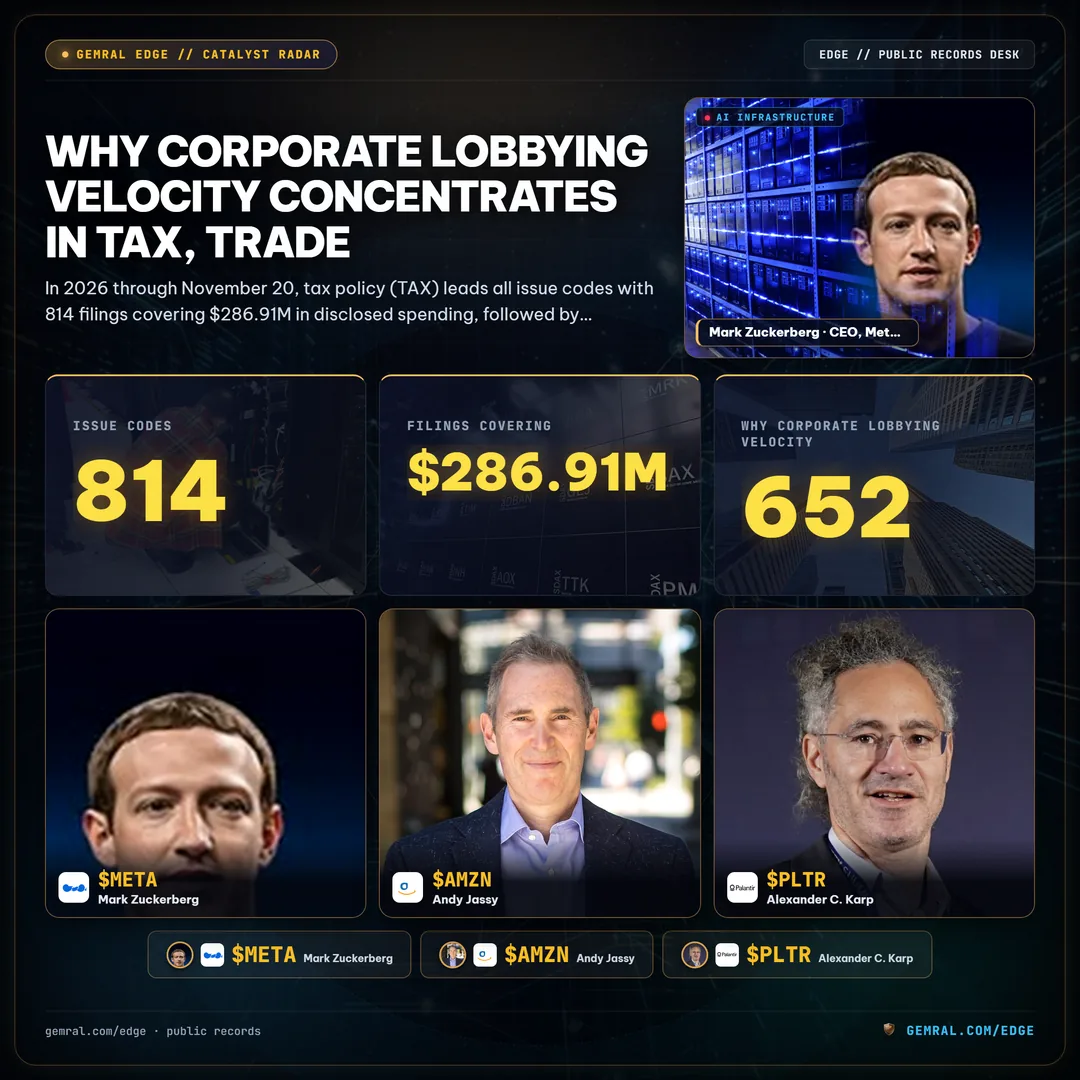
In 2026 through November 20, tax policy (TAX) leads all issue codes with 814 filings covering $286.91M in disclosed spending, followed by trade (TRD) at 652 filings ($236.35M) and defense (DEF) at 633 filings ($174.34M). Because a single quarterly filing frequently tags multiple issue codes, dollar totals across categories overlap—reflecting how multi-division corporations bundle tax, tariff, and procurement priorities into unified Washington campaigns.
| Issue Code | Policy Area | 2026 Filings | 2026 Tagged Spend ($M) |
|---|---|---|---|
| TAX | Taxation & Internal Revenue Code | 814 | $286.91M |
| TRD | Trade, Tariffs & Export Controls | 652 | $236.35M |
| DEF | Defense & National Security | 633 | $174.34M |
| BUD | Federal Budget & Appropriations | 558 | $163.96M |
| HCR | Health Issues & Biopharma | 544 | $144.65M |
| ENG | Energy & Nuclear Infrastructure | 443 | $117.06M |
| TEC | Science, Technology & AI Policy | 291 | $111.41M |
For institutional desks, the intersection of technology (TEC, 291 filings, $111.41M) and energy (ENG, 443 filings, $117.06M) mirrors the physical buildout of AI data centers, grid-interconnection queues, and semiconductor export rules. Cross-referencing these issue-code spikes against federal procurement awards—as outlined in our corporate lobbying and federal contract overlap guide—helps separate routine annual retainers from sudden policy-defense surges.
Corporate Lobbying and Firm Performance: Point-in-Time Verification and Known Data Limits
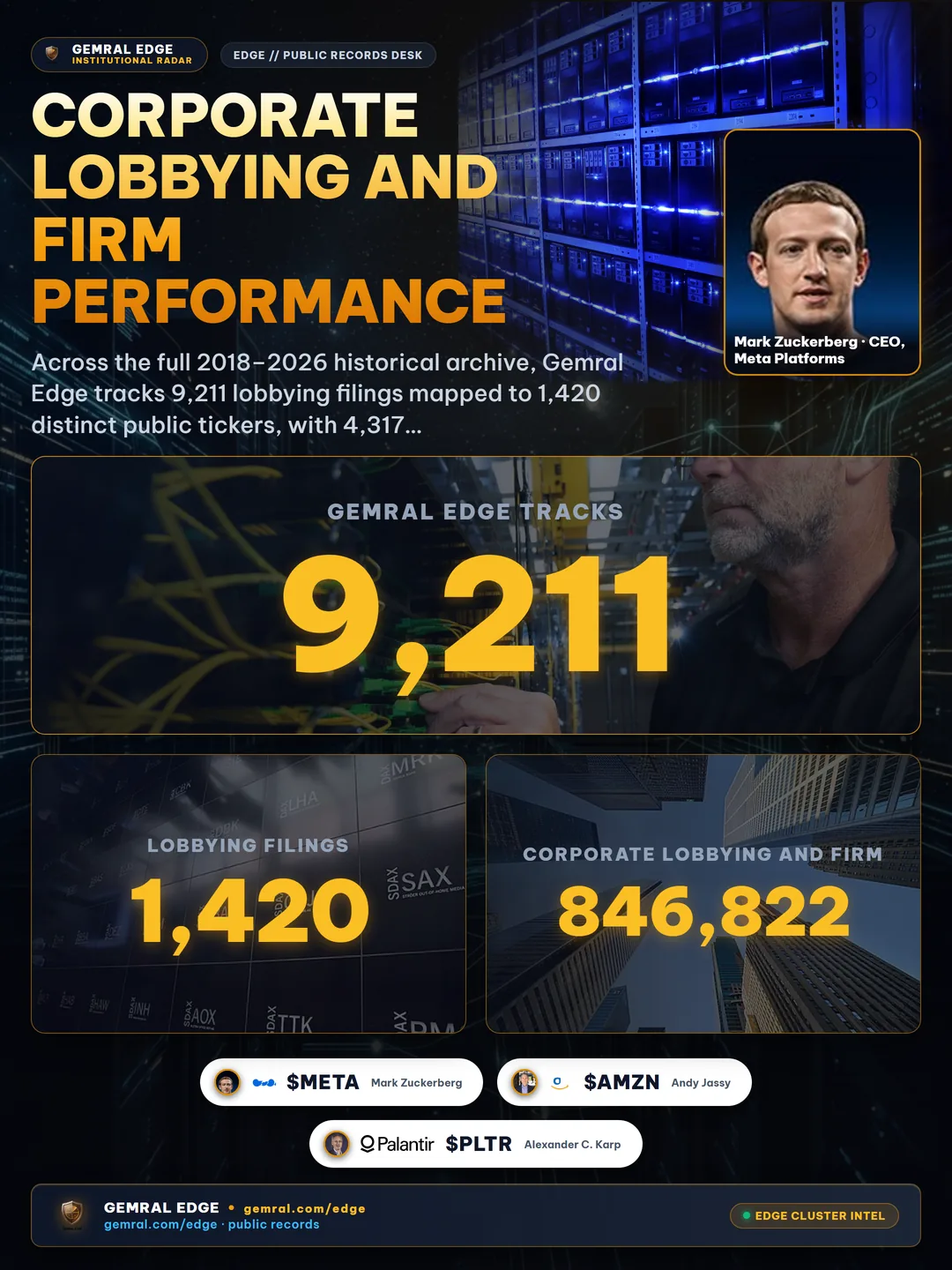
Across the full 2018–2026 historical archive, our dataset tracks 9,211 lobbying filings mapped to 1,420 distinct public tickers, with 4,317 lobbying filings packaged in the 300-ticker Wave 1 sample bundle (846,822 total rows across 24 tables, verified November 11, 2026). In our October 23, 2026 accuracy audit, sampled lobbying records achieved 96.0% entity-resolution precision (192 of 200 checked rows), clearing the 95% minimum threshold required for institutional delivery.
Researchers evaluating corporate lobbying alongside firm performance must account for two structural limits. First, quarterly filings are low-frequency disclosures with a 20-day post-quarter lag, making them unsuitable as high-frequency trading triggers. Second, subsidiary names and M&A transitions require effective-dated parent links so acquired or renamed companies remain attributed to the ticker valid on each public filing date. Our formal revision log began in October 2026 to preserve an immutable audit trail whenever amended filings arrive.
In practice, institutional analysts pair quarterly lobbying velocity with other asynchronous public datasets—such as congressional stock disclosures, federal contract modifications, and corporate insider filings—to map how policy capital allocation precedes or reinforces procurement cycles. Separating in-house government-affairs teams from external K-Street registrants also clarifies whether a company is maintaining baseline legislative monitoring or escalating spend around a specific tariff, tax-code, or defense-appropriation markup.
Institutional teams can explore live policy-spending records on the corporate lobbying hub or inspect point-in-time sample tables in the data preview.
Public data · not investment advice. Data comes only from public sources and contains no material non-public information. Gemral Edge story: gemral.com/edge/s/corporate-lobbying-velocity-policy-capital-allocation
Frequently asked questions
How does corporate lobbying disclosure work in the United States?
Under the Lobbying Disclosure Act of 1995, registered organizations and lobbying firms file quarterly reports within 20 days after each quarter ends, disclosing dollar amounts, federal agencies contacted, and standardized policy issue codes.
Why must corporate lobbying data be indexed by public posting date?
Because quarterly lobbying reports are filed up to 20 days after quarter-end, indexing records by their public posting timestamp rather than quarter-start or quarter-end prevents look-ahead bias in historical research.
Which policy issues attract the most corporate lobbying spend in 2026?
Through November 20, 2026, tax policy (TAX) leads with 814 filings ($286.91M), followed by trade (TRD) with 652 filings ($236.35M), defense (DEF) with 633 filings ($174.34M), and federal budget (BUD) with 558 filings ($163.96M).