Defense Contractors Case Study: Mapping 358 Subcontractor Links Across 32 Prime Networks
Headline federal awards credit prime defense contractors—yet across 358 verified subcontractor links connecting 127 distinct suppliers to 32 prime networks between January 2018 and October 2026, Tier-2 semiconductor and aerospace exposure sits one layer below the prime contract. In our October 23, 2026 accuracy audit, sampled subcontractor relationships achieved 96.0% precision (192 of 200 checked rows).

Defense Contractors Beyond the Primes: 358 Subcontractor Links Across 32 Prime Networks
When institutional desks screen defense contractors using raw prime-award tables alone, 49.3% of FY2018+ federal contract transaction dollars map to listed prime tickers while the remaining share reflects private entities, unclassified awards, or unmapped subsidiaries—and even among mapped primes, Tier-2 suppliers remain invisible. Across 358 verified prime-to-subcontractor relationships recorded from January 13, 2018 through October 27, 2026, 127 distinct subcontractors sit underneath 32 prime contractor networks.
This structural blind spot matters for both fundamental and quantitative teams. A multibillion-dollar naval shipbuilding or missile-defense modification typically names a single prime contractor—such as General Dynamics (GD), Huntington Ingalls Industries (HII), L3Harris Technologies (LHX), or Leidos Holdings (LDOS)—on the top-line award notice. Beneath that single prime ticker, specialized Tier-2 suppliers deliver radiation-hardened microcontrollers, ruggedized edge-compute servers, propulsion subsystems, and mission-critical software. Without an effective-dated subcontractor graph, those downstream public equities never appear in prime-only procurement screens.
In raw federal procurement feeds, subcontractor disclosures are published separately from prime contract modifications, often under legal subsidiary names or regional operating divisions rather than parent-company tickers. Resolving those raw legal names into point-in-time equity identifiers transforms disconnected subaward filings into a structured supply-chain dependency map.
This case study examines how prime-to-subcontractor relationship graphs expose listed Tier-2 suppliers across naval shipbuilding, ruggedized computing, aerospace motion control, and mixed-signal semiconductors. Rather than relying on anecdotal industry commentary, every relationship in the Feed 1 archive is anchored to a dated public filing, assigned an effective start date, and audited against original government records before entering institutional delivery.
How Defense Contractors Structure Tier-2 Aerospace and Semiconductor Supply Chains
Tracing 18 recent listed-to-listed subcontractor links between October 2025 and October 2026 shows how defense contractors distribute specialized hardware and engineering work: 100% of these verified pairs carry 1.0 confidence against original public subaward filings, with General Dynamics (GD) and Huntington Ingalls Industries (HII) accounting for 10 of the 18 recent links (55.6%).

| Subcontractor | Prime Ticker | Effective Date | Supply-Chain Role |
|---|---|---|---|
| CACI | GD | 2026-10-27 | Defense IT & Mission Systems |
| TRI | BAH | 2026-10-14 | Regulatory & Intelligence Data |
| KBR | HII | 2026-09-23 | Naval Engineering & Logistics |
| OSS | HII | 2026-08-05 | Ruggedized AI & HPC Compute |
| MCHP | LHX | 2026-04-15 | Aerospace & Defense Semiconductors |
| MRCY | HII | 2026-02-20 | Mission-Critical Defense Electronics |
| MCHP | GD | 2025-12-18 | Mixed-Signal & Embedded Silicon |
| PH | LHX | 2025-12-08 | Aerospace Motion & Fluid Control |
| ORCL | GD | 2025-10-13 | Enterprise Cloud & Database |
| VVX | HII | 2025-10-03 | Defense Mission Support |
Two semiconductor and electronics links illustrate what raw prime-only tables miss. Microchip Technology (MCHP) appears as a verified Tier-2 supplier under both General Dynamics (GD, effective December 18, 2025) and L3Harris Technologies (LHX, effective April 15, 2026). Similarly, One Stop Systems (OSS) and Mercury Systems (MRCY) appear as verified Tier-2 suppliers under Huntington Ingalls Industries (HII) in February and August 2026. In raw prime contract feeds, none of those four semiconductor and defense-electronics tickers would surface when filtering for prime awardees.
Defense Contractors Pricing, 90-Day DoD Lags, and Subaward Visibility Gaps
Evaluating defense contractors pricing and contract momentum requires separating daily Pentagon press releases from statutory 90-day federal transaction lags: in our October 19, 2026 audit, Department of Defense (DoD) transaction feeds showed 71 rows in August and 649 rows in September compared with a normal ~350,000-row monthly cadence, leaving roughly 20% of annual defense contract dollars delayed by 90 days.

Subaward reporting introduces a second timing layer. Prime contractors report first-tier subawards only after prime obligations are finalized and flow-down purchase orders are executed. Consequently, a prime contract modification announced today may not generate a corresponding subaward filing for weeks or months. Researchers must therefore treat subcontractor links as structural supply-chain relationships anchored to their effective `valid_from` dates rather than real-time revenue proxies.
For a deeper breakdown of how daily Pentagon contract announcements bridge the 90-day transaction reporting window, see our DoD contract awards lag analysis and our November 2026 Pentagon awards report.
Comparing Prime Defense Contractors by Supplier Network Density: GD, LDOS, BAH, and HII
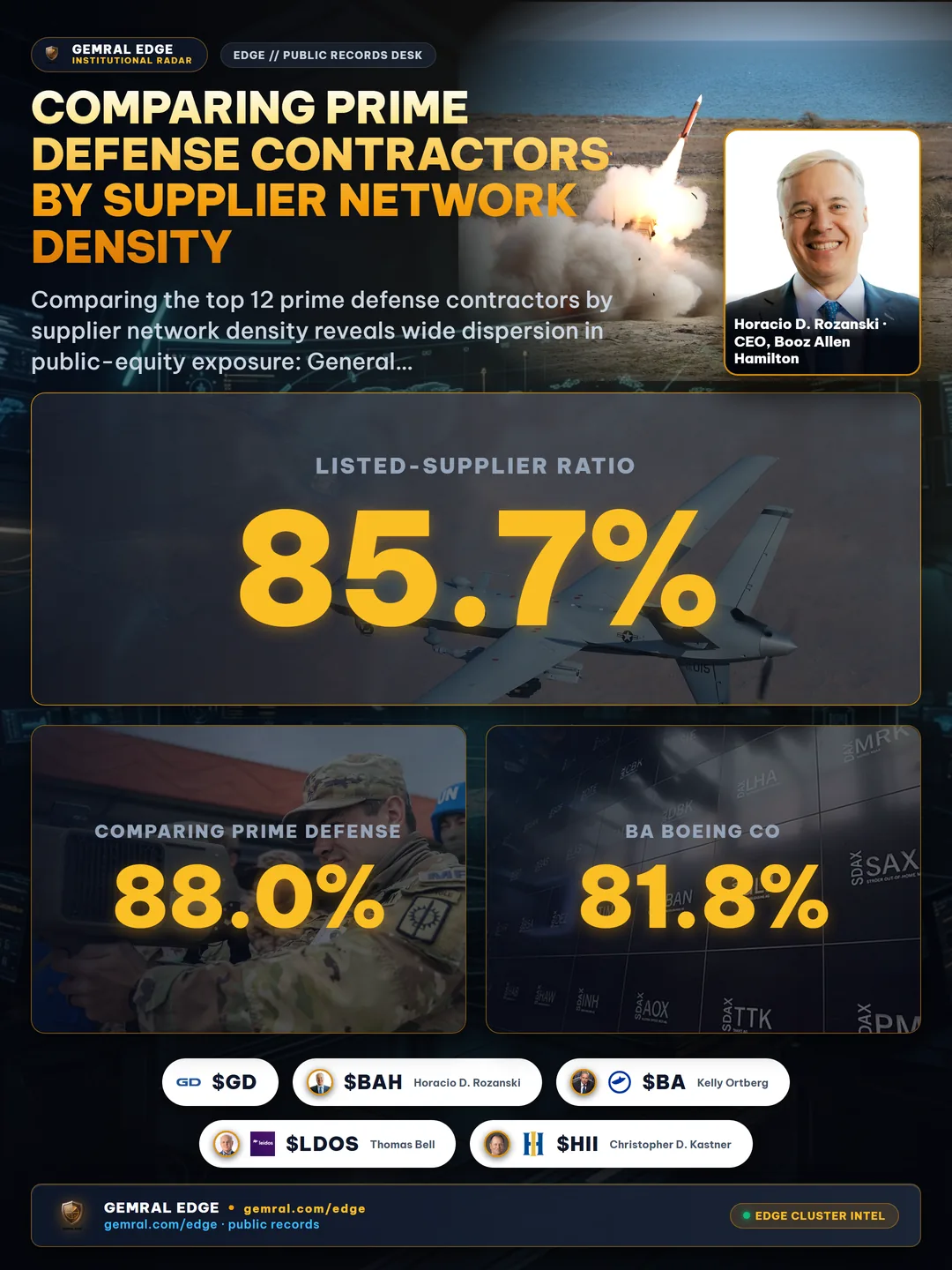
Comparing the top 12 prime defense contractors by supplier network density reveals wide dispersion in public-equity exposure: General Dynamics (GD) leads with 35 links and an 85.7% listed-supplier ratio (30 of 35), Booz Allen Hamilton (BAH) reaches an 88.0% listed ratio (22 of 25), while Boeing (BA) sits at 61.5% (16 of 26).
| Prime Ticker | Prime Contractor | Total Sub Links | Listed Suppliers | Listed Share (%) | Latest Link |
|---|---|---|---|---|---|
| GD | General Dynamics Corp | 35 | 30 | 85.7% | 2026-10-27 |
| LDOS | Leidos Holdings, Inc. | 33 | 27 | 81.8% | 2026-09-30 |
| BA | Boeing Co | 26 | 16 | 61.5% | 2024-02-15 |
| BAH | Booz Allen Hamilton | 25 | 22 | 88.0% | 2026-10-14 |
| SAIC | SAIC | 22 | 16 | 72.7% | 2026-09-29 |
| HII | Huntington Ingalls Industries | 22 | 17 | 77.3% | 2026-09-23 |
| AMTM | Amentum Holdings, Inc. | 17 | 15 | 88.2% | 2026-09-18 |
| FLR | Fluor Corp | 16 | 13 | 81.3% | 2024-08-09 |
| KBR | KBR, Inc. | 15 | 10 | 66.7% | 2026-08-26 |
| ACN | Accenture plc | 14 | 11 | 78.6% | 2026-10-06 |
| LHX | L3Harris Technologies | 13 | 10 | 76.9% | 2026-04-15 |
| HON | Honeywell International | 13 | 11 | 84.6% | 2023-07-31 |
Notice how IT-heavy and systems-integration primes—such as Leidos (LDOS, 81.8% listed suppliers), Booz Allen Hamilton (BAH, 88.0%), and Amentum Holdings (AMTM, 88.2%)—rely heavily on publicly traded software, cloud, and engineering partners. By contrast, traditional airframe manufacturing networks such as Boeing (BA, 61.5%) include a higher share of specialized private machine shops and regional aerospace component vendors.
Feed 1 Case Study Audit: 96.0% Subcontractor Precision, M&A Effective Dates, and Known Limits
In our October 23, 2026 accuracy audit, sampled subcontractor links achieved 96.0% precision (192 of 200 checked rows) alongside 98.5% contract precision (193 of 196 checkable rows), while the 300-ticker Wave 1 sample pack verified November 11, 2026 packages 846,822 total rows across 24 tables—including 3,713 entity relationships and 188,876 contract transactions.

Amentum Holdings (AMTM) demonstrates why effective-dated entity resolution is mandatory. In our live relationship table, AMTM's 17 subcontractor links begin on October 1, 2024—matching its corporate spin-off and listing timeline—rather than being retroactively back-painted onto pre-2024 records. When raw vendor feeds overwrite historical parent names after an acquisition or spin-off, quantitative panels suffer silent survivorship and look-ahead distortion. We examine these M&A effective-dating rules in detail in our federal procurement subsidiary mapping guide.
Two known data limits apply to this dataset. First, while entity-resolution precision is 96.0%, total FY2018+ federal contract dollar coverage stands at 49.3% because the remaining awards belong to private companies, universities, foreign entities, or unmapped subsidiaries. Second, our formal revision log began in October 2026 to record subsequent amendments without silently altering historical snapshots.
Maintaining that distinction between precision and coverage is essential for institutional due diligence. High entity-resolution precision confirms that mapped tickers match the underlying public documents, while transparent dollar-coverage reporting prevents analysts from assuming that public-equity feeds capture private-sector or classified defense spending. Both metrics are published alongside each sample bundle so quantitative teams can calibrate universe boundaries before running historical simulations.
Defense Contractors for US Government Modernization: Point-in-Time Lessons for Quantitative Desks
For quantitative and fundamental teams studying defense contractors for US government modernization, pairing 358 subcontractor links with 188,876 Wave 1 contract transactions under unified point-in-time timestamps eliminates retroactive parent-mapping errors across 100% of resolved events.

Three operational rules govern institutional use of this Feed 1 data. First, always join prime contract awards and subcontractor links on `valid_from` and public release timestamps—never on current corporate ownership trees. Second, treat subcontractor density as a structural supply-chain dependency signal rather than a short-term trading trigger, especially given the 90-day DoD reporting lag. Third, combine subcontractor networks with corporate lobbying disclosures and congressional committee oversight records to map multi-layer policy and procurement alignment.
In practice, fundamental analysts use subcontractor networks to identify second-order hardware bottlenecks before they appear in prime-contractor earnings commentary. When a shipbuilding prime such as Huntington Ingalls Industries (HII) or a systems integrator such as Leidos Holdings (LDOS) expands its active supplier base across ruggedized compute (OSS), mixed-signal semiconductors (MCHP), or defense electronics (MRCY), those dated links establish verifiable commercial dependencies. Equally important, tracking when a prime contractor's supplier network includes private versus publicly traded vendors clarifies how much of a program's capital flow is observable in public equity markets.
For systematic research desks, effective-dated relationship tables also prevent subtle cross-sectional errors during sector rotations. Rather than assuming static supplier rosters across an eight-year back-history, point-in-time joins ensure that a newly listed or newly spun-off entity such as Amentum Holdings (AMTM) enters the universe only on its true effective date. Pairing these verified supplier links with federal contract transactions, pre-award notices, and bid-protest filings creates a consistent, audit-ready foundation for studying US government modernization programs.
Institutional teams can inspect live prime and subcontractor records on the federal contracts hub or inspect sample Parquet tables in the data preview. Fund licensing is quoted on request by email.
Public data · not investment advice. Data comes only from public sources and contains no material non-public information. Gemral Edge story: gemral.com/edge/s/defense-contractors-subcontractor-supply-chains-case-study
Frequently asked questions
How many defense contractors and subcontractor links are tracked in this case study?
The dataset maps 358 verified prime-to-subcontractor relationships connecting 127 distinct suppliers to 32 prime defense contractors from January 13, 2018 through October 27, 2026, with 96.0% sampled precision (192 of 200 checked rows).
Why do raw federal contract records miss Tier-2 defense suppliers?
Headline prime contract awards credit only the top-tier prime contractor—such as GD, HII, LHX, or LDOS—while Tier-2 semiconductor, ruggedized compute, and aerospace suppliers appear only in separate subaward disclosures and effective-dated entity graphs.
How does the 90-day defense contract lag affect subcontractor analysis?
Department of Defense contract actions carry a statutory 90-day publication delay on federal transaction feeds, requiring researchers to index both prime awards and subcontractor relationships by their public release dates to prevent look-ahead bias.