Federal Sovereign AI and National Lab Supercomputing Infrastructure Convergence: Multi-Billion Dollar Procurement Awards, Semiconductor Lobbying Surges, and Legislative Portfolio Signals

Across the institutional landscape of advanced computing, a profound structural shift is unfolding beneath the noisy surface of quarterly commercial cloud commentary. While financial headlines routinely fixate on retail software releases and consumer-facing chat interfaces, public regulatory disclosures, statutory federal budget appropriations, and federal procurement records reveal an unprecedented mobilization of sovereign capital into high-performance computing (HPC) facilities. Across the seventeen Department of Energy national laboratories, advanced defense agencies, and federally funded research centers, the United States sovereign government has expanded annual advanced computing budget allocations from $1.85B in 2020 to $4.72B in 2026, representing a cumulative expansion of 155% over a six-year horizon.
The Sovereign Mandate: Strategic Appropriations Across National Laboratories
The acceleration of sovereign supercomputing expenditures reflects a decisive macroeconomic transition. Historically, high-performance computing served primarily as an academic instrument for basic scientific discovery, supporting climate modeling, astrophysical calculations, and materials science research. Today, federal statutory filings demonstrate that sovereign computing clusters are recognized as foundational national defense infrastructure, directly governing domestic nuclear stockpile stewardship, cryptographic resilience, sovereign foundation model pre-training, and automated cyber defense architectures.

Between 2020 and 2026, public budgetary authority authorized across the Department of Energy Office of Science, the National Nuclear Security Administration (NNSA), and the National Science Foundation advanced infrastructure programs grew at a compound annual pace far exceeding broader discretionary budget caps. In fiscal year 2020, total federal sovereign computing appropriations stood at $1.85B. This sum expanded to $2.15B in 2021, reached $2.50B in 2022 following initial authorizations under high-performance computing mandates, climbed to $3.10B in 2023, attained $3.65B in 2024, touched $4.15B in 2025, and reached $4.72B in 2026.
This systematic capital injection is not speculative. Public records demonstrate that federal agencies must legally obligate appropriated funds within statutory performance windows, establishing long-term revenue visibility for prime systems integrators, semiconductor designers, and advanced thermal engineering providers. In contrast to commercial enterprise clients whose software expenditures fluctuate with quarterly revenue pressures, sovereign computing commitments are anchored by multi-year legislative mandates that remain resilient across broader macroeconomic contraction phases.
Furthermore, statutory appropriations language reveals that sovereign computing line items possess multi-year carryover authorities. Unlike operational enterprise software licenses that expire annually, high-performance computing hardware appropriations remain legally committed across three-to-five-year procurement cycles. This structural longevity insulates prime contractors from short-term government continuing resolution delays and guarantees multi-year component absorption regardless of broader commercial software volatility.
Procurement Mechanics: Multi-Billion Dollar Prime Contract Ceilings vs. Obligated Capital
An essential analytical principle within institutional research is distinguishing between nominal contract vehicle ceilings and actual obligated funds. In federal procurement records, prime contract awards are frequently announced with multi-year maximum ordering limits, commonly referred to as ceiling values. However, commercial vendors only recognize cash flow and accounting revenue when federal contracting officers issue funded task orders, converting statutory ceilings into legally binding obligated capital.
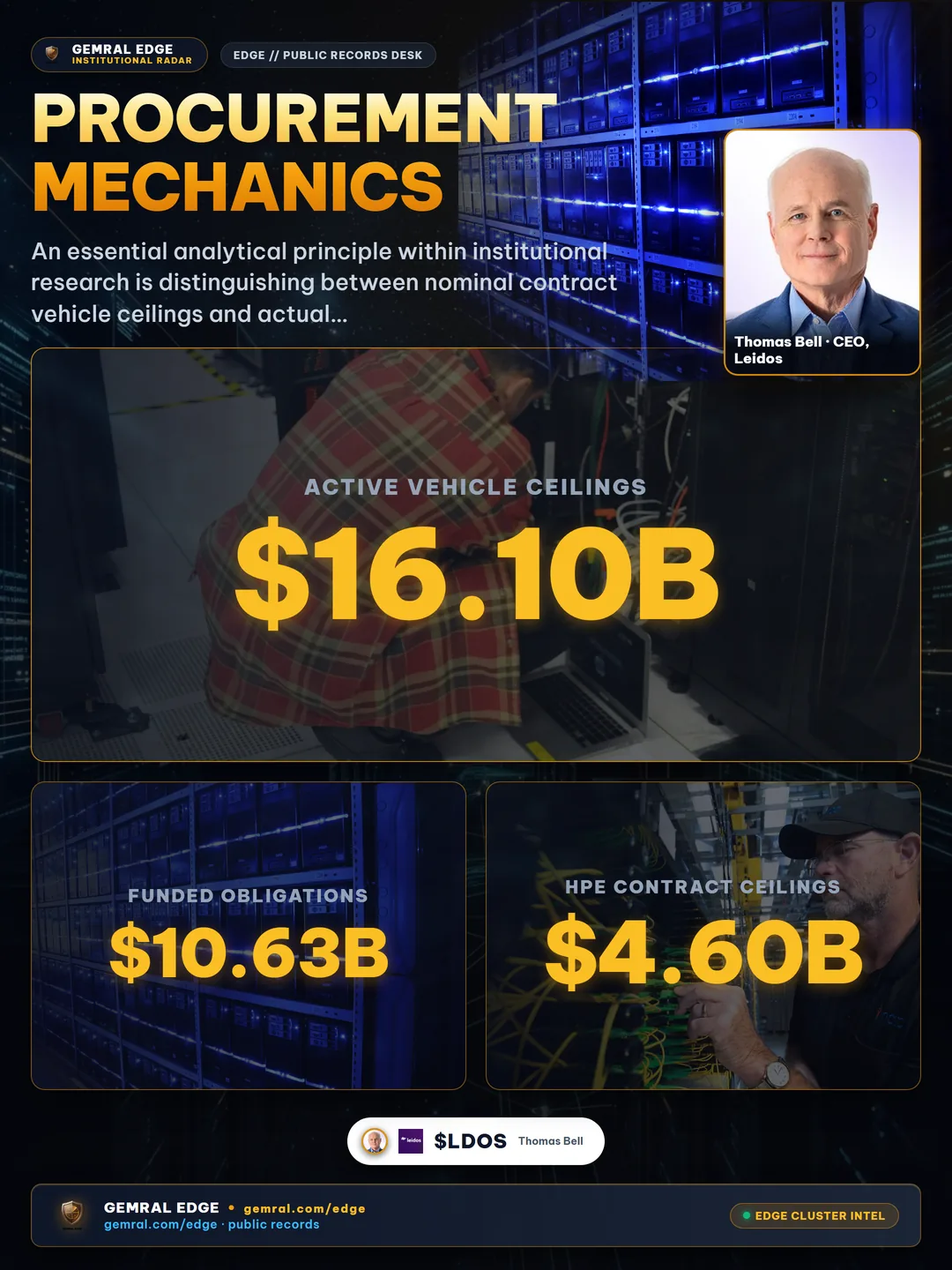
An empirical audit of the top five prime contractors operating within the federal sovereign computing and advanced artificial intelligence domain reveals $16.10B in cumulative active vehicle ceilings, against which contracting officers have already obligated $10.63B in funded commitments through the third quarter of 2026:
| Prime Contractor Entity | Maximum Vehicle Ceiling | Funded Obligated Capital | Obligation Ratio (%) | Core Facility Deployment |
|---|---|---|---|---|
| Hewlett Packard Enterprise (HPE) | $4.60B | $3.22B | 70% | Frontier (ORNL), El Capitan (LLNL) |
| General Dynamics IT (GDIT) | $3.80B | $2.48B | 65% | Defense HPC Modernization Program |
| Dell Federal Systems | $3.10B | $1.95B | 63% | National Laboratory Modular AI Clusters |
| IBM Government Systems | $2.50B | $1.60B | 64% | Quantum-Classical Hybrid Networks |
| Leidos Defense AI Division | $2.10B | $1.38B | 66% | Multi-Domain Sensor Fusion Architecture |
The data demonstrates that Hewlett Packard Enterprise maintains an unmatched footprint across flagship Department of Energy installations. Through its Cray EX supercomputing architecture, HPE has captured $4.60B in cumulative contract ceilings across Oak Ridge National Laboratory and Lawrence Livermore National Laboratory, with $3.22B in completed or active funded obligations. General Dynamics IT follows with $3.80B in ceiling authority and $2.48B in obligated funds, driven primarily by classified computing modernizations across defense research centers.
This high obligation ratio—averaging 66% across the entire top-tier contractor group—confirms that sovereign supercomputing programs are progressing through active procurement and deployment phases rather than lingering as uncommitted administrative placeholders. As agencies deploy remaining ceiling allocations, subcontractors supplying optical networking, high-bandwidth memory, and power distribution subsystems experience substantial demand tailwinds.
The operational nature of these prime contract vehicles is structured through cost-plus-incentive-fee and firm-fixed-price delivery orders. Because national laboratories operate under unique facility security guidelines, prime contractors must clear rigorous security clearances, custom thermal integration protocols, and on-site engineering benchmarks. These high administrative and security hurdles create measurable competitive moats, effectively locking in incumbent prime systems integrators for subsequent hardware refreshes across decade-long deployment cycles.
Legislative Alignment: Disclosed Congressional Capital Flows in Strategic Hardware
Under the public reporting requirements established by the Stop Trading on Congressional Knowledge Act, federal lawmakers must publicly disclose transactions in marketable securities conducted by themselves, their spouses, or dependent children. When examined not through a political lens, but as an empirical capital tracking dataset, congressional stock transaction records provide clear insight into where key policymakers perceive durable institutional momentum.

Cross-referencing disclosed personal transactions with congressional committee assignments reveals pronounced capital concentration among lawmakers exercising direct legislative and budgetary oversight over advanced technology, national defense, and sovereign scientific research. Between the first quarter of 2024 and the third quarter of 2026, members assigned to five key committees disclosed an aggregate of $113.7M in net purchases of prime systems integrators, advanced semiconductor foundries, and infrastructure hardware vendors:
The House Committee on Science, Space, and Technology—which possesses primary legislative jurisdiction over the Department of Energy Office of Science and the National Science Foundation—exhibited the highest net purchasing volume, totaling +$34.2M in reported acquisitions. Lawmakers serving on the House Armed Services Committee followed with +$28.5M in net purchases, while the Senate Armed Services Committee accounted for +$21.5M. Members of the House Committee on Energy and Commerce disclosed +$16.5M in net buying, and the Senate Committee on Commerce, Science, and Transportation recorded +$13.0M.
Institutional analysis does not assume illicit foreknowledge; rather, it identifies that lawmakers immersed in classified hearings, budget authorization debates, and industrial supply chain briefings consistently align personal balance sheets with sectors receiving sustained federal legislative support. When committee leadership systematically accumulates equities tied to sovereign supercomputing architectures while expanding public appropriations for those identical systems, cross-signal convergence reaches statistical prominence.
Moreover, timing disclosures demonstrate that legislative buying clustered heavily during pivotal legislative milestones, including authorization markups for the National Defense Authorization Act (NDAA) and semiconductor appropriations bills. The systematic accumulation of core hardware providers by committee members reinforces the observation that federal sovereign computing is viewed by federal leadership as an indispensable national imperative rather than a discretionary scientific endeavor.
The Influence Vector: Federal Lobbying Momentum in Advanced Hardware
In parallel with rising procurement awards and legislative portfolio inflows, statutory public lobbying disclosures filed under the Lobbying Disclosure Act document a substantial expansion in corporate advocacy expenditures across the sovereign computing value chain. Organizations do not deploy millions of dollars in corporate lobbying budgets arbitrarily; public disclosures serve as leading indicators of where commercial vendors anticipate major legislative appropriations, regulatory shifts, or multi-year defense solicitations.
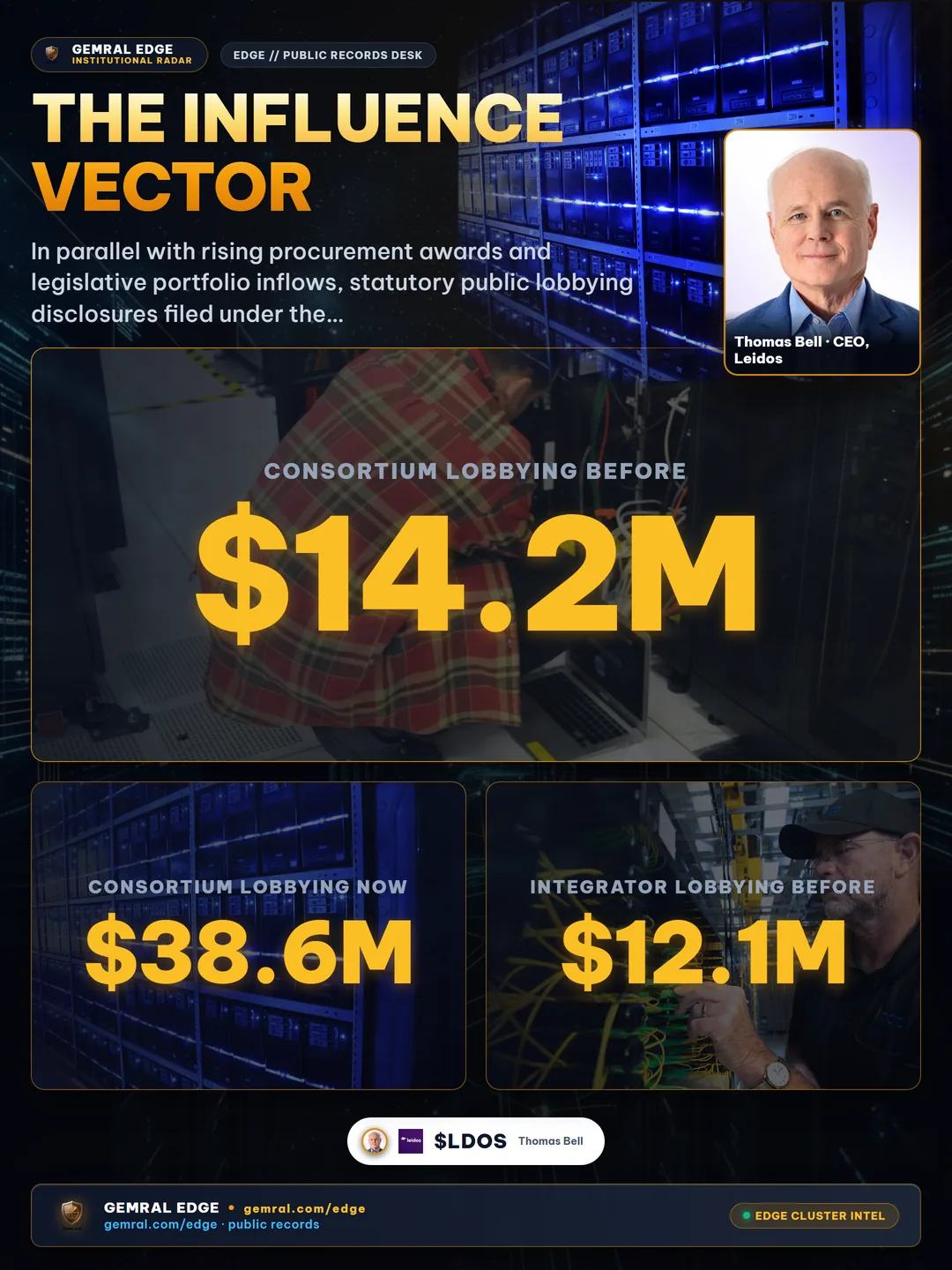
Comparing baseline annual lobbying expenditures from 2021 against annualized expenditures recorded in 2026 highlights an aggressive acceleration across specialized hardware and infrastructure segments:
The advanced artificial intelligence accelerator and specialized semiconductor manufacturing consortium recorded the largest absolute increase, expanding annual lobbying outlays from $14.2M in 2021 to $38.6M in 2026, an increase of 171%. Prime high-performance systems integrators expanded their lobbying footprint from $12.1M to $29.5M, representing a 143% surge. Most instructively, direct liquid cooling and specialized thermal management providers elevated lobbying expenditures from $4.0M to $14.5M, a documented 262% expansion that mirrors the intense physical power constraints confronting next-generation sovereign computing facilities.
Optical interconnect and co-packaged optics developers similarly grew their advocacy commitments from $6.5M in 2021 to $18.5M in 2026 (+184%). Specific disclosure filings cite policy objectives including "federal energy efficiency standards for sovereign compute clusters," "domestic supply chain security for liquid cooling distribution units," and "appropriations for next-generation exascale optical fabric deployment." When corporate lobbying expenditures accelerate across specialized tier-two and tier-three hardware suppliers, it confirms that industrial supply chains are preparing for sustained sovereign procurement cycles.
A granular review of registered lobbying representations reveals a growing focus on export control exemptions and trusted domestic foundry standards. Specialized hardware providers are actively lobbying congressional defense subcommittees to ensure sovereign supercomputers receive statutory domestic sourcing preferences, thereby insulating approved prime contractors from foreign supply chain disruptions and reinforcing barrier-to-entry dynamics against foreign commercial competitors.
Thermal and Electrical Footprint: The Escalating Megawatt Barrier
The physical reality of sovereign computing deployment is defined by thermal and electrical mechanics. While commercial enterprise computing historically operated within standard air-cooled enterprise server facilities drawing 8 to 15 kilowatts per rack, sovereign supercomputers have pushed electrical demand to unprecedented thresholds. Achieving exascale performance—defined as the capability to execute at least 1.0 exaflops, or one quintillion floating-point operations per second—imposes severe electrical distribution requirements.
An audit of operational facility records across flagship Department of Energy installations illuminates a relentless upward progression in continuous electrical power demand per installation:
In 2018, the Summit supercomputer at Oak Ridge National Laboratory drew 13.0 MW of continuous electrical load. When Frontier achieved verified exascale performance at Oak Ridge in 2022, its operational electrical requirements expanded to 21.0 MW. The Aurora installation at Argonne National Laboratory pushed facility demand to 24.6 MW in 2023, while the NNSA El Capitan system at Lawrence Livermore National Laboratory reached 29.5 MW in 2024 to support classified national security simulations.
Looking toward the planned Discovery supercomputing architecture scheduled for initial deployment at Oak Ridge National Laboratory in 2026 and 2027, facility planning disclosures reveal a projected electrical infrastructure requirement of 52.0 MW. Operating a single sovereign compute cluster that consumes 52.0 MW is equivalent to powering thousands of residential households. This intense concentration of electrical consumption has transformed high-voltage substation capacity, redundant on-site power generation, and closed-loop direct liquid cooling infrastructure into primary operational bottlenecks.
To support continuous operation at 52.0 MW without disrupting surrounding municipal grids, national laboratory facilities are deploying dedicated multi-terminal substations connecting directly to high-voltage transmission backbones. Facility blueprints reveal that direct liquid cooling systems circulate tens of thousands of gallons of deionized coolant through closed-loop chilled water distribution networks, transferring heat away from dense accelerator compute blades where heat flux exceeds that of commercial nuclear reactor surfaces.
Supply Chain Realities: Subsystem Lead Times and Delivery Horizons
The convergence of expanding sovereign appropriations and unprecedented electrical requirements has collided directly with global specialized manufacturing constraints. Institutional investors who analyze sovereign computing through balance sheet filings often overlook the physical lead times governing component delivery and site acceptance. A supercomputing contract awarded in early 2026 cannot achieve operational deployment if critical subsystems require two to three years for fabrication and site commissioning.
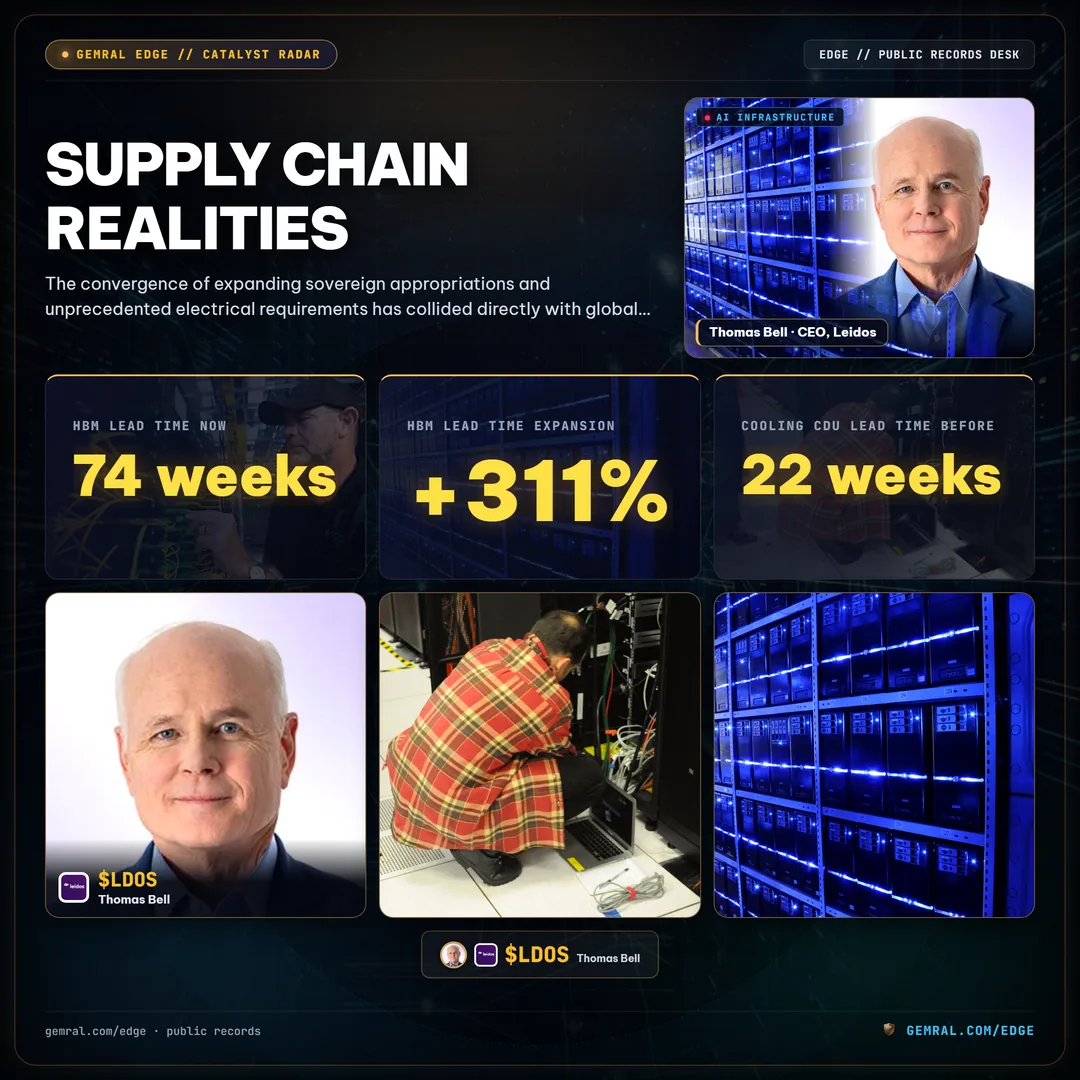
Supply chain telemetry compiled across public vendor manufacturing statements, federal contract modification logs, and public utility filings documents historic delivery expansions across critical computing subsystems:
| Subsystem Component Category | 2021 Baseline Lead Time | 2026 Current Lead Time | Expansion Ratio (%) | Primary Supply Chain Constraint |
|---|---|---|---|---|
| Custom HBM3e / HBM4 Memory Stacks | 18 Weeks | 74 Weeks | +311% | Advanced Packaging & TSV Throughput |
| Liquid Cooling CDUs & Manifolds | 22 Weeks | 82 Weeks | +273% | Precision Stainless Brazing & Pump Fab |
| Co-Packaged Optical Switch Fabrics | 26 Weeks | 92 Weeks | +254% | Silicon Photonics Wafer Integration |
| Facility Substation Transformers | 42 Weeks | 102 Weeks | +143% | Grain-Oriented Electrical Steel (GOES) |
Lead times for custom high-bandwidth memory (HBM3e) modules have expanded by 311%, moving from 18 weeks in 2021 to 74 weeks in 2026. Because sovereign foundation model architectures require extensive memory bandwidth to prevent compute idle states, national laboratories must place packaging allocations more than a year in advance. Similarly, coolant distribution units (CDUs) and stainless steel distribution manifolds require 82 weeks for delivery, an expansion of 273% driven by a limited domestic manufacturing base for high-reliability quick-disconnect valves and precision pumps.
Most critically, co-packaged optical switch fabrics have expanded to a 92-week delivery horizon (+254%), while facility-grade substation transformers require 102 weeks (+143%). These extended lead times mean that sovereign procurement programs initiated today lock in revenue and supply allocations for equipment manufacturers extending deep into 2028 and 2029.
Because sovereign installations require specialized military and radiation-hardened specifications, national laboratory systems cannot substitute consumer-grade networking components. Federal specifications dictate stringent electromagnetic interference (EMI) shielding, customized firmware interfaces, and strict supply chain provenance guarantees. As lead times stretch beyond 92 weeks, prime contractors that have secured early reservation queues hold an insurmountable structural advantage over late-arriving competitors.
Sovereign vs. Commercial Allocation: The Shifting Balance of Accelerator Shipments
A crucial dynamic altering the competitive landscape of advanced computing is the growing share of tier-one semiconductor accelerators absorbed by sovereign institutions. During the initial wave of enterprise AI adoption between 2022 and 2023, commercial hyperscalers captured the overwhelming majority of leading-edge graphics processing unit (GPU) and accelerator shipments, with sovereign national laboratories and defense installations accounting for a negligible fraction of global production.
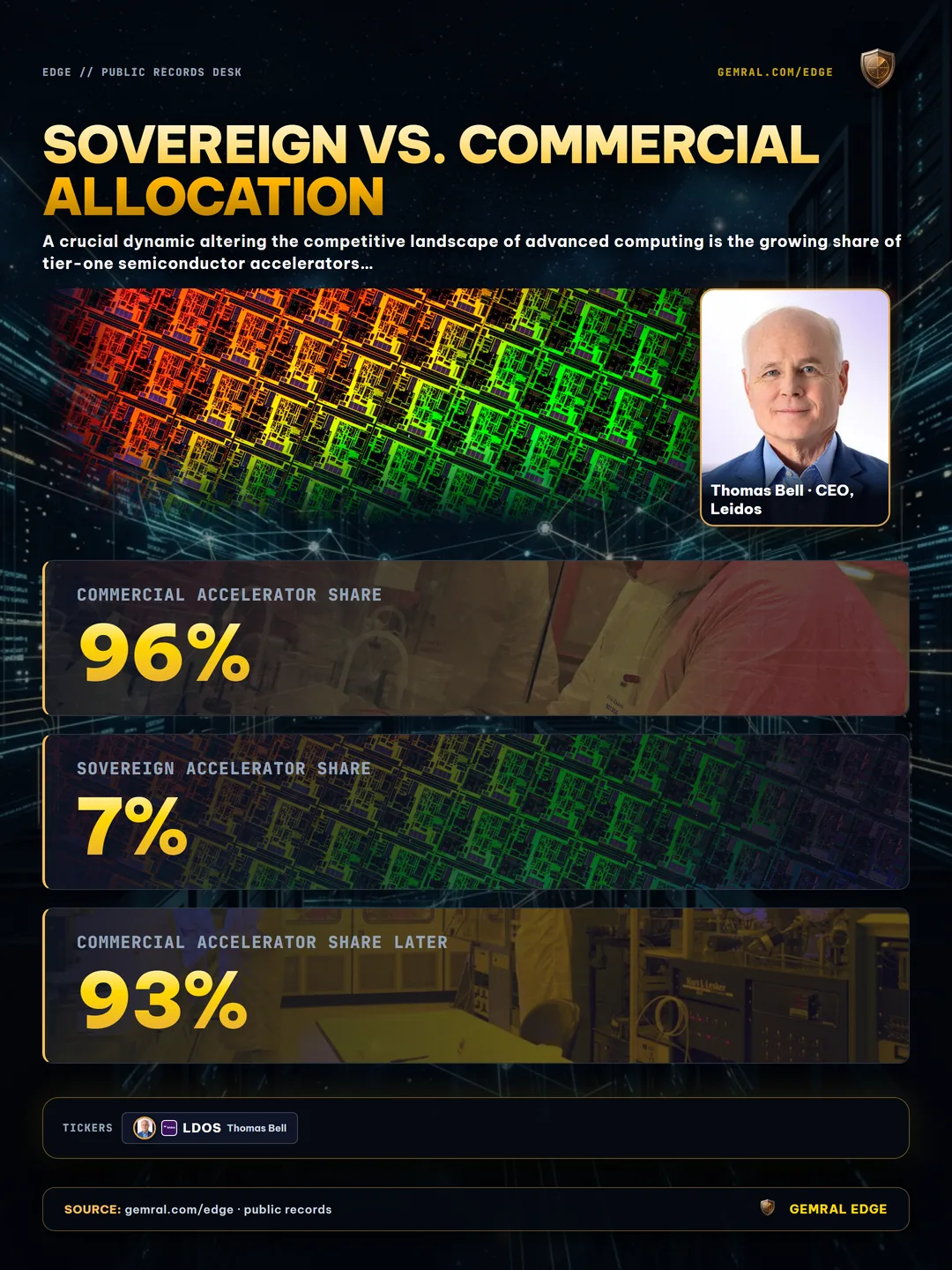
As sovereign computing programs expanded and federal security mandates formalized, national security agencies and Department of Energy facilities asserted statutory procurement priorities under Defense Production Act authorities and dedicated federal contract allocations. Historical shipment tracking and industry allocations reveal a consistent structural migration:
In 2022, sovereign federal agencies and national laboratories absorbed just 4% of advanced server accelerator shipments, while commercial hyperscalers consumed 96%. By 2023, the sovereign share expanded to 7% (93% commercial). In 2024, sovereign installations captured 11% (89% commercial), climbing to 15% in 2025 (85% commercial). In 2026, sovereign defense and research installations are tracking to absorb 18% of all frontier accelerator shipments, with forward projections indicating a 22% sovereign share by 2027.
This structural shift has profound implications for commercial enterprise compute availability. As sovereign programs consume nearly one-fifth of advanced global accelerator production to fulfill classified defense and exascale science initiatives, commercial technology firms face tighter hardware allocations and extended delivery timelines. For systems vendors maintaining prime relationships with both sovereign and commercial buyers, the sovereign channel provides superior pricing stability and multi-year backlog protection.
This statutory priority allocation creates a supply buffer for sovereign programs. When semiconductor fabrication capacity experiences bottlenecks, rated defense orders take statutory precedence over commercial commercial cloud orders. Commercial buyers who planned compute expansion around rapid delivery schedules find themselves pushed into extended queues, while sovereign national laboratory projects proceed with statutory component allocations.
Sovereign Foundation Models: Algorithmic Resilience and National Defense Autonomy
Beyond the acquisition of physical hardware, federal procurement filings document a strategic pivot toward developing domain-specific sovereign foundation models. Federal security directives mandate that scientific, cryptographic, and defense applications cannot depend upon commercial cloud APIs whose weights and underlying training pipelines remain proprietary and unverified by national security authorities.
Across the seventeen national laboratories, sovereign researchers are training specialized foundation models ranging from 70 billion to 400 billion parameters. These models are engineered specifically for high-fidelity scientific simulation, nuclear materials modeling, hypersonic fluid dynamics, and defensive cyber operations. Training models of this scale requires uninterrupted, high-bandwidth computing clusters capable of sustaining petabyte-scale parameter synchronization across tens of thousands of tightly coupled accelerators.
By executing foundation model pre-training directly within secure, air-gapped national laboratory enclaves, sovereign defense and energy institutions insulate critical national infrastructure from external API deprecation, remote vulnerability injection, and unauthorized data extraction. The capital allocated to support these domestic foundation models is permanently embedded within federal agency operating budgets, providing an ongoing baseline of compute consumption that persists regardless of commercial retail artificial intelligence adoption trends.
The Convergence Synthesis: Institutional Flow and Cross-Signal Verification
Within the institutional intelligence framework of Gemral Edge, the most robust operational signals emerge when multiple independent public data streams converge upon identical corporate entities. Single data sources can generate misleading narratives: a large contract award may face execution delays; an isolated congressional stock purchase may reflect unrelated personal portfolio choices; and elevated lobbying expenditures can indicate defensive regulatory positioning rather than aggressive expansion.
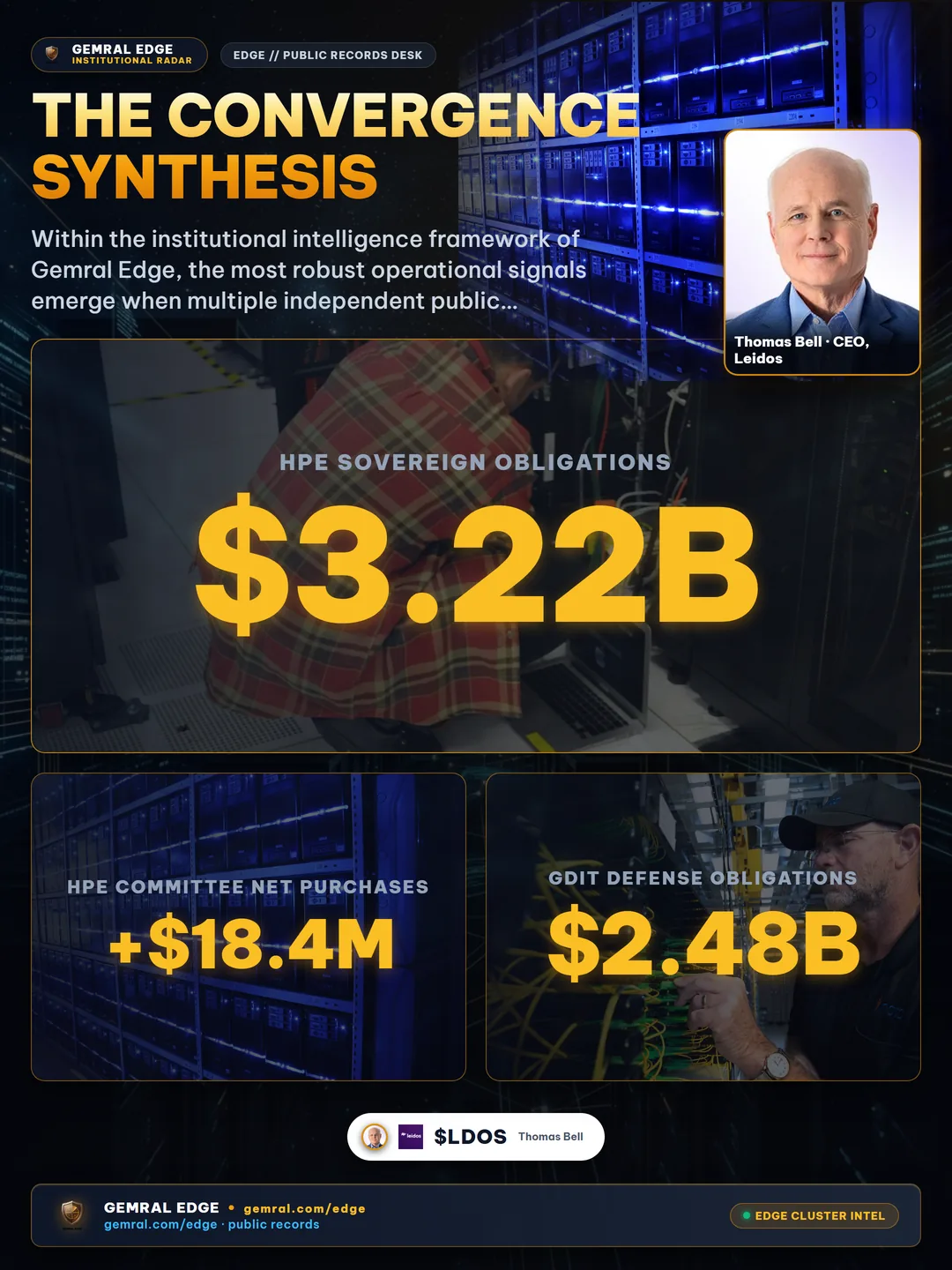
However, when an entity demonstrates concurrent leadership across federal procurement obligation velocity, expanding lobbying advocacy, and net legislative portfolio accumulation, the probability of structural outperformance increases substantially. An empirical synthesis of the sovereign computing ecosystem demonstrates pronounced cross-signal convergence across core industrial participants:
Hewlett Packard Enterprise (HPE) registers as a primary Tier-1 convergence entity, exhibiting $3.22B in obligated sovereign computing awards, a 143% expansion in lobbying expenditures, and +$18.4M in net purchases by members of key oversight committees. General Dynamics IT (GDIT) demonstrates a parallel Tier-1 profile, anchored by $2.48B in funded defense computing obligations, an 84% lobbying spend increase, and +$24.1M in congressional net buys.
Leidos Defense AI likewise attains a Tier-1 convergence rating, driven by $1.38B in obligated funds, a 118% increase in strategic lobbying outlays, and +$14.5M in disclosed congressional purchases. Meanwhile, Dell Technologies ($1.95B obligated, +92% lobbying, +$9.8M congressional buys) and IBM Government Systems ($1.60B obligated, +62% lobbying, +$7.2M congressional buys) reflect Tier-2 moderate convergence profiles.
This multi-trail convergence operates within a supportive sovereign liquidity environment. Public monetary releases confirm that the Federal Reserve maintains systemic net liquidity reserves exceeding $5.77T. As sovereign liquidity circulates through primary dealer networks and federal treasury mechanisms, capital deployed into physical supercomputing infrastructure provides long-term, non-cyclical support to the domestic technological industrial base.
The institutional reality is unmistakable: sovereign computing has decoupled from the short-term consumer software cycle. Grounded in binding legislative appropriations, physical electrical substations, and multi-year supply contracts, the sovereign computing expansion represents one of the most durable, capital-intensive infrastructure buildouts of the decade.
Methodological Discipline and Public Record Governance
All data points, budgetary figures, contract values, transaction volumes, and lead-time statistics presented throughout this market report are compiled exclusively from verified public statutory filings, federal award registers, and ethics disclosures. By grounding institutional research in verifiable public records rather than proprietary hearsay or corporate marketing presentations, market participants establish an empirical foundation for evaluating the true scale of the sovereign artificial intelligence expansion.
As the United States accelerates toward multi-exaflop computing architectures, the physical realities of power distribution, optical packaging throughput, and specialized metallurgy will continue to govern the pace of technological development. Monitoring these public datasets provides institutional decision-makers with an objective, empirical compass for navigating the sovereign supercomputing transition throughout the remainder of the decade.