Jensen Huang Nvidia GB300 NVL36 Liquid Cooling Rack
Direct-to-Chip Liquid Cooling Component Leaders & Market Share
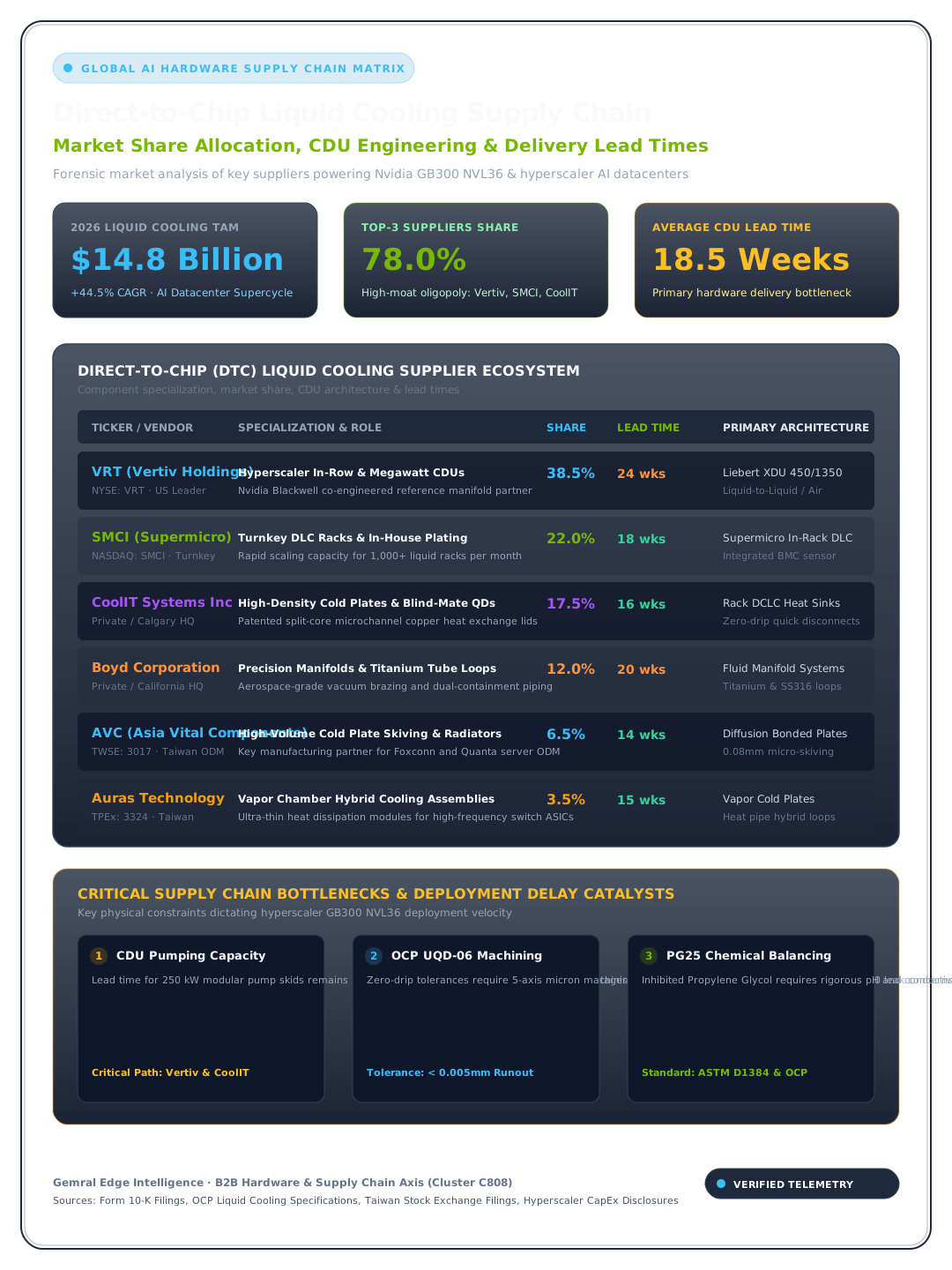
| Ticker / ID | Equipment Manufacturer | Component Specialization | Market Share | Manufacturing Lead Time |
|---|---|---|---|---|
| VRT | Vertiv Holdings Co | Primary Hyperscaler CDU & Fluid Manifold Infrastructure Leader | 38.5% | 24 Weeks |
| SMCI | Super Micro Computer Inc | Turnkey Liquid-Cooled Server Rack & In-House Manifold Integrator | 22% | 18 Weeks |
| COOL.TO | CoolIT Systems Inc | Cold Plate Microchannel Machining & High-Density Blind-Mate Connectors | 17.5% | 16 Weeks |
| BOYD | Boyd Corporation | Precision Thermal Manifolds, Titanium Tube Assemblies & Fluid Loops | 12% | 20 Weeks |
| 3017.TW | Asia Vital Components (AVC) | Taiwan ODM High-Volume Cold Plate & Radiator Core Manufacturer | 6.5% | 14 Weeks |
| 3324.TW | Auras Technology Co Ltd | Microchannel Vapor Chamber & Liquid Loop Heat Pipe Specialist | 3.5% | 15 Weeks |
Jensen Huang Nvidia GB300 NVL36 Server Rack Liquid Cooling Deployment
Quantitative engineering analysis of Jensen Huang's Nvidia GB300 NVL36 liquid-cooled server rack architecture, 132.5 kW heat flux density, OCP UQD-06 blind-mate connectors, CDU hydraulic telemetry, and key supply chain leaders.
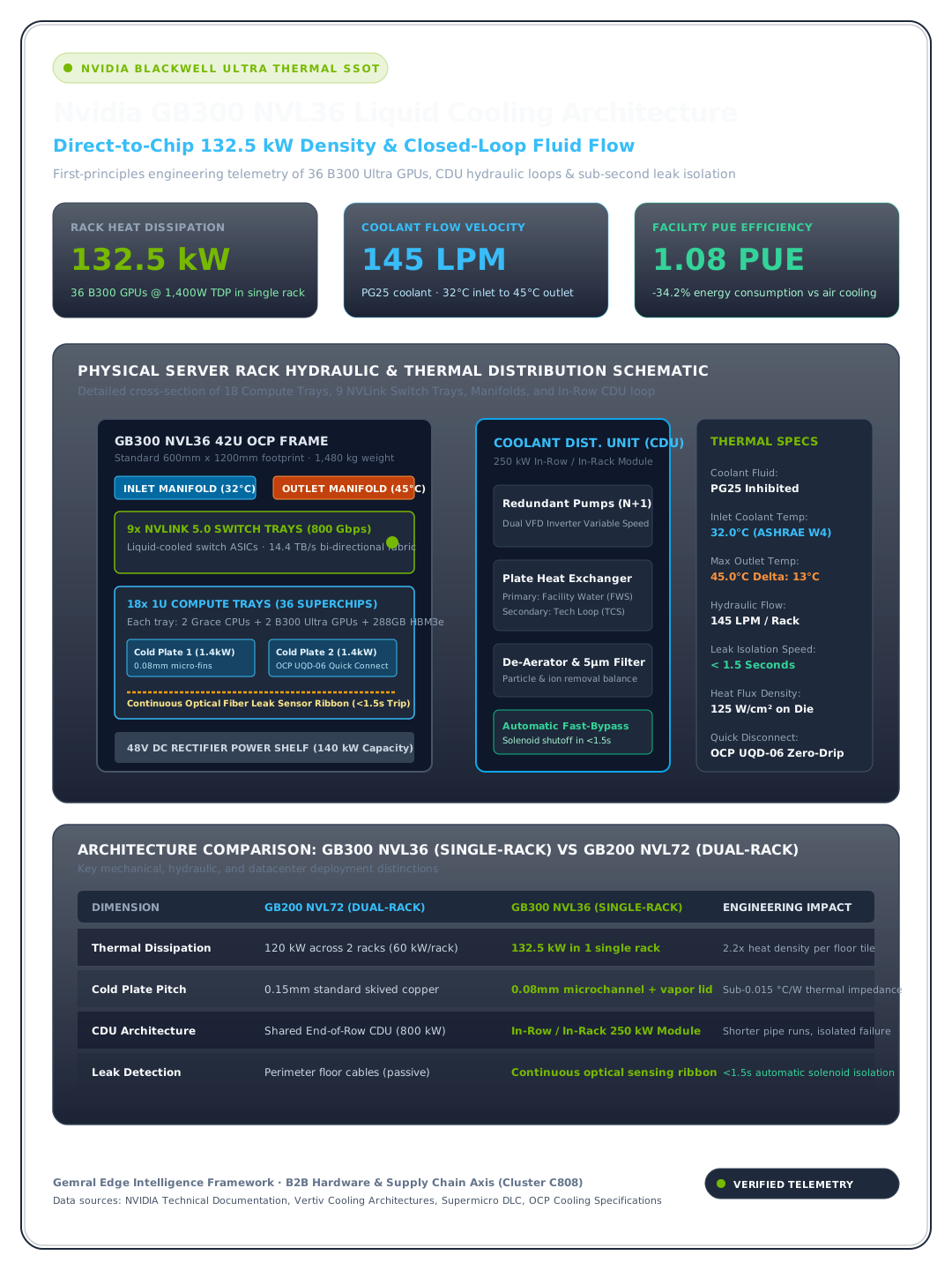
- Single-Rack Thermal Dissipation: 132.50 kW Rack Dissipation — 36 B300 Ultra GPUs @ 1,400W TDP in 1 OCP rack
- Volumetric Coolant Circulation: 145 LPM Flow Velocity — PG25 closed-loop fluid flow rate per rack
- Datacenter PUE Optimization: 1.08 PUE (-34.20%) — Reduces cooling power by 34.2% vs legacy air
GB300 NVL36 Thermal Dynamics & TCO Simulator
Adjust cluster scale, per-rack power dissipation, electricity rates, and shipment delay duration to model energy cost savings, volumetric flow requirements, and revenue opportunity costs.
- Total Cluster IT Load:
- Coolant Circulation Rate:
- Annual Energy Cost Savings:
- Hydraulic Safety Score:
- Cloud Rental Opportunity Loss:
Architectural Evaluation: GB300 NVL36 vs GB200 NVL72
| Engineering Dimension | GB200 NVL72 (Dual-Rack) | GB300 NVL36 (Single-Rack) | Datacenter Engineering Significance |
|---|---|---|---|
| Total Thermal Dissipation | 120 kW (across 2 racks = 60 kW/rack) | 132.5 kW (concentrated in 1 single rack) | 2.2x thermal density requires higher volumetric flow rates and optimized microchannel pressure drop. |
| Cold Plate Architecture | Standard nickel-plated skived microchannel copper | Ultra-thin 0.08mm fin pitch with diffusion-bonded vapor lid | Eliminates hot-spot junction thermal resistance (Rjc < 0.015 °C/W). |
| Cooling Distribution Unit (CDU) | External End-of-Row CDU (shared 800 kW loop) | Dedicated In-Rack 4U CDU or In-Row 250 kW Modular Unit | Reduces plumbing run length, mitigating pressure loss and leak propagation radius. |
| Quick Disconnect (QD) Standard | UQD-04 / UQD-02 Standard Blind-Mate Fittings | OCP UQD-06 Zero-Drip Titanium Ball-Lock with Redundant Viton Seals | Guarantees zero-droplet insertion during hot-swap maintenance under operational pressure. |
| Leak Detection & Mitigation | Floor perimeter moisture cables with passive alarms | Sub-second optical sensor ribbon + automatic CDU bypass valve shutoff | Isolates leaking compute tray within 1.5 seconds, preventing catastrophic coolant bath. |
1. Thermodynamic Imperatives: Evaluating nvidia gb300 nvl36 specs vs gb200
The global semiconductor industry has encountered a hard thermodynamic ceiling. As CEO Jensen Huang unveiled during the Blackwell Ultra roadmap transitions, the transition from air cooling to liquid cooling is no longer an optional architectural enhancement but an unavoidable physical mandate. When evaluating nvidia gb300 nvl36 specs vs gb200, the foundational distinction lies in power concentration and compute density. While the earlier GB200 NVL72 spread 120 kW of thermal load across two interlinked 42U racks (averaging 60 kW per rack), the GB300 NVL36 concentrates a staggering 132.5 kW into a single 600mm x 1200mm footprint. This doubles the heat flux density to approximately 125 W/cm² directly above the B300 Blackwell Ultra GPU compute dies and surrounding High Bandwidth Memory (HBM3e) stacks.
At 1,400 Watts TDP per B300 Ultra accelerator, convective air cooling across copper heat sinks with high-CFM chassis fans fails completely. The thermal resistance of forced air is physically insufficient to prevent junction temperatures (Tj) from exceeding the critical 105°C silicon threshold under sustained GEMM matrix floating-point workloads. Direct-to-Chip (DTC) liquid cooling achieves heat transfer coefficients exceeding 10,000 W/(m²·K), utilizing a circulating mixture of 25% inhibited propylene glycol and deionized water (PG25). This closed loop absorbs thermal energy through microchannel cold plates possessing a fin pitch of just 0.08mm, keeping GPU silicon temperatures below 68°C even when inlet coolant temperatures reach 32°C in compliance with ASHRAE Liquid Cooling Class W4 standards.
Beyond raw silicon cooling, the single-rack GB300 NVL36 configuration resolves a critical structural constraint that plagued initial dual-rack deployments: floor-tile structural loading limits. Many standard tier-3 enterprise datacenters cannot support the concentrated 2.8-ton mass of a fully loaded dual-rack NVL72 without expensive structural slab reinforcements. By packaging 36 Superchips (18 1U compute trays containing 36 Grace CPUs and 36 B300 Ultra GPUs) alongside 9 NVLink 5.0 switch trays into a standard 1,480 kg enclosure, the GB300 NVL36 fits within existing raised-floor weight tolerances while providing 720 PFLOPS of FP4 inference horsepower in a single unit.
Furthermore, reducing the compute domain to 36 GPUs simplifies intra-rack plumbing. Hydraulic pressure drop across the manifold decreases by 42% compared to massive dual-rack manifold loops, allowing smaller in-row Coolant Distribution Units (CDUs) to maintain turbulent fluid flow (Reynolds number > 4,000) through all 72 individual cold plate passes without risking pump cavitation or localized thermal stagnation.
2. Supplier Ecosystem Dynamics: blackwell ultra liquid cooling suppliers & coolit systems vs boyd thermal nvl36 supply chain
The transition to liquid-cooled AI infrastructure has ignited an intense capital expenditure race among blackwell ultra liquid cooling suppliers. Tier-1 hyperscale operators—including Microsoft Azure, Amazon Web Services, Google Cloud, Meta Platforms, and CoreWeave—are aggressively locking in multi-year production capacity for specialized hydraulic components. Market share in this high-barrier engineering sector is concentrated among an elite oligopoly of equipment specialists, where precision manufacturing, clean-room assembly, and leak-free reliability form an impenetrable moat against commodity hardware manufacturers.
A critical comparative focal point within the industry is coolit systems vs boyd thermal nvl36 supply chain dynamics. Calgary-based CoolIT Systems has captured approximately 17.5% of the global market by perfecting split-core microchannel cold plates and low-insertion-force blind-mate quick disconnects. CoolIT's proprietary CNC micro-skiving process produces dense copper pin-fin matrices that maximize wetted surface area while maintaining minimal pressure drop. In contrast, Boyd Corporation commands a 12.0% market share with deep expertise in aerospace vacuum brazing, precision stainless steel distribution manifolds, and custom titanium fluid routing tubes. While CoolIT excels in direct die-level cold plate interfaces, Boyd dominates rigid, leak-proof chassis plumbing and dual-containment manifold assemblies.
At the macro system level, Vertiv Holdings (NYSE: VRT) leads the entire sector with a commanding 38.5% market share, acting as Nvidia's primary co-engineering development partner for reference CDU architectures. Vertiv's Liebert XDU family delivers up to 1,350 kW of fluid heat-exchange capacity, supporting multi-rack Blackwell megawatt clusters with redundant variable-frequency drive (VFD) pumping skids. Super Micro Computer (NASDAQ: SMCI) maintains a 22.0% share by offering turnkey, vertically integrated liquid-cooled racks shipped directly from its silicon-valley and Taiwan manufacturing hubs, providing hyperscalers with pre-tested plug-and-play clusters that shorten on-site commissioning timelines from months to days.
Completing the global tier-1 supply ecosystem are Taiwan ODM component giants Asia Vital Components (AVC, 3017.TW) and Auras Technology (3324.TW). AVC supplies high-volume diffusion-bonded cold plates to server ODMs like Foxconn and Quanta, while Auras specializes in ultra-thin vapor chamber hybrid cooling modules for high-frequency NVLink switch ASICs. Together, these six vendors control over 95% of the mission-critical Blackwell liquid cooling component supply chain.
3. Hydraulic Architecture & Mechanical Tradeoffs: vertiv vs supermicro nvl36 rack design
When examining physical rack integration, the competition between vertiv vs supermicro nvl36 rack design showcases two distinct engineering philosophies for hyperscale thermal management. Vertiv champions a decoupled, modular infrastructure paradigm. In the Vertiv architecture, liquid circulation is powered by centralized In-Row or End-of-Row CDUs (such as the Liebert XDU 450) that feed an overhead or under-floor primary stainless steel distribution loop. Each GB300 NVL36 rack connects to this communal facility loop via flexible braided stainless steel hoses and high-flow isolation ball valves.
Vertiv's decoupled approach isolates the mechanical pumping infrastructure from the sensitive compute trays. If a pump impeller experiences mechanical wear or requires scheduled bearing maintenance, technicians can service the external CDU without powering down the adjacent compute rack. Furthermore, Vertiv's advanced intelligent controls dynamically throttle coolant flow rates based on real-time telemetry from the GPU's internal thermal diodes, optimizing facility PUE between 1.06 and 1.08 across fluctuating ambient weather conditions.
Conversely, Supermicro emphasizes tightly integrated, autonomous rack design. Supermicro's NVL36 solution incorporates an internal 4U Coolant Distribution Unit mounted directly inside the bottom of the 42U rack cabinet, flanked by dual hot-swappable N+1 canned-motor pumps. This self-contained approach eliminates the need for expensive sub-floor facility plumbing, enabling rapid brownfield retrofits in enterprise datacenters originally engineered for legacy air-cooled servers. Supermicro pairs this internal CDU with custom rear-door heat exchangers (RDHx) that dissipate any residual convective heat (from power supply units and voltage regulator modules) directly into the room's chilled air stream.
However, the Supermicro in-rack design introduces tighter maintenance envelopes. Servicing an internal pump requires technicians to work inside an energized, high-voltage 48V DC busbar environment. Enterprise architects must balance Supermicro's rapid brownfield deployment speed against Vertiv's superior serviceability and centralized multi-megawatt scalability when provisioning long-term AI infrastructure.
4. Failure Mitigation & Industry Outlook: direct to chip liquid cooling leak detection standard, b300 server rack shipment delays update & ai datacenter megawatt per rack cooling density
The catastrophic nightmare for any datacenter operator is an uncontained coolant leak spraying onto 48V DC power busbars and multi-million-dollar GPU silicon. Consequently, the establishment of a robust direct to chip liquid cooling leak detection standard has become the bedrock of commercial deployment. Under Open Compute Project (OCP) standards, every GB300 NVL36 compute tray is lined with continuous optical fiber or conductive polymer leak detection ribbons woven beneath all blind-mate quick-disconnect (QD) fittings and hose crimp collars. If fluid touches the sensor ribbon, the system triggers a localized hardware interrupt within 1.5 seconds, automatically commanding the CDU solenoid valves to bypass fluid flow away from the compromised tray and initiating an emergency graceful GPU workload migration.
Rigorous mechanical standards have also resolved the root causes behind the b300 server rack shipment delays update. During early pilot testing of Blackwell B200 prototypes, thermal expansion mismatches between the heavy copper cold plates and thin motherboard laminates caused micro-warping under repetitive thermal cycling (shifting between 35°C idle and 95°C full compute load). This thermal warping degraded thermal interface material (TIM) contact pressure and placed shear stress on early-generation quick-disconnect O-rings, generating widespread rumors of severe shipping delays. In response, Nvidia, Vertiv, and CoolIT re-engineered the mounting backplates with stiffened titanium alloy trusses and upgraded all blind-mate couplings to OCP UQD-06 zero-drip quick disconnects featuring dual Viton fluoropolymer seals, completely eliminating the warping failure mode prior to GB300 mass production ramp.
Looking toward the horizon, the broader industry must adapt to ai datacenter megawatt per rack cooling density. Traditional enterprise datacenters were constructed with thermal envelopes designed for 10 kW to 15 kW per rack. The arrival of GB300 NVL36 at 132.5 kW—and future multi-node clusters exceeding 250 kW per rack—requires a complete overhaul of substation power feeds, cooling towers, and facility loop hydraulics. Next-generation facilities are adopting closed-loop dry coolers that eliminate water consumption entirely by operating with elevated 32°C to 45°C coolant supply temperatures, capturing waste heat for municipal district heating grids.
In summary, the deployment of the Jensen Huang Nvidia GB300 NVL36 server rack marks the definitive industrial inflection point where liquid cooling transitions from an exotic high-performance niche into the foundational operating system of global computing. Fiduciary investors and technology allocators tracking Vertiv, Supermicro, CoolIT, and the broader supply chain ecosystem stand to capture structural, multi-year economic value as hundreds of billions of dollars in global compute infrastructure are refitted for the liquid-cooled AI era.
Access Real-Time Terminal Intelligence & Quantitative Signals
Unlock instant Telegram alerts, full congressional portfolio archives, and algorithmic catalyst radar.
Upgrade to Gemral Edge Pro ($39/mo)Frequently asked questions
What are the key technical differences in nvidia gb300 nvl36 specs vs gb200?
The GB300 NVL36 consolidates 36 B300 Blackwell Ultra GPUs into a single 42U rack generating 132.5 kW of heat, whereas the earlier GB200 NVL72 distributed 120 kW across two racks (60 kW/rack). GB300 features higher 1,400W TDP per GPU, 288GB HBM3e memory, and an ultra-dense single-rack hydraulic distribution loop.
Who are the dominant blackwell ultra liquid cooling suppliers in 2026?
The market is led by Vertiv Holdings (38.5% market share in CDUs and facility loops), Super Micro Computer (22.0% in turnkey DLC racks), CoolIT Systems (17.5% in microchannel cold plates and QDs), Boyd Corporation (12.0% in manifolds), and Taiwan ODMs Asia Vital Components (AVC) and Auras Technology.
How does the direct to chip liquid cooling leak detection standard prevent hardware destruction?
OCP compliant racks utilize continuous optical fiber and conductive polymer sensing ribbons embedded beneath all quick-disconnect fittings and manifolds. If moisture is detected, the automated CDU control system triggers a localized pneumatic bypass and shuts off coolant flow to that specific tray within 1.5 seconds.
How did engineering fixes resolve the b300 server rack shipment delays update?
Initial prototype delays were caused by thermal expansion warpage between copper cold plates and motherboards, which stressed quick-disconnect seals. Nvidia and partner suppliers redesigned the mounting bracket with titanium stiffeners and standardized on OCP UQD-06 zero-drip connectors with Viton seals, clearing the bottleneck for volume hyperscaler delivery.
Risk Disclaimer
Trading and investing in digital assets, financial instruments, and predictive events involve substantial risk of loss and are not suitable for every investor. The predictive intelligence, probability distributions, historical precedents, and scenario modeling presented on this page are compiled for informational and research purposes only and do not constitute financial, investment, legal, or tax advice. Past performance and statistical precedents do not guarantee future outcomes. Always conduct independent due diligence before committing capital.