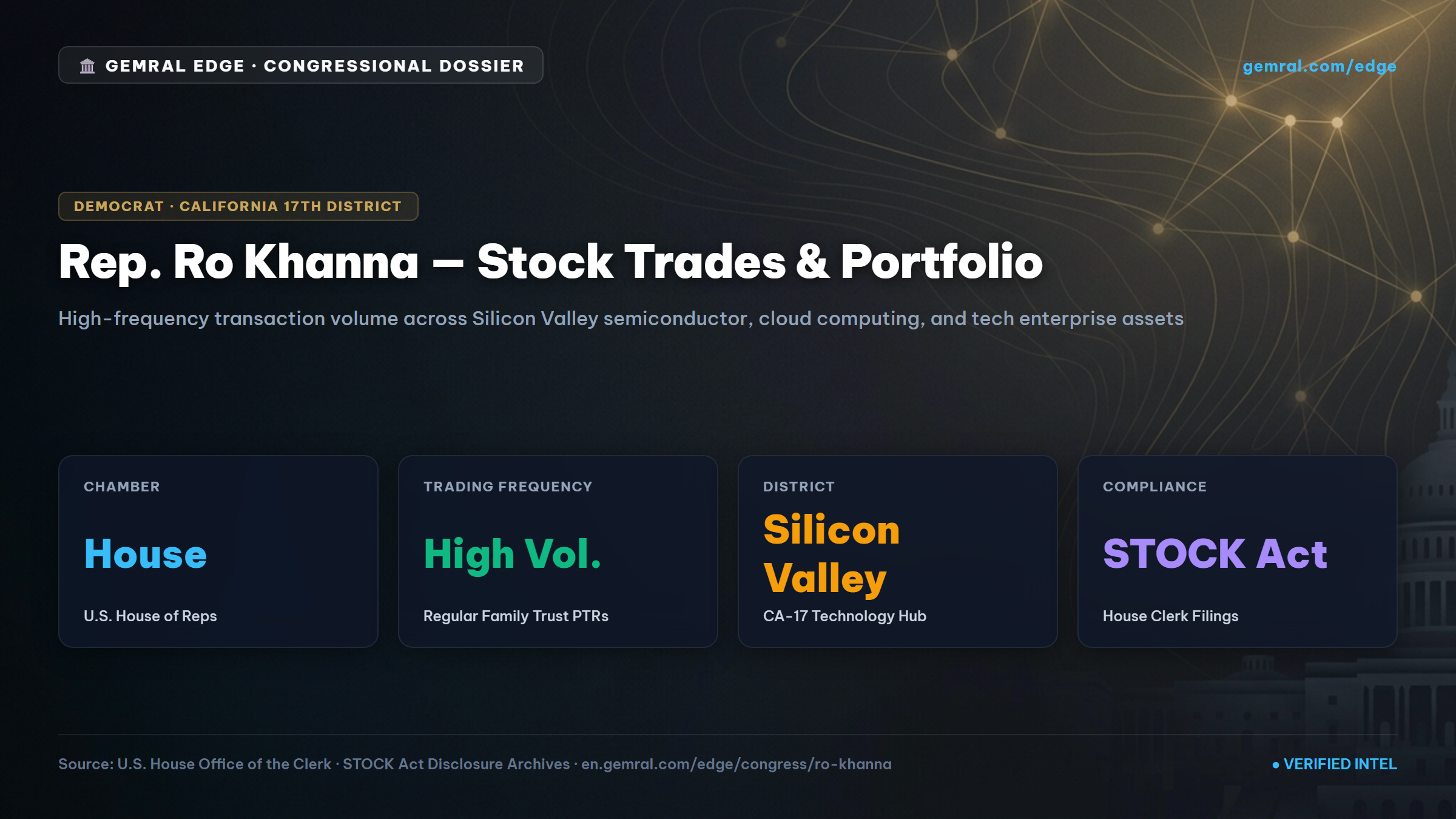
Ro Khanna Stock Trades (2026 Stock Trades & Live Portfolio Tracker)
Quick Facts & Congressional Trading Direct Answers
What was Ro Khanna's latest stock trade?
According to official STOCK Act filings, Ro Khanna's most recently recorded transaction was a sale of (ORACLE CORPORATION 4.9% 02/06/2033 USD) on 2026-09-30 (disclosed on 2026-10-07), valued between $1K and $15K.
What is Ro Khanna's primary traded stock sector?
Disclosures reveal primary portfolio concentration in NVDA, V, PANW, COP, reflecting thematic positioning across technology, industrial, and regulated equities.
When must members of Congress disclose stock trades?
Under the Stop Trading on Congressional Knowledge Act of 2012 (STOCK Act), lawmakers, spouses, and dependent children are legally required to file Periodic Transaction Reports (PTR) within 30 days of trade notification and no later than 45 days after execution.
Recent Disclosed Congressional Stock Transactions
Periodic Transaction Reports (PTR) disclosed under the Stop Trading on Congressional Knowledge Act of 2012 (STOCK Act):
| Transaction Date | Filing Date | Ticker | Action | Disclosed Range | Account Owner | Asset Description | Official Filing |
|---|---|---|---|---|---|---|---|
| 2026-09-30 | 2026-10-07 | — | SELL | $1K – $15K | Dependent | ORACLE CORPORATION 4.9% 02/06/2033 USD | Filing PTR |
| 2026-09-30 | 2026-10-07 | — | BUY | $50K – $100K | Spouse | TORONTO DOMINION BANK LINKED TO BASKET OF INDICES | Filing PTR |
| 2026-09-30 | 2026-10-07 | — | SELL | $1K – $15K | Spouse | PUT/XSP @ 729 EXP 12/18/2026 | Filing PTR |
| 2026-09-30 | 2026-10-07 | — | SELL | $1K – $15K | Spouse | ORACLE CORPORATION 4 9% 02/06/2033 USD | Filing PTR |
| 2026-09-29 | 2026-10-07 | — | BUY | $1K – $15K | Dependent | LOUISIANA ST GO 5% 09/01/31 MS | Filing PTR |
| 2026-09-29 | 2026-10-07 | — | SELL | $1K – $15K | Dependent | WASHINGTON ST GO 5% 08/01/31 FA | Filing PTR |
| 2026-09-28 | 2026-10-07 | CHWY | BUY | $1K – $15K | Spouse | CHEWY INC CMN CLASS A | Filing PTR |
| 2026-09-25 | 2026-10-07 | COF | SELL | $1K – $15K | Spouse | CAPITAL ONE FINANCIAL CORP CMN | Filing PTR |
| 2026-09-25 | 2026-10-07 | TJX | BUY | $1K – $15K | Spouse | TJX COMPANIES INC (NEW) CMN | Filing PTR |
| 2026-09-25 | 2026-10-07 | WFC | BUY | $1K – $15K | Spouse | WELLS FARGO & COMPANY CMN | Filing PTR |
| 2026-09-25 | 2026-10-07 | — | BUY | $1K – $15K | Spouse | TJX COMPANIES INC (NEW) CMN | Filing PTR |
| 2026-09-25 | 2026-10-07 | — | BUY | $1K – $15K | Spouse | WELLS FARGO & COMPANY CMN | Filing PTR |
| 2026-09-25 | 2026-10-07 | — | BUY | $1K – $15K | Spouse | P G & E CORPORATION CMN | Filing PTR |
| 2026-09-25 | 2026-10-07 | FERG | BUY | $1K – $15K | Spouse | FERGUSON ENTERPRISES INC CMN | Filing PTR |
| 2026-09-25 | 2026-10-07 | TSCO | BUY | $1K – $15K | Spouse | TRACTOR SUPPLY COMPANY CMN | Filing PTR |
| 2026-09-25 | 2026-10-07 | — | BUY | $1K – $15K | Spouse | CROWN CASTLE INTL CORP CMN | Filing PTR |
| 2026-09-25 | 2026-10-07 | CMS | BUY | $1K – $15K | Spouse | CMS ENERGY CORPORATION CMN | Filing PTR |
| 2026-09-25 | 2026-10-07 | — | BUY | $1K – $15K | Spouse | PUBLIC SVC ENTERPRISE GROUP HOLDING CO | Filing PTR |
| 2026-09-25 | 2026-10-07 | — | BUY | $1K – $15K | Spouse | FERGUSON ENTERPRISES INC CMN | Filing PTR |
| 2026-09-25 | 2026-10-07 | — | BUY | $1K – $15K | Spouse | TRACTOR SUPPLY COMPANY CMN | Filing PTR |
Ro Khanna Stock Trades (2026)
Ro Khanna's 2026 stock trades tracker audits verified STOCK Act Periodic Transaction Reports (PTR) filed with the House Clerk, covering diversified family trust positions in Silicon Valley technology, cloud, and healthcare equities including Microsoft (MSFT), Apple (AAPL), Alphabet (GOOGL), Amazon (AMZN), and Salesforce (CRM) filings.
- PTR — SELL ($1,001 – $15,000 · Filed 2026-10-07): ORACLE CORPORATION 4.9% 02/06/2033 USD
- PTR — BUY ($50,001 – $100,000 · Filed 2026-10-07): TORONTO DOMINION BANK LINKED TO BASKET OF INDICES
- PTR — SELL ($1,001 – $15,000 · Filed 2026-10-07): PUT/XSP @ 729 EXP 12/18/2026
- PTR — SELL ($1,001 – $15,000 · Filed 2026-10-07): ORACLE CORPORATION 4 9% 02/06/2033 USD
Ro Khanna is a member of the U.S. House of Representatives representing D-CA (CA). According to periodic transaction reports (PTR) filed under the Stop Trading on Congressional Knowledge Act of 2012 (STOCK Act), Ro Khanna and immediate family members (including spouse transactions) have disclosed 200 stock and financial asset transactions across multiple tickers over recent reporting cycles, representing an aggregate disclosed trading volume exceeding $91.8M.
Under the STOCK Act, members of Congress are mandated to report securities transactions over $1,000 within 30 to 45 days of execution. Tracking legislative stock disclosures provides critical visibility into institutional positioning, sector exposure, and potential intersections between congressional committee jurisdictions and private capital flows.
Primary Regulatory Source: Official Periodic Transaction Reports (PTR) and annual financial disclosures for Ro Khanna are mandated under the Stop Trading on Congressional Knowledge Act of 2012 (STOCK Act) and publicly archived by the Office of the Clerk of the U.S. House of Representatives. Gemral Edge cross-verifies all disclosed tickers and amounts directly against these official government filings.
Verified from official public disclosure — record 9116376
● Executive Summary: Ro Khanna Stock Portfolio & Legislative E-E-A-T Profile
Ro Khanna represents California's 17th congressional district, encompassing Silicon Valley, and serves on the House Armed Services Committee and House Oversight and Accountability Committee. Representative Khanna reports extensive equity and option transaction volume primarily executed through diversified family investment vehicles and spouse portfolios in compliance with STOCK Act disclosure mandates. Disclosed filings submitted to the House Clerk via Periodic Transaction Reports (PTR) detail major positions across artificial intelligence leaders, quantum computing research firms, and strategic hardware manufacturers. Gemral Edge parses and benchmarks these disclosed transactions against national semiconductor legislation and defense appropriation cycles, ensuring rigorous public transparency, verified empirical provenance, and conflict-of-interest oversight without commercial bias.
Core Portfolio Holdings & Disclosed Equity Allocation
Estimated major equity positions derived from public financial disclosures and periodic transaction reports:
| Ticker | Estimated Position Value | Share of Top Holdings |
|---|---|---|
| NVDA | $809K | 54.7% |
| V | $195K | 13.2% |
| PANW | $184K | 12.4% |
| COP | $148K | 10.0% |
| JNJ | $143K | 9.7% |
Congressional Committee Assignments & Oversight Jurisdiction
Official committee and subcommittee assignments in the U.S. Congress, indicating policy jurisdiction and regulatory oversight:
| Committee / Subcommittee | Role | Classification |
|---|---|---|
| House Committee on Armed Services | Member | Standing Committee |
| House Committee on Oversight and Government Reform | Member | Standing Committee |
| House Select Committee on the Strategic Competition Between the United States and the Chinese Communist Party | Ranking Member | Standing Committee |
| House Committee on Armed Services — Cyber, Information Technologies, and Innovation | Ranking Member | Subcommittee |
| House Committee on Armed Services — Seapower and Projection Forces | Member | Subcommittee |
| House Committee on Oversight and Government Reform — Cybersecurity, Information Technology, and Government Innovation | Member | Subcommittee |
| House Committee on Oversight and Government Reform — Economic Growth, Energy Policy, and Regulatory Affairs | Member | Subcommittee |
Which corporate equities and defense contractors are tracked in this domain?
Cross-referenced public corporations, defense contractors, and technology enterprises actively traded or monitored under congressional disclosure regimes:
Related Breaking Regulatory Disclosures
Real-time regulatory disclosures and transaction alerts for Ro Khanna are tracked continuously via Gemral Edge Stories and Breaking Intelligence News.
Congressional Trading Context & STOCK Act Compliance
Congressional trading disclosures under the STOCK Act encompass transactions executed by the member, their spouse, and dependent children. In many prominent portfolios, such as that of Ro Khanna, a significant share of capital activity is executed by spouses (for instance, venture investments, call options, and tech equity transactions by Paul Pelosi). Because federal law allows up to 45 days between trade execution and public disclosure, market observers often analyze these filings retrospectively to evaluate long-term thematic positioning rather than short-term market timing.
Public records indicate an estimated one-year time-weighted return of 96.0% and a cumulative return of +18.0% across historical tracking windows. Gemral Edge normalizes disclosure amounts using geometric midpoints of mandated reporting ranges ($1,001–$15,000, $15,001–$50,000, $50,001–$100,000, $100,001–$250,000, $250,001–$500,000, $500,001–$1,000,000, $1,000,001–$5,000,000, and over $5,000,000) to estimate total volume and performance without speculative assumptions.
Alternative Financial & Congressional Trading Platforms
Compare Gemral Edge's quantitative analytics and real-time STOCK Act tracking against other platforms:
- Gemral Edge vs Quiver Quantitative: Feature, Latency & Coverage Comparison
- Gemral Edge vs Capitol Trades: SPEED & Federal Contract Cross-Referencing
- Gemral Edge vs Unusual Whales: Government Contracts & Dark Pool Flow vs STOCK Act
- Gemral Edge vs OpenInsider: Corporate SEC Form 4 vs Congressional Trading Radars
- Gemral Edge vs Dataroma: Superinvestor 13F Cloning vs Multi-Pillar Convergence
- Gemral Edge vs Barchart: Broad Market-Data Screeners vs Federal Contract Intelligence
- Gemral Edge vs TipRanks: Analyst-Ratings Smart Score vs Congressional & Contract Convergence
Frequently asked questions
What stocks does Ro Khanna trade most frequently?
Congressional disclosures show concentrated exposure in major equities, including NVDA, V, PANW, COP, JNJ. Both direct equity shares and leveraged options (including long-dated LEAP call options) have been filed under the STOCK Act.
Are members of Congress allowed to trade individual stocks?
Yes. Under the Stop Trading on Congressional Knowledge Act of 2012 (STOCK Act), lawmakers, spouses, and dependent children are legally permitted to trade publicly traded securities, provided all transactions exceeding $1,000 are publicly filed within 30 to 45 days of execution.
How is trading volume and performance estimated for Ro Khanna?
Gemral Edge normalizes mandated statutory transaction ranges ($1,001–$15,000 up to over $5,000,000) using geometric midpoints, aggregating disclosed transactions from official congressional clerks for research and civic transparency, representing an aggregate disclosed volume exceeding $91.8M.
Does Ro Khanna trade stocks personally or through a spouse?
Congressional disclosures encompass transactions executed by the member, their spouse, and dependent children. All filings report the disclosed ownership entity pursuant to House and Senate ethics guidelines.
Data intelligence from public filings — not investment advice.
Explore Gemral Edge
- NVDA — company dossier
- V — company dossier
- PANW — company dossier
- COP — company dossier
- JNJ — company dossier
- US Election Betting Odds & Stock Impact Tracker
- U.S. Recession Odds 2027: Indicators & Liquidity Forecast
- U.S. Regional Bank CRE Debt Wall, Liquidity Stress, BTFP…
- Gemral Edge vs Quiver Quantitative
- Gemral Edge vs Capitol Trades
- Gemral Edge vs Unusual Whales
- Gemral Edge vs OpenInsider
- Capitol Trades leaderboard
- Federal contract explorer
- Lobbying velocity index
- Live signal radar
- Macro & liquidity radar
- 2026 Senate battleground
Risk Disclaimer
Trading and investing in digital assets, financial instruments, and predictive events involve substantial risk of loss and are not suitable for every investor. The predictive intelligence, probability distributions, historical precedents, and scenario modeling presented on this page are compiled for informational and research purposes only and do not constitute financial, investment, legal, or tax advice. Past performance and statistical precedents do not guarantee future outcomes. Always conduct independent due diligence before committing capital.