Báo cáo Thị trường Hợp đồng Quốc phòng Mỹ 2025–2026: 38.354 Thông báo Lầu Năm Góc và Độ dẫn 90 Ngày
Across 669,319 federal contract transactions, defense procurement accounts for 59% of all transaction rows and 65% of obligated dollars. Yet daily Pentagon contract announcements—38,354 historical disclosures in total—arrive at a median lead time of 90 days before those obligations appear in federal spending ledgers, creating a ~$155 billion FY2026 Q4 reporting gap. For institutional analysts tracking U.S. defense contracts in 2025–2026, separating early announcement signals from settled ledger obligations is essential.

1. Hợp đồng Quốc phòng Mỹ 2025–2026: 65% Ngân sách Liên bang và Độ dẫn 90 Ngày
Defense procurement dominates federal contracting: across 669,319 federal contract transactions, defense awards represent 59% of rows and 65% of total obligated dollars, while 38,354 daily Pentagon contract announcements provide a median 90-day visibility lead before settled federal ledger reporting. That 90-day window explains why reliance on quarterly spending summaries alone leaves analysts blind to major program awards during the quarter in which they are signed.
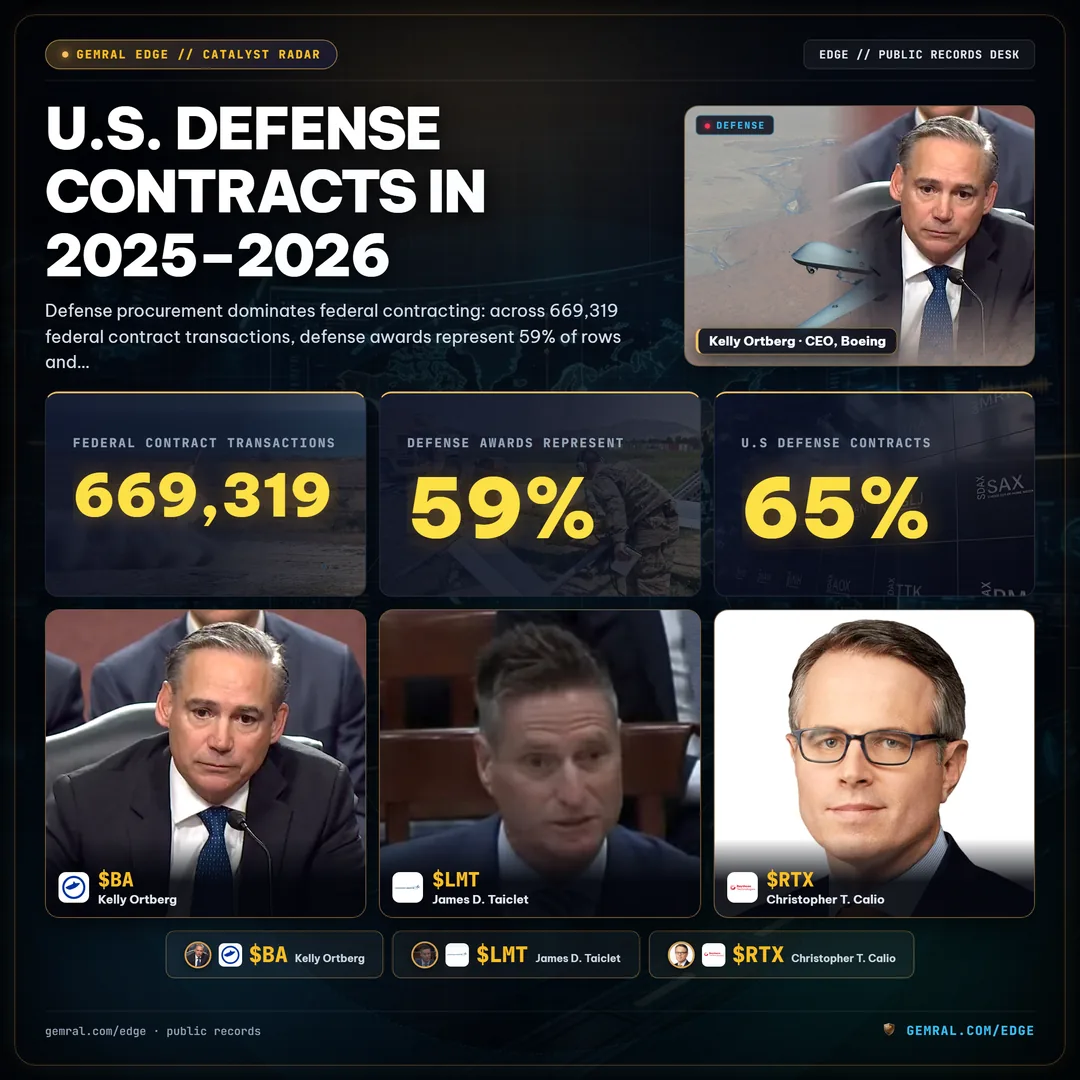
In FY2026 Q4, the timing divergence between daily Pentagon announcements and settled federal contract ledgers reached approximately $155 billion. Daily announcements capture contract modifications, multi-year ceiling increases, and Foreign Military Sales (FMS) awards on the day the Department of Defense publicizes them at 5:00 PM Eastern Time. By contrast, federal spending ledgers reflect accounting obligations only after agency finance offices process and transmit transaction records, which routinely lags by one to three months.
Equally important, analysts must respect coverage boundaries when mapping federal dollars to public equities. About 49.3% of FY2018+ contract transaction dollars are linked to a listed ticker (measured October 23, 2026); the remaining 50.7% flows to private or unlisted awardees, joint ventures, or entities not yet attributed to a public parent. For complementary context on how defense awards intersect with corporate lobbying and congressional disclosures, see our reports on defense lobbying and Pentagon awards and Congress stock trades and late disclosures.
2. Các Nhà thầu Quốc phòng Hàng đầu Mỹ năm 2026: Boeing, Lockheed Martin, Raytheon và General Dynamics
Through November 2026, 893 ticker-linked Pentagon contract announcements were recorded, led by a $131.23 billion F-15 award ceiling to The Boeing Co. (BA) on August 24, 2026 and a $53.86 billion PAC-3 award to Lockheed Martin Corp. (LMT) on July 30, 2026. The top 12 single-announcement awards in 2026 span five listed prime and IT contractors: Boeing (BA), Lockheed Martin (LMT), Raytheon (RTX), General Dynamics Electric Boat (GD), and Dell Federal Systems (DELL).

| Ngày thông báo | Nhà thầu | Mã CK | Giá trị công bố (USD) | Chương trình / Ghi chú |
|---|---|---|---|---|
| 2026-08-24 | The Boeing Co. | BA | $131,230,000,000 | F-15 program |
| 2026-07-30 | Lockheed Martin Corp. | LMT | $53,859,843,289 | PAC-3 missile defense |
| 2026-01-16 | Lockheed Martin Corp. | LMT | $25,357,000,000 | Multi-year award |
| 2026-01-16 | The Boeing Co. | BA | $25,357,000,000 | Multi-year award |
| 2026-09-28 | Raytheon Co. | RTX | $20,699,334,581 | Defense systems |
| 2026-03-18 | General Dynamics Electric Boat Corp. | GD | $15,383,494,792 | Submarine construction |
| 2026-09-11 | The Boeing Co. | BA | $13,400,000,000 | Aircraft support |
| 2026-07-15 | Lockheed Martin Corp. | LMT | $10,530,000,010 | DE-001 / RE-001 |
| 2026-05-27 | Dell Federal Systems | DELL | $9,690,000,000 | Enterprise IT |
| 2026-03-18 | Raytheon | RTX | $8,410,280,000 | Missile systems |
| 2026-06-23 | Lockheed Martin Corp. | LMT | $8,402,489,648 | Aerospace systems |
| 2026-10-13 | Raytheon Co. | RTX | $8,000,000,000 | Defense electronics |
Notice the concentration at the top of the 2026 announcement distribution. Boeing's August 24, 2026 F-15 announcement ($131.23 billion) and Lockheed Martin's July 30, 2026 PAC-3 announcement ($53.86 billion) represent multi-year contract ceilings rather than immediate single-quarter cash outlays. Analysts modeling backlog conversion must distinguish between indefinite-delivery/indefinite-quantity (IDIQ) ceiling modifications and funded task orders.
3. Khoảng cách 155 Tỷ USD Quý 4 FY2026 giữa Thông báo và Nghĩa vụ Sổ cái
In FY2026 Q4, daily Pentagon contract announcements exceeded settled federal ledger obligations by approximately $155 billion, driven by the median 90-day reporting lag across 38,354 historical announcements and 669,319 federal contract transactions. When an analyst relies solely on settled federal spending tables without incorporating daily announcement feeds, Q4 defense demand appears artificially depressed until subsequent quarters.
This reporting gap is not uniform across contract types. Fixed-price production awards and Foreign Military Sales modifications often appear in daily Pentagon releases months before the corresponding obligation lines clear agency accounting systems. Conversely, smaller sustainment modifications and sub-threshold orders may enter federal spending ledgers without a standalone daily press release. Combining both streams—while keeping announcement ceilings separate from obligated dollars—prevents double-counting while preserving the 90-day timing advantage.
4. Quy chiếu Mã Niêm yết: Vì sao Độ phủ 49,3% Đòi hỏi Kỷ luật Điểm thời gian
Across FY2018+ federal contract transactions, 49.3% of total transaction dollars are linked to a listed equity ticker (measured October 23, 2026), while the remaining 50.7% accrues to private contractors, foreign entities, universities, or unattributed awardees. Treating 49.3% as 100% of federal contracting—or assuming that subsidiary names remain static over time—introduces severe attribution bias.

Point-in-time corporate lineage is equally critical. Our revision log for federal contract and ownership records started in October 2026; prior to October 2026, corrected contract records show only the latest version. Analysts running historical studies must therefore account for both entity-resolution coverage (49.3% of FY2018+ dollars) and the October 2026 revision-log boundary rather than assuming complete historical restatements.
5. Khiếu nại Thầu GAO và Điểm nghẽn Mua sắm qua 13.850 Tranh chấp
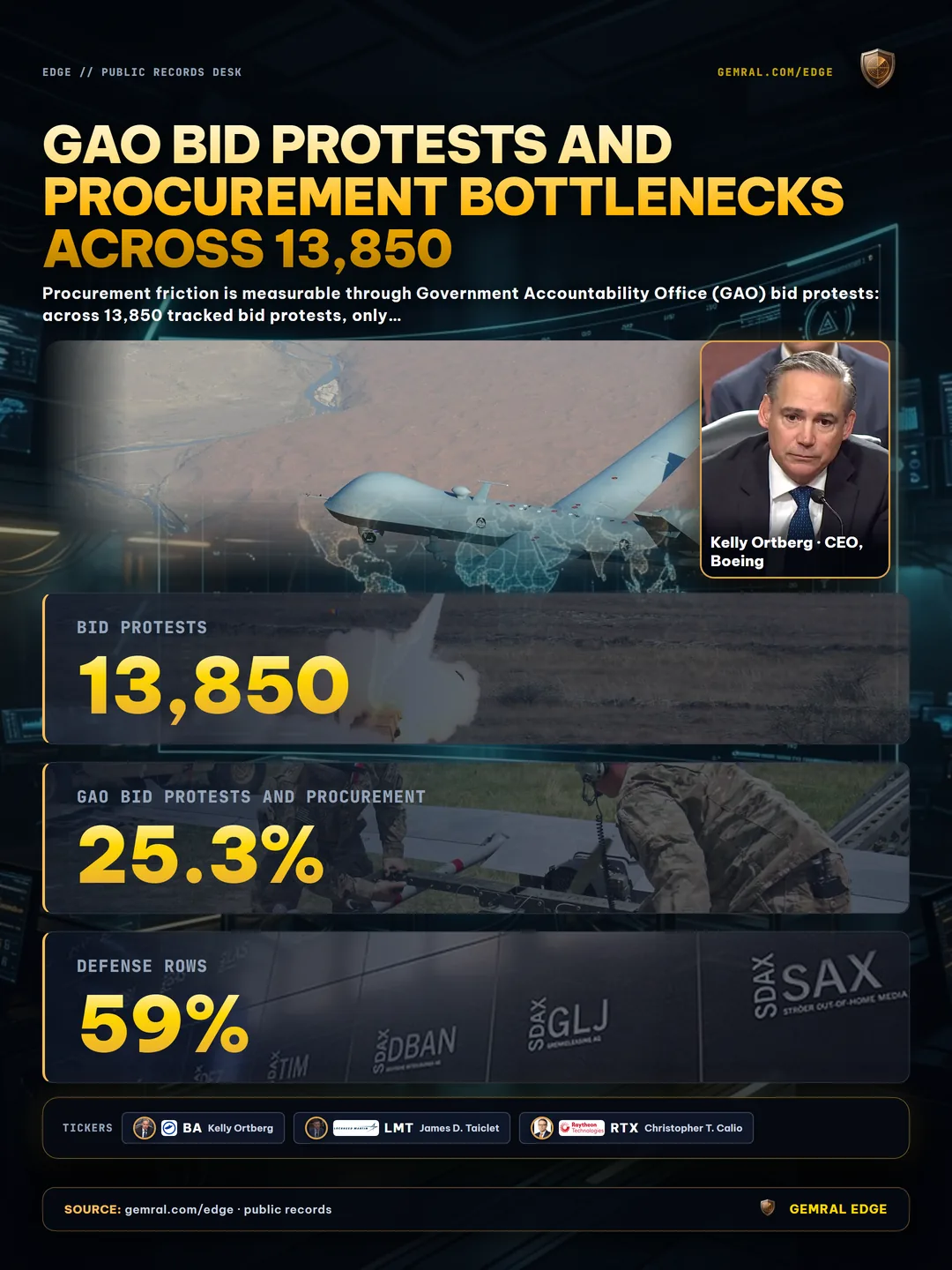
Procurement friction is measurable through Government Accountability Office (GAO) bid protests: across 13,850 tracked bid protests, only 25.3% (3,505 of 13,850) link cleanly to a specific contract transaction and awardee ID, and the statutory 100-day decision deadline matches exactly in 61.7% of cases. In the remaining 38.3% of protests, decision timelines shift due to weekends, federal holidays, or extended 143–145 day schedules.
| Bộ dữ liệu / Tín hiệu | Phạm vi đo lường | Lưu ý Độ phủ hoặc Thời gian |
|---|---|---|
| Federal Contract Transactions | 669,319 rows (59% defense rows, 65% defense dollars) | 49.3% of FY2018+ dollars linked to listed tickers (Oct 23, 2026) |
| Pentagon Daily Announcements | 38,354 total (893 ticker-linked in 2026) | Median 90-day lead; ~$155B FY2026 Q4 gap (compared with settled ledger) |
| GAO Bid Protests | 13,850 protests (3,505 linked, 25.3%) | 100-day deadline matches in 61.7% of cases (others 143–145 days) |
| Contract Revision History | October 2026 revision log start | Pre-October 2026 corrected records show latest version only |
When a major defense or IT award triggers a GAO protest, obligated funding and performance start dates can stall for 100 to 145 days. Tracking protest filings alongside daily Pentagon announcements helps analysts separate headline award ceilings from near-term revenue recognition—just as tracking physical permits separates paper grid queues from real power demand in our ERCOT large load interconnection queue case study.
7. Cơ chế Bán vũ khí Nước ngoài (FMS) và Trần Hợp đồng Nhiều năm qua 38.354 Thông báo
Across 38,354 Pentagon daily contract announcements and 669,319 federal contract transactions, Foreign Military Sales (FMS) and multi-year indefinite-delivery/indefinite-quantity (IDIQ) ceiling modifications account for the widest divergences between announced award values and quarterly ledger obligations. When an analyst reads a $131.23 billion F-15 announcement for The Boeing Co. (BA) or a $53.86 billion PAC-3 announcement for Lockheed Martin Corp. (LMT), the headline figure reflects an authorized ceiling spanning multiple fiscal years rather than an immediate cash disbursement.

In federal procurement accounting, an IDIQ ceiling establishes the maximum dollar value the Department of Defense may order under a master vehicle, whereas an obligated transaction in the federal spending ledger records a binding legal commitment for a specific delivery order or funded increment. Because funded increments are released in tranches—often months after the master ceiling modification is announced—the ~$155 billion FY2026 Q4 gap between announcements and ledger obligations is structurally recurring rather than a one-time anomaly. Analysts who treat announcement ceilings as single-quarter revenue systematically overstate near-term contractor cash flows, while analysts who ignore announcements miss major program wins for a median 90 days.
Foreign Military Sales add a second layer of timing complexity. FMS awards are funded by allied governments through the U.S. Defense Security Cooperation Agency and frequently bundle airframe, munitions, sustainment, and training packages into a single daily announcement. While the Pentagon publicizes the aggregate FMS ceiling on the day of contract signature, underlying obligation lines may appear across multiple fiscal quarters as partner-nation deposits clear and individual task orders are executed. Separating domestic procurement from FMS-linked announcements—while tracking both against the 49.3% listed-ticker coverage boundary—prevents analysts from conflating allied backlog with domestic appropriations.
8. Vệ sinh Dữ liệu Điểm thời gian: Tránh Trôi Quy chiếu và Thiên lệch Sống sót
Maintaining point-in-time integrity across 669,319 federal contract transactions, 38,354 Pentagon announcements, and 13,850 GAO bid protests requires strict discipline around entity resolution and revision-log boundaries. Because 49.3% of FY2018+ contract transaction dollars link to a listed ticker (measured October 23, 2026) and the remaining 50.7% flows to private or unlisted awardees, any universe-level summary must state its coverage denominator explicitly rather than extrapolating listed-company trends to the entire federal industrial base.

Equally important, corporate ownership of defense subsidiaries changes through mergers, divestitures, and spin-offs. If a historical dataset overwrites a subsidiary's parent ticker using today's corporate tree rather than the parent-child relationship active on the transaction date, historical attribution drifts backward in time. Our revision log for federal contract and ownership records began in October 2026; prior to October 2026, corrected contract records show only the latest version. Institutional teams should therefore anchor pre-October 2026 historical comparisons on stable awardee identifiers and disclose the October 2026 revision-log boundary in every research memo.
Finally, analysts should pair quantitative contract screens with qualitative procurement-friction checks. Across 13,850 GAO bid protests, only 25.3% (3,505 of 13,850) link cleanly to a contract transaction and awardee ID, and the 100-day statutory decision deadline matches in 61.7% of cases (with the remaining 38.3% extending to 143–145 days or shifting around weekends and holidays). By combining early 90-day announcement visibility, 65% defense-dollar ledger context, and 100-to-145-day protest monitoring, institutional analysts build an auditable, repeatable defense-contracting workflow grounded in public records.
6. Quy trình Tổ chức: Kết hợp Thông báo Hàng ngày, Sổ cái Nghĩa vụ và Khiếu nại Thầu
An institutional defense-contracting workflow pairs 38,354 Pentagon announcements (90-day median lead) with 669,319 federal ledger transactions (65% defense dollars) and 13,850 GAO bid protests, while respecting the 49.3% listed-ticker coverage boundary. Rather than treating any single feed as complete, analysts triangulate across all three stages: announcement ceiling, protest clearance, and ledger obligation.
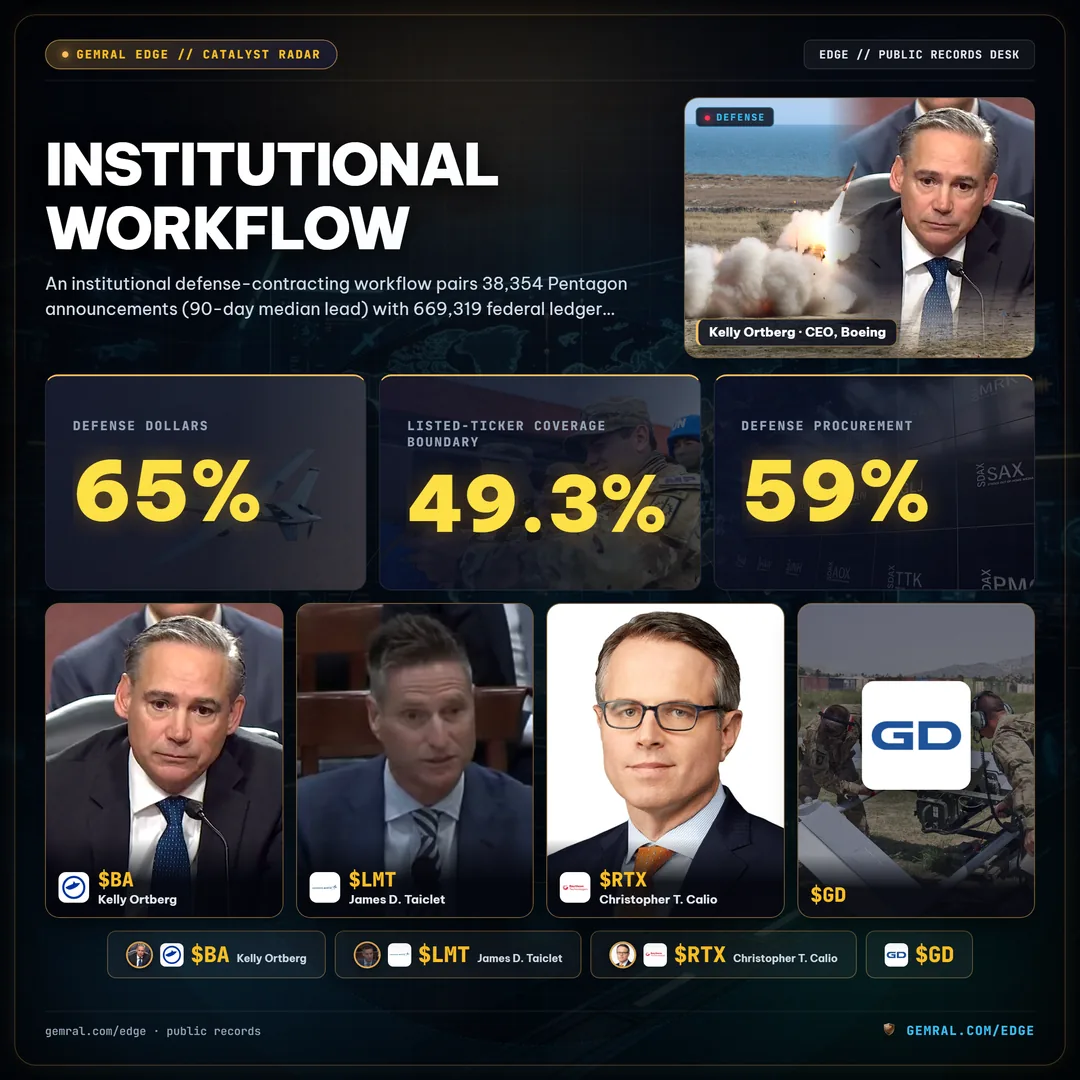
Specifically, teams should (1) monitor daily Pentagon releases for early visibility into multi-year program ceilings ($131.23 billion BA, $53.86 billion LMT, $20.70 billion RTX in 2026), (2) flag contested awards in the 13,850-protest GAO docket where 100-day to 145-day stays can delay execution, and (3) reconcile against settled federal obligations once the 90-day reporting lag closes. Review our data methodology for full schema definitions and coverage boundaries.
From a portfolio-construction and risk-management perspective, the practical implication of this 90-day lead-lag structure is straightforward: single-source federal spending models are structurally late on major defense awards, whereas single-source announcement models are structurally noisy on cash-flow timing. By reconciling 38,354 Pentagon daily announcements against 669,319 federal contract transactions, analysts can verify which announced ceilings convert into funded obligations within 90 days and which remain unexercised options or stalled under GAO bid protests. Across 2026, the 893 ticker-linked Pentagon announcements—led by Boeing ($131.23 billion), Lockheed Martin ($53.86 billion), Raytheon ($20.70 billion), General Dynamics ($15.38 billion), and Dell Federal Systems ($9.69 billion)—demonstrate how concentrated mega-awards drive headline totals while mid-tier sustainment and IT awards sustain baseline ledger volume.
In addition to timing differences between announcement dates and ledger obligations, institutional analysts must account for how federal procurement categories behave across budget cycles. Major weapon-system awards—such as aircraft production, missile-defense interceptors, and nuclear-powered submarine construction—are typically structured as multi-year indefinite-delivery/indefinite-quantity contracts or multi-year procurement authorizations. When the Department of Defense issues a daily announcement for a $131.23 billion F-15 ceiling or a $53.86 billion PAC-3 ceiling, the announcement establishes the upper contractual boundary over the life of the program rather than a single-year cash outlay. By contrast, enterprise information technology, cloud infrastructure, and logistics-support awards—such as the $9.69 billion Dell Federal Systems award announced on May 27, 2026—often convert into task-order obligations in smaller, more frequent increments across multiple defense agencies.
Understanding this structural split between platform ceilings and incremental task orders is essential when reconciling daily Pentagon announcements against the 669,319 federal contract transactions in the settled spending ledger. Defense procurement accounts for 59% of all federal transaction rows and 65% of obligated dollars, meaning that defense contracting drives the majority of federal industrial activity. Yet because daily announcements arrive at a median lead time of 90 days before ledger settlement, quarterly snapshots of settled federal spending systematically understate recent award momentum during periods of heavy contract signing—most visibly in the ~$155 billion FY2026 Q4 gap.
Furthermore, analysts evaluating contractor backlogs should distinguish between prime-contractor awards and downstream supply-chain visibility. While 49.3% of FY2018+ federal contract transaction dollars link to a listed equity ticker (measured October 23, 2026), the remaining 50.7% flows to privately held firms, joint ventures, foreign entities, or awardees not yet attributed to a public parent. Even among listed primes—such as Boeing (BA), Lockheed Martin (LMT), Raytheon (RTX), and General Dynamics (GD)—a substantial share of prime-contract dollars is subsequently subcontracted to specialized tier-two and tier-three suppliers in propulsion, avionics, radar, and naval components. Treating prime-level announcement totals as pure net revenue to the prime contractor ignores both multi-year phasing and supply-chain pass-through.
Procurement friction adds a further layer of dispersion between contract signature and revenue recognition. Across 13,850 tracked Government Accountability Office (GAO) bid protests, only 25.3% (3,505 of 13,850) link cleanly to a specific contract transaction and awardee ID, and the statutory 100-day decision deadline matches exactly in 61.7% of cases. In the remaining 38.3% of protests, decision timelines shift due to weekends, federal holidays, or extended 143–145 day schedules. When a losing bidder files a timely protest under the Competition in Contracting Act, an automatic stay of performance typically halts work on the contested award until the GAO issues its decision or the agency takes corrective action. For institutional models, tracking protest status alongside daily announcements prevents premature revenue-ramp assumptions on contested programs.
Finally, disciplined point-in-time data management requires explicit recognition of historical revision boundaries. Our revision log for federal contract and corporate ownership records began in October 2026; prior to October 2026, corrected contract records show only the latest version. Analysts conducting multi-year historical comparisons should therefore treat pre-October 2026 records as latest-known state rather than unrevised point-in-time snapshots, while using post-October 2026 revision logs to track subsequent modifications, ceiling adjustments, and entity-resolution updates. Combining 38,354 Pentagon announcements, 669,319 federal ledger transactions, and 13,850 GAO bid protests within these explicit coverage and timing boundaries provides a rigorous, auditable foundation for institutional defense-sector analysis.
When institutional teams evaluate defense-sector exposure across multi-year horizons, reconciling daily Pentagon announcements with settled federal spending ledgers also clarifies how contract modifications behave under continuing resolutions and late-fiscal-year obligation surges. During the fourth quarter of the federal fiscal year, contracting officers routinely accelerate task-order signings and ceiling extensions before annual appropriations expire. Because daily Pentagon announcements capture those signings immediately at 5:00 PM Eastern Time, while agency finance offices take weeks or months to transmit settled accounting lines into federal spending ledgers, the ~$155 billion FY2026 Q4 reporting gap reflects normal administrative settlement latency rather than missing awards. Analysts who monitor both streams side by side—keeping 38,354 daily announcements distinct from 669,319 settled ledger transactions—avoid mistaking fourth-quarter reporting lag for a sudden contraction in defense demand.
Equally important is recognizing how listed-ticker attribution interacts with contract size and awardee structure. Because 49.3% of FY2018+ federal contract transaction dollars link to a listed equity ticker (measured October 23, 2026) and 50.7% flow to private or unlisted awardees, large prime announcements—such as Boeing's $131.23 billion F-15 ceiling, Lockheed Martin's $53.86 billion PAC-3 award, Raytheon's $20.70 billion defense-systems award, General Dynamics Electric Boat's $15.38 billion submarine award, and Dell Federal Systems' $9.69 billion enterprise IT award—represent only the visible public-equity tier of the defense industrial base. Beneath those headline primes sits a deep network of private engineering firms, regional shipbuilders, and specialized component suppliers whose contract dollars are recorded in the federal ledger without a public ticker.
Finally, integrating GAO bid-protest tracking into the same analytical pipeline provides an objective check on execution risk. Across 13,850 tracked bid protests, only 25.3% (3,505 of 13,850) link cleanly to a specific contract transaction and awardee ID, and the 100-day statutory decision deadline matches in 61.7% of cases while 38.3% extend to 143–145 days or shift around weekends and holidays. By treating announcement ceilings, protest-docket stays, and settled ledger obligations as three complementary stages of the same procurement lifecycle—within the explicit October 2026 revision-log boundary—institutional analysts gain a repeatable, auditable framework for U.S. defense-contracting research.
In practical terms, institutional research teams building systematic defense-procurement trackers should enforce four operational guardrails across every quarterly review cycle. First, never sum daily Pentagon announcement ceilings directly with settled federal ledger obligations, because doing so double-counts multi-year program authorizations across both streams. Second, always normalize announcement volume against the 90-day median settlement lag so that fourth-quarter obligation surges—such as the ~$155 billion FY2026 Q4 divergence—are interpreted as administrative timing rather than sudden demand shifts. Third, state the 49.3% listed-ticker coverage denominator explicitly whenever presenting public-equity aggregates, ensuring that private and unlisted awardees representing 50.7% of FY2018+ federal contract dollars are not omitted from market-share context. Fourth, cross-check every major contested award against the 13,850-protest GAO docket to identify whether a 100-day to 145-day stay is delaying task-order execution.
When these four guardrails are applied consistently across 38,354 Pentagon daily announcements, 669,319 federal contract transactions, and 13,850 GAO bid protests, defense-contracting data transitions from noisy headline alerts into a structured, auditable institutional dataset. Analysts gain 90 days of early visibility into major awards—including Boeing's $131.23 billion F-15 ceiling, Lockheed Martin's $53.86 billion PAC-3 award, Raytheon's $20.70 billion defense-systems award, and General Dynamics Electric Boat's $15.38 billion submarine award—while maintaining strict point-in-time discipline around the October 2026 revision-log boundary. Together, these complementary public-record feeds give institutional researchers a verifiable, repeatable methodology for tracking federal defense procurement without conflating multi-year contract ceilings, contested protest dockets, and settled agency obligations across quarterly reporting cycles, budget appropriations, and long-term industrial capacity assessments across every major federal defense program and contractor.
Frequently asked questions
What share of federal contract dollars goes to U.S. defense contracts?
Across 669,319 federal contract transactions, defense procurement accounts for 59% of transaction rows and 65% of obligated dollars.
How early do Pentagon contract announcements appear compared with federal spending ledgers?
Across 38,354 historical Pentagon announcements, daily awards provide a median 90-day lead before settled federal ledger reporting, creating a ~$155 billion FY2026 Q4 gap.
How many GAO bid protests are linked to specific contract transactions?
Out of 13,850 tracked GAO bid protests, 25.3% (3,505) are linked to a contract transaction and awardee ID, and the 100-day decision deadline matches in 61.7% of cases.