Prediction Market Arbitrage: Exploiting Mispricings Across Event Contracts
Prediction Market Arbitrage: Exploiting Mispricings Across Event Contracts
The explosive growth of decentralized and regulated event platforms has created structural pricing discrepancies, turning prediction market arbitrage into a rapidly institutionalizing quantitative strategy. To monitor cross-platform odds divergence and execution spreads in real time, market participants utilize the prediction markets arbitrage intelligence hub, auditing liquidity pools against exchange order books.
Event contracts are binary derivative instruments that settle at either $1.00 (if a specified outcome occurs) or $0.00 (if it does not). As capital flows into decentralized automated market makers alongside CFTC-regulated designated contract markets like Kalshi and academic venues like PredictIt, identical event outcomes frequently trade at substantial price divergences. For example, during breaking geopolitical or economic news releases, the implied probability of an interest rate decision or election outcome may trade at 58% on one platform while lagging at 51% on another. Understanding how to capture this spread risk-neutrally requires examining cross-platform market microstructure, transaction friction, and capital velocity.
1. The Mechanics of Cross-Venue Arbitrage
The mathematical foundation of prediction market arbitrage is straightforward: if Platform A trades a binary event "YES" contract at price $P_A$ and Platform B trades the corresponding "NO" contract at price $P_B$ (where $P_B = 1 - P_{B,yes}$), an arbitrageur can purchase both contracts simultaneously whenever the total cost is below par:
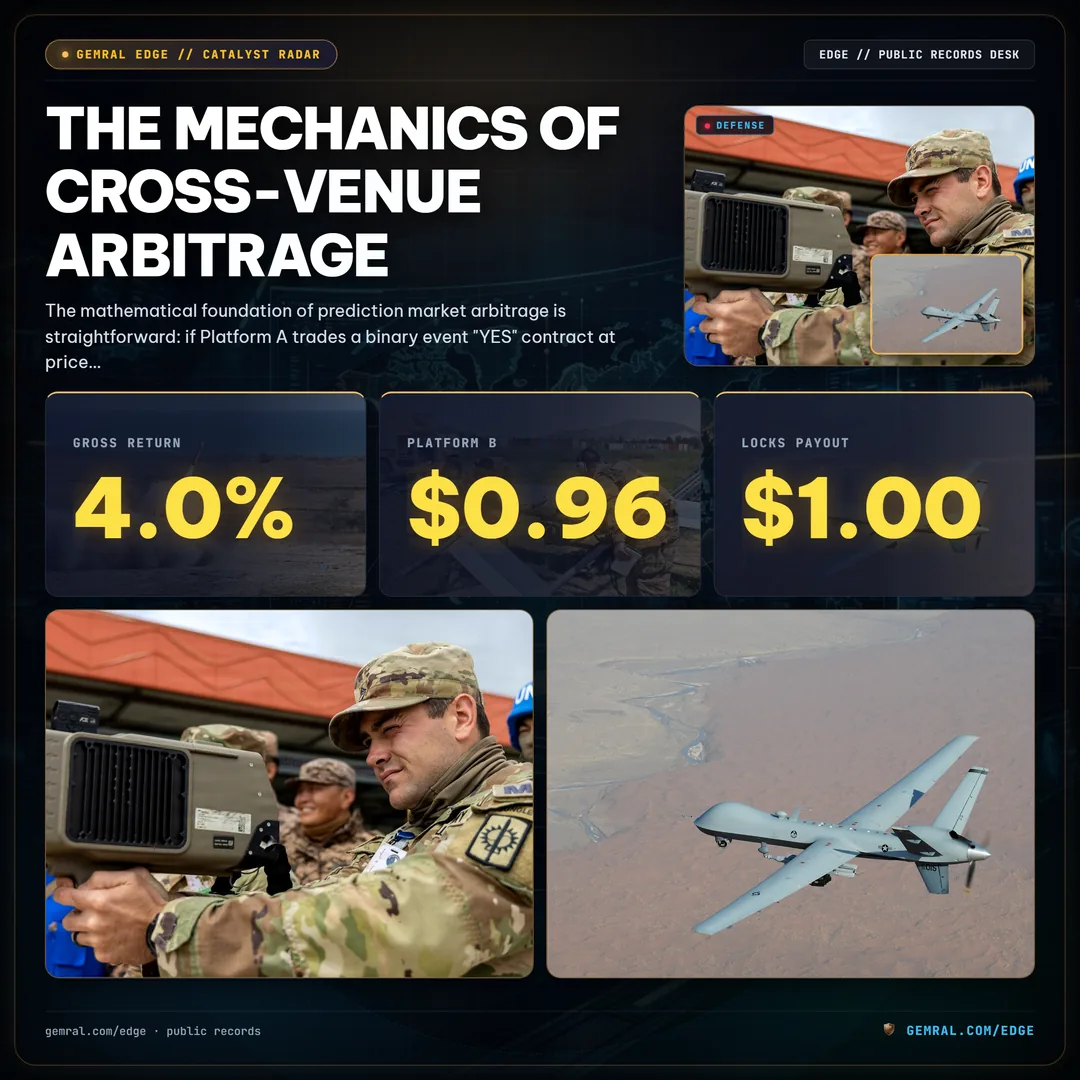
When the combined cost of buying "YES" on Platform A and "NO" on Platform B is less than $0.96 (leaving a 4.0% gross profit margin), the trader locks in a guaranteed payout of $1.00 regardless of the real-world outcome. Over $250M in monthly trading volume across public event contracts exhibits momentary spread divergences exceeding 3.5%, offering systematic risk-neutral returns.
Furthermore, automated market-making algorithms must manage execution slippage across thin order books. If an arbitrage bot attempts to deploy $25,000 across a 4.0% price divergence, market depth may only support $2,500 at the quoted price before consuming subsequent book tiers. Consequently, high-frequency desks deploy synthetic order-slicing algorithms, executing fractional fill sequences across multiple blocks to maintain positive expected value.
2. Comparing Prediction Market Execution Venues
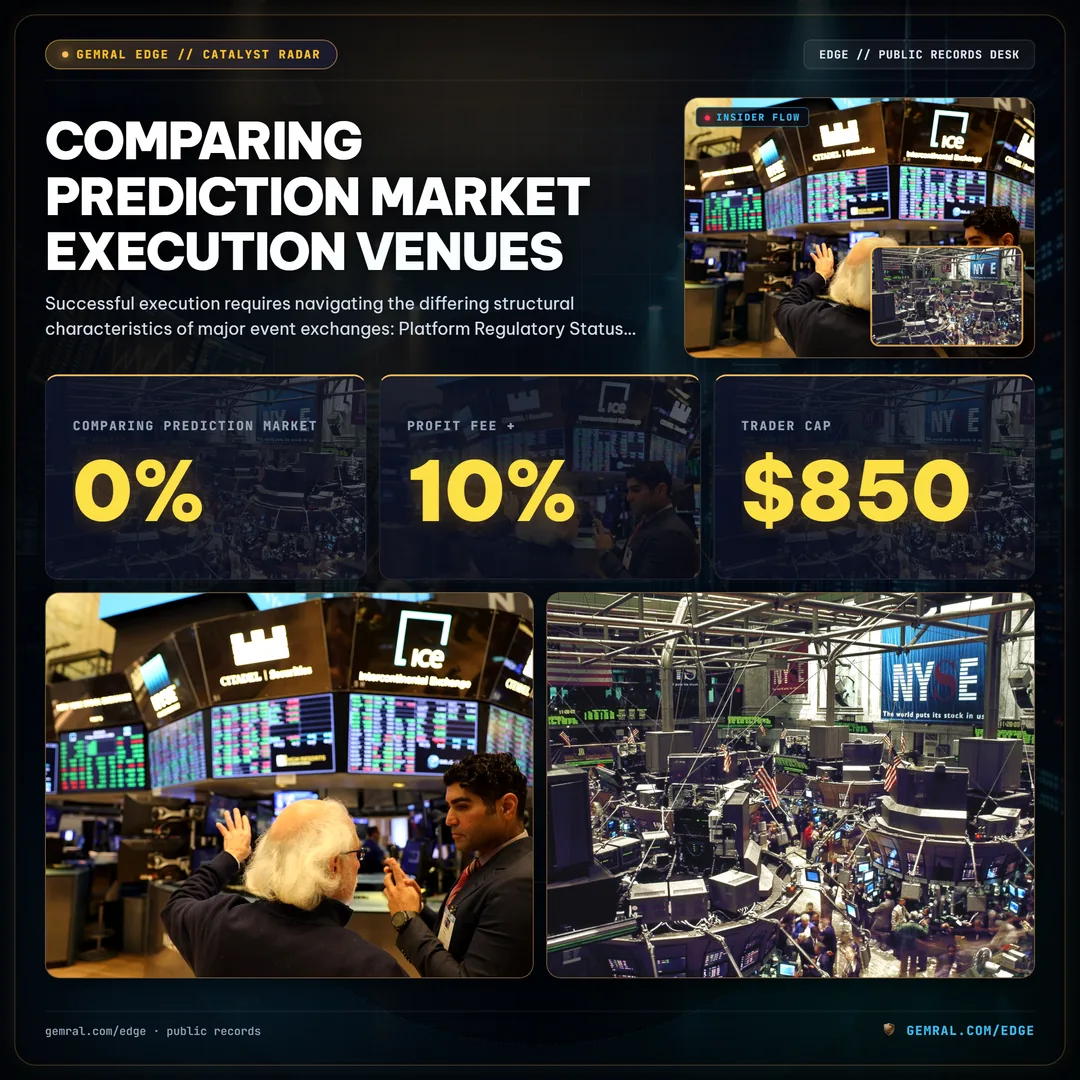
Successful execution requires navigating the differing structural characteristics of major event exchanges:
| Platform | Regulatory Status | Settlement Currency | Fee Structure | Liquidity Architecture |
|---|---|---|---|---|
| Polymarket | Offshore / Web3 (Polygon) | USDC (Stablecoin) | 0% Maker / 0% Taker Fees (Rebates) | Hybrid CLOB & Conditional Token AMM |
| Kalshi | CFTC-Regulated DCM | USD (Fiat ACH/Wire) | Exchange Fee per Contract (~1.5%) | Central Limit Order Book (CLOB) |
| PredictIt | CFTC No-Action Relief | USD (Fiat) | 10% Profit Fee + 5% Withdrawal | Limit Order Book ($850 Trader Cap) |
| Interactive Brokers | CFTC ForecastEx | USD (Brokerage Margin) | $0.01 per contract fee | Direct Clearing Exchange |
Because fees differ dramatically—ranging from 0% on decentralized hybrid CLOBs to 10% on profit at PredictIt—arbitrageurs must compute net basis spreads. A gross pricing divergence of 6.0% between venues often results in a negative net return after accounting for PredictIt's 10% profit tax and 5% withdrawal fee, requiring automated spread thresholds above 7.5% to justify capital commitment.
3. Friction and Latency: The Hidden Costs of Arbitrage
While theoretical prediction market arbitrage appears risk-free, executing cross-platform strategies involves significant operational friction:
Operational execution parameters must account for settlement cycles and banking clearing delays:
- Capital Lockup and Opportunity Cost: Event contracts lock up capital until official resolution. An arbitrage position yielding 3.0% over a 9-month resolution window translates to an annualized return of only 4.0%, trailing risk-free Treasury bill yields. Optimal arbitrage desks target short-duration events under 14 days to compound annualized yields above 18.5%.
- Cross-Rail Settlement Latency: Moving capital between on-chain USDC on Polygon and regulated US banking rails requires 1 to 3 business days. Without pre-funded capital balances exceeding $50,000 on both venues, traders cannot execute time-sensitive mispricings.
- Resolution Oracle Divergence: Platforms occasionally define contract resolution terms with subtle legal variations. If Platform A resolves via Associated Press calls while Platform B relies on official certified state election results, a contested outcome can freeze funds for over 45 days.
4. Advanced Statistical Arbitrage in Combinatorial Markets
Beyond simple two-venue binary arbitrage, sophisticated quantitative trading desks execute combinatorial arbitrage across mutually exclusive multi-outcome markets. In an election with 5 candidates, the sum of all "YES" contracts should theoretically equal exactly $1.00.
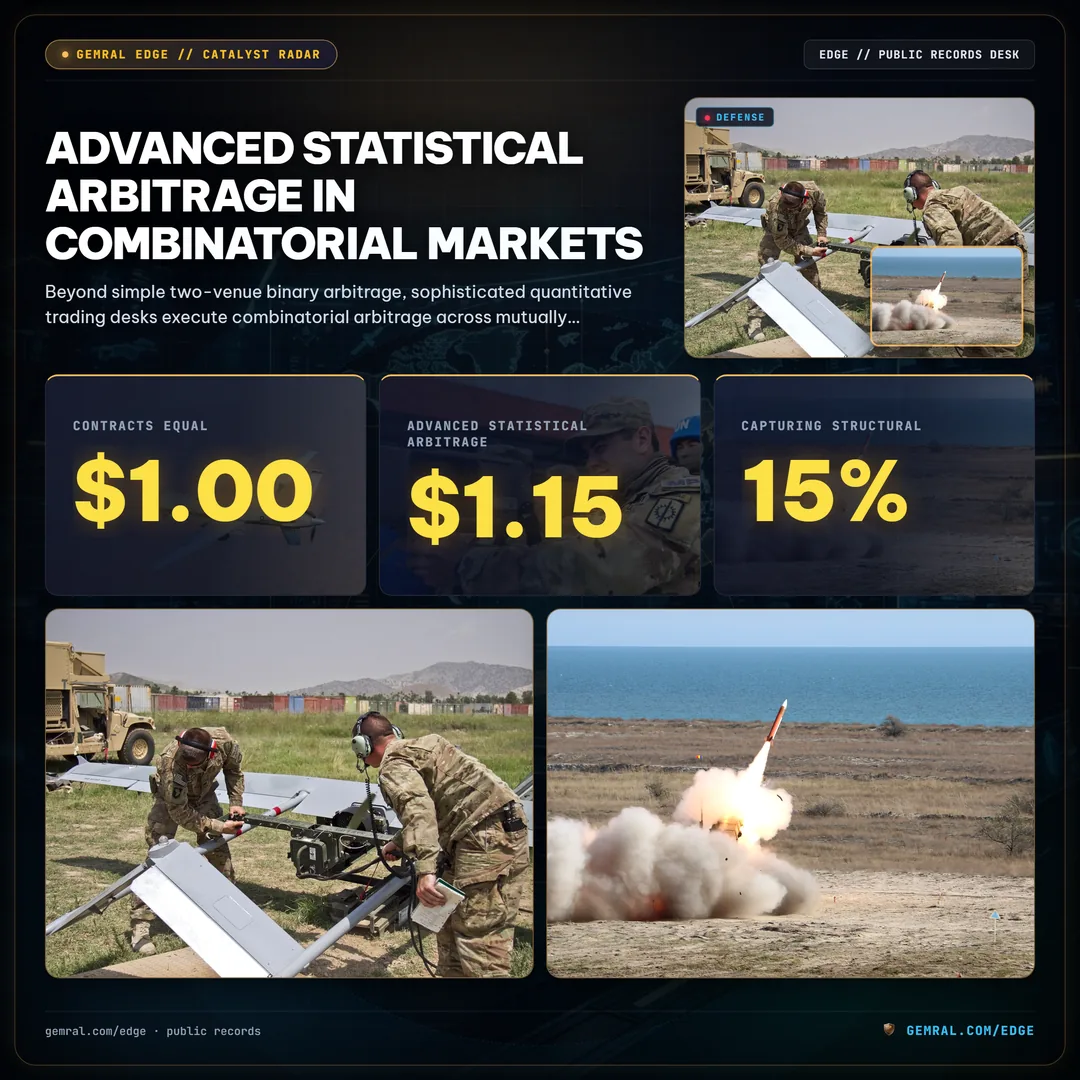
When retail sentiment drives speculative volume into long-shot candidates, the cumulative probability across all candidates often inflates to $1.15 or $1.25. Arbitrageurs exploit this overpricing by selling or minting complete outcome sets and shorting the overpriced tail, capturing the structural 15% to 25% premium as contracts converge to unity at settlement across multi-million dollar liquidity pools.
To hedge structural volatility in multi-candidate pools, statistical arbitrageurs construct dynamic basket hedges. By shorting long-tail candidates whose combined implied probability exceeds historical polling variance by more than 2.5 standard deviations, desks capture systematic mean-reversion profits. As election cycles mature and candidate dropouts accelerate, these probability bubbles deflate rapidly, enabling algorithmic traders to close hedged positions weeks prior to official voting certification.
Regulatory & Investment Disclaimer: Public data · not investment advice. All contract mechanics, fee schedules, and market structures are compiled from official public documentation published by Polymarket, Kalshi Inc., and the U.S. Commodity Futures Trading Commission (CFTC). Trading event contracts involves substantial capital risk.