Polymarket Arbitrage Strategies: Liquidity Pools, Fees, and Settlement Risk
Polymarket Arbitrage Strategies: Liquidity Pools, Fees, and Settlement Risk
As trading volumes on decentralized prediction protocols surge past multi-billion-dollar thresholds, executing polymarket arbitrage has evolved from manual retail betting into automated high-frequency liquidity provisioning. To monitor orderbook depth, slippage parameters, and cross-market price dislocations, quantitative desks rely on the prediction markets arbitrage tracker to audit smart contract interactions against centralized liquidity venues.
Operating as a decentralized information market on the Polygon proof-of-stake blockchain, Polymarket utilizes the Gnosis Conditional Token Framework (CTF) alongside an off-chain central limit order book (CLOB) with on-chain settlement. Because market participants can both trade individual binary tokens and interact directly with underlying token-splitting contracts, unique structural arbitrage opportunities arise within the protocol itself, independent of external platforms. Analyzing polymarket arbitrage strategies requires dissecting the mathematical mechanics of conditional token minting, negative risk pricing, and decentralized oracle settlement dynamics.
1. The Mint-and-Split Arbitrage Mechanism
The core structural primitive supporting polymarket arbitrage is the ability to interact directly with the CTF Exchange smart contracts. Any user can deposit 1.00 USDC to mint exactly one pair of outcome tokens: 1 "YES" token and 1 "NO" token.
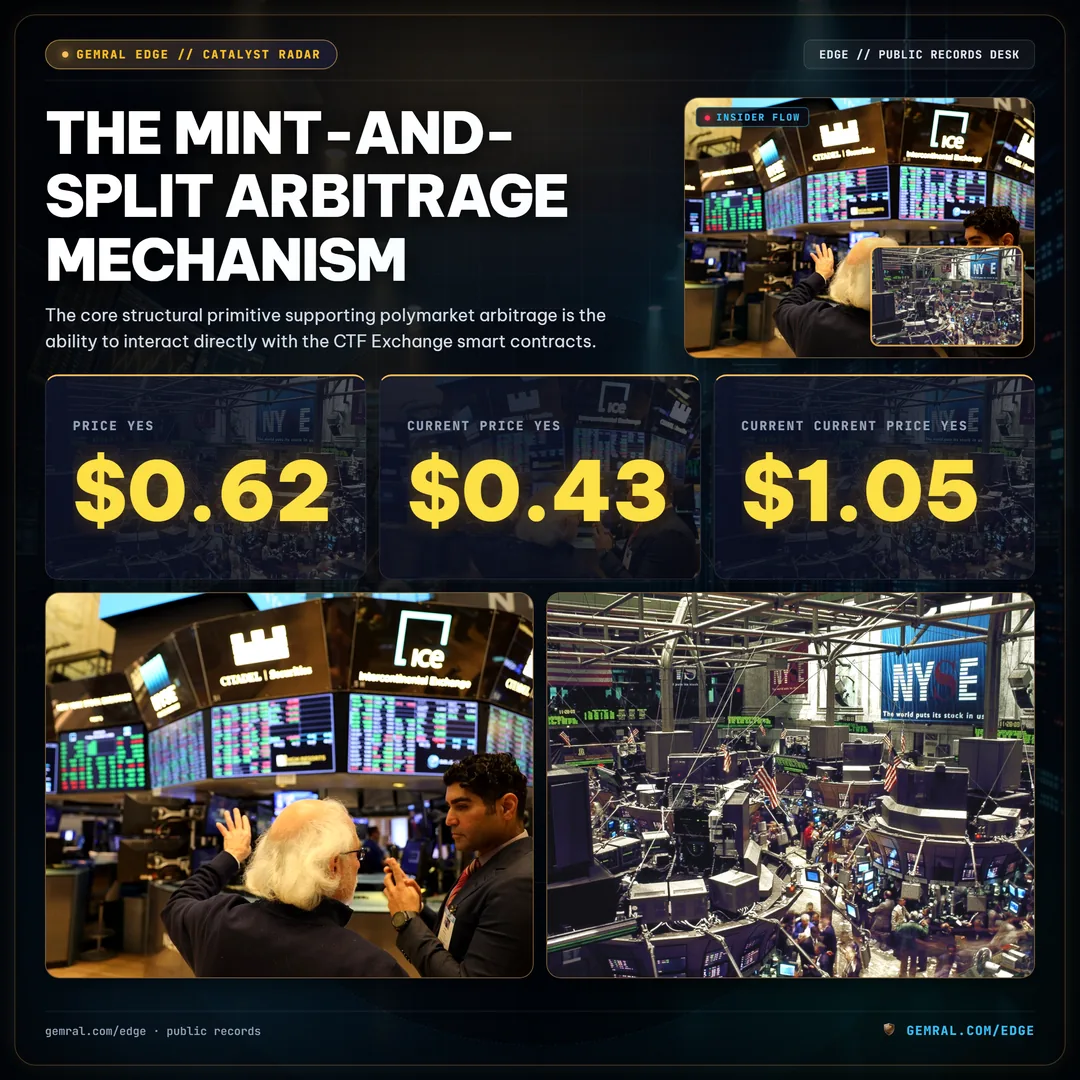
Because the sum of YES and NO tokens must redeem for 1.00 USDC upon market resolution, the combined price on the orderbook must reflect this parity. Weekly contract volume routinely surpasses $185 million across 1,450 active prediction markets, creating structural liquidity imbalances during fast-moving events. Systematic market participants closely audit contract spreads to identify fleeting pricing anomalies. If retail buying pressure drives the price of YES to $0.62 and NO to $0.43 (summing to $1.05), an arbitrageur executes an atomic mint-and-sell loop: depositing 1,000 USDC to mint 1,000 YES and 1,000 NO tokens, and instantly selling both on the CLOB for $1,050 USDC, capturing a risk-free 5% spread in a single block.
2. Negative Risk Markets: Multi-Outcome Mathematical Parity
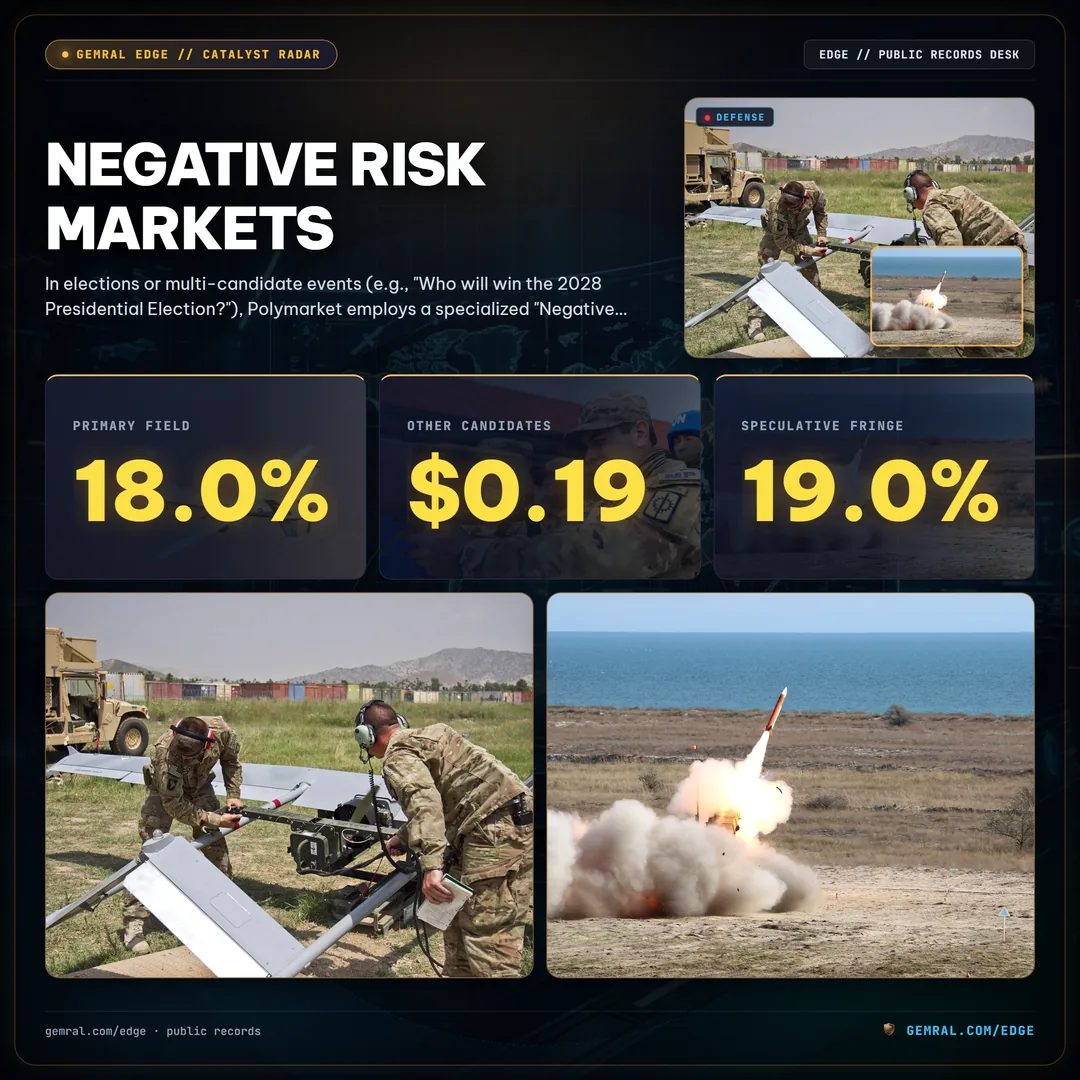
In elections or multi-candidate events (e.g., "Who will win the 2028 Presidential Election?"), Polymarket employs a specialized "Negative Risk" smart contract architecture. Instead of trading dozens of independent YES/NO pairs, the protocol links candidate tokens through a unified collateral pool:
| Outcome Candidate | Market Implied Price | Implied Probability | Arbitrage Functionality |
|---|---|---|---|
| Candidate Alpha | $0.42 | 42.0% | Core Front-Runner Liquidity |
| Candidate Beta | $0.31 | 31.0% | Secondary Challenger Liquidity |
| Candidate Gamma | $0.18 | 18.0% | Contested Primary Field |
| All Other Candidates | $0.19 (Sum of Long-Tails) | 19.0% | Overpriced Speculative Fringe |
| Total Outcome Sum | $1.10 (Mispriced) | 110.0% | 10% Overround Arbitrage Window |
When the sum of all mutually exclusive candidate prices exceeds $1.00 (the "overround"), arbitrage bots convert collateral into a complete basket of all candidate tokens and sell every component into existing bids. Conversely, if the sum drops below $1.00, traders buy one of each token across the market and merge them via the smart contract to redeem 1.00 USDC, locking in the discount.
3. Settlement Risk: The UMA Optimistic Oracle Architecture
While on-chain polymarket arbitrage offers deterministic mathematical margins, traders face one critical systemic vulnerability: settlement and oracle risk. Polymarket relies on the UMA Optimistic Oracle for market dispute resolution.
- The Assertion Lifecycle: Upon event conclusion, a proposer asserts the winning outcome and posts a bond of up to $15,000 in UMA tokens. If no dispute occurs within a two-hour challenge window, the market settles according to the assertion.
- Dispute Escalation to UMA Tokenholders: If an outcome is contested, the decision escalates to a global vote of UMA tokenholders. In ambiguous or contested real-world events, tokenholder governance decisions can deviate from literal market intent, creating catastrophic tail risk for unhedged arbitrageurs.
- Contract Wording Ambiguities: Markets with subjective resolution criteria—such as executive orders that face judicial stays—can freeze capital for weeks during protracted dispute cycles, eroding the annualized return of the trade.
4. Operational Infrastructure for On-Chain Execution
Capturing polymarket arbitrage opportunities at scale requires institutional-grade Web3 infrastructure. Market makers deploy dedicated RPC nodes on the Polygon network to eliminate transaction broadcast latency, while utilizing automated MEV-resistant private transaction relays.
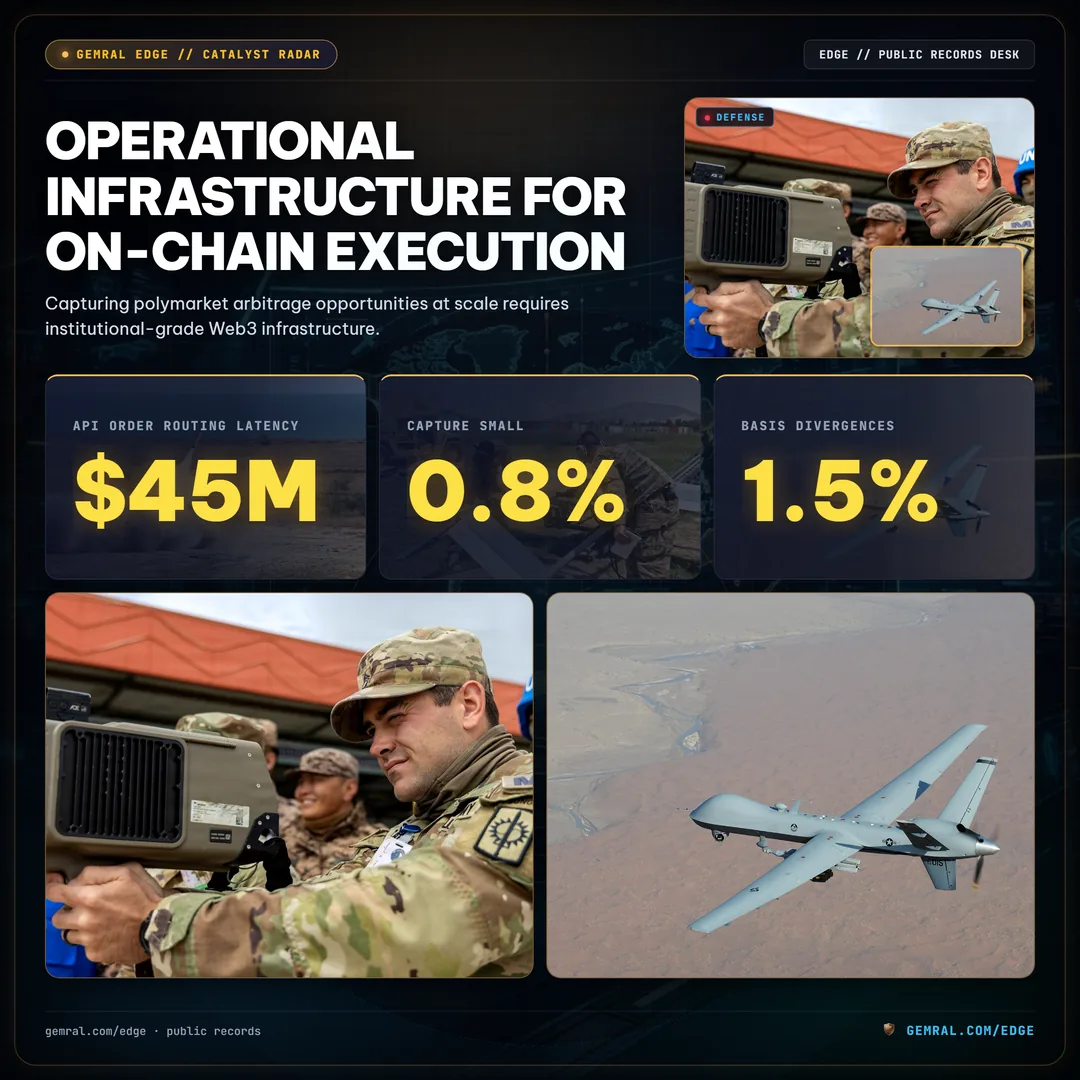
Furthermore, because Polymarket operates an off-chain CLOB matching engine via EIP-712 signed order messages, latency occurs at the API layer rather than purely in gas wars. Quantitative desks co-locate trading servers near Polymarket's AWS endpoints to maintain sub-35ms execution priority, ensuring that order cancellations and fills execute before manual participants react to real-time news. Daily traded notional volume exceeds $45 million with zero maker fees and taker fees below 0.15%, allowing market-neutral statistical arbitrage programs to capture small 0.8% to 1.5% basis divergences with consistent profitability.
As trading liquidity deepens across prediction ecosystems, multi-venue algorithmic routing will dominate order flow. Arbitrageurs who combine automated blockchain smart contract integration with low-latency API infrastructure and robust oracle dispute models will capture the vast majority of cross-venue price dislocations across decentralized capital markets.
Regulatory & Investment Disclaimer: Public data · not investment advice. All smart contract architectures, token mechanics, and oracle settlement parameters are compiled from public codebases and documentation published by Polymarket and UMA Protocol. DeFi trading involves smart contract and market risks.