Google Antitrust Settlement Scenarios: Choice Screens vs Browser Divestiture
Google Antitrust Settlement Scenarios: Choice Screens vs Browser Divestiture
Following the landmark monopoly liability judgment against Alphabet, legal scholars and corporate strategists are modeling the contours of a potential google antitrust settlement or judicial remedy decree. To evaluate how structural remedies alter search distribution economics, institutional analysts examine the Google antitrust distribution remedy tracker, auditing regulatory enforcement filings across jurisdictions.
When the Department of Justice outlines remedy proposals following an antitrust victory under Section 2 of the Sherman Act, the legal debate centers on behavioral constraints versus structural remedies. While Google advocates for narrow behavioral modifications that preserve its unified corporate structure, government prosecutors have signaled interest in fundamental business breakups. Navigating the probabilities of a negotiated google antitrust settlement versus a contested judicial decree requires analyzing historical antitrust precedents, European regulatory outcomes, and operational feasibility.
1. Behavioral Remedy Scenarios: Choice Screens and Contract Bans
The most probable baseline in any potential google antitrust settlement consists of behavioral remedies designed to eliminate anti-competitive distribution friction without forcibly carving up corporate divisions.
Under a behavioral framework, the court would issue a permanent injunction barring Google from paying device manufacturers, browser vendors, and telecommunications carriers for exclusive default search engine status. In addition, the court would mandate the implementation of an active choice screen across Android and iOS devices, presenting between 3 to 5 alternative engines. Even under mandatory choice selection, analysts model that Google will retain approximately 80% of active search volume due to entrenched consumer habitual usage.
2. Structural Divestiture Scenarios: Breaking Up Chrome and Android
The Department of Justice's high-impact remedy filing raised the prospect of structural relief—the most aggressive antitrust sanction available under US competition law. A structural google antitrust settlement or court-ordered divestiture would target Google's core distribution vehicles:

| Divestiture Candidate | Strategic Distribution Role | Divestiture Feasibility | Market Valuation Estimate |
|---|---|---|---|
| Google Chrome Browser | Controls ~65% of global browser market; routes default traffic | High; standalone open-source Chromium base | $35B – $50B (Standalone Entity) |
| Android Mobile OS | Operating system powering >70% of global smartphones | Complex; deeply integrated with Google Mobile Services (GMS) | $60B – $85B (Standalone Entity) |
| Google Play App Store | Monopolistic app distribution gateway on Android devices | Moderate; subject to ongoing Epic Games injunctions | $40B – $60B (Standalone Entity) |
| Ad Tech Stack (Google Ad Manager) | Publisher ad server and ad exchange infrastructure | High; subject to separate ongoing Virginia antitrust trial | $20B – $30B (Spun Off) |
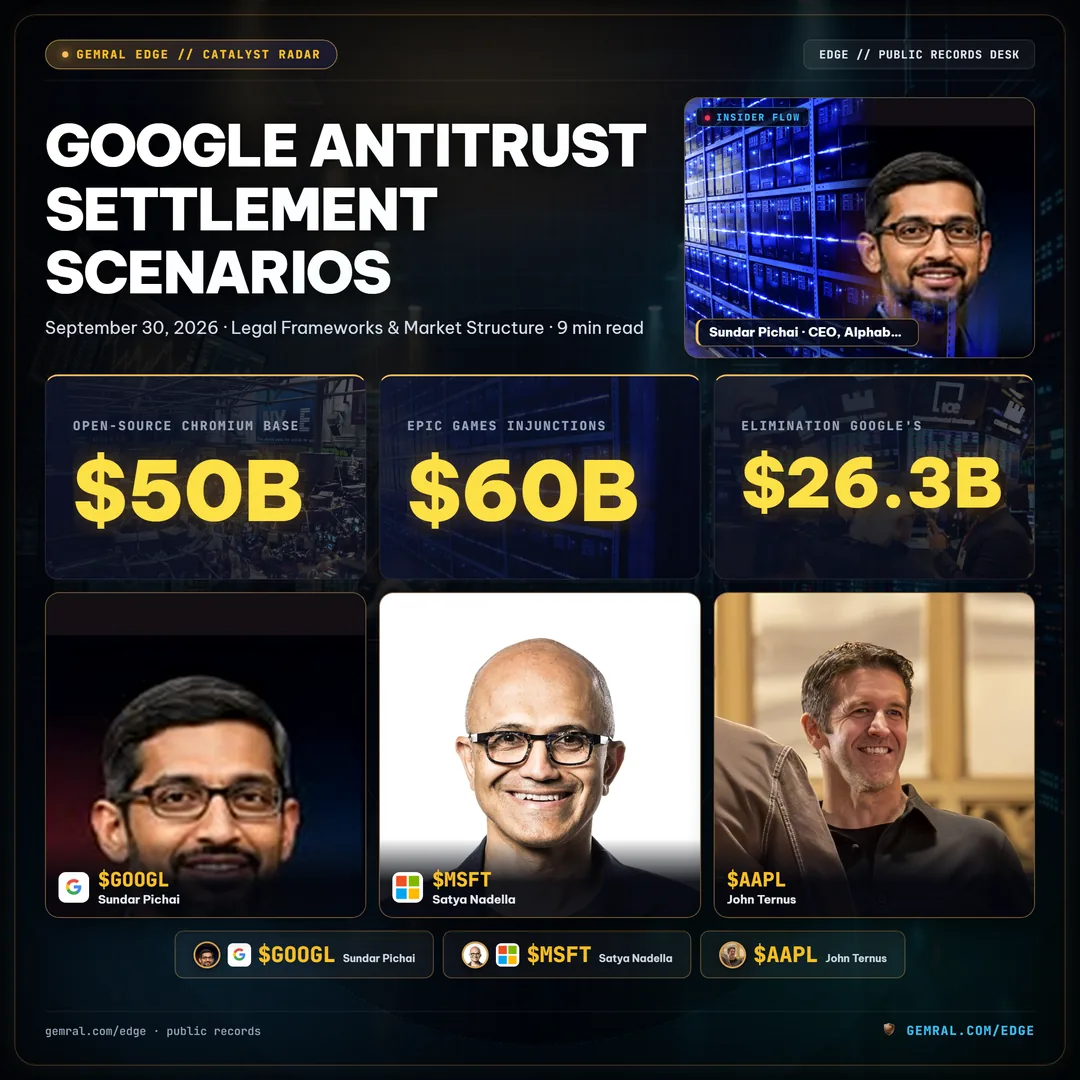
Separating the Chrome browser from Alphabet would eliminate Google's direct control over the world's most dominant web navigation surface. Chrome accounts for an estimated 35% of all Google search queries globally. If spun off as an independent entity valued at $50B, a divested Chrome could auction its default search engine placement to the highest bidder—such as Microsoft, OpenAI, or DuckDuckGo—instantly creating a competitive search market across 65% of global desktop web traffic.
3. Lessons from European Digital Markets Act (DMA) Precedents
Market participants assessing a potential google antitrust settlement can evaluate empirical evidence from the European Union, where Google implemented choice screens following the Digital Markets Act (DMA) enforcement in 2024.

European empirical data demonstrates that regulatory interventions yield measurable structural shifts across consumer search behaviors:
- Choice Screen Efficacy: European data indicates that when users are presented with a randomized selection of 5 search providers, between 75% and 82% still select Google voluntarily, demonstrating that brand equity and user habituation blunt the immediate impact of choice screens.
- Alternative Engine Gains: Niche privacy engines (such as Ecosia and DuckDuckGo) observed immediate market share increases of 1.5% to 3.0% in specific EU member states, proving that removing default exclusivity allows competitive entrants to gain viable footing.
- Browser Competition: Independent browser developers reported multi-fold spikes in download volume, with Firefox and Opera experiencing a 250% surge in EU installations when Apple and Google unbundled Safari and Chrome defaults under European mandates.
4. Strategic and Valuation Implications for Public Markets
For institutional investors, the resolution of the google antitrust settlement process carries nuanced valuation implications. Paradoxically, the elimination of Google's $26.3 billion annual TAC expense could provide a substantial boost to Alphabet's operating margins if organic retention remains above 70%.

Conversely, for Apple, losing $20.1B in annual pure-profit licensing revenue represents an approximate 15% reduction in annual operating income, forcing Cupertino to accelerate subscription services or develop its own proprietary search technology. Financial models indicate that if Alphabet eliminates $26.3B in TAC while preserving 75% of query traffic, Alphabet's operating profit could expand by $6.5B annually, reshaping digital capital flows across the tech sector.
Furthermore, quantitative valuation analysis highlights that unbundling default contracts will accelerate corporate partnerships between device OEMs and emerging foundation model labs. If smartphone manufacturers are prohibited from granting exclusive search defaults to Google, device makers will likely establish multi-provider AI search suites, licensing contextual query routing from OpenAI, Anthropic, and Microsoft Copilot alongside Google Gemini. This diversification will de-risk ecosystem distribution, lower customer acquisition barriers for specialized search applications, and permanently restructure multi-billion-dollar mobile software licensing economics.
Regulatory & Investment Disclaimer: Public data · not investment advice. All regulatory precedents, valuation scenarios, and contractual estimates are based on public court records, SEC filings, and regulatory documentation from the U.S. Department of Justice and European Commission.