Google Antitrust Lawsuit: Search Monopoly Ruling and Structural Remedies
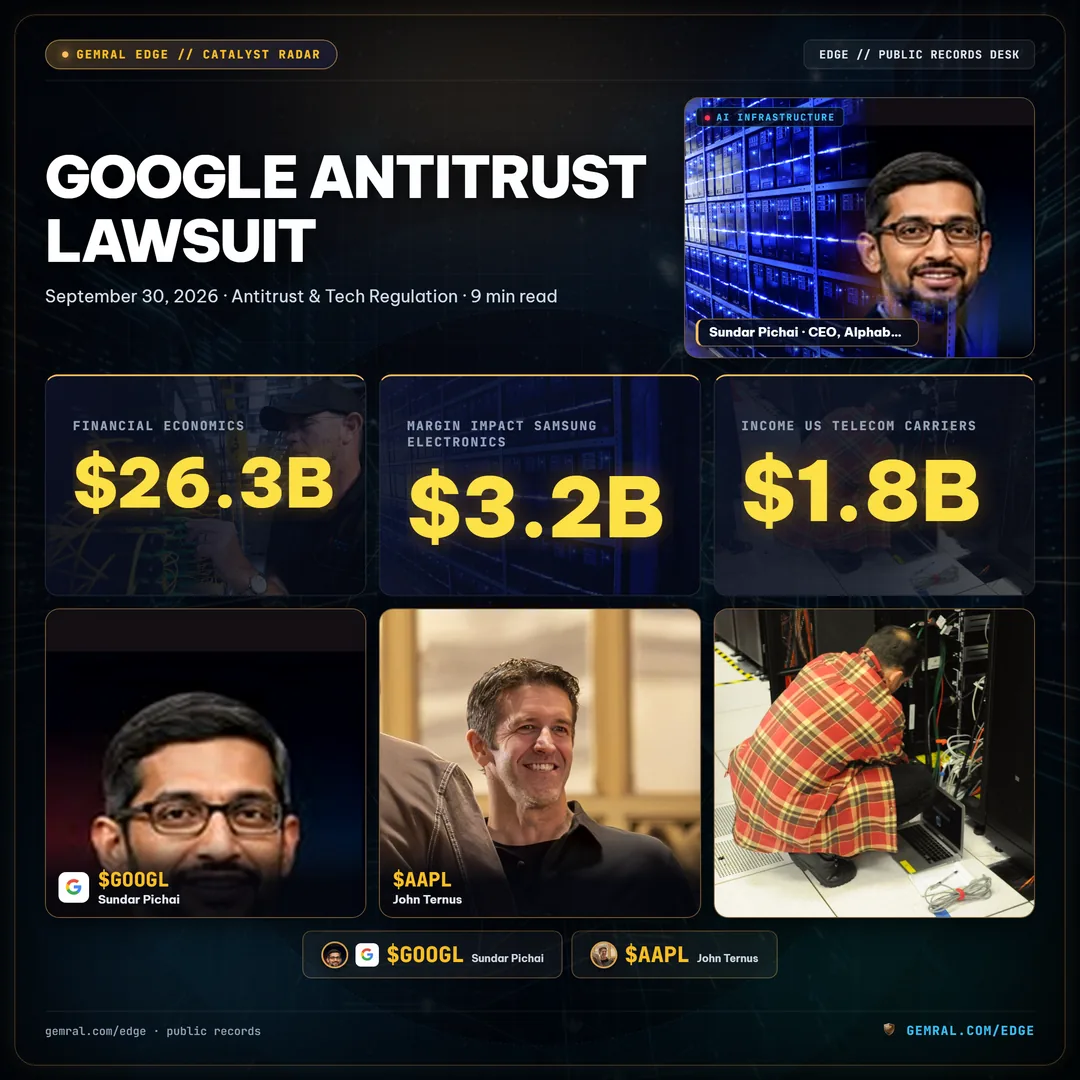
Google Antitrust Lawsuit: Search Monopoly Ruling and Structural Remedies
The historic decision issued in the google antitrust lawsuit has altered the regulatory landscape for mega-cap technology platforms, confirming that Alphabet maintained an illegal monopoly in general search services through exclusionary distribution agreements. To track the commercial fallout and potential structural divestitures, market analysts monitor the DOJ Google antitrust distribution remedy hub, auditing court filings against enterprise revenue models.
Following a ten-week trial in the U.S. District Court for the District of Columbia, Judge Amit P. Mehta issued a landmark 286-page memorandum opinion finding Google liable under Section 2 of the Sherman Act. The court determined that Google holds an 89.2% market share in general search services—rising to 94.9% on mobile devices—and that its multi-billion-dollar revenue-sharing agreements with browser developers, wireless carriers, and device manufacturers effectively foreclosed competing search engines from achieving minimum efficient scale. As the remedy phase commences, public filings reveal profound implications for Alphabet, Apple, and the broader internet advertising ecosystem.
1. The Liability Finding: Mechanics of Section 2 Sherman Act Violations
In the liability phase of the google antitrust lawsuit, the Department of Justice and state attorneys general successfully established two essential elements under Section 2 of the Sherman Act: possession of monopoly power in the relevant market and willful acquisition or maintenance of that power through exclusionary conduct.
Judge Mehta found that Google preserved its dominance not through product superiority alone, but by locking up default distribution touchpoints. The court specifically cited the Information Sharing and Revenue Share Agreements (RSAs) executed with Apple, Samsung, and major US telecom carriers. Under these contracts, partners agreed to set Google as the exclusive default search engine across all pre-installed browsers in exchange for a percentage of search advertising revenue generated on those devices. The court determined that Alphabet extracted over $175.0B in annual search advertising gross revenue while insulating its 89.2% desktop market share from competitive challenge.
2. Financial Economics of the $26.3 Billion Default Tax
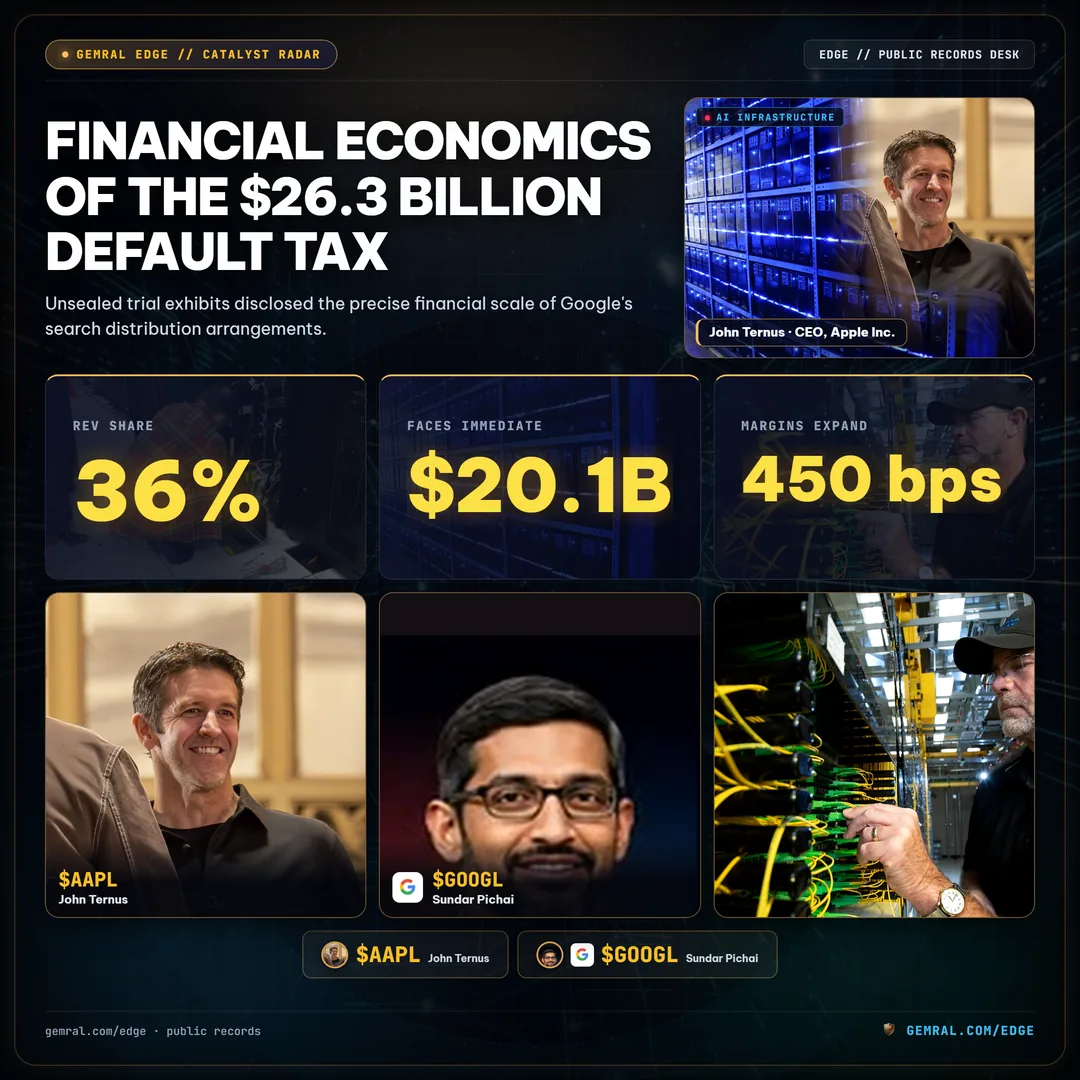
Unsealed trial exhibits disclosed the precise financial scale of Google's search distribution arrangements. In fiscal year 2021 alone, Google paid a staggering $26.3 billion in Traffic Acquisition Costs (TAC) to maintain default status across partner devices.
| Distribution Partner | Estimated Annual Revenue Share | Contractual Default Scope | Operating Margin Exposure |
|---|---|---|---|
| Apple Inc. (Safari) | $20.1 Billion (36% Rev Share) | Default Search on iOS, iPadOS, macOS | Direct Pre-Tax Services Margin Impact |
| Samsung Electronics | $3.2 Billion | Default Engine on Galaxy Hardware | Mobile Division Operating Income |
| US Telecom Carriers | $1.8 Billion (AT&T, Verizon) | Pre-loaded Search Widgets & Chrome | Wireless Services EBITDA |
| Mozilla Corporation | $450 Million (80% of budget) | Default Search Engine on Firefox | Core Foundation Operational Funding |
The unsealed revenue-share agreement with Apple revealed that Google transfers 36% of all search revenue generated through the Safari browser directly to Cupertino. If the court terminates these default revenue-sharing agreements, Apple faces an immediate $20.1B contraction in high-margin Services revenue, while Alphabet's operating margins could paradoxically expand by 450 basis points if users continue selecting Google organically without payment.
3. Proposed Remedies: Behavioral Choice Screens vs Structural Divestiture
With liability firmly established in the google antitrust lawsuit, the legal proceedings transition to the remedy phase. The Department of Justice's proposed remedy framework spans four distinct tiers of regulatory intervention:
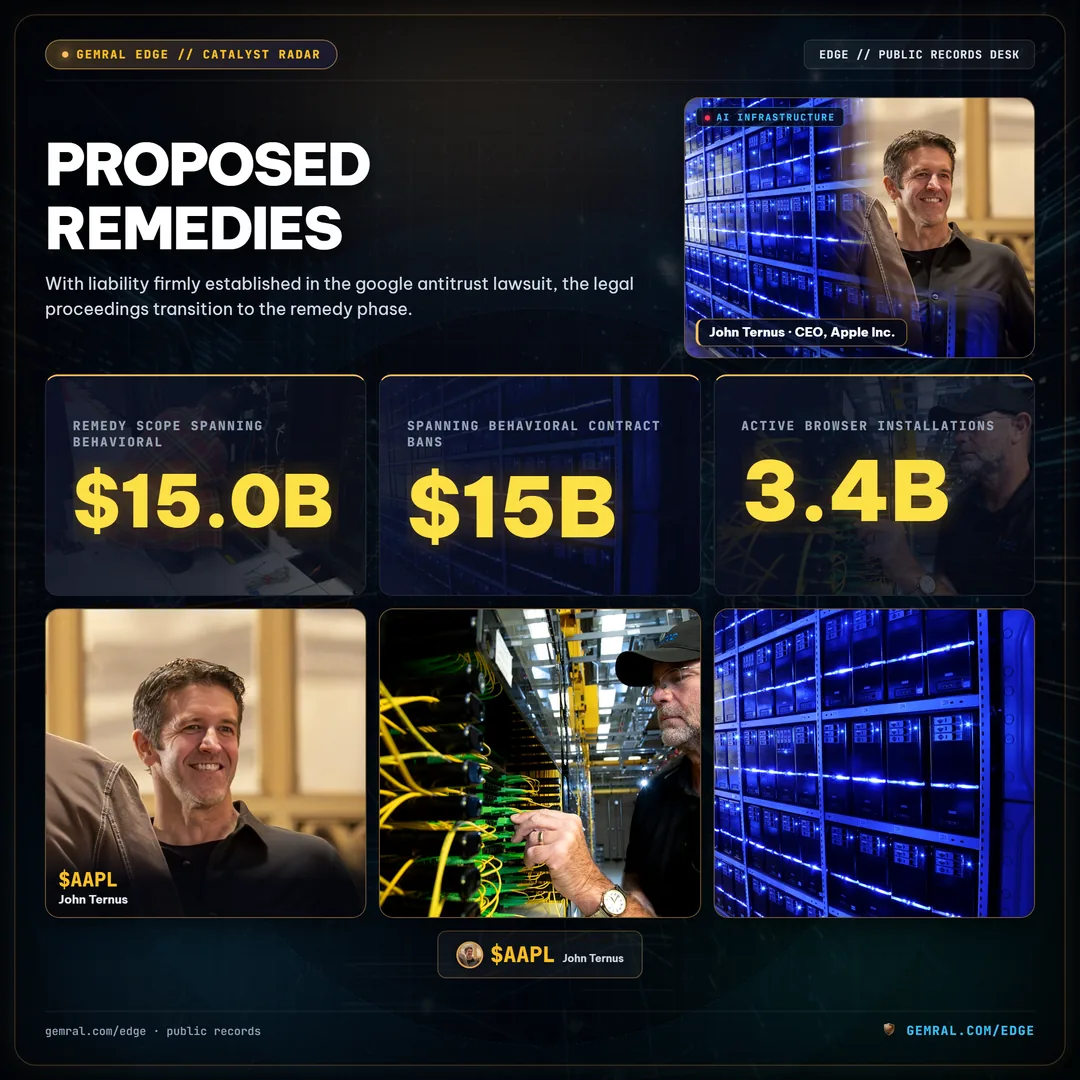
Antitrust regulators propose 4 remedy tiers that could redistribute up to $15.0B in annual search advertising spend away from Google, impacting over 3.4B active browser installations across global hardware ecosystems:
- Prohibition of Exclusive Default Contracts: Banning revenue-sharing agreements that require default search placement on mobile devices and web browsers. Partners would be free to negotiate non-exclusive placements across 100% of consumer hardware channels.
- Mandatory Choice Screens: Forcing Android and Apple operating systems to present a randomized "ballot screen" upon initial device activation, requiring users to explicitly choose their preferred search engine among 5 distinct providers.
- Search Index Syndication and Data Sharing: Compelling Google to license its underlying search index, ranking signals, and user interaction click-and-query telemetry to competing engines at a marginal cost below 0.05% of standard commercial rates.
- Structural Separation: Forced divestiture of key distribution assets, including the Chrome browser with its 65% market share, the Android mobile operating system, or Google Play store infrastructure.
4. Industry Impact on Artificial Intelligence and Digital Ads
The resolution of the google antitrust lawsuit arrives during a generational transition from keyword-based search to generative AI retrieval systems. Traditional search engines relied heavily on query volume scale to refine ranking algorithms; access to user query streams served as an insurmountable competitive moat.

AI search query volume expands by 140% year-over-year, while projections suggest conversational answer engines could capture 25% of commercial search queries by 2028, compressing Alphabet's 70% advertising gross margins. If remedy orders mandate the unbundling of search distribution and require open licensing of training index data, venture-backed generative AI platforms will obtain direct access to distribution channels previously foreclosed by exclusive contracts. However, structural remedies will face protracted appeals, prolonging market uncertainty across public technology equities.
Regulatory & Investment Disclaimer: Public data · not investment advice. All market share data, financial contractual figures, and legal findings are derived directly from public judicial opinions and unsealed trial exhibits in United States et al. v. Google LLC (Civil Action No. 20-cv-3010, D.D.C.).