Google Antitrust Appeal: Legal Strategy & Timeline
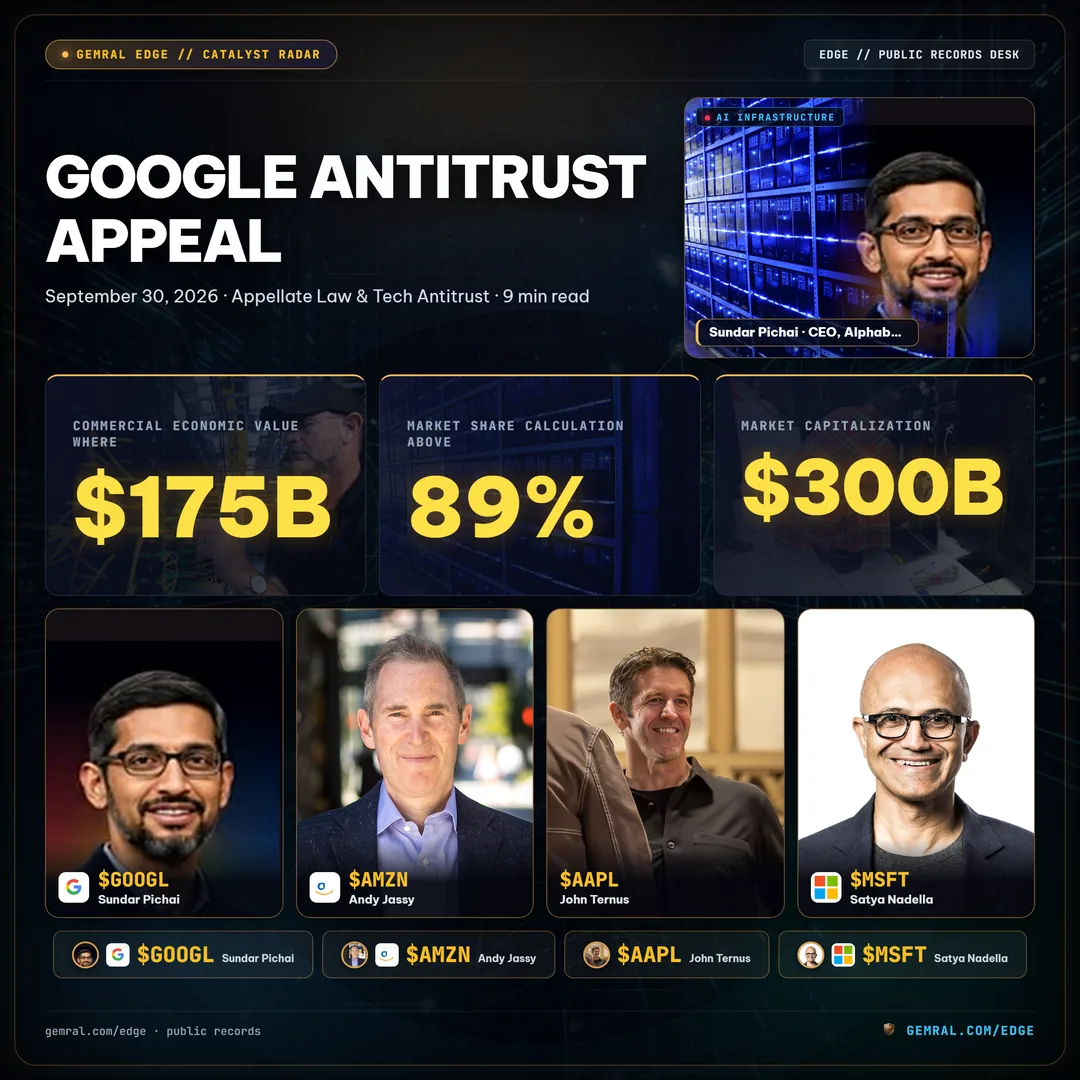
Google Antitrust Appeal: Legal Strategy and Court of Appeals Timeline
Following Judge Mehta's liability finding against Alphabet, corporate legal teams have begun orchestrating the google antitrust appeal, preparing a multi-year challenge before the US Court of Appeals for the District of Columbia Circuit. To evaluate how appellate timelines and legal arguments impact equity valuation volatility, market participants follow the Google antitrust distribution remedy radar, analyzing federal docket filings and judicial briefing schedules.
In federal antitrust jurisprudence, an appeal cannot be formally docketed until the trial court enters a final judgment, which requires concluding both the liability and remedy phases. As Judge Mehta finalizes remedial decrees addressing Google's exclusive distribution agreements, Alphabet will invoke its statutory right of appeal under 28 U.S.C. § 1291. Understanding the central legal arguments of the google antitrust appeal, the composition of the DC Circuit, and the multi-stage appellate timeline is crucial for assessing long-term regulatory overhang on mega-cap tech equities.
1. Core Legal Arguments: Google's Appellate Doctrine
In its anticipated google antitrust appeal to the DC Circuit, Alphabet's appellate litigation team will focus on three primary doctrinal challenges to Judge Mehta's Section 2 liability findings:
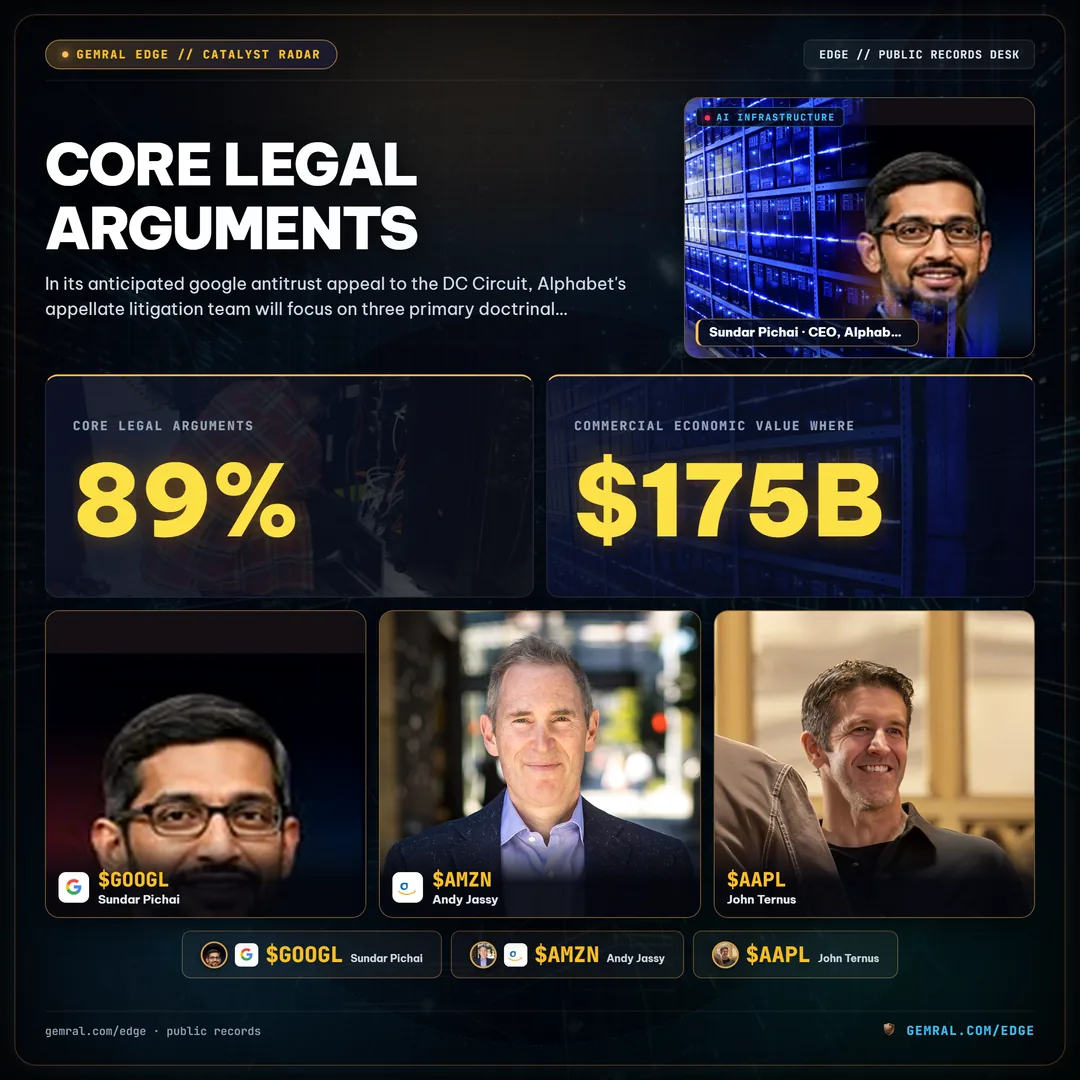
First, Google will challenge the legal standard applied to exclusive dealing contracts under Section 2. Alphabet will argue that its revenue-sharing agreements were non-coercive partnerships generating over $175B in commercial economic value where partners willingly chose Google because of its monetization superiority, relying on the Supreme Court's precedent in United States v. Grinnell Corp. (1966) and the principle that competition for an exclusive contract is a legitimate form of competition.
Second, Alphabet will contest the definition of the relevant product market. Google maintains that Judge Mehta improperly excluded specialized vertical search engines (such as Amazon for product search, Expedia for travel, and TikTok or Reddit for discovery) as well as emerging generative AI search tools, artificially inflating Google's market share calculation above 89% across traditional web search portals.
Third, Google will assert that the court failed to properly weigh pro-competitive justifications, specifically how default agreements allowed partners like Mozilla to provide free open-source software and incentivized Apple and Samsung to continuously upgrade consumer hardware security across hundreds of millions of devices.
2. Procedural Timelines: The Path Through the DC Circuit
Federal appellate procedure dictates a structured, sequential schedule for complex commercial appeals. Below is the projected milestone timeline governing the google antitrust appeal process:
| Appellate Phase | Projected Calendar Window | Procedural Milestone |
|---|---|---|
| Final Remedy Order Entered | Mid 2025 | District Court issues final remedial injunction under Section 2 |
| Notice of Appeal Filed | Within 30 Days of Final Order | Alphabet files formal notice with DC Circuit under FRAP 4(a) |
| Motion for Stay Pending Appeal | Immediately Following Notice | Google requests stay of structural divestitures pending appellate review |
| Appellate Briefing Schedule | Q3 2025 – Q1 2026 | Opening briefs, government response, amicus filings, and reply briefs |
| Oral Arguments Held | Spring 2026 | Three-judge panel of the DC Circuit hears oral arguments |
| Panel Decision Issued | Late 2026 / Early 2027 | Written opinion affirming, reversing, or remanding for further proceedings |
| Supreme Court Certiorari Petition | Mid 2027 | Potential petition for writ of certiorari to the US Supreme Court |
Critically, the filing of an appeal does not automatically pause a district court's injunction. Alphabet must persuade either Judge Mehta or the DC Circuit to grant a stay pending appeal within 30 days, arguing that implementing structural remedies—such as divesting Chrome or modifying complex codebases—would cause irreparable harm before the appellate court determines the legality of the underlying verdict.
3. Historical Precedent: The 2001 Microsoft Antitrust Precedent
The defining precedent for the google antitrust appeal is the historic 2001 DC Circuit decision in United States v. Microsoft Corp. (253 F.3d 34). In that landmark case, District Judge Thomas Penfield Jackson found Microsoft liable for monopolizing PC operating systems and ordered the structural breakup of Microsoft into two separate companies (an OS company and an applications company).

The legal parallels between the Microsoft precedent and Google's appellate defense provide critical institutional insights:
- Reversal of Structural Breakup: On appeal, the DC Circuit unanimously reversed the structural breakup remedy, holding that the trial judge failed to hold adequate evidentiary hearings on remedy feasibility and that behavioral relief was more appropriate for dynamic software markets.
- Affirmance of Monopoly Maintenance: While overturning the divestiture, the DC Circuit affirmed the liability finding that Microsoft illegally maintained its monopoly by contractual exclusionary tying of Internet Explorer to Windows, establishing a precedent that Judge Mehta applied directly to Google's distribution agreements.
- Relevance to Google: Legal analysts anticipate the DC Circuit will follow a similar path in Google's appeal: upholding the liability finding regarding exclusionary default contracts while sharply curtailing or reversing any drastic structural breakup orders by a margin of 100% on remedy grounds.
4. Market Implications During Multi-Year Appellate Stasis
For capital allocators, the multi-year timeline of the google antitrust appeal ensures that radical structural changes to Alphabet's business model will not take effect overnight. Corporate operations will continue largely unimpeded while appellate courts debate legal nuances across a 24 to 36 month procedural horizon.
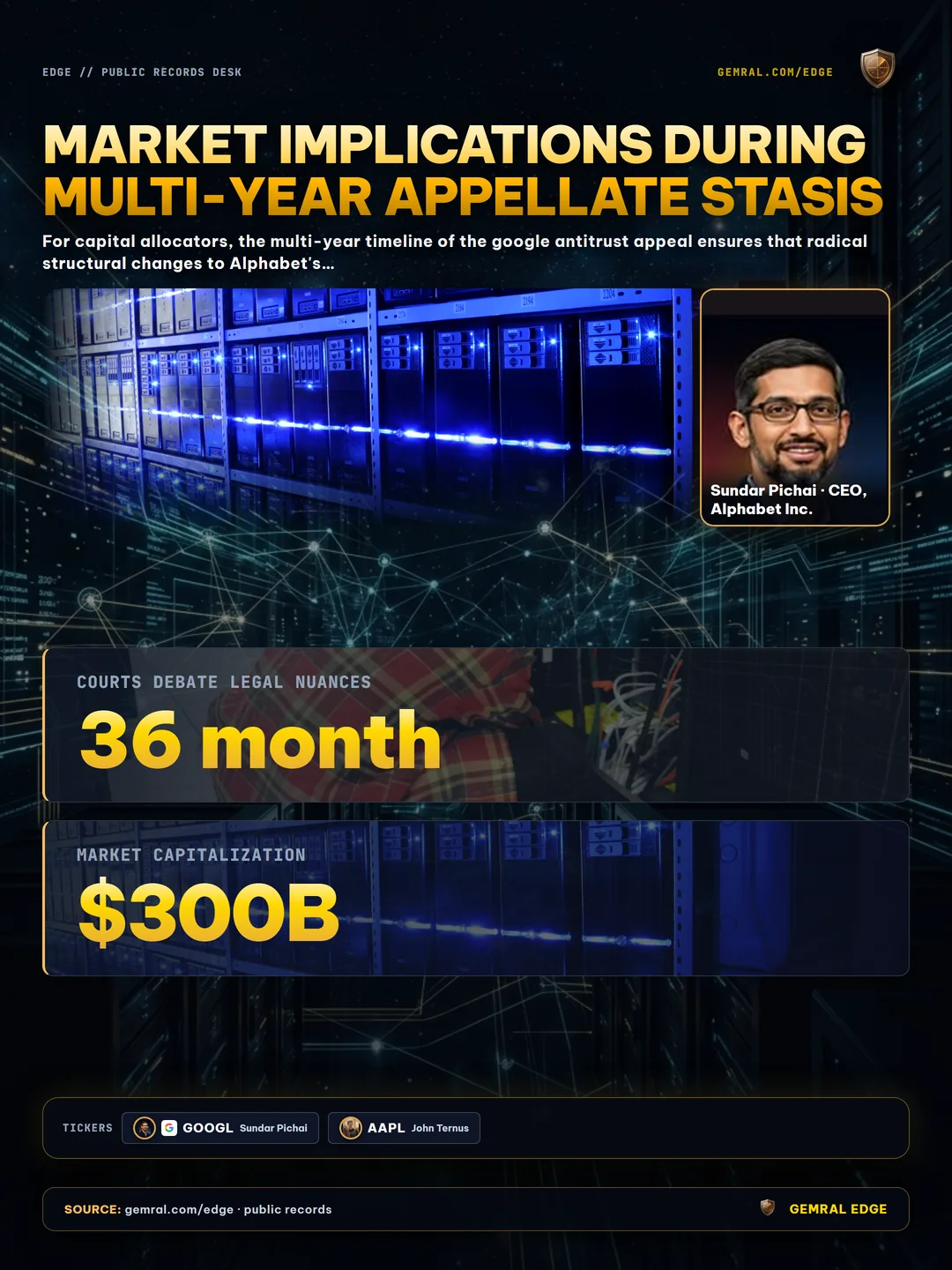
However, the existence of an affirmed liability finding fundamentally weakens Google's negotiating leverage in renegotiating distribution pacts, opening doors for rival platforms to secure distribution footholds on next-generation consumer hardware devices. Over $300B in combined market capitalization across Alphabet, Apple, and ad-tech intermediaries remains tethered to the procedural resolution of the appeal. By tracking appellate dockets and stay applications, investors can navigate regulatory event risk with verifiable institutional discipline.
Regulatory & Investment Disclaimer: Public data · not investment advice. All legal timelines, appellate arguments, and case citations are derived from public records, judicial opinions, and docket entries filed with the U.S. District Court for the District of Columbia and the U.S. Court of Appeals for the D.C. Circuit.