Colossus Datacenter GPU Power Consumption Calculator
xAI Colossus GPU Power & Utility Load Estimator
As artificial intelligence training models scale into hundreds of billions and trillions of parameters, electrical grid capacity has emerged as the definitive physical bottleneck for AI frontier labs. This WebMCP simulation tool calculates baseline silicon draw, PUE cooling penalties, utility substation load, and total annual electricity expenditure for megawatt-scale hyperscale supercomputing facilities.
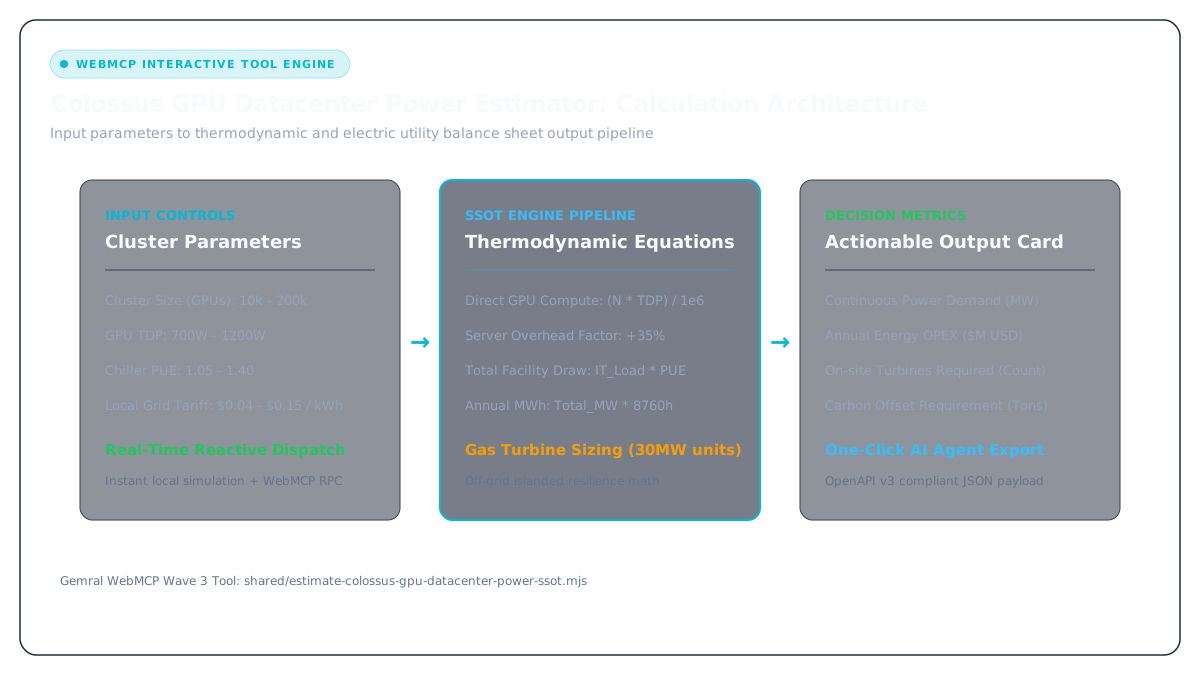
Colossus Megawatt Load & Power OPEX Calculator
Simulate instantaneous IT megawatt draw, facility cooling overhead, transformer headroom, and annual utility electricity OPEX for 100k+ GPU AI clusters.
- Base IT Silicon Load:
- Total Facility Grid Load:
- Annual Energy Consumption:
- Annual Electricity OPEX:
- Mobile Gas Turbines Needed (25MW each):
- Datacenter Infrastructure Tier:
Hyperscale Silicon Thermodynamics: Power Delivery Chain
Modern AI datacenter engineering operates under extreme thermal and electrical power densities. An individual NVIDIA H100 SXM5 GPU requires 700 watts of sustained continuous power, whereas Blackwell B200 and Ultra chips consume between 1,000 to 1,200 watts per package. When aggregated into an NVLink 8-way node, a single 4U server consumes over 10.2 kW including CPUs, high-speed InfiniBand NICs, memory modules, and onboard power stages.
Scaling this infrastructure to 100,000 GPUs in an architecture such as xAI's Colossus in Memphis, Tennessee requires solving massive multi-stage engineering challenges. Grid transmission at 161 kV must step down through regional utility substations to 13.8 kV distribution loops, followed by 480V unit substations, and finally 54V direct-to-rack DC distribution busbars. Every percentage of electrical transmission and conversion resistance translates into megawatts of parasitic heat that must be extracted.
At full utilization during large language model pre-training runs, the base IT equipment power for 100k GPUs exceeds 135 megawatts. When factoring in auxiliary network switches, optical transceivers, and storage petabytes, the raw compute footprint alone rivals the electrical load of mid-sized industrial smelting facilities.
Managing continuous electrical delivery without voltage drop or line sag requires dedicated high-voltage substation interconnections. Without purpose-built substation capacity, local municipal grids risk catastrophic transformer saturation during high-demand summer peak cooling hours.
PUE Efficiency & Direct-to-Chip Liquid Cooling Physics
The Power Usage Effectiveness (PUE) ratio represents the total energy consumed by the data center facility divided by the energy consumed by the computing equipment alone. A traditional air-cooled enterprise data center operates at a PUE between 1.4 to 1.6, meaning 40% to 60% of total energy is wasted on air handlers, chillers, and fans. In a 100k GPU installation, that inefficiency translates to an extra 40 to 60 megawatts of lost power.
In contrast, state-of-the-art facilities deploying direct-to-chip liquid cooling achieve PUE benchmarks between 1.15 and 1.25. Warm-water loops running at 32°C to 45°C inlet temperatures allow cooling towers to operate without mechanical compressor chillers during substantial portions of the annual meteorological cycle, generating tens of millions of dollars in annual utility OPEX savings.
Liquid cold plates mounted directly over GPU dies and companion memory stacks absorb over 80% of heat directly into closed water loops. The specific heat capacity of water is over 4,000 times higher than that of air by volume, enabling thermal extraction from compact 120 kW server racks that would immediately experience thermal runaway under conventional air circulation.
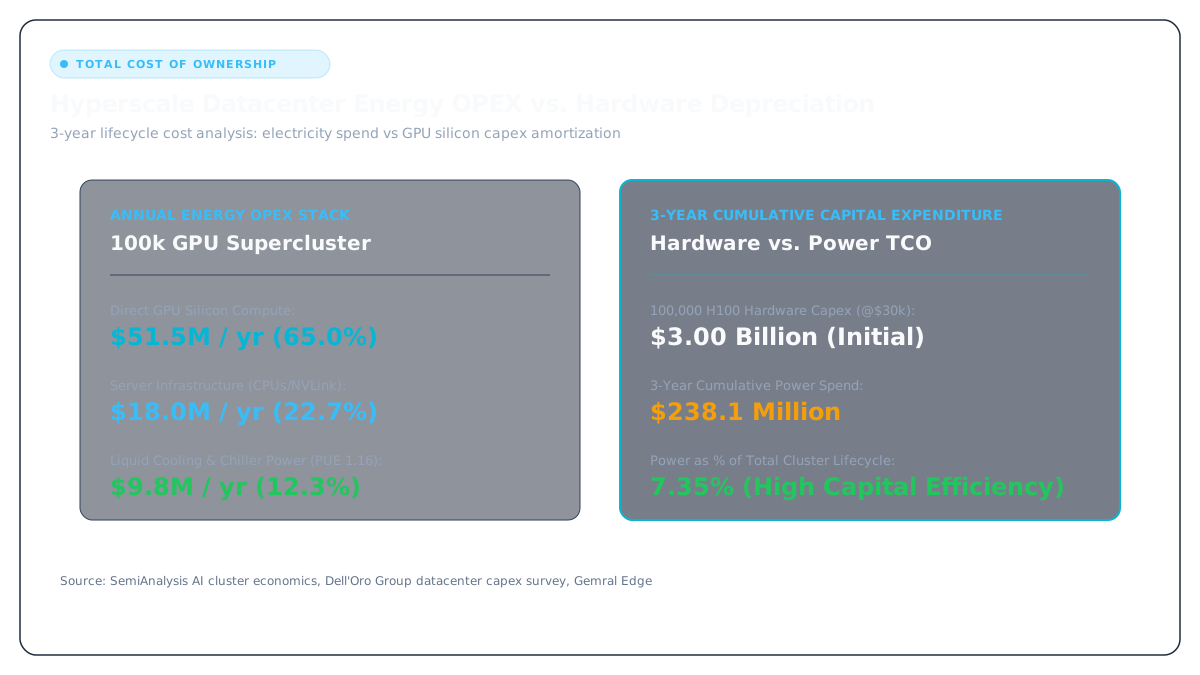
This simulation model incorporates thermodynamic PUE curves to dynamically calculate additional cooling fan and pumping overhead, demonstrating how lowering PUE from 1.30 to 1.16 directly yields over $14 million in annual power bill reductions.
Grid Interconnection Queues & On-Site Turbine Microgrids
To accelerate time-to-market and avoid the multi-year queue required for regional utility substation upgrades by Memphis Light, Gas and Water (MLGW) and Tennessee Valley Authority (TVA), xAI deployed a fleet of mobile gas turbine generators. Operating in tandem with 50 megawatts of initial utility grid supply, these onsite generators delivered temporary baseline power to fire up 100,000 GPUs within 122 days.
However, long-term commercial operations require permanent interconnection agreements and battery energy storage systems (BESS). A 100k GPU cluster undergoing synchronized gradient all-reduce cycles induces rapid 20-30 MW power swings in milliseconds. Without megawatt-class battery buffers to absorb dynamic load step changes, electrical harmonics can trigger protective utility breaker trips, shutting down the entire training job and corrupting neural network checkpoints.
Mobile aeroderivative gas turbines, such as the GE Vernova TM2500, deliver approximately 25 to 30 MW of flexible capacity per unit. Deploying a cluster of five to six turbines allows the facility to bridge generation deficits during grid curtailment events or peak industrial tariff windows.
Our engineering calculator projects the precise count of mobile turbine units required to achieve 100% off-grid autonomy or supplemental peak-shaving coverage based on specified cluster GPU counts and local grid tariffs.
Financial Sensitivity: Tariff Fluctuations & Annual Electricity OPEX
Electricity is the single largest ongoing operational expenditure for AI supercomputers. At an industrial rate of $0.075 per kilowatt-hour, a continuous 156 MW facility consumes over $102 million worth of electricity every single year. A modest one-cent fluctuation in regional utility tariffs shifts annual corporate cash burn by over $13.6 million.
This acute cost sensitivity drives AI infrastructure operators to negotiate long-term Power Purchase Agreements (PPAs) with utility operators, nuclear energy providers, and renewable hydro facilities. Regions offering sub-$0.05/kWh baseload power, such as the US Southeast, Pacific Northwest, or Nordic corridors, command massive valuation premiums for datacenter real estate.
Furthermore, sovereign carbon compliance frameworks and municipal environmental regulations increasingly impose carbon offset penalties on fossil-fired turbine microgrids. Operators must evaluate whether installing onsite solar plus megawatt-scale battery storage provides superior risk-adjusted return on invested capital.
By integrating variable industrial power tariffs from $0.03 to $0.25/kWh, our calculator provides infrastructure architects and financial analysts with transparent multi-scenario sensitivity modeling.
Next-Generation Scaling: 300,000 GPUs & Gigawatt Datacenters
As frontier AI developers prepare for next-generation foundation models, plans for 300,000 to 1,000,000 GPU installations are transitioning from theoretical concepts to active zoning proposals. At this monumental scale, total facility power demands escalate beyond 500 megawatts to over 1.2 gigawatts—equivalent to the entire output of a commercial nuclear power reactor.
Gigawatt-scale AI computing necessitates co-locating data center clusters directly adjacent to baseload energy generation assets, bypassing transmission lines entirely via 'behind-the-meter' campus designs. Strategic partnerships between hyperscalers and nuclear utility providers, such as Microsoft with Constellation Energy or Amazon AWS with Talen Energy, illustrate this profound paradigm shift.
Engineers must also redesign liquid cooling infrastructure for gigawatt facilities. Advanced two-phase immersion cooling systems and district heating networks that export server waste heat into municipal thermal systems will become standard engineering requirements.
The Colossus GPU Power Estimator serves as the definitive reference model for calculating the physical, electrical, and economic realities of hyperscale artificial intelligence infrastructure.
Access Real-Time Terminal Intelligence & Quantitative Signals
Unlock instant Telegram alerts, full congressional portfolio archives, and algorithmic catalyst radar.
Upgrade to Gemral Edge Pro ($39/mo)Frequently asked questions
How much power does a 100,000 GPU cluster consume?
For 100,000 GPUs running at 1,000W TDP with supporting servers and a modern PUE of 1.16, total facility load reaches approximately 156.6 Megawatts, requiring over 1.37 million MWh of annual electricity.
What is the primary difference between air cooling and liquid cooling PUE?
Air cooling systems operate at a PUE of 1.3 to 1.6 due to massive mechanical blowers and chillers. Direct-to-chip liquid cooling enables PUE efficiency of 1.15 to 1.20, cutting cooling energy consumption by over 50%.
Why are battery energy storage systems (BESS) necessary for AI supercomputers?
AI distributed training creates rapid 20-30 MW swings in milliseconds during collective all-reduce operations. BESS buffers absorb transient load surges and prevent substation breaker trips.
How does power tariff sensitivity impact AI cluster operational economics?
Every $0.01/kWh increase in industrial power rates adds approximately $13.7 million to the annual operating costs of a 156 MW supercomputing facility.
Risk Disclaimer
Trading and investing in digital assets, financial instruments, and predictive events involve substantial risk of loss and are not suitable for every investor. The predictive intelligence, probability distributions, historical precedents, and scenario modeling presented on this page are compiled for informational and research purposes only and do not constitute financial, investment, legal, or tax advice. Past performance and statistical precedents do not guarantee future outcomes. Always conduct independent due diligence before committing capital.