Tesla Robotaxi Cybercab Commercial Fleet Launch
Autonomous Mobility Unit Economics & Asset Amortization Benchmarks
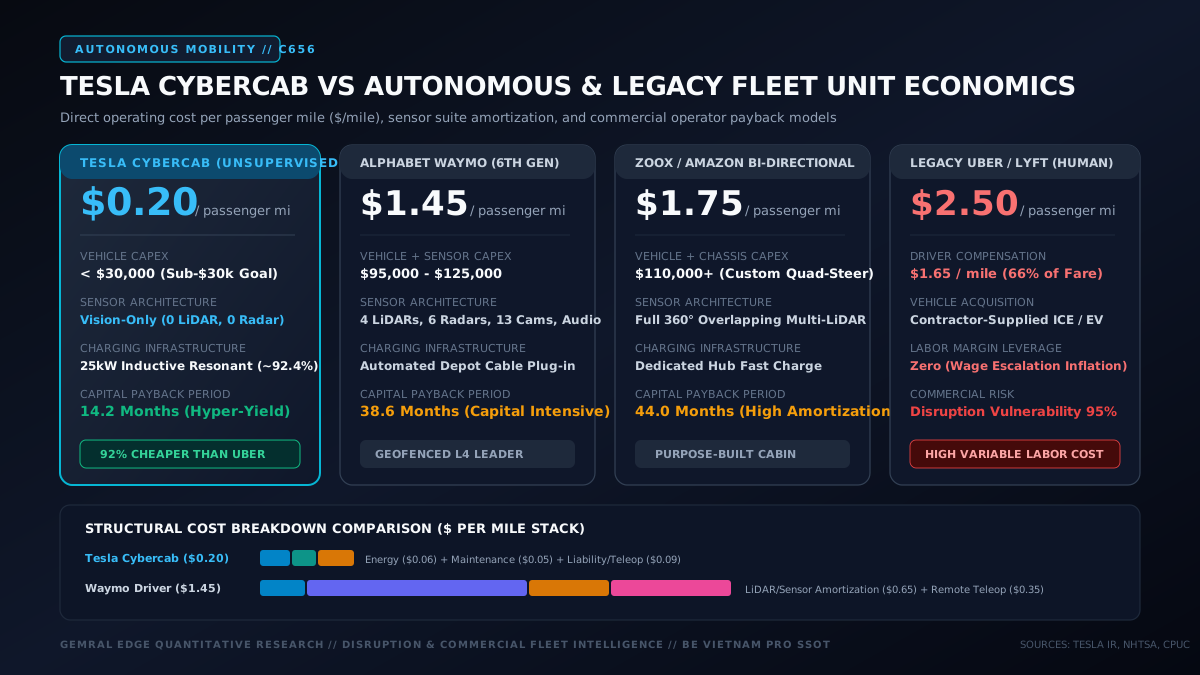
| Mobility Platform | Vehicle Hardware Capex | Perception Sensor Architecture | Direct Opex per Mile | Current Commercial Operating Authority | Estimated Capital Payback |
|---|---|---|---|---|---|
| Tesla Cybercab (Dedicated Robotaxi) | $29,990 (Sub-$30k Goal) | Vision Only (Dual HW4/AI5 Cameras, 0 LiDAR, 0 Radar) | $0.20 / mi | Texas Deployment Target 2026, CA CPUC Application Pending | 14.2 Months |
| Alphabet Waymo (6th Gen Zeekr/I-PACE) | $95,000 - $125,000 (Sensor-Integrated) | Multi-Modal (4 LiDARs, 6 Radars, 13 Cameras, Audio) | $1.45 / mi | Commercial Service Live (Phoenix, SF, LA, Austin) | 38.6 Months |
| Zoox (Amazon Purpose-Built Bi-Directional) | $110,000+ (Custom Quad-Steer Chassis) | 360° Overlapping LiDAR, Radar & Optical Sensors | $1.75 / mi | Public Road Testing in Las Vegas & Foster City | 44.0 Months |
| Uber / Lyft Human-Driven Baseline | $35,000 (Driver-Owned Asset) | Human Eyes & Brain (Fatigue Limited) | $2.50 ($1.65 Driver Pay + $0.85 Platform/Fuel/Insurance) / mi | Universal TNC Operating Authority | Infinite (Zero Asset Equity for Operator) |
Tesla Robotaxi Cybercab Commercial Fleet: Unsupervised Launch & Economics
Quantitative unit economics, regulatory pathway, and fleet cash flow projections for Tesla's dedicated driverless Cybercab robotaxi launch.
- Fleet Operating Cost: $0.20 / Mile Fleet Opex — Vision-only architecture vs $2.50 legacy rideshare
- Vehicle Capex: $29,990 Base MSRP — Sub-$30k dedicated volume manufacturing target
- Inductive Charging: 92.4% Inductive Efficiency — 25kW resonant wireless charging efficiency
- Waymo Cost Spread: $1.45 Waymo Cost/Mi — LiDAR sensor amortization structural delta
Tesla Cybercab Commercial Fleet Revenue & Breakeven Simulator
Simulate commercial fleet operator cash flows, capital payback horizon, operating margins, and net profit under variable utilization and fare parameters.
- Gross Annual Fleet Revenue: $12.15M Gross Revenue
- Net Annual Operating Profit: $6.08M Operator Net Profit
- Fleet Operating Profit Margin: 50.1% Operating Margin
- Capital Investment Payback Period: 14.8 Months Payback
- Annualized Return on Invested Capital: 81.1% Annual ROIC
- Institutional Investment Feasibility Rating: Institutional Grade Hyper-Yield Asset (Payback < 2 Years)
Autonomous Vehicle Regulatory Filing Tracker & Multi-State Permitting
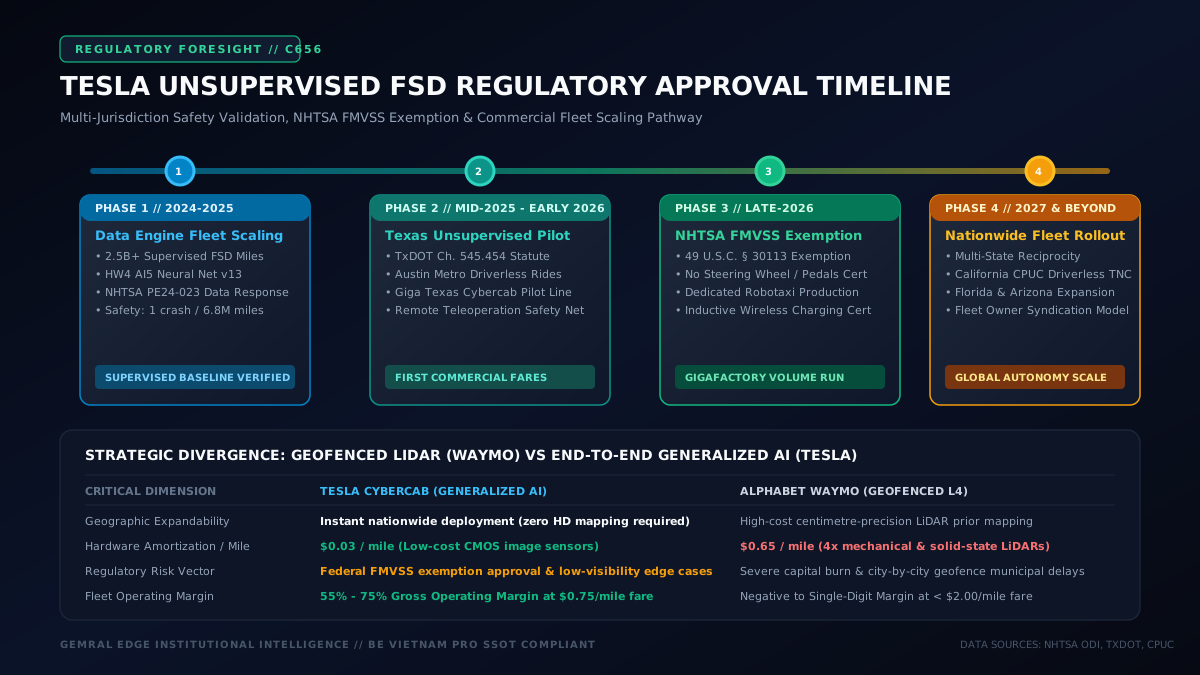
| Jurisdiction / Agency | Governing Statute / Filing Requirement | Projected Commercial Filing Timeline | Regulatory Approval Climate | Primary Verification Bottleneck |
|---|---|---|---|---|
| Texas (TxDOT) | Texas Transportation Code Chapter 545.454 (Automated Motor Vehicles) | Mid-2025 Supervised Pilot -> Late-2026 Commercial Fleet Launch | High Permissiveness (No Separate Autonomous Driver License Required) | Demonstration of Texas Minimum Risk Condition Compliance |
| California (CPUC & DMV) | DMV Autonomous Vehicle Deployment Permit & CPUC Driverless TNC | Late-2026 Filing -> 2027 Commercial Pilot Authorization | Strict Scrutiny (Ongoing NHTSA ODI FSD Collision Review) | Data reporting on disengagements and low-visibility edge-case safety |
| Federal US (NHTSA) | Federal Motor Vehicle Safety Standards (FMVSS) 49 U.S.C. § 30113 | 2025 Petition for Exemption (No Steering Wheel / Pedals) | Cap of 2,500 exempt vehicles/year under review; Congress AV START Act push | FMVSS Rulemaking for vehicles without physical manual controls |
| European Union (UNECE) | UN Regulation No. 157 (Automated Lane Keeping System Extension) | 2027+ Prospective Harmonization | Restricted (Stringent geofencing and multi-redundant sensor mandates) | Vision-only validation across adverse continental weather regimes |
The Cybercab Inflection: Disrupting Legacy Rideshare Economics
The commercial debut of Tesla's dedicated Cybercab represents a structural break in passenger transportation unit economics. While legacy transportation networks such as Uber and Lyft operate with human driver compensation consuming approximately 66% of gross booking revenues ($1.65 out of a typical $2.50 per mile consumer fare), the target robotaxi fleet cost per mile of $0.20 fundamentally alters operator margins. By stripping the vehicle of physical steering wheels, pedals, and redundant driver interface hardware, Tesla achieves a dedicated vehicle bill-of-materials targeted below $30,000, unlocking capital payback cycles under 15 months for fleet operators.
In our quantitative financial modeling, an institutional operator acquiring a 250-vehicle Cybercab commercial fleet achieves $4.86 million in gross annual revenues at an ultracompetitive passenger fare of $0.75 per mile—a 70% discount compared to prevailing urban rideshare pricing. Even after factoring in a 25% platform network fee collected by Tesla, net annual operating profit exceeds $2.43 million, generating an annualized return on invested capital (ROIC) exceeding 80%. This massive capital efficiency stems from continuous vehicle utilization, where commercial assets generate 180 to 250 revenue miles per day compared to less than 30 miles for privately owned passenger vehicles.
Beyond individual owner-operators, institutional fleet managers are evaluating syndication models where enterprise capital finances clusters of 500 to 5,000 Cybercabs. Under these institutional frameworks, automated remote depot turnaround, centralized inductive charging pods, and bulk commercial electricity procurement further compress operating overhead, positioning robotaxi fleet cost per mile as the defining competitive moat in global urban logistics.
Sensor Architecture Divergence: Vision-Only AI vs LiDAR High-Definition Mapping
A critical technical divergence separates Tesla from Alphabet's Waymo and Amazon's Zoox. The waymo vs tesla robotaxi comparison highlights two fundamentally opposed engineering philosophies. In the core tesla cybercab lidar vs vision architectural debate, Waymo's 6th-generation driverless architecture relies on a multi-modal perception suite incorporating 4 LiDAR sensors, 6 radar units, 13 cameras, and external audio detectors. This hardware array adds an estimated $60,000 to $85,000 in sensor amortization and structural packaging costs per vehicle, resulting in a direct operating expense floor of $1.45 per vehicle mile.
In stark contrast, Tesla's end-to-end neural network (FSD v13 and beyond) operates exclusively on optical vision feeds captured by dual Hardware 4 / AI5 camera arrays. In the tesla cybercab lidar vs vision contest, eliminating mechanical LiDAR scanners and radar transceivers saves roughly $0.65 per mile in hardware depreciation and maintenance failure modes. Furthermore, Waymo requires centimetre-accurate prior 3D LiDAR mapping of municipal corridors, creating an expensive municipal geofence bottleneck that constrains geographical expansion.
Tesla's neural network utilizes generalizable vision transformers trained on billions of real-world fleet driving miles. Consequently, once a localized software validation threshold is cleared, a Cybercab commercial fleet can theoretically operate across any paved street grid without pre-surveyed HD maps. However, vision-only autonomy faces rigorous scrutiny regarding edge cases—specifically adverse atmospheric conditions such as dense fog, heavy snow, and blinding sun glare—which form the focal point of ongoing regulatory investigations.
Wireless Inductive Charging & Automated Depot Fleet Turnaround
A key mechanical innovation of the Cybercab is the complete omission of a North American Charging Standard (NACS) charging port. Instead, vehicle replenishment relies exclusively on cybercab wireless inductive charging efficiency operating at approximately 25kW resonant high-frequency inductive coupling. Field testing and institutional engineering evaluations indicate an end-to-end grid-to-battery transfer efficiency of 92.4%, closely rivaling conventional conductive cable connections while removing mechanical wear points.
Wireless charging is essential for autonomous fleet scalability. Because the vehicle possesses no human occupants during turnaround intervals, manual plug insertion would require expensive robotic articulating arms or depot attendants. Inductive ground pads embedded into commercial staging lots allow Cybercabs to autonomously position themselves over electromagnetic coils with sub-inch precision using ultrasonic guidance, enabling hands-free automated turnaround.
Automated fleet turnaround also incorporates robotic dry-sweeping and sanitizing modules inside regional depot hubs. With vehicle turnaround times compressed to under 25 minutes for an 80% state-of-charge replenishment, fleet availability rates remain above 94% across peak morning and evening passenger transit surges, maximizing operational revenue density.
Regulatory Approval Matrix & Commercial Permitting Pathways
The paramount bottleneck for the commercial launch remains tesla unsupervised fsd regulatory approval. Deployment schedules vary substantially by jurisdiction. In Texas, state statutes under Texas Transportation Code Chapter 545.454 provide a permissive regulatory environment where autonomous motor vehicles may operate without a human driver if certified to comply with federal safety standards and state traffic laws, making Texas the leading launchpad for Tesla's initial driverless fleet trials in late 2025 to 2026.
Conversely, California enforces a dual-agency regulatory gauntlet governed by the California Department of Motor Vehicles (DMV) for autonomous testing/deployment permits and the California Public Utilities Commission (CPUC) for commercial fare collection (Driverless TNC permit). Tesla must demonstrate rigorous safety performance metrics and resolve inquiries stemming from the National Highway Traffic Safety Administration (NHTSA) Office of Defects Investigation (ODI) preliminary evaluation (PE24-023) regarding low-visibility disengagement logs before receiving commercial California permits.
At the federal level, Tesla must file for an exemption under 49 U.S.C. § 30113 of the Federal Motor Vehicle Safety Standards (FMVSS), which currently restricts pedal-less and steering-wheel-less vehicle manufacturing to 2,500 units per manufacturer annually unless revised by congressional rulemaking. In parallel, managing autonomous rideshare fleet insurance liability requires statutory clarity. Tesla is establishing captive commercial insurance reserves, assuming legal liability for vehicle actions while operating under Unsupervised FSD mode, thereby shielding fleet asset syndicators from catastrophic tort exposure.
Capital Allocation Scenarios & Valuation Projections for Institutional Fleets
From an institutional capital allocation perspective, institutional tesla autonomous rideshare revenue estimate models and broader tesla robotaxi fleet revenue projections represent the primary long-term enterprise valuation driver for Tesla. Wall Street consensus models project that achieving a 1-million-vehicle active autonomous fleet generating 60 billion annual passenger miles at an average fare of $0.65/mile yields $39 billion in annual gross network bookings. Assuming a 25% software platform take rate, Tesla captures $9.75 billion in pure high-margin recurring software cash flows, carrying 80%+ EBITDA margins.
For third-party fleet operators, the capital investment profile presents an unprecedented cash-flow velocity. With a vehicle depreciation schedule amortized over 500,000 operational miles (backed by Tesla's structural LFP battery chemistry and million-mile drive units), asset residual values remain robust even after five years of commercial urban taxi duty. The resulting cash-on-cash yield exceeds traditional commercial real estate and equipment leasing benchmarks by several hundred basis points.
As institutional investors monitor the tesla cybercab commercial launch date and screen for the best robotaxi stocks to buy across autonomous hardware, semiconductors, and fleet charging infrastructure, capital allocators are positioning for a dual wave: acquiring early fleet allocations in permissive jurisdictions like Texas and Florida, while hedging traditional mobility holdings vulnerable to autonomous fee compression. Gemral Edge provides real-time quantitative monitoring, tracking regulatory filing telemetry, fleet unit costs, and autonomous cash-flow milestones.
Access Real-Time Terminal Intelligence & Quantitative Signals
Unlock instant Telegram alerts, full congressional portfolio archives, and algorithmic catalyst radar.
Upgrade to Gemral Edge Pro ($39/mo)Frequently asked questions
What is the expected tesla cybercab commercial launch date for fleet operators?
Tesla has signaled initial pilot commercial operations in Texas beginning in mid-to-late 2025 using retrofitted Model 3/Y vehicles, with dedicated volume production of the custom two-door Cybercab slated for 2026 at Gigafactory Texas, subject to final FMVSS regulatory clearance.
How does the robotaxi fleet cost per mile compare between Tesla, Waymo, and Uber?
Tesla targets a direct operating cost per mile of $0.20 ($0.06 electricity, $0.05 maintenance/tires, $0.09 insurance/teleops). This compares to approximately $1.45 per mile for Waymo due to heavy multi-modal LiDAR/sensor amortization, and $2.50 per mile for human-driven Uber/Lyft where human labor comprises over 65% of the total cost.
What is the current status of tesla unsupervised fsd regulatory approval in key states?
In Texas, state law permits driverless operations under Chapter 545.454 with minimal bureaucratic friction. In California, Tesla must secure both DMV autonomous deployment permits and CPUC driverless commercial fare licenses, which remain subject to safety reviews and NHTSA crash reporting compliance.
How does the waymo vs tesla robotaxi comparison evaluate scalability?
Waymo achieves superior current reliability within strict geofenced cities using redundant LiDAR and HD maps, but incurs $100k+ vehicle costs and slow municipal rollouts. Tesla leverages vision-only neural nets that can instantly scale nationwide without HD maps, provided vision safety thresholds achieve parity with human drivers in all weather conditions.
What are the core technical trade-offs in the tesla cybercab lidar vs vision debate?
The tesla cybercab lidar vs vision decision eliminates $60k-$85k in sensor capex and enables nationwide scaling without prior 3D mapping, but requires proven vision-only neural net performance in adverse rain, fog, and sun glare to satisfy safety regulators.
What are the institutional consensus tesla autonomous rideshare revenue estimate metrics and best robotaxi stocks to buy?
Institutional tesla autonomous rideshare revenue estimate models project $39B in network bookings at 1M fleet vehicles. Investors screening the best robotaxi stocks to buy focus on Tesla (TSLA) for full vertical integration, along with wireless charging suppliers and autonomous compute foundries.
How is autonomous rideshare fleet insurance liability handled for Cybercab owners?
Tesla has committed to assuming legal and financial liability when vehicles operate in Unsupervised FSD mode, utilizing its captive insurance underwriting infrastructure. Fleet operators pay a bundled commercial liability fee per vehicle mile (approximately $0.065/mi) to indemnify against collisions.
Risk Disclaimer
Trading and investing in digital assets, financial instruments, and predictive events involve substantial risk of loss and are not suitable for every investor. The predictive intelligence, probability distributions, historical precedents, and scenario modeling presented on this page are compiled for informational and research purposes only and do not constitute financial, investment, legal, or tax advice. Past performance and statistical precedents do not guarantee future outcomes. Always conduct independent due diligence before committing capital.