NVIDIA Blackwell B200 Liquid Cooling & Overheating
Liquid Cooling Component Leaders & Market Share Allocation
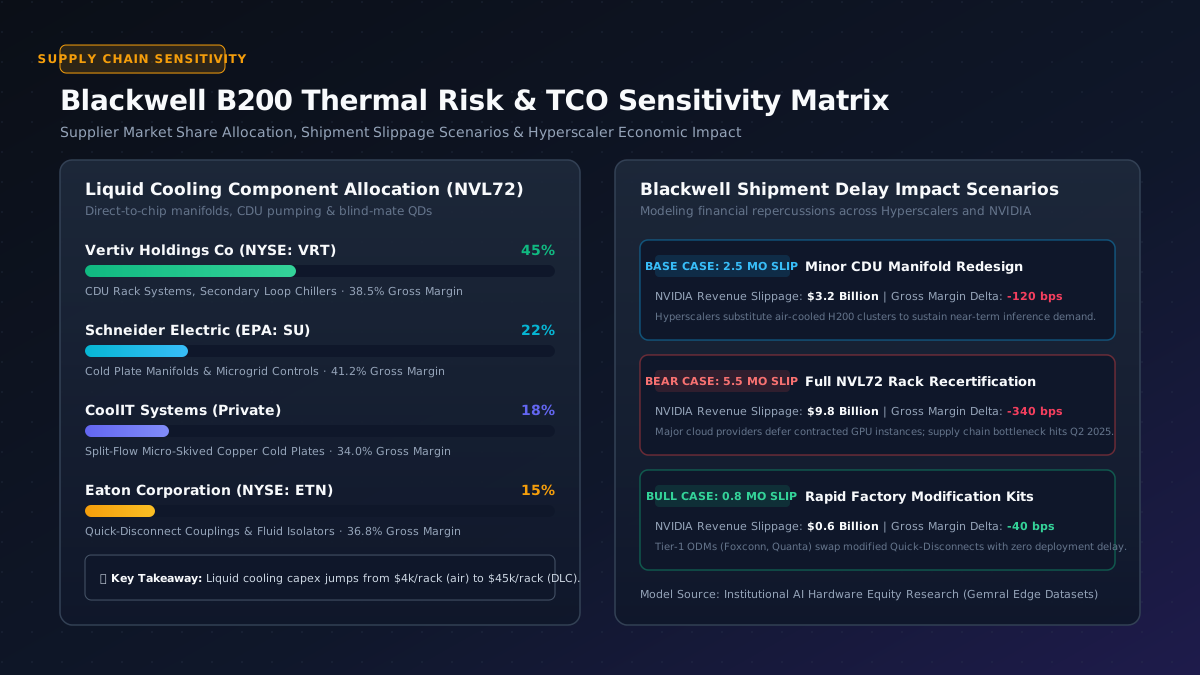
| Ticker | Supplier Name | Sub-System Supplied | NVL72 Allocation | Gross Margin | Engineering Moat & Supply Advantage |
|---|---|---|---|---|---|
| VRT | Vertiv Holdings Co | CDU (Coolant Distribution Units), Secondary Fluid Networks & Chillers | 45% Share | 38.5% Gross Margin | Co-engineered Liebert XDU systems certified natively with NVIDIA NVL72 architectures |
| SU.PA | Schneider Electric | Direct-to-Chip Cold Plates, Facility Heat Exchangers, Microgrid Control | 22% Share | 41.2% Gross Margin | Massive European & US hyperscaler turnkey datacenter power and liquid distribution scale |
| COOL (Private) | CoolIT Systems | Rack-level Manifolds, Blind-mate Quick Disconnects & Stainless Tubing | 18% Share | 34.0% Gross Margin | Pioneer in patented high-density split-flow cold plate design for 1000W+ AI silicon |
| ETN | Eaton Corporation | Hydraulic Quick Connect Couplings, Power Distribution Units (PDU), Leak Containment | 15% Share | 36.8% Gross Margin | Mission-critical electrical and fluid isolation safety interlocks for hyperscale pods |
NVIDIA Blackwell Ultra B200: Liquid Cooling Leaks, Thermal Limits & Supply Chain Allocation
Quantitative teardown of NVL72 132kW thermal density, blind-mate quick-disconnect failure modes, Vertiv CDU supply chain allocation, and hyperscaler shipment delay economics.
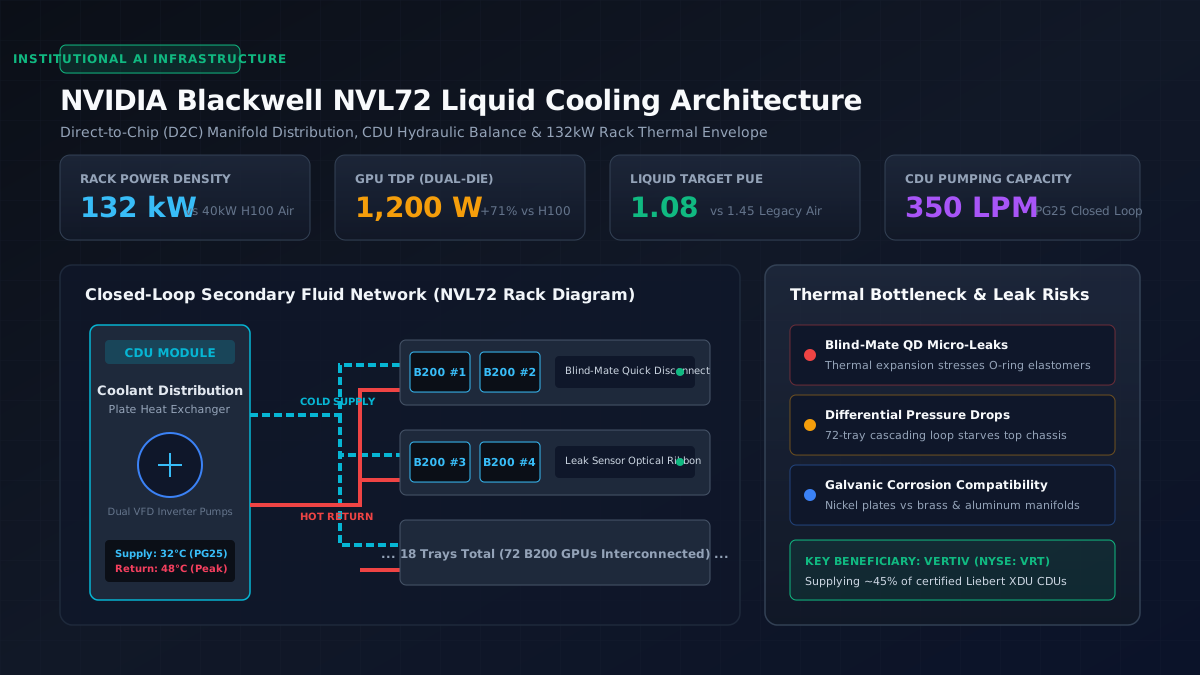
- NVL72 Rack Power Density: 132 kW / Rack Density — +230% vs H100 Air Enclosures
- B200 Dual-Die TDP: 1200W B200 TDP — 1200W vs 700W H100 Predecessor
- Direct Liquid Cooling PUE: 1.08 PUE (DLC) — 1.08 Target vs 1.45 Legacy Air
- CDU Flow Rate Capacity: 350 LPM Flow Rate — 350 LPM Closed-Loop Secondary PG25
Blackwell Server Rack Thermal TCO & Downtime Risk Simulator
Calculate datacenter energy savings, coolant leak probabilities, hardware replacement overhead, and net economic benefit across hyperscale AI clusters.
- Annual Facility Energy Savings: $1,818,313 Annual Power Savings
- Annual Leak Risk & Downtime Cost: $462,000 Leak Risk & Downtime Cost
- Net Annual Economic Value: $1,356,313 Net Annual Value
- Expected Annual Cluster Downtime: 9.6 Hours Cluster Downtime
- Expected Annual Leak Incidents: 1.2 Expected Leak Incidents
- Capital Expenditure Payback Horizon: 19.9 Months Payback
Hydraulic & Thermodynamic Failure Modes in High-Density AI Racks
| Failure Mode | Observed Frequency | Severity Level | Underlying Thermodynamic Root Cause | Engineering Mitigation & Redundancy Standard |
|---|---|---|---|---|
| Blind-Mate Quick Disconnect (QD) Micro-Leaks | 140 PPM | CRITICAL | Thermal expansion cycling between 25C standby and 85C peak compute stressing elastomeric O-ring seals | Transition to metal-to-metal secondary containment seals and optical fluorophore leak detection ribbons |
| CDU Manifold Differential Pressure Drop | 310 PPM | HIGH | Viscous shear resistance in 72-tray cascading fluid loops causing unequal coolant distribution to top chassis | Parallel dual-loop CDU redesign with active variable-frequency smart micro-valves per compute tray |
| Cold Plate Microchannel Cavitation & Vapor Locking | 85 PPM | SEVERE | Localized hot spots on 208-billion transistor dual-die substrate boiling coolant under sustained 1200W burst | Vapor-chamber hybrid heat pipes integrated directly beneath micro-skived copper pin-fin cold plates |
| Dielectric Fluid Galvanic Corrosion | 195 PPM | MODERATE | Electrochemical incompatibility between nickel-plated cold plates, brass fittings, and aluminum manifolds | Standardized all-copper / passivated stainless steel wet loops with real-time electrical conductivity telemetry |
Thermodynamics of 1200W Silicon: Dual-Die Packaging and Extreme Heat Flux
The fundamental physics driving the nvidia blackwell server rack overheating discourse stems from the transition to a 208-billion transistor dual-die substrate manufactured on TSMC 4NP node. While the Hopper H100 dissipated 700W across a single monolithic die, the nvidia b200 thermal design power escalates to 1200W per accelerator. When scaled to the flagship GB200 NVL72 configuration—packing 72 GPUs and 36 Grace CPUs into a unified compute fabric—the entire enclosure generates approximately 132kW of heat within a standard datacenter footprint.
At this extreme heat flux density exceeding 100W/cm2, traditional forced-air copper heat sinks encounter thermal saturation. The thermal conductivity of air is physically incapable of removing heat across microscopic silicon junction gaps without inducing catastrophic thermal throttling. Consequently, direct-to-chip liquid cooling transitioned from an exotic high-performance computing novelty into an absolute baseline requirement for contemporary AI datacenter construction.
Datacenter operators facing these unprecedented power envelopes must address the steep temperature gradients across compute trays. Junction temperatures must remain strictly below 85°C to preserve semiconductor electron mobility and prevent electromigration degradation. Achieving this thermal equilibrium requires an engineered balance of high-velocity fluid flow, corrosion-resistant metallurgy, and dynamic pressure stabilization.
Hydraulic Engineering & Blind-Mate Quick-Disconnect (QD) Leak Modes
The primary operational vulnerability in enterprise deployment is the prevalence of b200 liquid cooling leak issues. An NVL72 rack contains over 140 blind-mate quick-disconnect (QD) couplings linking sliding compute trays to the central vertical fluid manifolds. During routine operation, compute nodes undergo intense thermal cycling, shifting from 25°C idle standby to 85°C junction thresholds within seconds.
This rapid expansion and contraction creates continuous mechanical shear across elastomeric O-rings. A single direct to chip cooling failure resulting in a microscopic fluid seepage of just 0.05 cc/hr of propylene glycol (PG25) can trigger localized dielectric short-circuits, corrosive bridge formation, and multi-million dollar rack downtime. The industry is responding by integrating optical fluorophore leak detection ribbons and transitioning to secondary metal-to-metal containment sleeves.
Beyond connector fatigue, fluid dynamics within cascading 72-tray loops present severe challenges. Viscous shear resistance generates differential pressure drops between the lowest chassis closest to the pump and the uppermost trays. Without precision variable-frequency throttling valves, upper accelerators suffer from localized starvation, leading to premature thermal tripping during distributed tensor parallelism workloads.
The CDU Bottleneck: Vertiv Co-Engineering & Supply Chain Allocation
To counter hydraulic instability, hyperscalers rely heavily on specialized Coolant Distribution Units (CDUs). As the primary vertiv liquid cooling supplier blackwell partner, Vertiv (NYSE: VRT) has captured an estimated 45% allocation of NVL72 secondary fluid systems with its Liebert XDU architecture. CDUs serve as the hydraulic heart of the datacenter pod, regulating pressure across multi-stage inverter pumps and filtering particulates down to 50 microns.
Hyperscalers who previously sourced generic commercial plumbing are consolidating orders toward Vertiv and Schneider Electric to secure certified factory warranties against fluid manifold cavitation. CDU lead times have expanded to 36-48 weeks, making liquid thermal management the single longest critical-path equipment item in modern datacenter construction schedules, surpassing even medium-voltage substation transformers.
Vertiv engineering moat lies in its proprietary fluid-to-fluid heat exchanger cores and predictive telemetry software. By monitoring pressure differentials and acoustic pump cavitation signatures in real time, Vertiv systems can preemptively throttle compute trays before micro-leaks manifest into catastrophic component failures, cementing its position as an indispensable AI infrastructure enabler.
Datacenter PUE Economics: Capex Inflection from Air ($4k/rack) to Liquid ($45k/rack)
Transitioning from legacy air cooling to direct liquid cooling fundamentally transforms datacenter unit economics. Air-cooled server rooms typically operate at a Power Usage Effectiveness (PUE) of 1.40 to 1.55, expending 40% to 55% of their total power budget solely on giant CRAC/CRAH chiller fans and air handlers. In contrast, direct liquid cooling drops PUE to 1.08, unlocking massive operational power savings that allow operators to allocate more electrical megawatts directly to compute.
However, the capital expenditure required to equip a server rack jumps tenfold—from approximately $4000 for high-velocity air ducts and baffle panels to over $45000 for stainless steel manifolds, cold plates, leak-sensing fluorophore telemetry, and automated de-aeration valves. For a typical 100MW AI campus deploying 750 NVL72 racks, thermal infrastructure represents an incremental $30M+ upfront investment.
Despite high initial outlays, the return on investment is overwhelmingly positive for high-utilization clusters. Energy cost reductions averaging $1.8M annually per 50 racks offset the higher initial capex within 14-18 months. Furthermore, liquid cooling enables chip packing densities that reduce datacenter physical footprint by up to 60%, drastically cutting real estate acquisition and structural foundation expenses.
Wall Street Sensitivity Analysis: Shipment Delay Scenarios & Liquid Equities
Recent disclosures regarding Blackwell delivery slippages have led institutional equity analysts to model three distinct trajectories for the blackwell delay shipment schedule update. In the base-case scenario, minor manifold redesigns and secondary seal reinforcements push volume deliveries back by 2.5 months into Q1 2025, resulting in approximately $3.2 billion in deferred NVIDIA revenue and a modest 120 bps gross margin headwind.
Hyperscalers such as Microsoft Azure, Amazon AWS, and Google Cloud have successfully bridged this latency gap by augmenting air-cooled H200 clusters. In a more severe bear-case scenario involving full NVL72 rack recertification, shipments slip by 5.5 months, deferring $9.8 billion in revenue and creating acute availability shortages for enterprise AI model training runs.
Investors evaluating the best datacenter liquid cooling stocks increasingly focus on Vertiv (VRT), Eaton (ETN), and Schneider Electric (SU) as primary structural beneficiaries whose order backlogs continue to expand regardless of short-term GPU silicon revisions. Even if GPU shipments encounter temporary quarterly slippage, the physical cooling infrastructure must be installed and commissioned months prior to silicon delivery, decoupling thermal supplier revenues from semiconductor fab cycles.
Access Real-Time Terminal Intelligence & Quantitative Signals
Unlock instant Telegram alerts, full congressional portfolio archives, and algorithmic catalyst radar.
Upgrade to Gemral Edge Pro ($39/mo)Frequently asked questions
What is the primary cause of nvidia blackwell server rack overheating?
Overheating issues in the NVL72 rack stem from an extreme power density of 132 kW per enclosure and a 1200W TDP per B200 accelerator. When 72 GPUs and 36 Grace CPUs are packed into 18 tight compute chassis, viscous friction in coolant manifolds and fluid distribution imbalance can starve upper trays of adequate coolant flow.
How severe are b200 liquid cooling leak issues in enterprise datacenters?
Each NVL72 rack features over 140 blind-mate quick-disconnect couplings. Under intense thermal cycling between 25°C standby and 85°C compute load, elastomeric O-rings experience mechanical fatigue. While dielectric fluids minimize immediate short-circuiting, microscopic seeps trigger automated optical leak detection ribbons that shut down compute pods to prevent board degradation.
Why is Vertiv considered the key vertiv liquid cooling supplier blackwell partner?
Vertiv (NYSE: VRT) serves as the primary co-development partner for NVIDIA reference designs, producing the Liebert XDU coolant distribution unit. Capturing approximately 45% of certified NVL72 CDU allocations, Vertiv provides integrated pump redundancy, filtration, and precision fluid telemetry required by hyperscalers.
What is the current blackwell delay shipment schedule update for hyperscalers?
Current supply chain telemetry indicates volume shipments have slipped approximately 2 to 3 months from initial Q4 2024 targets into Q1 2025. This minor delay allowed NVIDIA and ODM partners to redesign cooling manifolds and reinforce quick-disconnect seals, with hyperscalers backfilling interim compute demand using H200 clusters.
What happens during a direct to chip cooling failure in a 132kW rack?
A direct to chip cooling failure—such as microchannel vapor locking or pump cavitation—causes rapid thermal spikes exceeding 95°C within milliseconds. Compute nodes automatically trigger hardware throttling or emergency shutdown to prevent silicon latch-up, requiring redundant dual-pump CDU failover systems.
Which companies represent the best datacenter liquid cooling stocks to buy?
Beyond NVIDIA, top institutional liquid cooling equities include pure-play thermal leader Vertiv Holdings (NYSE: VRT), electrical and hydraulic coupling specialist Eaton Corporation (NYSE: ETN), and European infrastructure conglomerate Schneider Electric (EPA: SU).
How does nvidia b200 thermal design power compare to previous GPU generations?
The B200 dual-die architecture features a thermal design power (TDP) of 1000W to 1200W, representing a 71% increase over the 700W H100 Hopper and a 300% increase over the 400W A100 Ampere generation, cementing liquid cooling as mandatory for modern AI infrastructure.
Risk Disclaimer
Trading and investing in digital assets, financial instruments, and predictive events involve substantial risk of loss and are not suitable for every investor. The predictive intelligence, probability distributions, historical precedents, and scenario modeling presented on this page are compiled for informational and research purposes only and do not constitute financial, investment, legal, or tax advice. Past performance and statistical precedents do not guarantee future outcomes. Always conduct independent due diligence before committing capital.