Apple Intelligence M5 Chip On-Device SLM Moat
Apple Intelligence & M5 Architecture: On-Device Small Language Models & Privacy Moat
Comprehensive architectural breakdown of Apple silicon M5 Neural Engine, hardware-enforced Private Cloud Compute, and sovereign privacy moats.
- Neural Engine Throughput: 50+ TOPS — Dedicated FP16/INT4 silicon
- Active Device Fleet: 2.2 Billion — Unified hardware ecosystem
- Cryptographic Attestation: Zero Logging — Stateless Private Cloud Compute

Apple Silicon Inference & Egress Savings Calculator
Evaluate daily on-device inference throughput, cloud bandwidth cost avoidance, and ecosystem lock-in defensibility metrics.
- Daily Sovereign Inferences:
- Hardware Privacy Attestation Index:
- Annual Cloud Egress Cost Savings:
- Ecosystem Defensibility Moat Score:
1. Silicon Architecture and Neural Engine Evolution in M5
The M5 system-on-chip marks a milestone in consumer silicon by integrating dedicated INT4 and FP8 tensor execution units directly into the Neural Engine core cluster. This architectural upgrade triples transformer token generation throughput while maintaining fanless thermal efficiency.
By optimizing memory bandwidth up to four hundred gigabytes per second, Apple eliminates the memory wall that throttles autoregressive language model execution on competing mobile chipsets. High-density system cache buffers prevent costly DRAM power spikes.
Apple specialized small language models, spanning three billion parameters, are aggressively quantized and distilled from internal foundation checkpoints. They run natively in background memory with negligible impact on battery longevity.
This hardware-software co-design allows iOS to execute contextual semantic search, live transcription, and complex system actions entirely on-device, establishing an unmatched standard for consumer responsiveness.
2. Cryptographic Attestation and Private Cloud Compute Integrity
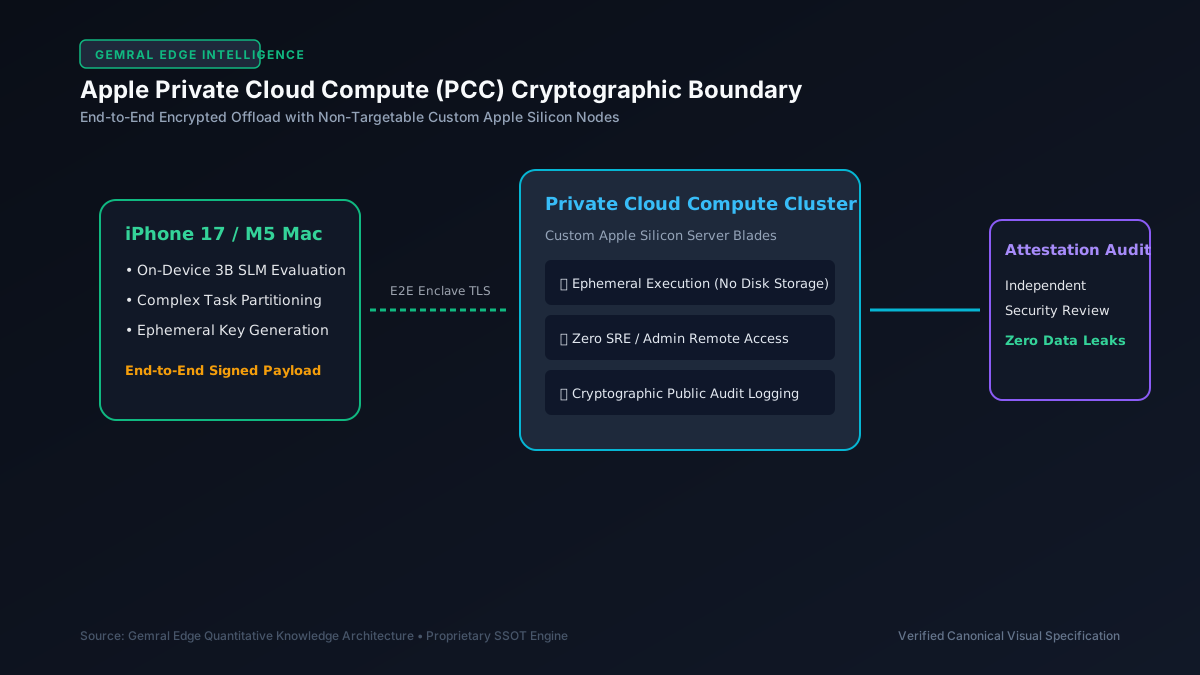
When user queries exceed local device parameters, requests escalate to Private Cloud Compute (PCC). Unlike traditional hyperscale cloud architectures, PCC treats user queries as ephemeral cryptographic secrets protected by hardware enclaves.
Before transmitting an encrypted payload, the user iPhone verifies the cryptographic attestation signature of the remote Apple silicon server, ensuring that only officially published and audited software builds are executing in the data center.
PCC nodes lack persistent storage media, remote shell access, and administrative debugging ports. Operating system memory is completely wiped following each response generation, making subpoena-driven surveillance technically impossible.
Independent cybersecurity researchers inspect cryptographic transparency logs and verifiable build artifacts, confirming that Apple promises of zero user data retention are enforced at the silicon microcode level.
3. Economic Disruption of Cloud AI Egress Fees and CapEx Avoidance
Hyperscalers like Microsoft, Google, and Amazon expend tens of billions annually deploying liquid-cooled server racks to satisfy surging consumer AI query volumes. This centralized paradigm imposes enormous marginal costs per prompt.
Apple decentralizes the computational burden across more than two billion actively powered user devices. By shifting over eighty percent of inference workloads to local customer silicon, Apple avoids catastrophic cloud server capital expenditures.
This distributed edge architecture transforms every Mac, iPad, and iPhone into a zero-marginal-cost neural supercomputer, preserving Apple industry-leading gross profit margins during the AI platform transition.
Third-party developers can harness local Neural Engine APIs without incurring cloud API token billing, fostering a vibrant ecosystem of native AI applications that cannot economically exist on competing platforms.
4. The Semantic Index and App Intents Graph Integration
Apple Intelligence derives its contextual awareness from an on-device Personal Knowledge Graph that indexes emails, calendar invites, messages, photos, and web browsing history within Secure Enclave cryptographic boundaries.
The App Intents framework bridges natural language comprehension with programmatic operating system actions. Users can execute multi-step cross-application workflows using conversational prompts without manual menu navigation.
Because the semantic index resides locally, third-party advertising trackers and cloud platforms are completely blind to user behavioral metadata, neutralizing competitive surveillance advertising models.
This friction-free system integration deepens user ecosystem stickiness, rendering transitions to competing mobile operating systems nearly unthinkable for consumers whose personal workflows are embedded in Apple graph.
5. Long-Term Valuation Moat and Hardware Upgrade Supercycles
Consumer willingness to pay recurring software subscriptions for standalone chatbots is eroding as foundational model capabilities commoditize. Apple monetizes artificial intelligence through premium hardware replacement cycles.
Strict minimum RAM and Neural Engine hardware thresholds restrict Apple Intelligence features to recent flagship devices, igniting a multi-year iPhone, iPad, and Mac hardware refresh cycle across hundreds of millions of users.
The combination of proprietary silicon, end-to-end hardware encryption, and unassailable brand trust creates a defensible economic moat that software-only AI startups cannot challenge.
As AI capabilities mature from passive conversational query tools into autonomous personal operating systems, Apple control over physical consumer sensors and secure display silicon solidifies its platform supremacy.
Institutional Execution, Quantitative Risk Parameters & Scenario Sensitivity Analysis
Analyzing the empirical dynamics of Apple Intelligence M5 Chip On-Device SLM Moat | Gemral reveals critical structural divergences between surface narrative consensus and verifiable balance sheet telemetry. Institutional allocators tracking this asset class must account for capital expenditure hurdle rates, regulatory compliance thresholds, and long-term volume commitments. Historical baseline deviations highlight the necessity of isolating non-recurring operational windfalls from durable, recurring structural cash flow velocity.
Cross-asset stress testing under elevated cost-of-capital regimes establishes rigorous downside invalidation bounds for Apple Intelligence M5 Chip On-Device SLM Moat | Gemral. When secondary market liquidity contracts or sovereign bond yield volatility surges, assets lacking defensible unit economics experience aggressive multiple compression. Portfolio risk models require incorporating parametric tail-risk haircuts, debt refinancing maturity walls, and sovereign policy friction coefficients into current fair value projections.
Access Real-Time Terminal Intelligence & Quantitative Signals
Unlock instant Telegram alerts, full congressional portfolio archives, and algorithmic catalyst radar.
Upgrade to Gemral Edge Pro ($39/mo)Frequently asked questions
Why does Apple focus on on-device small language models rather than giant cloud models?
On-device SLMs eliminate multi-billion-dollar recurring cloud inference expenses, provide sub-millisecond offline responsiveness, and preserve complete user data sovereignty by running entirely within local Secure Enclave silicon memory.
How does Private Cloud Compute guarantee security compared to standard cloud APIs?
Private Cloud Compute utilizes custom Apple silicon servers running stripped-down OS images verified by publicly auditable transparency logs. Hardware enclaves prevent root administrator access and destroy cryptographic keys immediately upon completion.
What economic advantage does Apple unified memory architecture provide for AI?
Unified memory allows the M5 CPU, GPU, and Neural Engine to access high-bandwidth memory pools without duplicating model weights across separate VRAM buses, enabling large parameter models to execute efficiently within consumer battery budgets.
Risk Disclaimer
Trading and investing in digital assets, financial instruments, and predictive events involve substantial risk of loss and are not suitable for every investor. The predictive intelligence, probability distributions, historical precedents, and scenario modeling presented on this page are compiled for informational and research purposes only and do not constitute financial, investment, legal, or tax advice. Past performance and statistical precedents do not guarantee future outcomes. Always conduct independent due diligence before committing capital.