MicroStrategy Bitcoin Convertible Notes & Arbitrage
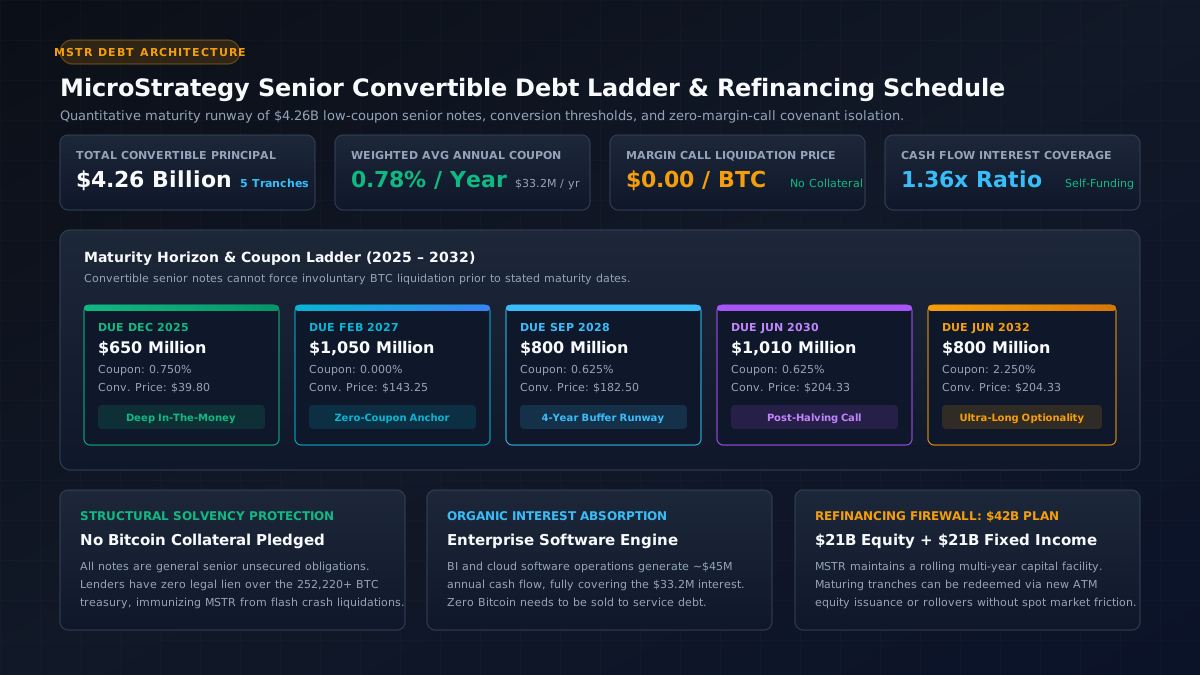
MicroStrategy Senior Convertible Debt Maturity & Refinancing Ladder
| Note Tranche | Maturity Date | Principal | Annual Coupon | Conversion Price | Parity Status | Refinancing Profile |
|---|---|---|---|---|---|---|
| 0.750% Convertible Senior Notes due 2025 | Dec 15, 2025 | $650M | 0.75% | $39.80 | Deep In-The-Money (Parity > 400%) | Zero (Equity conversion voluntary, cash settlement optional) |
| 0.000% Convertible Senior Notes due 2027 | Feb 15, 2027 | $1050M | 0.00% | $143.25 | In-The-Money | Negligible (Zero interest burden, ample equity buffer) |
| 0.625% Convertible Senior Notes due 2028 | Sep 15, 2028 | $800M | 0.63% | $182.50 | At-The-Money / Near Parity | Low (4-year runway, replaceable via ATM equity facility) |
| 0.625% Convertible Senior Notes due 2030 | Jun 15, 2030 | $1010M | 0.63% | $204.33 | Long-Duration Optionality | Very Low (6-year maturity horizon past next Bitcoin halving) |
| 2.250% Convertible Senior Notes due 2032 | Jun 15, 2032 | $800M | 2.25% | $204.33 | Long-Duration Optionality | Very Low (8-year runway through 2028 and 2032 halving cycles) |
MicroStrategy Bitcoin Convertible Notes: Refinancing & Volatility Arbitrage Playbook
Institutional teardown of Michael Saylor's $4.26B convertible debt flywheel. How MicroStrategy monetizes 60-90% equity implied volatility through delta-neutral hedge fund demand to perpetually accrete Bitcoin per share with zero margin call liquidation risk.
- Total Bitcoin Treasury Holdings: $252,220 BTC Treasury — Over 1.2% of total 21M circulating Bitcoin supply
- Senior Convertible Debt Principal: $4.26B Low-Coupon Debt — Weighted average interest rate across all tranches is 0.78%
- Year-To-Date BTC Yield Accretion: 17.80% BTC Yield YTD — Net expansion of Bitcoin holdings per diluted share
- Margin Call Liquidation Price: $0 Margin Call Floor — Unsecured structure carries zero Bitcoin collateral covenants
MSTR Convertible Note & Volatility Arbitrage Simulator
Stress-test MSTR NAV premium multipliers, new ATM equity issuance, BTC purchase pacing, and dilution yield accretion under varying spot Bitcoin regimes.
- BTC Treasury Fair Value: $16.39B BTC Treasury Value
- Underlying BTC NAV per Share: $74.52 BTC NAV / Share
- MSTR NAV Premium Ratio: 2.55x NAV Multiple (155.00%)
- BTC per Share Accretion: +8.75% BTC/Share Accretion
- Spot Bitcoin Acquired: +38,462 BTC Acquired
- Debt Parity BTC Floor: $16,890 Debt Parity BTC Floor

MicroStrategy Convertible Note Explained & Senior Debt Mechanics
Understanding microstrategy convertible note explained requires examining the unique capital structure pioneered by Michael Saylor since August 2020. MicroStrategy has issued five distinct tranches of senior convertible notes totaling over $4.26 billion. These instruments are convertible senior debt obligations that pay minimal nominal coupons ranging from 0.000% to 2.250%, with a weighted average cost of capital under 0.78%. Institutional purchasers receive a senior claim on corporate assets alongside an embedded call option on MSTR equity struck at a 30% to 40% conversion premium above prevailing stock prices.
The core economic appeal for fixed-income hedge funds is not the negligible coupon, but the extreme implied volatility of MicroStrategy stock, which frequently trades between 60% and 90% annualized IV. Convertible arbitrage funds—such as Citadel, Millennium Management, and Man Group—purchase the notes to isolate and capture this volatility. By establishing a delta-neutral hedge (buying the convertible note while dynamically shorting MSTR common stock), arbitrage funds monetize volatility fluctuations without directional Bitcoin price exposure.
This institutional demand enables MicroStrategy to raise billions in non-dilutive liquidity at negligible interest expense. The Saylor bitcoin buying debt strategy transforms Wall Street volatility arbitrage into physical spot Bitcoin reserves. Instead of using operating debt to fund capital-intensive plant and equipment that depreciates over time, MicroStrategy issues low-cost paper to acquire a pristine, supply-inelastic digital monetary asset.
MSTR NAV Premium Volatility Arbitrage & Accretive Dilution Dynamics
The heart of MicroStrategy's corporate strategy is the mstr nav premium volatility arbitrage. MSTR equity consistently trades at a significant premium to its Net Asset Value (NAV)—historically ranging between 1.5x and 2.5x the market value of its underlying Bitcoin holdings. Traditional equity analysts often label this premium irrational; however, quantitative analysis reveals that the premium is an institutional pricing mechanism reflecting leveraged Bitcoin exposure, high option gamma, structural liquidity, and index eligibility.
Crucially, Michael Saylor leverages this NAV premium to execute accretive share dilution through At-The-Market (ATM) equity offerings. In our mstr stock dilution risk analysis, we demonstrate that when a company trades at a 2.0x NAV premium, issuing $1.00 of new equity enables the purchase of $1.00 of spot Bitcoin, while only expanding the equity share count by $0.50 of underlying NAV value. Consequently, existing shareholders experience an expansion in Bitcoin holdings per share, a quantitative metric MicroStrategy designates as 'BTC Yield.'
During 2024 alone, MicroStrategy delivered an audited BTC Yield exceeding 17.8%, meaning every outstanding share commanded 17.8% more satoshis at year-end than at the beginning of the year. Far from being destructive shareholder dilution, selling high-premium equity to purchase spot Bitcoin at a 1.0x multiple creates persistent mathematical accretion. The announcement of the '42 Plan'—targeting $21 billion in ATM equity and $21 billion in fixed-income offerings over three years—formalizes this capital markets flywheel at sovereign scale.
MicroStrategy Liquidation Price Bitcoin Drop & Solvency Stress-Testing
A persistent market misconception involves the theoretical microstrategy liquidation price bitcoin drop. Retail commentary frequently alleges that a sudden decline in Bitcoin spot prices would trigger forced margin calls and catastrophic liquidation of MicroStrategy's 252,220+ BTC treasury. Institutional examination of MicroStrategy's SEC filings dismantles this myth: MicroStrategy's convertible notes are senior unsecured debt instruments that contain zero margin call covenants and zero loan-to-value (LTV) collateral pledge requirements.
Lenders have no legal right or operational mechanism to demand additional collateral or force Bitcoin liquidations during price downturns. The only collateralized facility MicroStrategy ever held—a $205 million Silvergate Bank loan that carried a potential margin threshold at $21,000 BTC—was fully repaid and retired in March 2023. Consequently, the actual liquidation price for MicroStrategy's Bitcoin holdings is precisely $0.00.
The primary financial obligation MicroStrategy faces is servicing its annual coupon interest of approximately $33.2 million. The company's legacy enterprise analytics software division generates approximately $45.0 million in annualized operating cash flow, providing a 1.36x organic interest coverage ratio without requiring the sale of a single satoshi. Furthermore, with debt maturities staggered between late 2025 and 2032, MicroStrategy possesses a multi-year liquidity runway to refinance or retire obligations through its active ATM facilities.
Best Bitcoin Treasury Company Stocks & Corporate Adoption Landscape
MicroStrategy's capital markets triumph has catalyzed a corporate treasury revolution, establishing a distinct asset class of best bitcoin treasury company stocks. While MicroStrategy remains the undisputed titan with 252,220+ BTC valued at over $16 billion, other publicly traded corporations are adopting differentiated balance sheet strategies. Mining enterprises like Marathon Digital Holdings (MARA) and Riot Platforms (RIOT) have shifted toward 'full HODL' strategies, retaining 100% of mined Bitcoin while issuing convertible notes to fund operational expansion.
In the small-cap corporate sector, Semler Scientific (SMLR) has adopted a programmatic Bitcoin treasury policy, deploying excess operating cash flow from its healthcare diagnostic business to accumulate over 1,050 BTC. In Japan, publicly listed Metaplanet (3350.T) has replicated MicroStrategy's playbook to hedge against catastrophic Japanese Yen depreciation, utilizing stock acquisition rights and debt to accumulate over 1,000 BTC and earning the moniker 'Asia's MicroStrategy.'
Despite these emerging entrants, MicroStrategy maintains an impregnable competitive moat. Its multi-billion-dollar market capitalization, inclusion in major benchmarks like the MSCI USA and Nasdaq 100, and institutional liquidity profile enable it to issue convertible debt at coupon rates that smaller competitors cannot replicate. MicroStrategy functions as the primary corporate transmission mechanism bridging global capital markets to Bitcoin.
MSTR vs BTC ETF Comparison & Institutional Portfolio Allocation
Following the approval of US spot Bitcoin exchange-traded funds in January 2024, institutional allocators must conduct a rigorous mstr vs btc etf comparison. Spot Bitcoin ETFs, such as BlackRock's IBIT and Fidelity's FBTC, provide pristine, unleveraged 1.0x exposure to spot Bitcoin, charging management fee expense ratios between 0.20% and 0.25% annually. In contrast, MicroStrategy offers dynamic non-recourse leverage, zero asset management fees to equity holders, and an actively accretive BTC Yield model.
A critical institutional distinction lies in benchmark index eligibility. Spot Bitcoin ETFs are structured as statutory grantor trusts, rendering them legally ineligible for inclusion in standard equity indices such as the S&P 500, Nasdaq 100, or Russell 2000. MicroStrategy, as an operating Delaware corporation, is already embedded in major passive equity indices, generating automatic, non-discretionary capital inflows from global mutual funds and target-date retirement accounts.
Furthermore, the ultra-liquid options market on MSTR equity enables sophisticated quantitative hedge funds to deploy convex derivative strategies, collar overlays, and volatility arbitrage that cannot be mirrored in spot ETF products. While spot ETFs serve as pure passive beta vehicles, MicroStrategy operates as a high-octane capital markets synthesizer that compounds Bitcoin per share across secular market cycles.
Corporate Bitcoin Treasury Equities Comparison Basket
| Ticker | Corporate Entity | Treasury Holdings | Market Value ($B) | Treasury Issuance Model | NAV Multiple | BTC Yield (Per Share) |
|---|---|---|---|---|---|---|
| MSTR | MicroStrategy Inc. | 252,220 BTC | $16.39B | Levered Convertible Notes & ATM Equity Volatility Arbitrage | 1.98x | +17.8% YTD |
| MARA | Marathon Digital Holdings | 26,842 BTC | $1.74B | Hybrid 100% Mining HODL + $250M Convertible Debt Issuance | 1.15x | +4.2% YTD |
| RIOT | Riot Platforms | 10,019 BTC | $0.65B | Pure-Play Mining Production Retention & Power Curtailment | 1.08x | +1.9% YTD |
| SMLR | Semler Scientific | 1,058 BTC | $0.07B | Corporate Healthcare Operating Free Cash Flow Sweep | 1.25x | +8.5% YTD |
| 3350.T | Metaplanet Inc. | 1,018 BTC | $0.07B | Japanese Yen Depreciation Hedge via Stock Acquisition Rights | 1.82x | +24.5% YTD |
Institutional Comparison: MicroStrategy (MSTR) vs Spot Bitcoin ETF (IBIT)
| Structural Metric | MicroStrategy (MSTR) | Spot Bitcoin ETF (IBIT/FBTC) | Strategic Alpha |
|---|---|---|---|
| Leverage Structure | Intelligent Non-Recourse Leverage (Convertible Debt at <1% Coupon) | 1.0x Unleveraged Spot Exposure (100% Cash Collateralized) | MSTR generates leveraged upside without liquidation margin calls. |
| Yield Accretion (BTC/Share) | Accretive BTC Yield (+17.8% YTD) via NAV Premium Share Issuance | Negative Yield (-0.20% to -0.25% per year due to ETF management fee) | MSTR holders gain more Bitcoin per share over time. |
| Volatility & Option Convexity | Extreme Volatility (60-90% IV), massive liquidity in equity options | Standard Crypto Volatility (40-60% IV), emerging options market | Hedge funds and quant allocators execute volatility arbitrage. |
| Valuation Multiple | Trades at 1.5x - 2.5x NAV Premium (Flywheel for Capital Raising) | Strict 1.0x NAV (Arbitraged continuously by Authorized Participants) | NAV premium allows MSTR to sell overpriced equity to buy underpriced BTC. |
| Institutional Index Inclusion | Included in MSCI USA, Nasdaq 100, Russell 2000, potential S&P 500 | Grantor Trusts cannot be included in major broad-market equity indices | Passive 401(k) and mutual fund capital inflows buy MSTR automatically. |
| Tax & Holding Structure | Operating Corporation (No annual K-1 or trust distribution taxable events) | Grantor Trust (Capital gains passed through upon redemption/rebalance) | Corporates and foreign fiduciaries avoid direct crypto regulatory friction. |
Access Real-Time Terminal Intelligence & Quantitative Signals
Unlock instant Telegram alerts, full congressional portfolio archives, and algorithmic catalyst radar.
Upgrade to Gemral Edge Pro ($39/mo)Frequently asked questions
How does MicroStrategy's convertible note strategy work in practice?
MicroStrategy issues senior unsecured convertible debt with near-zero coupons (0.00% to 0.75%) and a 30% to 40% conversion premium. Hedge funds buy these notes to capture MSTR's high implied equity volatility (60-90% IV) via delta-neutral hedging. Saylor uses the cash proceeds to buy spot Bitcoin at 1.0x NAV, creating low-cost non-recourse leverage.
What is the MSTR NAV premium and why does it exist?
The NAV premium occurs when MSTR market capitalization exceeds the spot value of its Bitcoin holdings, historically by 1.5x to 2.5x. It exists due to intelligent structural leverage, accretive BTC Yield per share, inclusion in major passive equity indices, and high demand from institutional investors restricted from holding spot crypto.
What is Michael Saylor's '42 Plan' for Bitcoin accumulation?
The '42 Plan' is MicroStrategy's 3-year capital plan to raise $42 billion—split evenly between $21 billion in At-The-Market (ATM) equity offerings and $21 billion in fixed-income convertible securities—to aggressively expand its Bitcoin treasury while accreting BTC per share.
Does issuing new MSTR shares dilute existing shareholders?
No, because MSTR issues equity at a massive premium to NAV (e.g. 2.0x). Selling $1.00 of equity at 2.0x NAV allows purchasing $1.00 of spot Bitcoin while only adding $0.50 of underlying Bitcoin value dilution. This results in positive 'BTC Yield,' meaning Bitcoin per share increases over time.
What is MicroStrategy's liquidation price if Bitcoin drops significantly?
MicroStrategy has no margin call liquidation price ($0.00). Its convertible notes are senior unsecured obligations without collateral pledge covenants or margin maintenance requirements. Furthermore, software cash flow covers all annual interest obligations.
Which other companies are following MicroStrategy's Bitcoin treasury model?
Key companies adopting corporate Bitcoin treasuries include Marathon Digital (MARA, 26,800+ BTC), Riot Platforms (RIOT, 10,000+ BTC), Semler Scientific (SMLR, 1,050+ BTC), and Japan's Metaplanet (3350.T, 1,000+ BTC). MicroStrategy remains the dominant player with over 252,220 BTC.
Why would an institutional investor buy MSTR instead of a spot Bitcoin ETF?
MSTR provides non-recourse leverage, expands Bitcoin holdings per share via positive BTC Yield (+17.8% YTD), charges zero asset management fees, is eligible for major broad-market equity indices (Nasdaq 100, MSCI USA), and features a hyper-liquid options market for volatility strategies.
Risk Disclaimer
Trading and investing in digital assets, financial instruments, and predictive events involve substantial risk of loss and are not suitable for every investor. The predictive intelligence, probability distributions, historical precedents, and scenario modeling presented on this page are compiled for informational and research purposes only and do not constitute financial, investment, legal, or tax advice. Past performance and statistical precedents do not guarantee future outcomes. Always conduct independent due diligence before committing capital.