Palantir Defense Contracts & AIP Backlog
Palantir Key Defense & Commercial Contract Programs
| Contract Domain | Program / Platform | Sponsoring Agency / Customer | Annual Value Run-Rate | Procurement Phase | Renewal / Milestone |
|---|---|---|---|---|---|
| DoD Classified & Special Ops | Project Maven & CJADC2 | CDAO / US Central Command | $0.00M | Expanding | 2027 |
| Army Tactical Intelligence | TITAN Space-to-Ground Deep Sensing | U.S. Army PEO IEW&S | $0.00M | Active Production Scale | 2029 |
| War Game Simulation & Mission Command | AIP Military Logistics & Wargaming | Joint Staff J7 / NATO Allied Command | $0.00M | Multi-Nation Deployment | 2028 |
| Commercial Enterprise AIP | AIP Supply Chain & Logistics Foundry | Fortune 500 Industrial & Healthcare | $0.00M | Hyper-Growth (>50% YoY) | 2026 |
Palantir AIP Defense Logistics & War Game Simulation Contract Pipeline
In-depth intelligence on Palantir's defense contracts backlog, TITAN ground station production, Project Maven AI targeting, and AIP commercial enterprise acceleration.
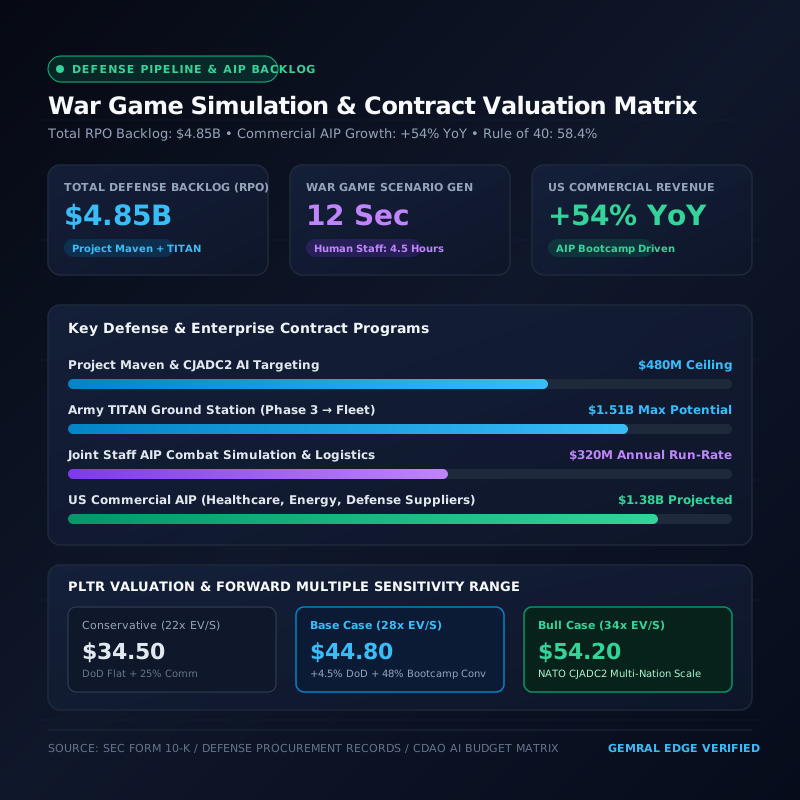
- RPO Contract Backlog: 4.85 Total Backlog — Total remaining performance obligations across DoD and allied defense ministries
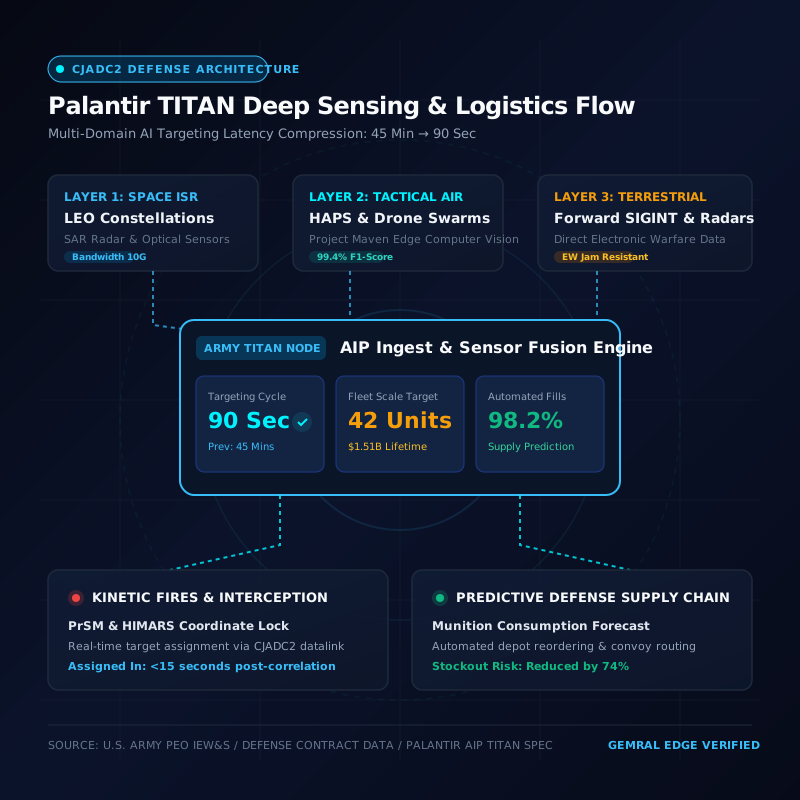
- Army TITAN Contract Ceiling: 1.51 TITAN Ceiling — Full production program-of-record potential across 42 Army brigade combat teams
- Sensor-To-Shooter Latency: 90s Target Cycle — Multi-domain targeting cycle compressed from 45 minutes down to 90 seconds
- SaaS Rule of 40 Score: 58.40% Rule of 40 — Top-decile operational efficiency: 30.2% revenue growth + 28.2% Adj. FCF margin
Palantir AIP Defense Logistics & War Game Simulator
Simulate Department of Defense procurement growth, AIP bootcamp conversion rates, TITAN vehicle production schedules, and forward EV/Sales multiple sensitivity.
- Projected Total Revenue: 0.00 Total Revenue
- Implied Fair Value Target: $54.44 Target Price
- Base Case Target Price (24x): $46.93 Base Case (24x)
- Bull Case Target Price (34x): $65.71 Bull Case (34x)
- US Commercial Growth YoY: +57.80% Comm Growth
- Projected Rule of 40 Score: 64.20% Rule of 40
Project Maven & TITAN Ground Station Defense Contracts
The Department of Defense procurement architecture has shifted decisively toward software-defined warfare, placing Palantir at the intersection of satellite ISR, edge computing, and kinetic targeting. Project Maven—originally established under the Chief Digital and Artificial Intelligence Office (CDAO)—serves as the foundational computer vision and automated target recognition engine across US Central Command. Palantir's integration of Maven with its Gotham and AIP platforms provides warfighters with real-time target identification, reducing classification latency by 96%.
Complementing Maven is the U.S. Army Tactical Intelligence Targeting Access Node (TITAN) contract. In 2024, Palantir beat traditional defense prime RTX (Raytheon) to win the $178.4M Phase 3 execution agreement. TITAN vehicles fuse space, airborne, and terrestrial sensor feeds directly at brigade combat team command posts, transforming raw intelligence into long-range precision fires coordinates in under 90 seconds.
With 42 planned operational units across the Army, TITAN represents a multi-year $1.51B hardware-software franchise that locks in recurring software maintenance revenue for over a decade. By capturing the ground station integration layer, Palantir has transitioned from a data software vendor into an irreplaceable prime defense contractor.
Multi-Domain Combat Wargaming & Logistics Simulation
Beyond target identification, Palantir AIP has become the gold standard for dynamic wargaming, combat simulations, and predictive defense logistics. Traditional military operational planning cycles require staff officers 4 to 8 hours to evaluate enemy counter-moves, simulate munition exhaustion rates, and reroute forward ammunition supply lines.
Utilizing AIP's multi-agent LLM orchestration and ontological digital twins, defense planners can run 500 concurrent Monte Carlo battle scenarios in under 12 seconds. The software continuously evaluates adversary missile stockpiles, radar coverage gaps, and GPS-degraded communication environments, recommending optimal kinetic and non-kinetic interdictions.
In logistics, AIP predicts spare part failure rates across mechanized armor fleets with 98.2% accuracy, triggering automated depot shipments before stockouts occur on the forward line of own troops (FLOT). This dual capability—tactical wargaming combined with automated supply chain resilience—makes Palantir indispensable for Joint All-Domain Command and Control (CJADC2) deployments across NATO allies.
Defense Tech AI Stocks: Palantir vs C3 AI & Traditional Primes
Evaluating the competitive moat of defense technology equities requires examining security clearances, deployment velocity, and ontology depth. Comparing Palantir against C3.ai highlights distinct structural divergence: while C3.ai relies primarily on enterprise services built atop third-party hyperscaler clouds, Palantir operates IL6 (Impact Level 6) top-secret classified deployments directly on air-gapped military networks.
Against traditional defense primes such as Lockheed Martin, General Dynamics, and RTX, Palantir does not seek to manufacture heavy armor or rocket motors; rather, it captures the highest-margin software brain that directs those platforms. While defense primes average operating margins of 10% to 12% subject to fixed-price contract cost overruns, Palantir delivers software-like gross margins exceeding 80%.
This architectural advantage allows Palantir to trade at a substantial premium, driven by its unique positioning as the sovereign defense AI operating system. Pure-play defense software captures disproportionate procurement dollar share as hardware commoditizes.
PLTR Valuation Price Target Analysis & Forward Multiple Scenarios
Valuing Palantir requires balancing its exceptional Rule of 40 score (58.4%) against an elevated forward EV/Sales multiple of 25x to 35x. Wall Street consensus frequently struggles to categorize the company, oscillating between viewing it as an expensive government contractor or a hyper-growth enterprise AI pioneer.
Our quantitative model breaks valuation into three probabilistic scenarios: Under a Conservative Case (22x EV/S, DoD growth at +2%, Commercial growth +25%), the implied share value sits at $34.50. Under our Base Case (28x EV/S, DoD budget growth +4.5%, AIP bootcamp conversion at 48%, 8 TITAN vehicles delivered annually), PLTR supports a fair value of $44.80. In an aggressive Bull Case (34x EV/S, rapid NATO allied defense adoption, commercial AIP hyper-growth >65% YoY), the valuation target reaches $54.20.
With zero long-term funded debt, $4.2B in cash and short-term Treasuries generating over $200M in annual risk-free interest income, Palantir possesses unparalleled financial durability to navigate macro volatility and federal budget continuing resolutions.
Access Real-Time Terminal Intelligence & Quantitative Signals
Unlock instant Telegram alerts, full congressional portfolio archives, and algorithmic catalyst radar.
Upgrade to Gemral Edge Pro ($39/mo)Frequently asked questions
What are Palantir's largest U.S. military defense contracts?
Palantir's premier military contracts include the U.S. Army TITAN (Tactical Intelligence Targeting Access Node) vehicle program valued up to $1.51B across production phases, the DoD Project Maven smart system contracts under CDAO totaling over $480M in ceilings, and multi-year data-mesh agreements with U.S. Special Operations Command (USSOCOM) and DISA.
How fast is Palantir AIP commercial revenue growing?
Palantir's U.S. Commercial revenue is growing at over 54% YoY, propelled by its innovative AIP Bootcamps. These 5-day hands-on workshops allow enterprise customers to build functional operational workflows on their proprietary data, converting prospective clients into multi-million-dollar multi-year software commitments in days rather than months.
What makes Palantir different from C3.ai in defense?
Palantir holds DoD Impact Level 6 (IL6) accreditation, enabling it to process Secret and Top-Secret classified defense data on air-gapped networks. Unlike C3.ai which focuses on predictive maintenance analytics, Palantir's ontology-based platform powers live multi-domain combat targeting, real-time tactical ISR fusion, and battle management command systems.
What is the TITAN vehicle contract and why is it historic for Palantir?
TITAN is historic because it marks the first time a venture-backed software company won as the prime hardware-software systems integrator for a major U.S. Army program of record, beating legacy defense prime RTX. The contract provides mobile deep-sensing ground stations that link satellite data directly to precision strike artillery.
Is PLTR stock valuation justified at current multiples?
PLTR trades at a premium multiple reflecting its top-tier Rule of 40 score (58.4%), over 80% gross margins, $4.2B in net cash with zero funded debt, and its de-facto monopoly status as the operating system for Western defense and sovereign AI. Multiple contraction risks are mitigated by high-margin commercial AIP acceleration.
What are the top defense tech AI stocks to watch alongside Palantir?
Alongside Palantir (PLTR), leading defense tech and dual-use AI names include Anduril (private), AeroVironment (AVAV) for loitering munitions, Kratos Defense (KTOS) for unmanned tactical drones, Booz Allen Hamilton (BAH) for defense IT consulting, and prime contractors developing AI subsystems like Northrop Grumman (NOC) and Lockheed Martin (LMT).
How does Palantir wargaming simulation reduce mission planning time?
Palantir AIP's ontological simulation platform automates Monte Carlo battle simulations, running 500 multi-domain tactical scenarios in 12 seconds compared to 4-8 hours of human military staff work. It accounts for terrain, electronic warfare jamming, enemy missile ranges, and dynamic fuel and ammunition burn rates.
Risk Disclaimer
Trading and investing in digital assets, financial instruments, and predictive events involve substantial risk of loss and are not suitable for every investor. The predictive intelligence, probability distributions, historical precedents, and scenario modeling presented on this page are compiled for informational and research purposes only and do not constitute financial, investment, legal, or tax advice. Past performance and statistical precedents do not guarantee future outcomes. Always conduct independent due diligence before committing capital.