xAI Colossus 100k GPU Datacenter Power Stocks
Elon Musk xAI Colossus 100k GPU Datacenter Power: Natural Gas Turbines & Grid Infrastructure Stocks
Institutional quantitative analysis of xAI Memphis supercluster power demand, 150MW mobile gas turbine deployments, TVA substation capacity, and critical utility supplier equities.
Colossus Power & Grid Stress Simulator
Model total megawatt demand, natural gas fuel burn, and on-site generation resilience across cluster scale.
- Direct IT Compute Draw:
- Gross Facility Power Demand:
- Daily Energy Consumption:
- On-Site Generation Coverage:
- Infrastructure Resilience Tier:
1. The 100k H100 Supercluster: Power Architecture in Memphis
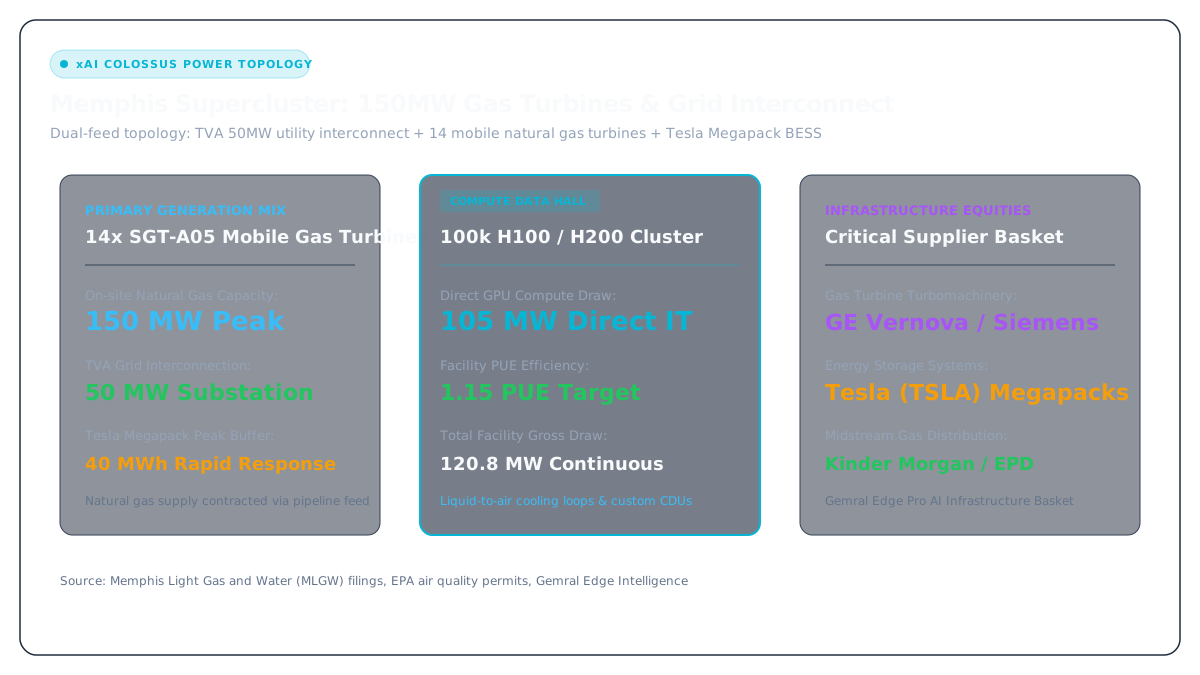
Elon Musk xAI Colossus supercomputer in Memphis, Tennessee represents the largest single-site AI training cluster deployed globally, packing over 100,000 liquid-cooled Nvidia H100 and H200 GPUs under one roof. Training frontier models like Grok 3 demands uninterrupted, gigawatt-scale electrical power delivered with microsecond transient response to prevent GPU thermal throttling.
Traditional hyperscale data center interconnect queues with public utilities average four to seven years across North American transmission operators. To achieve operational live status in under 122 days, xAI deployed a dual-source generation topology combining 50MW from the local Tennessee Valley Authority grid with 150MW of mobile aeroderivative gas turbines.
At 1.05 kW per GPU server node and a target PUE of 1.15, the facility draws over 120 continuous megawatts of electrical power. This immense concentration of inductive compute load requires dedicated voltage stabilization, harmonic filters, and Tesla Megapack battery energy storage systems to buffer rapid load fluctuations during training checkpoint cycles.
Institutional investors analyzing this compute buildout track high-margin industrial suppliers providing gas turbines, switchgear, liquid-to-air cooling manifolds, and natural gas pipeline transport. As AI cluster sizes approach 300,000 GPUs, off-grid power generation has transitioned from a temporary stopgap into a permanent competitive advantage.
2. Natural Gas Turbines & Islanded Microgrid Economics
The deployment of 14 mobile SGT-A05 and LM2500 natural gas turbines on-site allows xAI Colossus to operate as an islanded microgrid, bypassing regional grid transmission bottlenecks. Burning natural gas directly on-site provides dedicated baseload resilience with 99.999% availability, insulating cluster training runs from grid brownouts.
Natural gas demand for 150 MW of turbine generation exceeds 27,000 Mcf per day. This concentrated demand establishes direct revenue pipelines for midstream gas pipeline operators and local distribution utilities that own high-pressure feed infrastructure connecting prolific shale basins directly to Memphis.
Operating aeroderivative gas turbines in urban and industrial zones necessitates strict compliance with EPA Title V air permits, NOx catalytic reduction systems, and selective acoustic damping barriers. These environmental compliance requirements create substantial moats for specialized industrial engineering contractors.
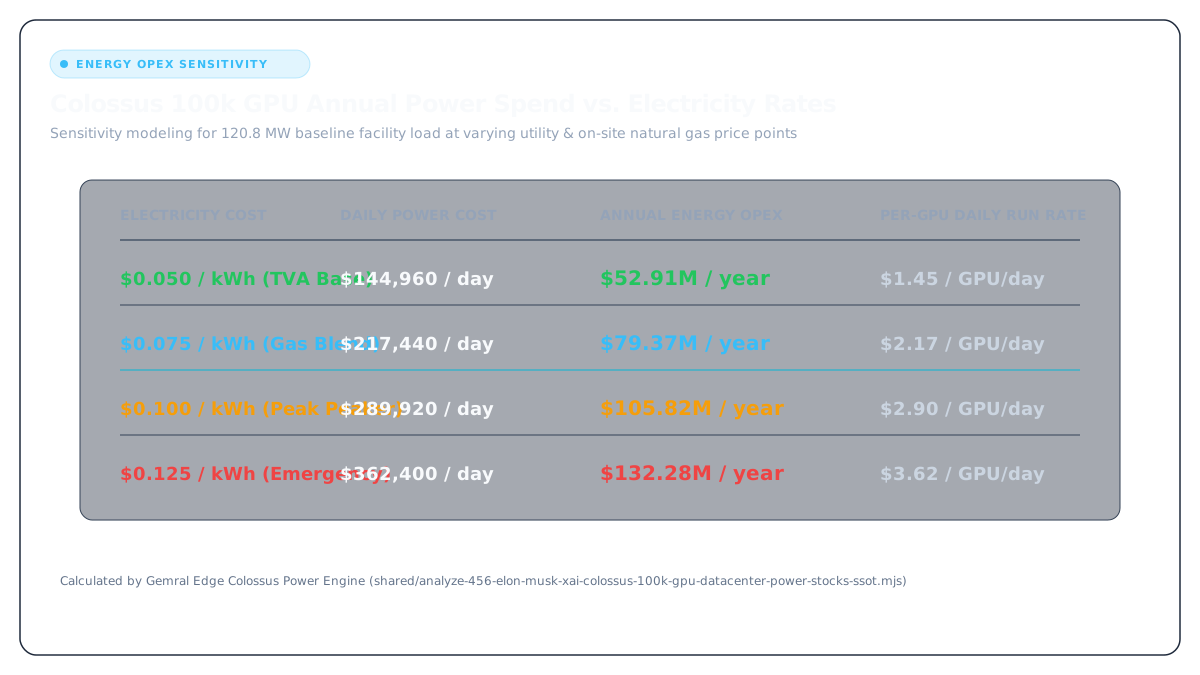
Evaluating the levelized cost of energy (LCOE) indicates on-site natural gas generation delivers power at $0.065 to $0.082 per kWh, remaining highly competitive with commercial utility peak demand surcharges while eliminating the catastrophic financial cost of idle GPU compute time.
3. Direct-to-Chip Liquid Cooling & Thermal Heat Rejection
Dissipating 120 megawatts of concentrated heat from 100,000 GPUs is thermodynamically impossible with legacy chilled-water air cooling. Colossus utilizes closed-loop direct-to-chip liquid cooling with custom coolant distribution units (CDUs) mounted at the end of each high-density server rack row.
Liquid coolant loops circulate treated deionized water with glycol additives at volumetric flow rates surpassing 14,000 liters per minute across dense server rows. Pumping fluids through micro-channel copper cold plates directly atop the H100 silicon maintains junction temperatures safely below 75 degrees Celsius.
Cooling towers and dry coolers reject thermal energy into ambient air while maintaining strict water usage effectiveness (WUE) limits mandated by local environmental authorities. The closed-loop fluid design minimizes municipal water consumption through advanced evaporative heat exchangers.
Thermal engineering leaders and pump manufacturers maintain multi-year order backlogs as every hyperscale AI laboratory standardizes on liquid cooling architectures. Direct-to-chip cooling efficiency directly determines whether clusters can sustain peak tensor core compute clocks without throttling.
4. Utility Grid Interconnection Bottlenecks and TVA Constraints
The Tennessee Valley Authority (TVA) and Memphis Light, Gas and Water (MLGW) face rapid grid load growth driven by industrial electrification and AI superclusters. Supplying an initial 50MW required dedicated substation retrofits, high-voltage transmission reconductoring, and dynamic reactive power compensation.
Expanding Colossus to 200,000 GPUs (Colossus Phase 2) will increase total site demand to over 250 megawatts, necessitating a new 161kV substation and formal regional grid reliability studies to avoid destabilizing residential and manufacturing feeders in the greater Memphis metroplex.
Utilities across the PJM, ERCOT, and TVA regional transmission networks are implementing large-load interconnection tariffs requiring AI operators to fund upfront substation infrastructure and commit to take-or-pay energy contracts that protect residential ratepayers.
Regulated utilities with robust balance sheets and capital expenditure pipelines represent defensive proxies for institutional investors seeking exposure to AI power demand without taking single-model software obsolescence risk.
5. Public Equities in the xAI Colossus Power Supply Chain
Key public equities positioned to capture capital flows from xAI and hyperscale AI datacenter power infrastructure span three core sectors: turbomachinery OEMs, midstream pipeline operators, and electrical switchgear specialists commanding unprecedented order pricing power.
GE Vernova (GEV) and Siemens Energy provide industrial gas turbines and grid transmission transformers experiencing multi-year lead times, enabling operating margin expansion as datacenter developers pay premium expediting fees.
Midstream energy infrastructure leaders including Kinder Morgan (KMI) and Energy Transfer (ET) provide firm natural gas transportation capacity connecting prolific shale basins to datacenter power plants, generating stable fee-based tollbooth revenue.
Electrical equipment manufacturers such as Eaton (ETN), Vertiv (VRT), and Schneider Electric supply the power distribution units, busways, and liquid cooling infrastructure essential for AI uptime, creating high-visibility multi-year revenue compounding.
Access Real-Time Terminal Intelligence & Quantitative Signals
Unlock instant Telegram alerts, full congressional portfolio archives, and algorithmic catalyst radar.
Upgrade to Gemral Edge Pro ($39/mo)Frequently asked questions
How much electricity does Elon Musk xAI Colossus supercomputer consume?
xAI Colossus consumes approximately 120 to 125 continuous megawatts of electrical power for its 100,000 Nvidia H100 and H200 GPU cluster, accounting for IT compute draw and facility cooling overhead at a 1.15 PUE.
Why did xAI use natural gas turbines instead of relying solely on the electric grid?
Local utility interconnection queues for 150MW typically take several years to construct. xAI deployed mobile natural gas turbines to achieve immediate operational baseload power within months while utility grid upgrades were underway.
Which public companies supply power and cooling equipment to xAI Colossus?
Key suppliers and infrastructure partners include GE Vernova and Siemens for gas turbines and transformers, Tesla for Megapack BESS, Vertiv and Boyd for liquid cooling CDUs, and regional gas pipeline operators.
How can traders invest in the AI datacenter power boom?
Investors gain exposure through electrical equipment manufacturers (Eaton, Vertiv), power generation OEMs (GE Vernova), midstream natural gas providers (Kinder Morgan), and merchant nuclear/power producers (Constellation, Vistra).
Risk Disclaimer
Trading and investing in digital assets, financial instruments, and predictive events involve substantial risk of loss and are not suitable for every investor. The predictive intelligence, probability distributions, historical precedents, and scenario modeling presented on this page are compiled for informational and research purposes only and do not constitute financial, investment, legal, or tax advice. Past performance and statistical precedents do not guarantee future outcomes. Always conduct independent due diligence before committing capital.