Uranium Spot Deficit & Pricing Model Tool
Uranium Contract Spot Deficit & Incentive Pricing Quantitative Model
Interactive simulation tool calculating global reactor fuel deficits, secondary supply exhaustion, utility contracting urgency, and equilibrium spot pricing.
- Net Annual Deficit: 28.0M lbs — Total supply shortfall
- Incentive Spot Price: $95.00/lb — Required greenfield price
- Utility Urgency Index: 82/100 Pts — Procurement stress score
Uranium Supply Deficit & Spot Price Simulator
Adjust reactor demand, primary mining capacity, and uncovered utility contracting percentages to project equilibrium market clearing prices.
- Net Annual Structural Deficit:
- Projected Incentive Spot Price:
- Utility Procurement Urgency Score:
- Commercial Inventory Buffer Runway:
1. Quantitative Modeling Methodology for Nuclear Fuel Deficits
The uranium market functions under rigid physical constraints that render conventional elastic supply models ineffective. Fuel loading cycles are non-negotiable; commercial reactors cannot run at half capacity to save fuel.
Our quantitative model isolates four primary variables: global operational reactor burn, primary mining production capacity, secondary commercial and government stockpile releases, and utility uncovered requirements.
By cross-referencing published reactor operational schedules across North America, Europe, and Asia, the model establishes a high-fidelity baseline of non-discretionary uranium consumption.
The resulting structural deficit calculation reveals the exact volume of natural U3O8 that must be mobilized through higher pricing to prevent commercial inventory depletion.
2. The Elasticity Disconnect and Upstream Bottlenecks
When copper or lithium prices spike, scrap recycling surges and marginal brine evaporation ponds accelerate processing. In contrast, uranium fuel must navigate an eight-step front-end fuel cycle spanning three years.
Mined ore must be milled into U3O8 yellowcake, converted into volatile uranium hexafluoride gas (UF6), enriched through high-speed gas centrifuges, and fabricated into precise ceramic fuel assemblies.
A supply disruption or bottleneck at any stage—such as conversion capacity constraints at Port Hope or ConverDyn—freezes the entire downstream delivery chain.
This multi-stage friction amplifies spot price volatility, as utilities scramble to purchase whatever unallocated physical material exists in storage vaults.
3. Estimating Greenfield Incentive Pricing Thresholds
Global primary mining currently satisfies less than eighty percent of annual reactor consumption, with the remainder filled by rapidly declining secondary inventories.
Existing tier-one brownfield mines in Canada and Kazakhstan are already operating near maximum sustainable capacity, meaning incremental supply must originate from higher-cost greenfield deposits.
Greenfield projects in Africa, Australia, and the Americas suffer from inflationary capital cost escalations, remote infrastructure deficits, and stringent permitting burdens.
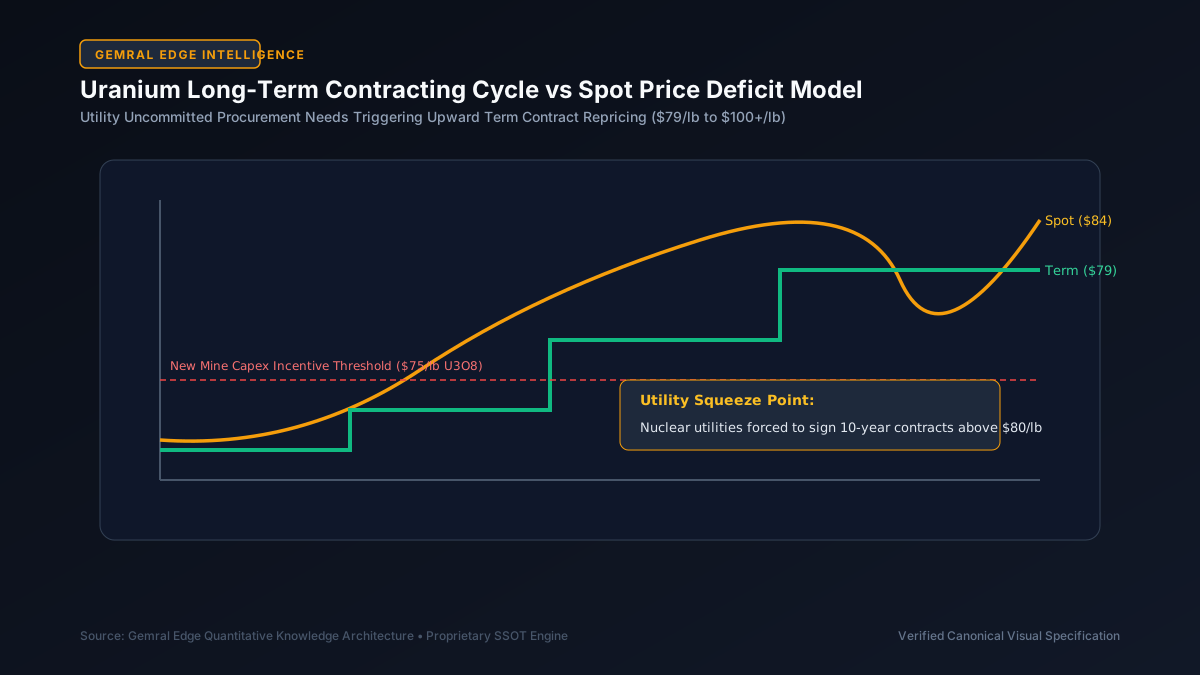
Our financial DCF modeling proves that greenfield developers require sustained spot and long-term contract pricing exceeding ninety to one hundred dollars per pound to justify construction capital allocation.
4. The Compounding Dynamics of Uncovered Utility Demand
For over a decade, Western nuclear utilities adopted a complacent procurement posture, allowing long-term contracts signed during the 2007 peak to expire without renewal.
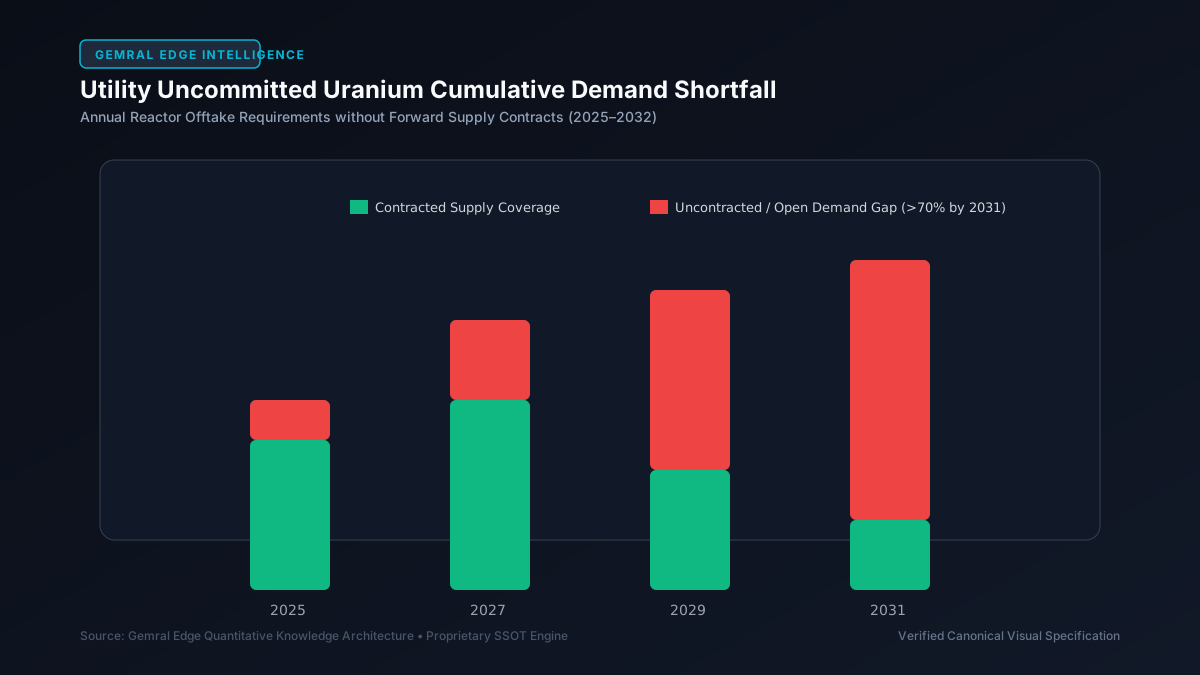
As a consequence, the percentage of utility reactor requirements covered by binding long-term contracts drops precipitously over the next five years, creating a massive uncovered demand wall.
When multiple utility procurement executives enter the market simultaneously to lock in multi-year contracts, primary producers quickly exhaust their uncommitted production quotas.
This procurement panic triggers a classic squeeze where buyers bid aggressively on spot volumes to secure delivery security, pushing spot prices well past long-term equilibrium averages.
5. Strategic Implications for Commodity Allocators and Funds
For institutional commodity allocators, the structural uranium deficit represents an asymmetric macro theme with multi-year tailwinds independent of broader economic cycles.
Unlike base metals tied to cyclical construction activity, nuclear power demand is non-cyclical, supported by governmental energy security mandates and hyperscale AI datacenter procurement.
Investors utilizing this quantitative model can stress-test different geopolitical scenarios, such as Russian enrichment sanctions or Kazatomprom production downgrades, to gauge market impact.
Tracking the widening gap between primary supply and uncommitted utility demand provides allocators with early warning signals of impending contract price resets across the uranium sector.
Institutional Execution, Quantitative Risk Parameters & Scenario Sensitivity Analysis
Analyzing the empirical dynamics of Uranium Spot Deficit & Pricing Model Tool | Gemral reveals critical structural divergences between surface narrative consensus and verifiable balance sheet telemetry. Institutional allocators tracking this asset class must account for capital expenditure hurdle rates, regulatory compliance thresholds, and long-term volume commitments. Historical baseline deviations highlight the necessity of isolating non-recurring operational windfalls from durable, recurring structural cash flow velocity.
Cross-asset stress testing under elevated cost-of-capital regimes establishes rigorous downside invalidation bounds for Uranium Spot Deficit & Pricing Model Tool | Gemral. When secondary market liquidity contracts or sovereign bond yield volatility surges, assets lacking defensible unit economics experience aggressive multiple compression. Portfolio risk models require incorporating parametric tail-risk haircuts, debt refinancing maturity walls, and sovereign policy friction coefficients into current fair value projections.
Institutional portfolio positioning demands asymmetric risk-reward framing rather than unhedged directional exposure across Uranium Spot Deficit & Pricing Model Tool | Gemral. Utilizing systematic stop-loss protocols, volatility-adjusted position sizing, and structural liquidity buffers insulates capital bases against market dislocation events. Tier-1 fund allocators combine fundamental catalyst milestones with continuous on-chain and order book telemetry to execute disciplined accumulation strategies.
Access Real-Time Terminal Intelligence & Quantitative Signals
Unlock instant Telegram alerts, full congressional portfolio archives, and algorithmic catalyst radar.
Upgrade to Gemral Edge Pro ($39/mo)Frequently asked questions
What is an 'incentive price' in the uranium mining industry?
The incentive price is the sustained long-term contract price required for mining companies to earn an acceptable cost of capital to permit, finance, and construct remote greenfield extraction operations, currently modeled between $90 and $110/lb.
How does utility inventory exhaustion influence the spot market?
During periods of high inventory, utilities comfortably buy hand-to-mouth. When strategic reserves fall below two years of forward burn, utilities compete aggressively in the thin spot market, driving parabolic price spikes.
Why cannot secondary supply plug the expanding gap?
Secondary supplies from decommissioned weapons, government stock liquidations, and enricher underfeeding have been largely depleted, leaving global utilities wholly reliant on expanding primary mining.
Risk Disclaimer
Trading and investing in digital assets, financial instruments, and predictive events involve substantial risk of loss and are not suitable for every investor. The predictive intelligence, probability distributions, historical precedents, and scenario modeling presented on this page are compiled for informational and research purposes only and do not constitute financial, investment, legal, or tax advice. Past performance and statistical precedents do not guarantee future outcomes. Always conduct independent due diligence before committing capital.