US Strategic Bitcoin Reserve Simulator
US Strategic Bitcoin Reserve Acquisition Simulator
Under proposed legislation including Senator Cynthia Lummis's Bitcoin Act and executive frameworks championed by Donald Trump, the United States Department of the Treasury would accumulate up to 1,000,000 Bitcoins over five years. This WebMCP sovereign finance tool calculates annual capital outlays, compounded price appreciation paths, supply shock absorption, and potential federal debt offset metrics.
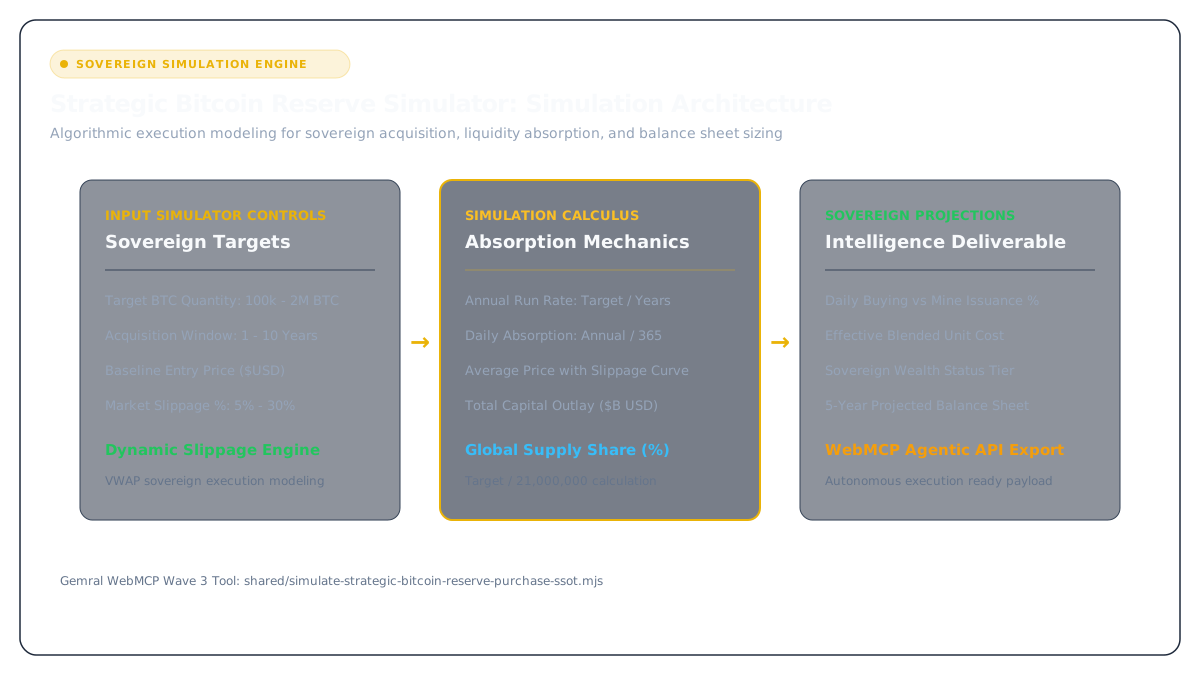
Sovereign Bitcoin Reserve Purchase & Valuation Model
Simulate the 1,000,000 BTC federal accumulation schedule, daily mining absorption rate, average acquisition price, and multi-billion dollar budget requirements.
- Annual Bitcoin Accumulation:
- Daily Purchase Run-Rate:
- Average Execution Price:
- Total Treasury Capital Outlay:
- New Mining Issuance Absorbed:
- Sovereign Reserve Scale Rating:
Sovereign Game Theory: The Mathematical Mechanics of the Bitcoin Act
The proposed BITCOIN Act (Boosting Innovation, Technology, and Competitiveness through Optimized Investment Nationwide) establishes a formal federal program to accumulate 1,000,000 BTC, representing nearly 5% of the total hard-capped 21,000,000 supply. Under this legislative design, purchases of 200,000 BTC per year across five consecutive years would be funded without raising taxes or increasing deficits, primarily by revaluing the Federal Reserve's statutory gold certificates to contemporary spot prices.
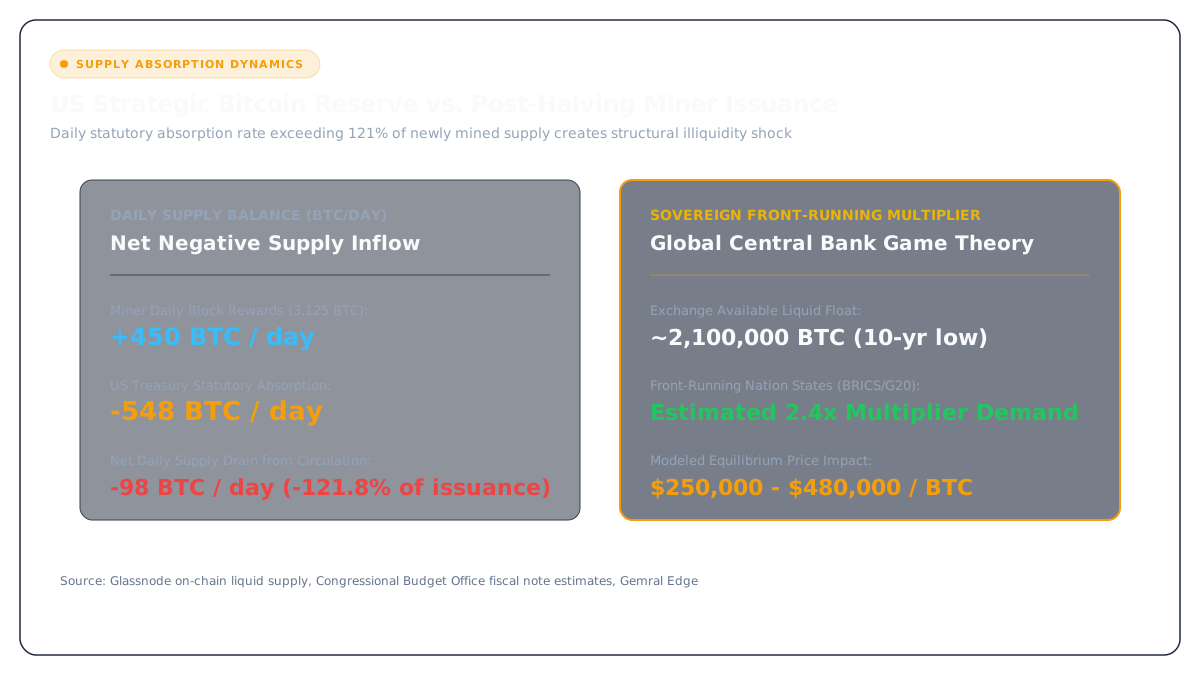
From a market microstructure perspective, an institutional purchase mandate of 200,000 BTC annually represents approximately 548 BTC per day. With Bitcoin's programmatic block subsidy halving reducing daily new issuance to just 450 BTC, the US Treasury alone would absorb more than 120% of all newly minted coins, creating a structural supply deficit that ignites profound sovereign game theory among global central banks.
When the world's preeminent superpower signals a programmatic multi-year bid for an inelastic asset, game theory dictates that competing nations cannot afford to remain idle. Sovereign wealth funds across the Middle East, Asia, and Europe would be compelled to front-run US Treasury purchases to preserve sovereign monetary parity.
This sovereign accumulation race permanently removes liquid inventory from secondary OTC desks and centralized exchange order books, compressing free-float supply and sparking parabolic upward repricing dynamics.
Sovereign Treasury Simulation Architecture: Modeling Price Paths
This simulation engine projects multi-year treasury cash flows by incorporating compound annual growth rate (CAGR) assumptions alongside supply absorption coefficients. When a sovereign entity signals programmatic buying over a 60-month horizon, private market participants, corporate treasuries, and sovereign wealth funds adjust their reservation prices upward, permanently removing liquid coins from secondary OTC desks and exchange reserves.
By evaluating terminal portfolio values across conservative (15% CAGR), moderate (25% CAGR), and aggressive (40% CAGR) scenarios, fiscal analysts can quantify the asymmetric debt-to-asset balance sheet enhancement. Even under a modest 25% annual appreciation trajectory, a 1,000,000 BTC reserve acquired at an average cost basis of $120,000 grows into a multi-trillion dollar sovereign reserve within a decade.
The model incorporates dynamic slippage factors that scale with the sovereign purchase run-rate. Attempting to acquire 200,000 BTC in a compressed 12-month window would induce severe liquidity dislocation, driving average purchase prices higher than an orderly 5-year dollar-cost-averaging schedule.
Our WebMCP simulator provides financial planners with real-time feedback on capital allocation efficiency, contrasting front-loaded aggressive buying with linear annual tranches.
The Sovereign Balance Sheet: Federal Debt Stabilization Mechanics
The United States national debt currently expands at an alarming pace of approximately $1 trillion every 100 days. Traditional fiscal austerity or tax increases face insurmountable political resistance, leaving economic growth and monetary debasement as the sole viable avenues for sovereign debt management. A sovereign Bitcoin reserve introduces a third mechanism: asymmetric equity appreciation.
Because Bitcoin's hard cap of 21 million units cannot be inflated by government decree, its purchasing power relative to sovereign fiat expands exponentially over secular multi-decade horizons. By establishing a 1,000,000 BTC reserve asset, the US Treasury captures the upside of global digital monetary adoption, creating an appreciating collateral base capable of amortizing maturing Treasury bonds without debasing the domestic purchasing power of the dollar.
Holding 1,000,000 Bitcoins on the federal balance sheet transforms the US from a passive victim of global monetary debasement into the principal beneficiary of the worldwide shift toward hard digital assets. If Bitcoin reaches parity with physical gold's total market capitalization, a 1M BTC reserve would be worth over $800 billion.
In an extended secular bull scenario where Bitcoin emerges as the neutral global reserve currency, the terminal value of the strategic reserve could exceed $3 to $5 trillion, providing significant balance sheet relief against the national debt.
Gold Certificate Revaluation: Funding Without Deficit Expansion
A critical innovation within the Lummis Bitcoin Act is the funding mechanism: statutory revaluation of Federal Reserve gold certificates. Currently, the Federal Reserve carries approximately 261.5 million fine troy ounces of Treasury gold at an archaic statutory price of $42.22 per ounce, valuing the total US gold hoard at just $11 billion on official balance sheets.
Marking these gold certificates to prevailing market prices around $2,700 per ounce instantly unlocks over $700 billion in unrealized statutory paper profit. Under the proposed legislation, this accounting gain would be remitted to the Treasury to capitalize the Bitcoin Reserve Fund without issuing a single dollar of new Treasury debt or increasing tax burdens on citizens.
This financial maneuver mirrors historical precedent: in 1934, President Franklin D. Roosevelt revalued gold from $20.67 to $35.00 per ounce under the Gold Reserve Act, generating a windfall profit that capitalized the Exchange Stabilization Fund (ESF).
By modernizing this mechanism, the United States can acquire an apex digital monetary asset while maintaining strict adherence to statutory fiscal discipline.
Custody, Security & Decentralized Federal Architecture
Establishing a 1,000,000 BTC sovereign reserve introduces unprecedented requirements for cryptographic security and multi-jurisdictional key management. The Bitcoin Act mandates that reserve coins must be held in cold storage across geographically dispersed, air-gapped federal facilities operated by the Department of the Treasury.
A multi-signature threshold scheme (such as an m-of-n Shamir's Secret Sharing or multi-party computation architecture) prevents unilateral access by any individual official, requiring concurrent authorization from the Treasury Secretary, Federal Reserve Chairman, and Congressional leadership to authorize valid outgoing transactions.
Furthermore, the legislation establishes a strict minimum 20-year holding period during which reserve Bitcoins cannot be sold, swapped, or hypothecated, guaranteeing that the sovereign reserve functions as permanent national infrastructure rather than a short-term trading vehicle.
The Strategic Bitcoin Reserve Simulator enables macro economists and citizens to understand the transformative implications of institutional Bitcoin adoption at the sovereign nation-state level.
Access Real-Time Terminal Intelligence & Quantitative Signals
Unlock instant Telegram alerts, full congressional portfolio archives, and algorithmic catalyst radar.
Upgrade to Gemral Edge Pro ($39/mo)Frequently asked questions
How would the US Treasury finance the purchase of 1,000,000 Bitcoins?
Under the BITCOIN Act framework, the Federal Reserve's statutory gold certificates would be revalued from $42.22/oz to contemporary market spot prices (~$2,700/oz), generating over $700 billion in unrealized paper profit without increasing taxes or public debt.
What happens to the supply of Bitcoin if the US government buys 200,000 BTC per year?
Post-halving annual miner issuance is only 164,250 BTC. An annual US Treasury purchase of 200,000 BTC absorbs over 121% of all new issuance, forcing supply withdrawal from institutional exchange order books.
Can a Strategic Bitcoin Reserve genuinely pay off the US national debt?
While a 1M BTC reserve cannot immediately extinguish a $35+ trillion debt, compound appreciation over 15 to 20 years could yield a multitrillion-dollar reserve asset that dramatically lowers the US debt-to-GDP ratio.
What are the custody requirements for sovereign Bitcoin reserves?
The Bitcoin Act mandates geographically dispersed, air-gapped cold storage facilities with multi-party threshold cryptography and a statutory 20-year lockup preventing premature liquidation.
Risk Disclaimer
Trading and investing in digital assets, financial instruments, and predictive events involve substantial risk of loss and are not suitable for every investor. The predictive intelligence, probability distributions, historical precedents, and scenario modeling presented on this page are compiled for informational and research purposes only and do not constitute financial, investment, legal, or tax advice. Past performance and statistical precedents do not guarantee future outcomes. Always conduct independent due diligence before committing capital.