Pentagon Replicator Drone Swarm Procurement | Edge
Pentagon Replicator Prime Contractors & Capabilities
| Prime Contractor | Domain Specialization | Allocated Funding | Autonomous Mesh Software | Annual Production Run | Flight Hour Cost |
|---|---|---|---|---|---|
| Anduril Industries (Lattice OS & Ghost / Altius Swarm) | Defense Tech Disruptor | $285M | Lattice Multi-Domain Command & Control | 4200 Units/Yr | $120/hr |
| AeroVironment (Switchblade 600 / Puma / Jump 20) | Loitering Munition Specialist | $310M | Crysalis Tactical Autonomy Framework | 5500 Units/Yr | $210/hr |
| Shield AI (Hivemind Edge Autonomy & V-BAT) | GPS-Denied Autonomy Pioneer | $195M | Hivemind Swarm Reinforcement Learning | 1800 Units/Yr | $185/hr |
| Kratos Defense & Security Solutions (Airwolf & XQ-58A) | Attritable Jet & High-Speed Drone OEM | $210M | Autonomous Tactical Combat Architecture | 950 Units/Yr | $850/hr |
US Defense Department Replicator Initiative Drone Swarm Procurement
Institutional intelligence on the Pentagon's Replicator initiative, procurement contracts for thousands of low-cost attritable autonomous systems, edge AI mesh coordination, and defense contractor disruption.
- Initial Procurement Tranche: $1000M Procurement — DoD DIU committed capital
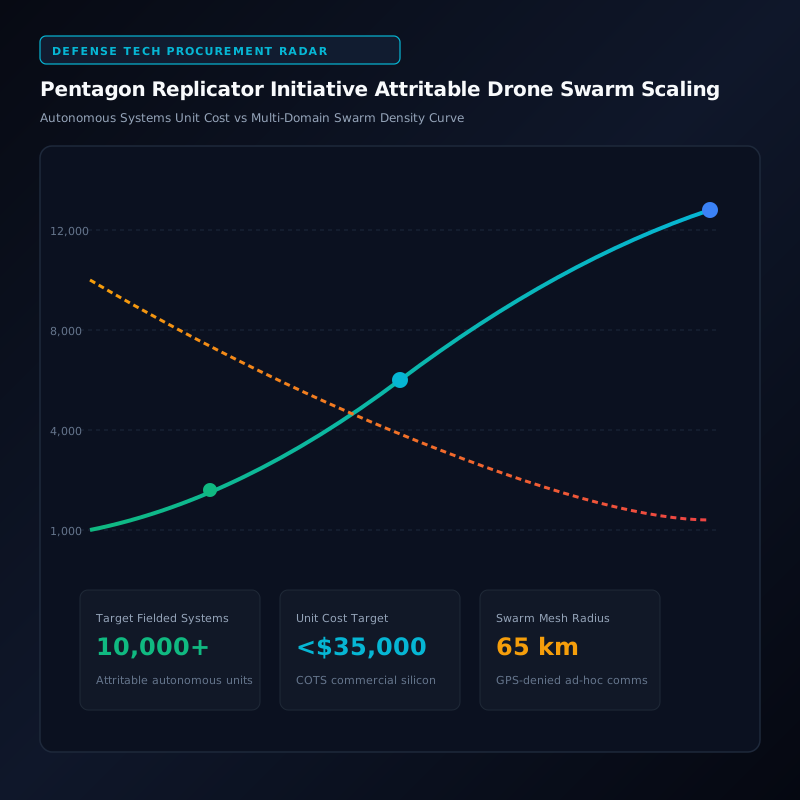
- Fielded Drone Target: 10000+ Units — Low-cost attritable air & sea units
- Target Unit Cost Ceiling: <$45000 / Drone — Commercial COTS silicon components
- Autonomous Mesh Radius: 65 km Mesh Radius — GPS-denied decentralized communications
Replicator Initiative Drone Procurement & Tactical Output Simulator
Model fielded drone volume, operational mesh coverage, attrition tolerance, and cost-per-target metrics based on defense allocations.
- Annual Fielded Drones: 17857 Fielded Drones/Yr
- Mission-Ready Swarm Units: 12053 Mission Ready
- Cost Per Target Neutralized: $57750 / Neutralized Target
- Operational Swarm Coverage: 151785 sq km Coverage

Tactical Mission Domain Swarm Profiles
| Mission Operational Domain | Swarm Size | Decoy Absorption Rate | Kinetic Strike Success | Total Mission Capex |
|---|---|---|---|---|
| Indo-Pacific Anti-Access / Area Denial (A2/AD) Penetration | 1200 Drones | 88.5% | 74% | $38.4M |
| Littoral Strait Autonomous Reconnaissance & ASW Patrol | 450 Drones | 94% | 82.5% | $14.8M |
| Distributed Electronic Warfare Jamming & Radar Suppression | 600 Drones | 91% | 86% | $19.2M |
1. The Paradigm Shift: From Exquisite Legacy Platforms to Attritable Mass
For over four decades, United States military procurement doctrine centered on exquisite, multi-billion-dollar weapon systems: nuclear-powered supercarriers, stealth fifth-generation fighters like the F-35, and guided-missile destroyers. While technologically peerless, these capital-intensive platforms require decades to manufacture, cost tens of thousands of dollars per operational flight hour, and represent catastrophic fiscal and strategic losses if neutralized.
The Pentagon's Replicator initiative, spearheaded by the Defense Innovation Unit (DIU), dismantles this centralized philosophy. Announced to counter anti-access/area-denial (A2/AD) challenges across the Indo-Pacific, Replicator mandates the fielding of thousands of low-cost, all-domain, attritable autonomous (ADA2) systems within an aggressive 18-to-24-month horizon.
Attritable systems are designed from the ground up for high-risk mission profiles where loss in combat is anticipated and economically acceptable. By exchanging multi-million-dollar defense-spec components for commercial off-the-shelf (COTS) electronics and edge AI microprocessors, Replicator achieves asymmetric mass that overwhelms adversaries' costly interceptor inventories.
2. The Industrialization of Drone Swarms: Commercial Silicon Meets Military Autonomy
The core technological enabler of the Replicator initiative is decentralized edge autonomy. Unlike traditional remote-piloted unmanned aerial vehicles (UAVs) like the MQ-9 Reaper, which require dedicated satellite links and two operators per airframe, Replicator swarms operate via collaborative peer-to-peer mesh networks under human-on-the-loop oversight.
In contested electronic warfare environments where adversaries deploy intense GPS spoofing and radio frequency jamming, Replicator drones utilize optical flow, visual inertial odometry, and onboard neural network accelerators to navigate, identify targets, and coordinate flight paths without external communication.
Algorithms dynamically reassign roles in mid-flight: if lead sensor drones are shot down, trailing loitering munitions automatically assume reconnaissance and relay duties, preserving mission continuity despite 60% swarm attrition.
3. Disruption of the Defense Primes: The Rise of Silicon Valley Defense Tech
The rapid procurement cycle of Replicator is fundamentally altering the defense industrial base. Traditional 'Big Five' defense primes—Lockheed Martin, Boeing, RTX, Northrop Grumman, and General Dynamics—struggle with multi-year cost-plus contract overhead and slow development timelines.
In contrast, non-traditional defense technology firms operate under rapid software iteration cycles. Companies like Anduril Industries (with its Lattice C2 operating system and Altius modular drones), AeroVironment (Switchblade series), and Shield AI (Hivemind autonomy stack) are capturing substantial tranches of DIU funding.
These tech-first defense contractors build modular, hardware-agnostic software architectures that allow rapid sensor upgrades and commercial component integration, cutting procurement lifecycles from a decade down to months.
4. The Economic Asymmetry of Modern Warfare: Overwhelming Interceptor Costs
Modern air defense physics reveals a severe cost-exchange asymmetry. Advanced surface-to-air interceptors—such as the Patriot PAC-3 ($4 million per missile), SM-6 ($4.3 million), or Israeli Iron Dome Tamir ($50,000)—are designed to intercept high-value ballistic and cruise missiles.
When an adversary or task force launches saturated salvos of autonomous drones costing $15,000 to $35,000 each, the defending force rapidly exhausts magazine depth and incurs unsustainable financial burn rates. Expending a $4 million interceptor against a $30,000 attritable drone is an economically bankrupting exchange.
Replicator weaponizes this exact economic dynamic. By fielding thousands of synchronized autonomous decoys, electronic jamming nodes, and kinetic strike units simultaneously, Replicator drains adversarial interceptor magazines while preserving capital fleet assets.
5. Institutional Investor Strategic Allocations & Defense Sector Playbook
Institutional asset managers seeking exposure to the modern warfare supercycle must reposition capital away from legacy heavy-armor OEMs toward agile autonomous defense electronics and software leaders.
Key public market allocations focus on companies supplying flight control avionics, counter-UAS electronic warfare systems, lightweight composite airframes, and edge compute silicon (e.g., Kratos Defense, AeroVironment, Mercury Systems, and Teledyne FLIR).
Additionally, venture and private equity allocators are aggressively deploying growth capital into pre-IPO defense tech leaders (Anduril, Shield AI) that hold long-term software licensing agreements across the Department of Defense's joint all-domain command and control (JADC2) enterprise.
Access Real-Time Terminal Intelligence & Quantitative Signals
Unlock instant Telegram alerts, full congressional portfolio archives, and algorithmic catalyst radar.
Upgrade to Gemral Edge Pro ($39/mo)Frequently asked questions
What is the Department of Defense Replicator initiative?
Replicator is a Pentagon procurement program aiming to deploy thousands of low-cost, attritable autonomous drones across air, land, and sea within 24 months to counter asymmetric military threats.
What does 'attritable' mean in modern military doctrine?
Attritable systems are low-cost unmanned platforms designed for high-risk missions where vehicle loss in combat is anticipated and financially sustainable.
How do Replicator drone swarms operate in GPS-denied environments?
Swarm drones carry onboard edge AI processors running computer vision, inertial odometry, and peer-to-peer mesh communications that function autonomously without satellite navigation.
Which companies are leading the Replicator manufacturing effort?
Leaders include non-traditional defense technology firms such as Anduril Industries, AeroVironment, Shield AI, and Kratos Defense & Security Solutions.
Risk Disclaimer
Trading and investing in digital assets, financial instruments, and predictive events involve substantial risk of loss and are not suitable for every investor. The predictive intelligence, probability distributions, historical precedents, and scenario modeling presented on this page are compiled for informational and research purposes only and do not constitute financial, investment, legal, or tax advice. Past performance and statistical precedents do not guarantee future outcomes. Always conduct independent due diligence before committing capital.