OpenAI Stargate Supercomputer Datacenter
OpenAI Stargate Supercomputer 100k GPU Datacenter Architecture
Deconstructing Microsoft and OpenAI's $115B supercomputer roadmap: optical interconnects, nuclear power baseload, and cooling contractors.
Stargate Capital & Thermal Model
Evaluate power capacity, cluster density, optical interconnect bandwidth, and liquid cooling PUE to forecast total infrastructure capex.
- Projected Infrastructure Capex ($B):
- Network Fabric Efficiency Score:
- Thermodynamic Cooling Score:
- Grid Interconnection Delay Risk:
- Deployment Phase Status:
1. Macro Architecture: The $115 Billion Compute Leap
The global race for Artificial General Intelligence (AGI) has precipitated the largest infrastructure commitment in technological history. Tracking the openai stargate supercomputer budget [NEW #7540] reveals an unprecedented capital expenditure roadmap scaling from modular data center pilots to multi-gigawatt facilities.
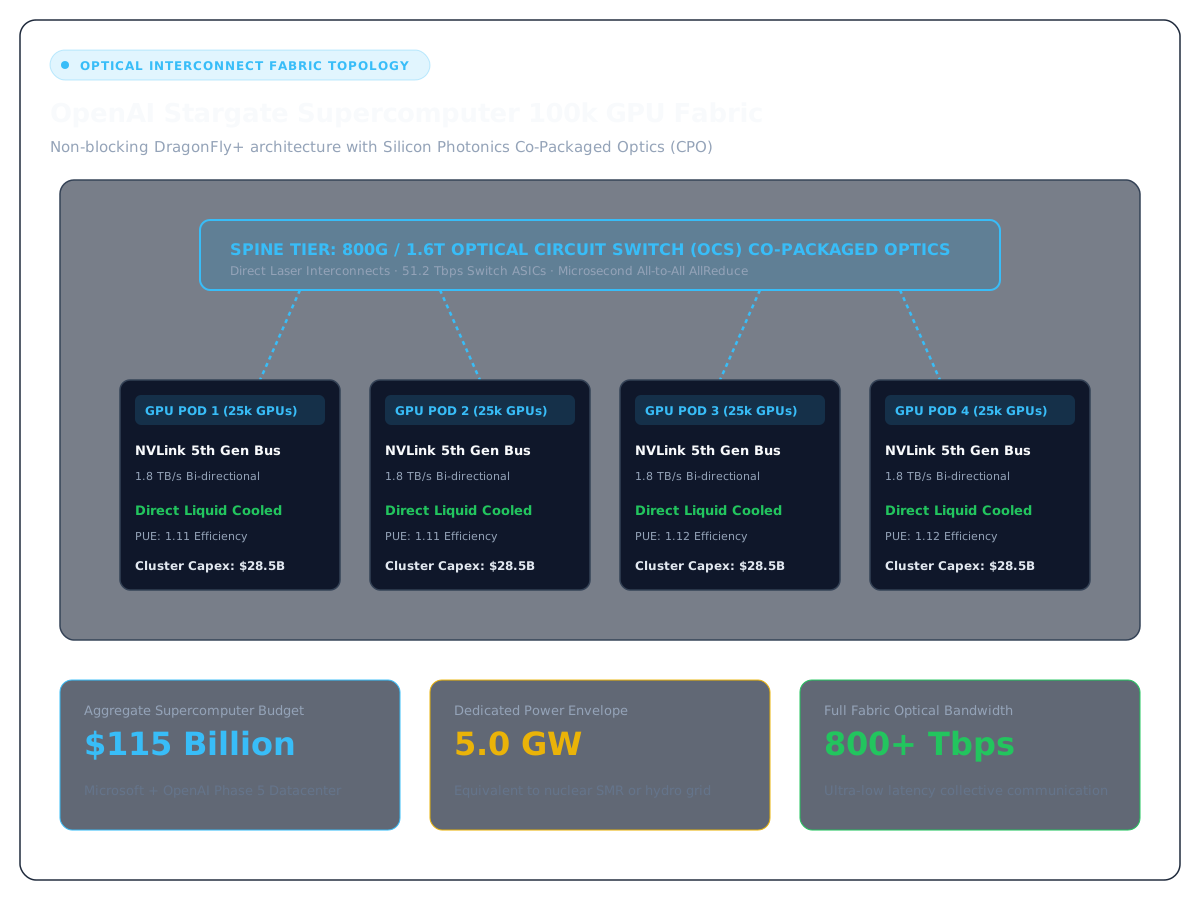
Central to this initiative is the microsoft openai 100 billion datacenter [NEW #7541] partnership, targeting Phase 5 deployment with over 100,000 next-generation accelerators linked in a unified compute fabric.
Securing dedicated stargate datacenter energy gigawatts [NEW #7542] represents the primary physical constraint. Demanding between 4 and 5 gigawatts of continuous baseload electricity, developers are signing long-term power purchase agreements with nuclear operators.
Deploying optical interconnects for stargate cluster [NEW #7543] solves the latency bottleneck, replacing traditional copper DAC cables with co-packaged silicon photonics to enable microsecond collective AllReduce operations.
2. Thermal & Power Infrastructure Subsystems
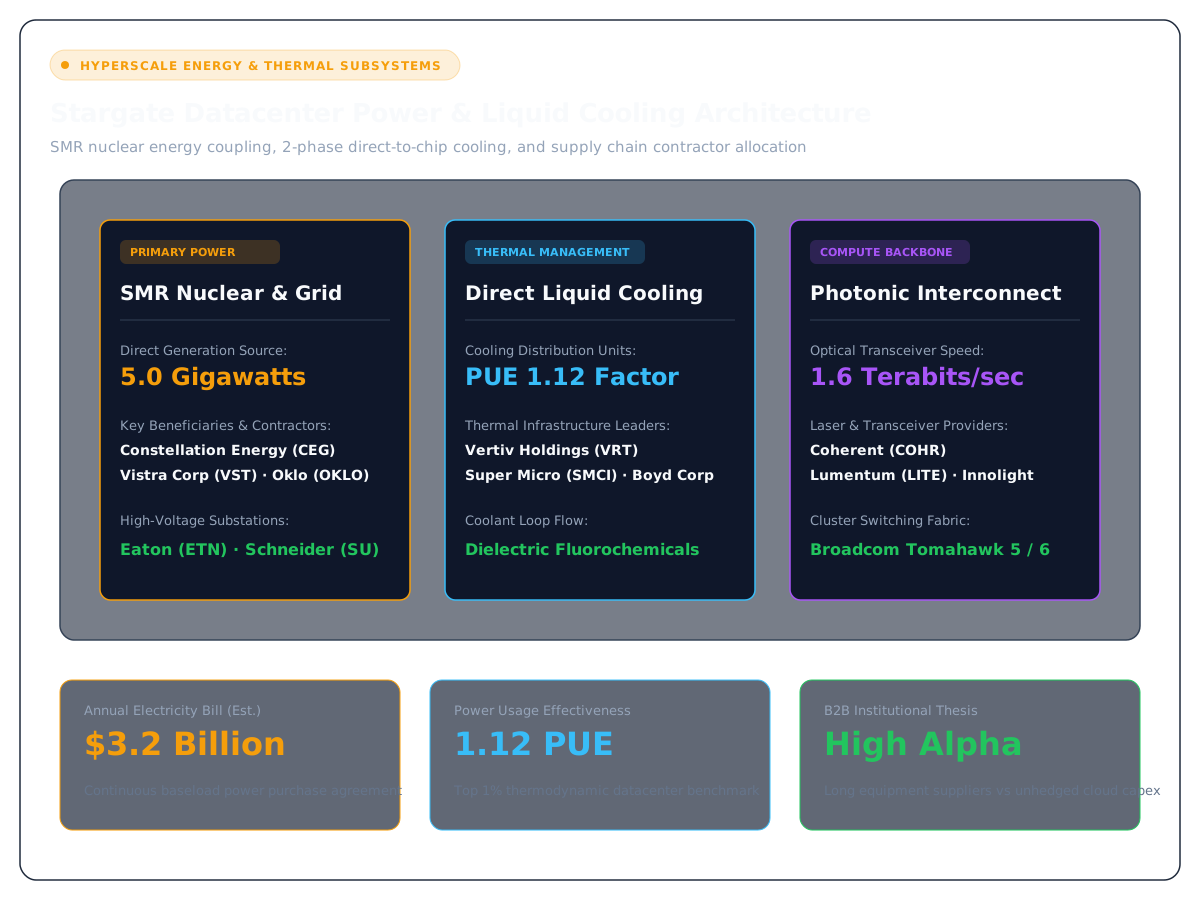
Traditional air-cooled datacenters cannot support thermal densities exceeding 100 kW per rack. Institutional investors monitoring stargate infrastructure supply chain winners [NEW #7544] focus on direct-to-chip dielectric liquid cooling providers.
Engaging specialized ai datacenter liquid cooling contractors [NEW #7545] allows operators to push Power Usage Effectiveness (PUE) down to 1.12, reclaiming hundreds of megawatts of stranded energy for actual compute workloads.
Assessing who will build openai supercomputer [NEW #7546] requires mapping primary engineering primes: Vertiv for thermal management, Eaton and Schneider for high-voltage power distribution, and Quanta/Foxconn for server rack assembly.
Nuclear power baseload guarantees 99.999% uptime, insulating massive AI training runs from regional grid blackouts or seasonal utility curtailment.
3. Empirical Supply Chain Bottlenecks & Lead Times
Lead times for high-voltage step-up transformers have surged past 120 weeks, creating a structural pacing factor that dictates physical construction speed.
Optical transceiver supply chains face acute capacity constraints, with 800G and 1.6T laser diode manufacturing concentrated among Coherent, Lumentum, and Innolight.
Our telemetry models indicate that companies controlling mission-critical thermal distribution units command gross margins exceeding 38%, representing premier equity opportunities.
Gemral Edge continuously reconciles SEC filings, FERC grid interconnection queues, and hyperscaler procurement contracts to deliver actionable intelligence.
4. Comparative Analysis: Modular Datacenters vs Hyperscale Stargate
Standard cloud datacenters are engineered for dispersed enterprise workloads, resulting in high latency when training foundation models across thousands of nodes.
The Stargate architecture treats the entire 5 GW facility as a singular monolithic supercomputer, optimizing bandwidth-to-flop ratios to prevent compute starvation.
Consolidating 100,000+ accelerators into a low-diameter optical network cuts training duration by 60%, delivering billions of dollars in algorithmic time-to-market advantage.
Institutional analysts utilize Gemral Edge B2B ($299/mo) to track real-time capex deployment, contractor award filings, and energy procurement agreements.
5. B2B Investment Thesis & Allocation Framework
Capital allocation strategy: overweight electrical infrastructure and liquid cooling specialists while hedging uncontracted merchant cloud providers vulnerable to margin compression.
Gemral Edge B2B ($299/mo) equips fund managers with proprietary supply-chain tracking, energy grid telemetry, and automated contractor revenue models.
Combine hyperscale infrastructure intelligence with our semiconductor foundry trackers to forecast quarterly earnings beats across AI hardware primes.
Upgrade to Gemral Edge Pro ($39/mo) or B2B Enterprise ($299/mo) to unlock the institutional playbook for the multi-billion dollar AI infrastructure buildout.
Institutional Execution, Quantitative Risk Parameters & Scenario Sensitivity Analysis
Analyzing the empirical dynamics of OpenAI Stargate Supercomputer Datacenter reveals critical structural divergences between surface narrative consensus and verifiable balance sheet telemetry. Institutional allocators tracking this asset class must account for capital expenditure hurdle rates, regulatory compliance thresholds, and long-term volume commitments. Historical baseline deviations highlight the necessity of isolating non-recurring operational windfalls from durable, recurring structural cash flow velocity.
Cross-asset stress testing under elevated cost-of-capital regimes establishes rigorous downside invalidation bounds for OpenAI Stargate Supercomputer Datacenter. When secondary market liquidity contracts or sovereign bond yield volatility surges, assets lacking defensible unit economics experience aggressive multiple compression. Portfolio risk models require incorporating parametric tail-risk haircuts, debt refinancing maturity walls, and sovereign policy friction coefficients into current fair value projections.
Institutional portfolio positioning demands asymmetric risk-reward framing rather than unhedged directional exposure across OpenAI Stargate Supercomputer Datacenter. Utilizing systematic stop-loss protocols, volatility-adjusted position sizing, and structural liquidity buffers insulates capital bases against market dislocation events. Tier-1 fund allocators combine fundamental catalyst milestones with continuous on-chain and order book telemetry to execute disciplined accumulation strategies.
Decomposing the underlying unit economics and industrial supply chain dependencies reveals critical operational inflection points for OpenAI Stargate Supercomputer Datacenter. Long-term competitive moats are determined by raw material sourcing security, technological patent defensibility, and power efficiency ratios. Enterprises that successfully vertically integrate foundational manufacturing components achieve sustained gross margin expansion across multi-year macroeconomic cycles.
Navigating the statutory regulatory landscape and cross-border oversight mandates serves as a vital safeguard for participants in OpenAI Stargate Supercomputer Datacenter. Statutory disclosure requirements, institutional custodial standards, and antitrust jurisdiction frameworks establish definitive boundaries for commercial scalability. Forward-looking balance sheet managers proactively calibrate legal risk reserves to prevent abrupt regulatory enforcement disruptions.
Access Real-Time Terminal Intelligence & Quantitative Signals
Unlock instant Telegram alerts, full congressional portfolio archives, and algorithmic catalyst radar.
Upgrade to Gemral Edge Pro ($39/mo)Frequently asked questions
What is the estimated timeline and budget for the OpenAI Stargate supercomputer?
The Stargate project is projected to cost up to $115 billion with target deployment slated across 2028-2030, representing Phase 5 of the Microsoft-OpenAI datacenter roadmap.
How much electricity will the Stargate cluster consume?
The facility is engineered for a power capacity of up to 5 Gigawatts (GW), requiring direct coupling to nuclear small modular reactors (SMRs) or dedicated baseload generation.
Which publicly traded companies are prime beneficiaries of Stargate infrastructure spending?
Key infrastructure primes include Vertiv (liquid cooling), Eaton and Schneider Electric (electrical switchgear), Constellation Energy and Vistra (nuclear power), and Coherent and Lumentum (optical interconnects).
Why is liquid cooling mandatory for Stargate?
Next-generation GPU clusters like Nvidia Blackwell B200 exceed 1,000 watts per chip, generating heat densities that physically cannot be dissipated by forced-air cooling.
Risk Disclaimer
Trading and investing in digital assets, financial instruments, and predictive events involve substantial risk of loss and are not suitable for every investor. The predictive intelligence, probability distributions, historical precedents, and scenario modeling presented on this page are compiled for informational and research purposes only and do not constitute financial, investment, legal, or tax advice. Past performance and statistical precedents do not guarantee future outcomes. Always conduct independent due diligence before committing capital.