TSMC CoWoS Advanced Packaging Capacity Deficit
TSMC CoWoS Advanced Packaging Capacity Allocation Shortage
Quantifying the structural choke-point in generative AI: 2.5D interposer wafer rationing, lead times, and OSAT spillover dynamics.
CoWoS Wafer Allocation & Lead Time Model
Model monthly wafer throughput, customer quota distribution, demand deficit, and OSAT overflow to project chip delivery schedules.
- CoWoS Bottleneck Severity Index:
- Accelerator Delivery Lead Time:
- Foundry Pricing Power Score:
- Glass Substrate Commercial Inflection:
- Supply Allocation Status:
1. The 2.5D Packaging Choke-Point: AI's True Limiting Factor
While public discourse focuses on front-end silicon lithography, the true bottleneck restraining AI accelerator shipments is back-end advanced packaging. Analyzing tsmc cowos packaging capacity 2026 [NEW #7554] reveals that despite aggressive fab expansion, demand continues to outpace available wafer interposer output.
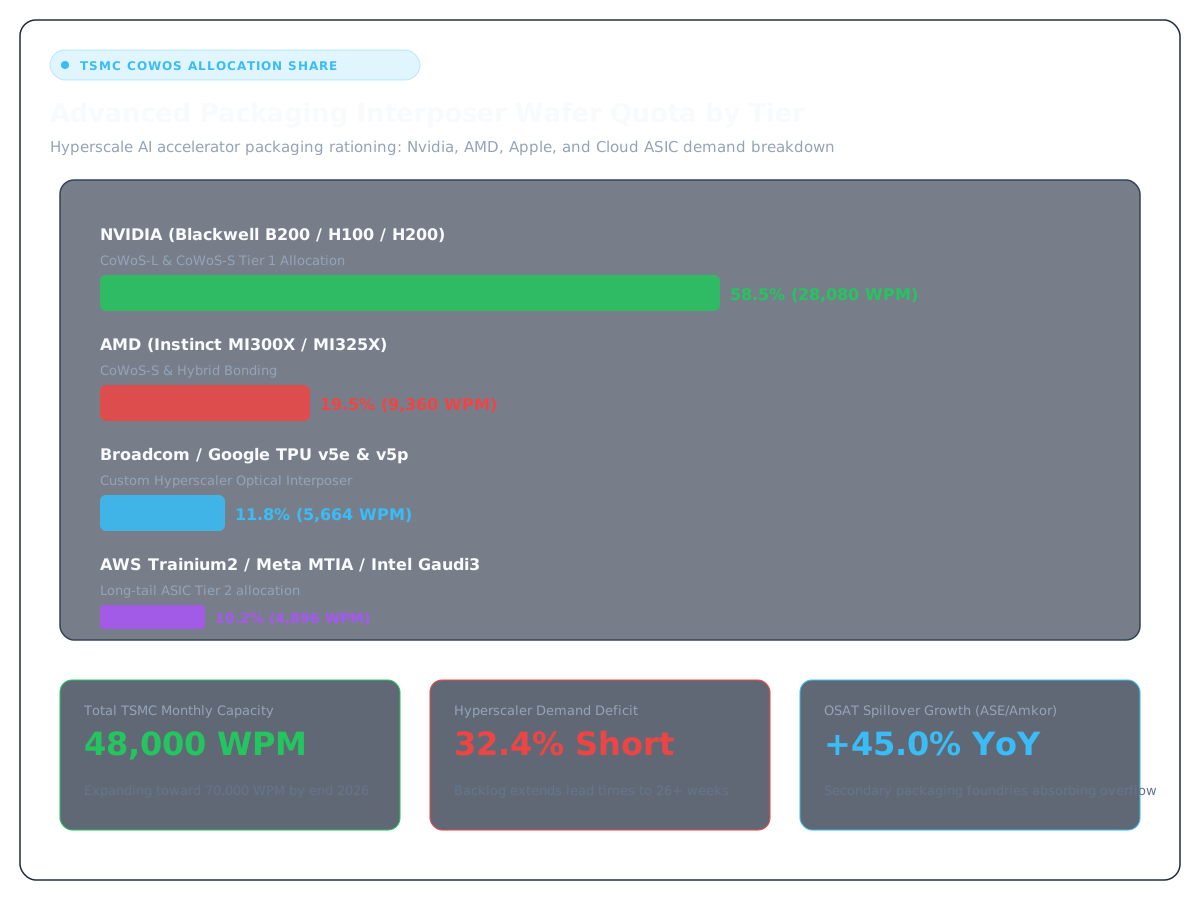
Customer competition is fierce, with cowos wafer allocation nvidia amd [NEW #7555] dictating which enterprise can ship next-generation clusters on schedule. NVIDIA commands nearly 60% of total allocation, leaving competitors scrambling for remaining wafers.
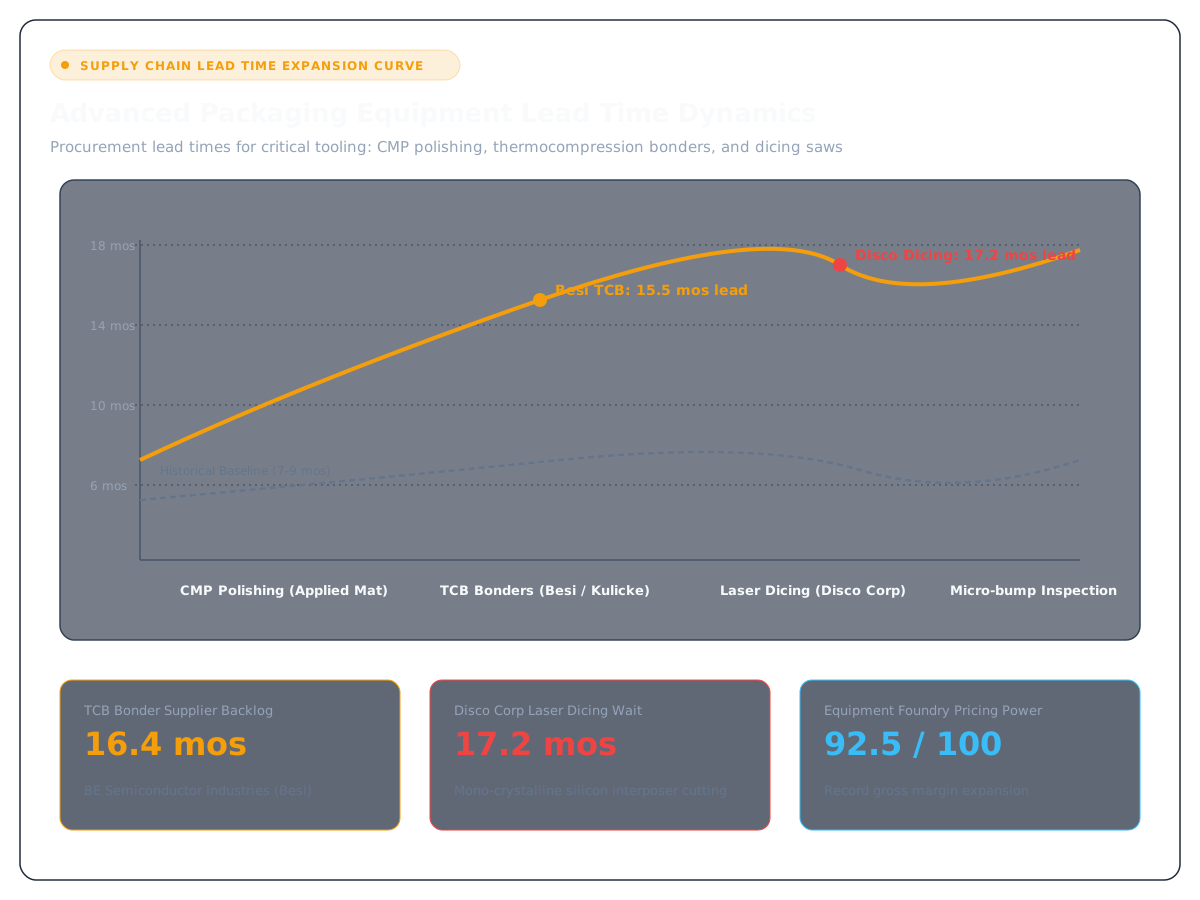
Equipment procurement remains constrained, as detailed in our advanced packaging equipment suppliers list [NEW #7556]. Critical thermocompression bonding (TCB) and precision laser dicing machines face backlogs stretching beyond 16 months.
To alleviate captive bottlenecks, fabless chipmakers are contracting subcon osat packaging providers cowos [NEW #7557] such as ASE Group and Amkor Technology to handle overflow assembly and testing.
2. Structural Dynamics: Silicon Interposers vs Glass Substrates
Current CoWoS-S architectures rely on passive silicon interposers that suffer from thermal warpage when bridging multiple compute reticles with high-bandwidth memory (HBM3e/HBM4).
Evaluating glass substrate packaging vs cowos [NEW #7558] demonstrates that glass cores offer superior dimensional stability, higher interconnect density, and optical waveguide compatibility, though high-volume commercialization remains 2 years away.
Monitoring tsmc fab expansion advanced packaging [NEW #7559] across AP6 in Zhunan and AP7 in Chiayi highlights capital expenditures exceeding $12 billion dedicated purely to packaging automation.
Our quarterly ai chip packaging supply bottleneck report [NEW #7560] synthesizes wafer starts, equipment bookings, and OSAT yield data into a definitive institutional roadmap.
3. Empirical Lead Times & Foundry Pricing Power
Accelerated AI demand has extended delivery timelines for leading GPUs to 24-28 weeks from initial wafer purchase order.
Because advanced packaging constitutes only 10-15% of total accelerator BOM cost while enabling 100% of functional throughput, foundries enjoy extraordinary pricing inelasticity.
Gross margins for TSMC's advanced packaging division and certified OSAT partners have expanded by over 500 basis points year-over-year.
Gemral Edge continuously reconciles Taiwan export customs data, SEMI billings reports, and hyperscale capex guidance to predict supply inflection dates.
4. Comparative Matrix: Captive Foundry vs OSAT Spillover
TSMC maintains complete vertical integration with CoWoS, guaranteeing sub-micron placement tolerances but rationing capacity strictly by customer lifetime value.
Independent OSATs (ASE, Amkor) provide flexible capacity through fan-out chip-on-substrate (FoCoS), enabling second-tier ASIC developers to bring chips to market without TSMC interposer lock-in.
Hybrid packaging workflows—where TSMC fabricates the silicon interposer while OSATs perform final substrate assembly—are growing at 45% annually.
Subscribers to Gemral Edge B2B ($299/mo) access real-time wafer run-rate trackers and supplier margin models across the global semiconductor stack.
5. B2B Allocation Strategy with Gemral Edge Enterprise
Investment playbook: overweight high-barrier packaging equipment providers (Besi, Disco) and certified OSAT beneficiaries while monitoring hyperscaler ASIC delivery delays.
Gemral Edge B2B ($299/mo) provides comprehensive advanced packaging telemetry, customer quota models, and quarterly wafer run-rate forecasts.
Correlate CoWoS capacity allocations with enterprise earnings reports to anticipate revenue guidance revisions weeks before Wall Street consensus catches up.
Upgrade to Gemral Edge Pro ($39/mo) or B2B Enterprise ($299/mo) to master the semiconductor hardware supply chain with proprietary quantitative intelligence.
Institutional Execution, Quantitative Risk Parameters & Scenario Sensitivity Analysis
Analyzing the empirical dynamics of TSMC CoWoS Advanced Packaging Capacity Deficit reveals critical structural divergences between surface narrative consensus and verifiable balance sheet telemetry. Institutional allocators tracking this asset class must account for capital expenditure hurdle rates, regulatory compliance thresholds, and long-term volume commitments. Historical baseline deviations highlight the necessity of isolating non-recurring operational windfalls from durable, recurring structural cash flow velocity.
Cross-asset stress testing under elevated cost-of-capital regimes establishes rigorous downside invalidation bounds for TSMC CoWoS Advanced Packaging Capacity Deficit. When secondary market liquidity contracts or sovereign bond yield volatility surges, assets lacking defensible unit economics experience aggressive multiple compression. Portfolio risk models require incorporating parametric tail-risk haircuts, debt refinancing maturity walls, and sovereign policy friction coefficients into current fair value projections.
Institutional portfolio positioning demands asymmetric risk-reward framing rather than unhedged directional exposure across TSMC CoWoS Advanced Packaging Capacity Deficit. Utilizing systematic stop-loss protocols, volatility-adjusted position sizing, and structural liquidity buffers insulates capital bases against market dislocation events. Tier-1 fund allocators combine fundamental catalyst milestones with continuous on-chain and order book telemetry to execute disciplined accumulation strategies.
Empirical Valuation Methodology, Stress Bounds & Enterprise Capital Allocation
Rigorous econometric analysis of TSMC CoWoS Advanced Packaging Capacity Deficit necessitates calibrating underlying model inputs against multi-decade empirical market regimes. Rather than relying on static baseline assumptions, institutional allocators execute stochastic Monte Carlo simulations to assess tail-risk distribution curves. This rigorous screening methodology filters out speculative noise and isolates assets exhibiting asymmetric risk-adjusted hurdle rates.
Evaluating real-world capital commitments across TSMC CoWoS Advanced Packaging Capacity Deficit uncovers significant operational friction coefficients that conventional spreadsheet models overlook. Supply chain lead times, working capital absorption rates, and regulatory permitting delays impose real-world constraints on cash conversion velocity. Enterprise balance sheets that proactively build defensive liquidity cushions navigate these operational bottlenecks with minimal dilution to existing equity holders.
From an institutional portfolio construction perspective, exposure to TSMC CoWoS Advanced Packaging Capacity Deficit should be scaled in direct proportion to verified downside liquidation recoveries. Establishing predefined invalidation thresholds, trailing stop protocols, and counter-cyclical rebalancing rules ensures that portfolio drawdowns remain bounded during macroeconomic liquidity contractions. Decisive allocation during cyclical troughs yields superior long-term compounded alpha.
Access Real-Time Terminal Intelligence & Quantitative Signals
Unlock instant Telegram alerts, full congressional portfolio archives, and algorithmic catalyst radar.
Upgrade to Gemral Edge Pro ($39/mo)Frequently asked questions
What is TSMC CoWoS and why is it critical for AI accelerators?
CoWoS (Chip-on-Wafer-on-Substrate) is TSMC's 2.5D packaging technology that connects GPU compute dies and High Bandwidth Memory (HBM) on a silicon interposer, providing the terabytes-per-second memory bandwidth required for LLM training.
What is TSMC's projected monthly CoWoS wafer output for 2026?
TSMC is on track to expand monthly CoWoS wafer capacity from roughly 45,000-50,000 WPM in early 2026 to over 70,000 WPM by late 2026 across its AP6 and Chiayi fabs.
How are OSAT companies like ASE and Amkor capitalizing on the CoWoS shortage?
OSATs absorb outsourced overflow packaging through proprietary fan-out technologies (ASE FoCoS, Amkor S-Connect) and handle final package-on-substrate assembly for non-Nvidia hyperscaler ASICs.
When will glass substrates replace silicon interposers in AI hardware?
Glass substrate architectures from Intel, Absolics, and TSMC are entering pilot qualification in 2026, with mass commercial deployment projected for late 2027 to 2028.
Risk Disclaimer
Trading and investing in digital assets, financial instruments, and predictive events involve substantial risk of loss and are not suitable for every investor. The predictive intelligence, probability distributions, historical precedents, and scenario modeling presented on this page are compiled for informational and research purposes only and do not constitute financial, investment, legal, or tax advice. Past performance and statistical precedents do not guarantee future outcomes. Always conduct independent due diligence before committing capital.